TR Encyclopedia – Foreign Affairs
The Great War
On June 28, 1914, Austria-Hungary’s Archduke Franz Ferdinand was assassinated in Serbia by Bosnian nationalist Gavrilo Princip, leading to a declaration of war between Serbia and Austro-Hungary one month later. Due to the intricate alliances that had been formed, and past grudges that had yet to resolve themselves, the world was plunged into the chaos of war, as the pacts between the Central Powers of Germany, Austria-Hungary, the Ottoman empire, and Bulgaria on one side, and the Triple Entente of Russia, France, and Great Britain on the other began slowly grinding to pull nearly all the nations of Europe into war. World War I, (or ‘The Great War’ as it was known at the time) represented a shift in the dynamics of Global politics. The feelings of tension that existed in Europe on the eve of war was no different for the United States, who argued over whether it was their duty to intervene in the greatest conflict in human history, or whether it should remain on the sidelines of a conflict that seemed not to concern it.1
Prior to the tragic events of June 28, the relationship between Austria-Hungary and its Serbian inhabitants had been strained at best. Due to the number of Serbs living within the borders of their holdings within the Southern Balkans, Austria-Hungary was aware of the threat of Serbian Nationalism, and was poised to push back against any calls for independence.2 For their part, Serbia had remained safe from Austrian aggression in the past thanks to their warm relations with the Russian Empire. After the assassination of Franz Ferdinand, however, Austria-Hungary was handed a “blank check” in their treatment of their Serb population by the German Empire, who vowed to support Vienna in the event of war.3 From there, tensions continued to escalate. Following their carefully scheduled battle plans nations swung into motion, with the days between August 2-7 seeing Germany invading Luxembourg and Belgium, while France invaded Alsace with British support.4 Although not formally required as part of the Entente to join France and Russia in the war, the invasion of Belgium, a neutral country, served as cause enough for the British Parliament to declare war on Germany.
While the Great War raged in Europe, the Woodrow Wilson administration was apprehensive about getting involved in what it saw as a European affair. To quote the Library of Congress; “President Woodrow Wilson declared U.S. neutrality on August 4, 1914, and many Americans saw little reason to entangle themselves in what they viewed as European quarreling and intrigue.”5 Woodrow Wilson had vastly more experience and interest in domestic affairs than international relations, even going so far as to say “it would be the irony of fate if my administration had to deal chiefly with foreign affairs.” While the United States officially remained out of the conflict for several years, the nation continued to debate the prospect of its involvement. Some within the United States, such as President Wilson, believed it was not America’s place to become involved with The Great War. They believed in upholding the precedent of avoiding international alliances and conflict in Europe. On the other side sat those who witnessed the destruction of Europe, and the events in Belgium, and believed it was the moral duty of the United States to get involved in the Great War. Theodore Roosevelt spoke and wrote for this side of the argument, strongly believing the United States should prepare for war, train troops and perform training exercises even if they avoided war. “I detest war. But if war came I’d have to go, and my four boys would go, too, because we have ideals in this family.”
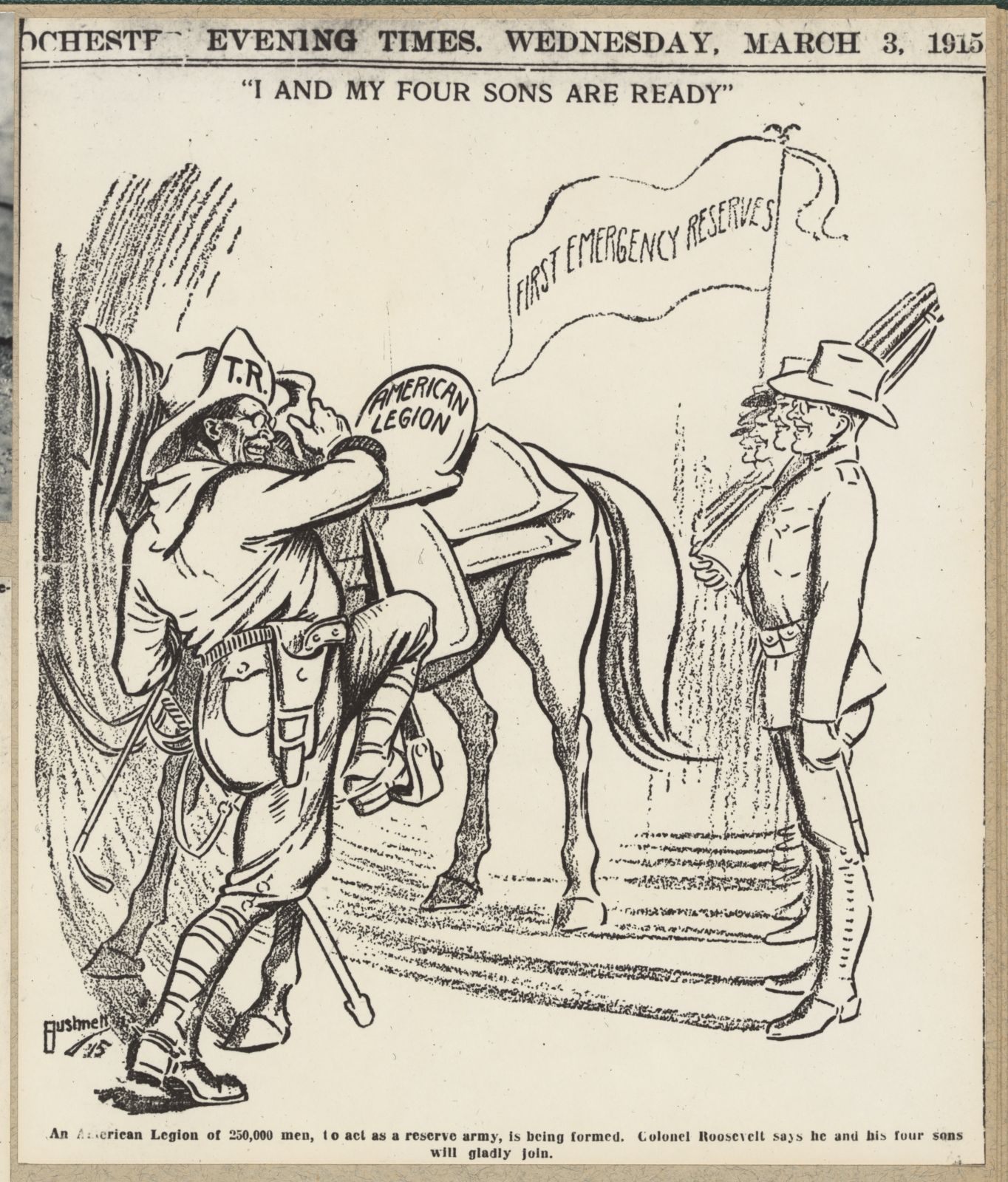
The minds of Americans changed in 1917 when the German High Command voted to resume unrestricted submarine warfare under the grounds that the United States had violated their neutrality by trading with the Allied Powers, and that they believed the war would be over by the time U.S. troop carriers crossed the Atlantic.6 This served as the final straw, adding to American anxieties about the Zimmerman Telegram and the sinking of numerous American vessels, finally pushing the country to enter the war.7 While Theodore Roosevelt himself was judged unfit for service due to his increasing maladies and advanced age (although he nevertheless inquired about raising a regiment, similar to the first Volunteer Cavalry in the Spanish American War), his three sons, Ted Jr., Kermit, and Archie joined the armed forces in his stead. Ted would take command of the First Battalion of the 26th Infantry, 1st Division, with his younger brother Archie serving underneath him, while Kermit traveled to the Middle East with the British Army.8 His son Quentin Roosevelt would also join the fight, enlisting in the 95th Aero Squadron. Even Roosevelt’s daughter, Ethel Roosevelt Derby would join the action, working in the American Ambulance Hospital alongside her husband, Richard Derby. Unfortunately, Quentin Roosevelt would be the only son not to return, getting shot down over France in aerial combat.
Ultimately an armistice ending the war was signed on November 11, 1918, with the Paris Peace Conference beginning the following year on January 18, 1919, to determine the exact terms of the peace. Germany was named the primary belligerent and thus was forced to give up territory, limit the size of its army and navy, and demilitarize the Rhine Land as well as pay off a substantial war debt in reparations.9 The Ottoman Empire, which had joined Germany and Austria-Hungary as part of the Central Powers, received a harsh peace treaty as well but thanks to the efforts of Mustafa Kamal would retain control over Anatolia, although giving up their imperial holdings in the Middle East.10 The Treaty of Trianon was the harshest of all, as the Dual Monarchy of Austria-Hungary was split apart, with Austria and Hungary becoming two separate nations, as well as the establishment of former Yugoslavia and the transfer of Transylvania to Romania.11 The Paris Peace Conference also established the League of Nations—an international body aimed at collective security and disarmament central to President Wilson’s “Fourteen Points.” Due to the reluctance of the United States to actually join this organization, however, it was doomed to failure, and it’s promise of arbitration would fail as the bruises and battered egos of the nations involved would come back in an even more horrendous and grotesque war not 20 years later.
Sources
1. “Timeline (1914 – 1921): A World at War: Articles and Essays: Stars and Stripes: The American Soldiers’ Newspaper of World War i, 1918-1919: Digital Collections: Library of Congress.” The Library of Congress, www.loc.gov/collections/stars-and-stripes/articles-and-essays/a-world-at-war/timeline-1914-1921/. Accessed 9 Oct. 2024.
2. “How The World Went to War in 1914.” Imperial War Museums, 2024, https://www.iwm.org.uk/history/how-the-world-went-to-war-in-1914.
3. “World War I: Summary, Causes & Facts.” History.Com, A&E Television Networks, 10 May 2024, www.history.com/topics/world-war-i/world-war-i-history.
4. Timeline.
5. “Arguing over War.” Library of Congress. https://www.loc.gov/exhibitions/world-war-i-american-experiences/about-this-exhibition/arguing-over-war/.
6. Timeline.
7. Ibid.
8. “The Bull Moose in Winter: Theodore Roosevelt and World War I (U.S. National Park Service).” National Parks Service, U.S. Department of the Interior, 26 Apr. 2019, www.nps.gov/articles/the-bull-moose-in-winter-theodore-roosevelt-and-world-war-i.htm.
9. “The Paris Peace Conference and the Treaty of Versailles.” U.S. Department of State, U.S. Department of State, www.history.state.gov/milestones/1914-1920/paris-peace. Accessed 9 Oct. 2024.
10. Smith, Leonard V. “Post-War Treaties (Ottoman Empire/ Middle East) / 1.0 / Handbook – 1914-1918-Online (WW1) Encyclopedia.” 1914, 9 July 2024, https://encyclopedia.1914-1918-online.net/article/post-war-treaties-ottoman-empire-middle-east/.
11. Zeidler, Miklós. “Trianon, Treaty of / 1.0 / Encyclopedic – 1914-1918-Online (WW1) Encyclopedia.” 1914, 9 July 2024, https://encyclopedia.1914-1918-online.net/article/trianon-treaty-of/.
Entry contributed by Isaac Baker – Theodore Roosevelt Center Student Employee