TR Encyclopedia – Culture and Society
Coinage Crisis of 1907
The Coinage Crisis of 1907 was the result of a minor change spiraling into a major political episode. During his second term in office, Theodore Roosevelt sought to redesign the $10 and $20 gold pieces to bring an artistic and “civilized” aesthetic to the American coinage.1
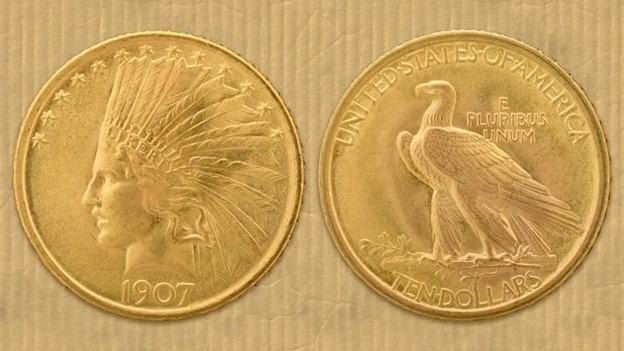
The man he would work with on this “pet project” was Augustus Saint-Gaudens. Saint-Gaudens and Roosevelt had already developed a close relationship when the sculptor designed Roosevelt’s inauguration medal in 1905. The cause of the crisis was due to the intentional omission of the phrase “In God We Trust.”2 “Both men agreed that Greek coins should serve as initial inspiration but that the coins should have figures and symbols that represent American icons and values,” as the National Park Service puts it.3
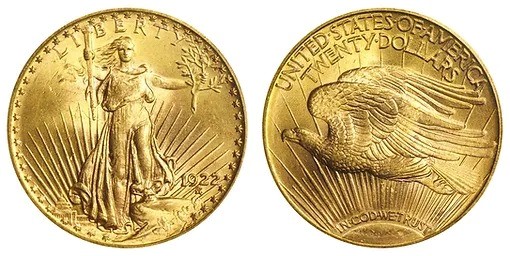
With the health of Saint-Gaudens beginning to fail, and complications with the design, Roosevelt personally ordered the immediate minting of the coins in November of 1907.4 The distribution of the coins came at an inconvenient time, however, as at this time the United States was still reeling under the effects of the Panic of 1907. Roosevelt’s opponents–including Republicans who wished to divert the party away from him–sought to humble the president by seeking to emphasize the controversy caused by this change to their political advantage. A popular bill penned by William Brown McKinley, of the committee on Coinage in the House of Representatives, sought to make it law to include the phrase “In God We Trust” on all American currency. Roosevelt detested the bill to the core, referring to it as “pure rot,” but eventually signed the bill on May 19th, 1908, bringing an end to the crisis. Even in the midst of the crisis, however, Roosevelt wrote that, “I cannot help feeling that [removing “In God We Trust”] was the right action from the standpoint of good taste, and indeed a little more than good taste.” While the crisis eventually subsided in 1908 with Roosevelt signing the McKinley bill into law, his bold artistic reforms would go on to inspire more artistic adaptations of American currency.
Sources
1. Gatewood, Willard B. “Theodore Roosevelt and the Coinage Controversy.” American Quarterly 18, no. 1 (1966): 35–51. https://doi.org/10.2307/2711109.
2. “Augustus Saint-Gaudens, Theodore Roosevelt, and the Coin (U.S. National Park Service).” National Parks Service, U.S. Department of the Interior, 19 Oct. 2021, http://www.nps.gov/articles/000/a-living-thing-and-typical-of-progress-augustus-saint-gaudens-theodore-roosevelt-and-the-coins.htm.
3. Hering, Henry. “Design History of 1907 Gold Coinage (U.S. National Park Service).” National Parks Service, U.S. Department of the Interior, 16 Mar. 2021, http://www.nps.gov/articles/000/studio-assistant-henry-hering-recounts-design-of-1907-gold-coinage.htm.
4. Wister, Owen, Roosevelt: The Story of a Friendship, 1880-1919 (New York, 1930), p. 268.
Entry contributed by Isaac Baker – Theodore Roosevelt Center Student Employee.