Intern Projects
Gemma Koontz – Rediscovering TR the Horseman
Originally posted to the TR Center blog in two parts in November 2020.
Part 1: November 22.
During her internship with the Theodore Roosevelt Center, Gemma Koontz reconnected with Roosevelt as a horseman.
Because of his variety of interests, prominent positions, larger than life personality, and continued popularity, there are many ways to cross paths with Theodore Roosevelt. Although I have since come to know him for much more, I first met Teddy through a shared love of horses. Think of the stereotypical horse-crazy girl—that was, and still is, me. Exactly when or how I first became acquainted with Roosevelt, the lifelong horseman, has long since receded into the depths of memory. Prior to my internship, I knew Theodore Roosevelt, not just the lifelong horseman, but TR the daring horseman who viewed riding as a fundamental component of “the strenuous life.”
There was Roosevelt, the blazing Dakota cowboy:
“[O]ne night there was a heavy storm…the lightning struck right by the herd, and away all the beasts went…I galloped as hard as ever beside them…and the next moment the horse and I went off a cut bank into the Little Missouri. I bent away back in the saddle, and though the horse almost went down he just recovered himself, and, plunging and struggling through water and quicksand, we made the other side.” (Autobiography, p. 104)

Of course, there was Colonel Roosevelt, the Rough Rider, aboard the small but mighty Little Texas, charging up Kettle Hill:
“He gave the order to charge on Kettle Hill, and led us on horseback up the hill, both rough riders and the Ninth Cavalry. He was the first on the hill.” (as told by H. P. Bardshar, Rough Rider, in the Autobiography, p. 265)

There was also President Roosevelt, the icon, fearlessly jumping his 16 hands high hunter, Bleistein, over split rail fences.

When I started my internship with the Theodore Roosevelt Center at Dickinson State University, I was excited to learn more about Theodore Roosevelt, the politician, president, historian, philanthropist, patron of the arts, conservationist, author, bibliophile, big game hunter, husband, father, friend, celebrity, the man in the arena. Yet, as I worked with the items, searched the collections, and learned more about the man behind the myth, I rediscovered TR, the horseman. However, this time it was Roosevelt, the intimate, conscientious horseman who enjoyed sharing his interest with others.
The man who sincerely wrote, “Bleistein is really my favorite horse. He is such a gallant, spirited old fellow.”
And also said, “Bleistein I have ridden very little, because I think one of his forelegs is shaky, and I want to spare him all I can.”

The man who patiently worked with his horse:
“Renown is behaving better about automobiles and the like. I think the difference is largely in the way I handle him. He is a very good-natured and gentle horse, but timid and not over wise, and when in a panic his great strength makes him well-nigh uncontrollable. Accordingly he is a bad horse to try to force by anything. If possible, it is much better to give him a little time, and bring him up as gently as may be to the object of terror. When he behaves well I lean forward and give him a lump of sugar, and now the old boy eagerly puts around his head when I stretch out my hand.”

The man who patted his horse while eagerly feeding him treats from his pocket.
One item, in particular, fully captured this rediscovery. While rummaging through the collections, I came across this letter to Joseph “Joe” Ferris expressing regret over the death of “old Muley.”
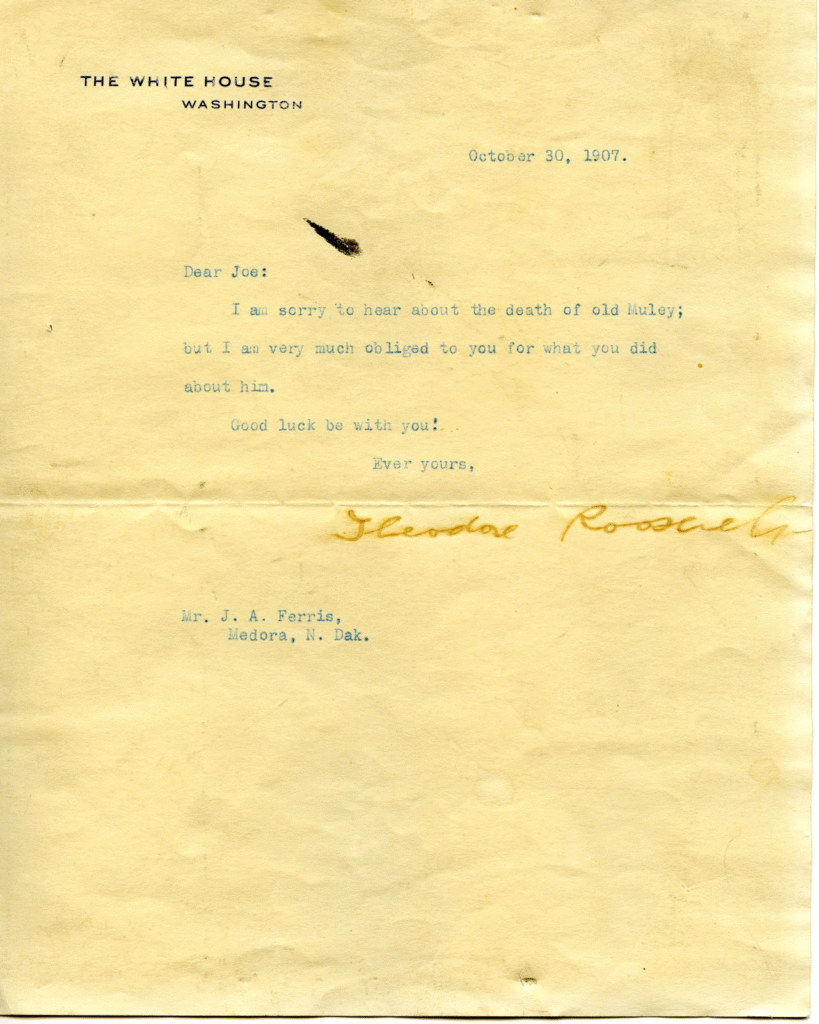
Intrigued that Roosevelt would take time to write such a message, I dug around and found Roosevelt’s letter from the previous year imploring Ferris to take care of Muley at Roosevelt’s expense.

I also found a write-up from the Billings County Republican about the matter.

Beyond telling an interesting anecdote in the life of Theodore Roosevelt, these items resonated with me deeply. For several years I cared for my own retired senior horse who, incidentally, was my favorite during my younger years in South Dakota. Even though he could no longer be ridden, I did not want to sell him and wanted him to live comfortably despite the expense. However, last November, with winter quickly approaching, I decided to euthanize him.
There, for just a moment, as I sat at my computer reading these items, Roosevelt and I shared a similar experience. Not the president, or soldier, or celebrity, but the man who truly wanted the best for a favorite horse that had served him well and ensured it happened.

I could have left it there, but I had to know, beyond being one of TR’s old ranch horses and having the Maltese Cross brand on his left hip, who was Muley?
Part 2: November 28
Gemma Koontz continues her story of rediscovering TR the horseman. Who was Muley, about whom Roosevelt cared so much?
As with his other horses, TR provides descriptive snippets of Muley throughout his letters and literary works, such as the following excerpts from Outdoor Pastimes of an American Hunter which recount an 1896 hunting trip.
I rode out with my foreman, Sylvane Ferris. I was mounted on Muley. Twelve years before, when Muley was my favorite cutting pony on the round-up, he never seemed to tire or lose his dash, but Muley was now sixteen years old, and on ordinary occasions he liked to go as soberly as possible; yet the good old pony still had the fire latent in his blood, and at the sight of game—or, indeed, of cattle or horses—he seemed to regain for the time being all the headlong courage of his vigorous and supple youth…Our two ponies went steadily forward at a single-foot or shack, as the cow-punchers term what Easterners call a “fox trot”….
They did not go very fast, and I held in Muley, who was all on fire at the sight of the game…Now was my chance, and wheeling at right angles to my former course, I galloped Muley as hard as I knew how.
The unshod feet of the horses made hardly any noise.
For some moments I kept at a hand gallop, until they got thoroughly settled in their line of flight; then I touched Muley, and he went as hard as he knew how…At the pull of the rein Muley stopped short, like the trained cow-pony he is.
A portrait of Muley emerges upon close inspection of the text.
- Smaller in height
- Having stamina
- Bold in character
- Smooth gait
- Naturally tough hooves
- Well-trained to be maneuverable and responsive
These are desirable characteristics in a good ranch horse, which Muley appears to have been. Additionally, they make for an ideal hunting horse, which Muley seems to have also been. Although well-trained, eager, and ideally suited for both ranching and hunting, Roosevelt’s account of an 1894 hunting trip suggests Muley had a sensitive side. Perhaps it was this one fault in character that endeared him to Roosevelt and was the reason he kept the horse.
Muley was a pet horse, and enjoyed immensely the gallop after game; but his nerves invariably failed him at the shot. On this occasion he stood snorting beside me, and finally, as the deer came in sight, away he tore—only to go about 200 yards, however, and stand and watch us, snorting with his ears pricked forward until, when I needed him, I went for him (Outdoor Pastimes, 223).
Roosevelt’s 1906 letter to Joseph Ferris was not the first instance of his concern for Muley. In 1898 Roosevelt sold his ranch to his foreman Sylvane Ferris, Joe’s brother. While finalizing the sale, the newly appointed Governor Roosevelt wrote to Sylvane,
“As for Sorrel Joe, Muley, Wirefence, and Spear Fish, I wish you or Joe would just keep them and use them. They are old now and I hate to sell them just to be knocked about and ridden to death.”
It seems that Ferris granted Roosevelt’s request. How Muley spent his time from 1899 to 1906 is not known. Perhaps Sylvane continued to employ him at the ranch for a time and, when no longer able to keep up with ranch work, granted Muley to Joseph, for the more sedate life of a store owner and postmaster’s horse. Regardless, it appears Muley reached a point where work was not comfortable, at which time Joseph contacted Roosevelt about the situation. In turn, Roosevelt replied with his letter of December 1, 1906. Having come full circle, I now knew Muley’s story. Or did I?
While wrapping up work for my internship, I came across another letter, recently cataloged by my fellow intern, that documents Muley’s final days.

Letter from Joe Ferris about Muley’s final days
That Muley ranged so far in such condition seems a fitting end for a horse who, like his daring and caring rider, “never seemed to tire or lose his dash.”
Postscript
What’s in a name? I initially figured Muley earned his moniker because he resembled a mule either in appearance (big ears?) or somewhat in temperament (stubborn at times?). Although this theory is still entirely plausible, I stumbled across something while finalizing sources and images, which gave me pause. The term “muley” refers to naturally hornless animals, particularly cows (Merriam-Webster.com Dictionary). Was Muley named such because he was a cow horse? Maybe he looked or acted like cow-like? Additionally,
“muley” is derived from the Gaelic maol, meaning “bald.”
I recalled seeing a photograph labeled as some of Roosevelt’s ranching associates on horseback circa 1884 to 1886. While not identified as Roosevelt, the figure mounted on the horse with a white face, bears a resemblance. The horse’s white facial marking is a “blaze” or could be considered a “bald face.” Could Muley have had a “muley” or “bald” face? Is this an image of Roosevelt and Muley? Of course, this is entirely speculation on my part. Still, I like to think this image was taken in 1885 “when Muley was my favorite cutting pony on the round-up” and possessed “all the headlong courage of his vigorous and supple youth” and when “he never seemed to tire or lose his dash.”
Sources
“Horse Markings,” August 29, 2020. https://en.wikipedia.org/wiki/Horse_markings.
Merriam-Webster.com Dictionary, s.v. “muley,” accessed September 2, 2020, https://www.merriam-webster.com/dictionary/muley.
Roosevelt, Theodore. Outdoor Pastimes of an American Hunter. London: Longmans, Green, and Company, 1905.
Theodore Roosevelt: An Autobiography. New York, NY: C. Scribner’s Sons, 1913.