TR Encyclopedia – Culture and Society
Charles Lang Freer Collection
The Freer Gallery, named after American industrialist and Asian art collector Charles Lang Freer, is one of the first public collections of Asian Art. It is currently housed at the Smithsonian National Museum of Asian Art. The collection consists of objects dating from Neolithic times through to the early 20th century, including the world’s most significant collection of James McNeill Whistler’s work. Freer had a vision that Washington, D.C. would become an educational center due to growing tourism, and proposed the idea of bequeathing his collection to the board of regents of the Smithsonian in 1904. At the time, however, the focus of the Smithsonian collection was on natural history not art, and there was a lack of interest in his proposal.
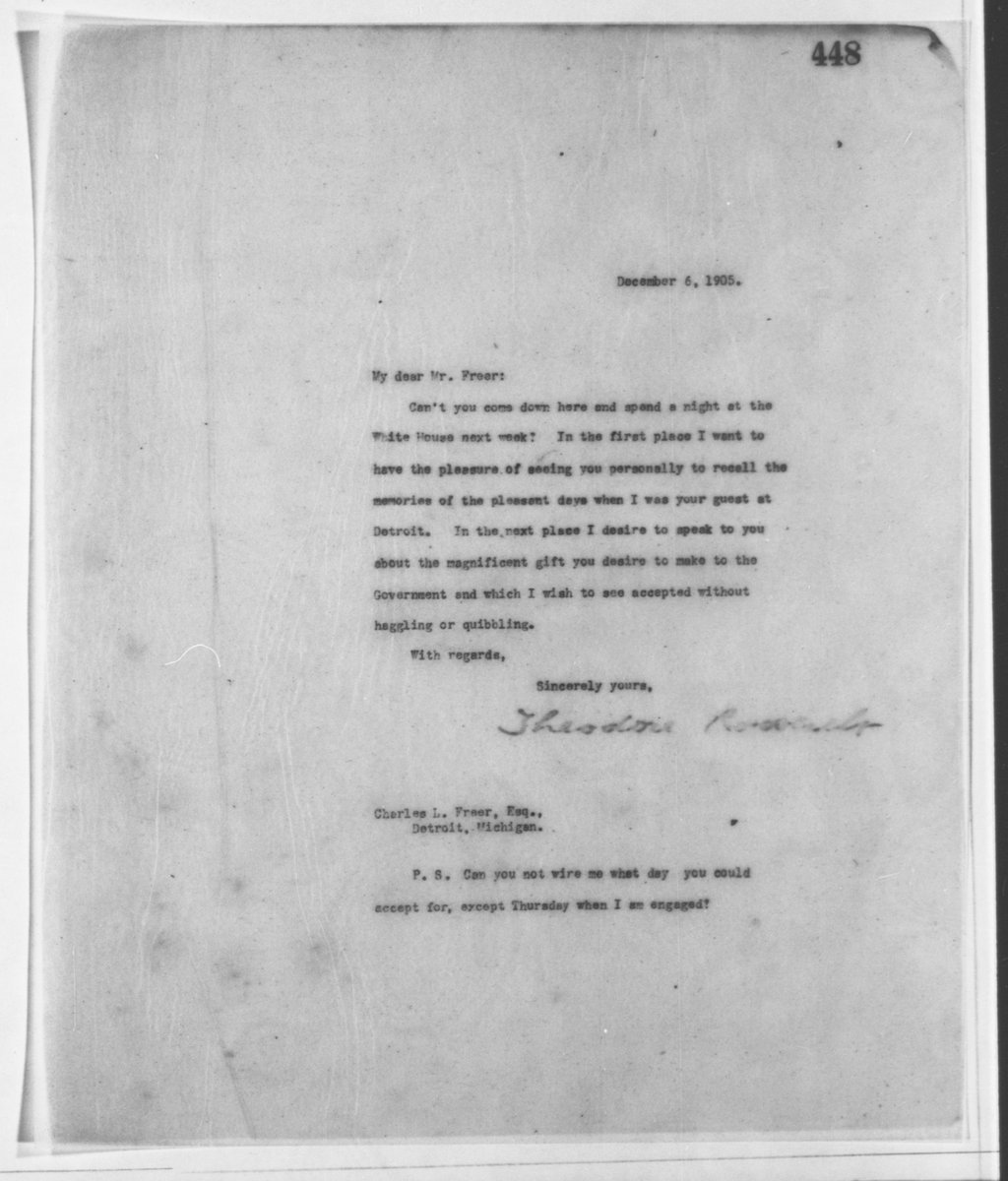
Among those who recognized the value of the collection at the time were Freer’s friend, President Theodore Roosevelt, and Massachusetts Senator Henry Cabot Lodge. In a letter dated March 21, 1905, Roosevelt wrote to Samuel Pierpont Langley, secretary of the Smithsonian, telling him to not refuse the offer from Freer. In the letter, Roosevelt stresses that the collection is highly valuable, and that he is confident Congress will appropriate the funds required to take care of the collection. By December, Lodge wrote to Roosevelt expressing his concern to Roosevelt that the Smithsonian might not accept Freer’s offer, and suggests being named as a regent on the board at the Smithsonian. The following day, Roosevelt invited Freer to visit the White House to discuss Freer’s gift to the government which Roosevelt would like to see accepted without hassle.
On December 19, 1905, Roosevelt wrote to Melville Weston Fuller, Chancellor of the Smithsonian Institution, enclosing a letter from Freer. He urges Fuller to accept the collection on behalf of the nation, along with $500,000 provided by Freer for a building to house the art. Roosevelt describes the collection as priceless, and suggests having the collection examined to alleviate any doubts about its value. In the months that follow, the board of regents decided to accept Freer’s offer, presenting the letter from Roosevelt at the annual meeting on January 24, 1906.
On May 5, 1906, the Smithsonian and Freer finalized their agreement. Freer continued to build his collection until his death in 1919. He almost tripled the inventory that existed at the time of the agreement and through his vision established the Smithsonian’s first art museum.
Entry contributed by Theodore Roosevelt Center Summer Intern Alison McKee