TR Encyclopedia – Foreign Affairs
Alaska Border Dispute
The Alaskan Border dispute between the United States and Great Britain grew out of an effort to more precisely define the borders of the Alaskan panhandle, which shared its Pacific coast with the northern portion of the Canadian province of British Columbia.
This conflict initially began between the Russian Empire and the British Empire, before being inherited by the United States upon its purchase of the territory on March 30, 1867. While Russia had previously been interested in maintaining this North American colony, Tsar Aleksandr II’s growing interest in Central Asia and Northern China led to a shift in Russian opinion and the sale of the territory to the United States.1 The border determined between the Russian and British governments prior to the purchase in the Treaty of Saint Petersburg registered the border between British Canada and Russian Alaska to be “set along the southern coastal border of the Panhandle at 54°40’ N latitude.”2
Although this treaty left the border relatively ill-defined, the issue would remain a small one until the Klondike Gold Rush of 1898. After this, the issue of the Alaskan border resurfaced and became an international issue. Both the United States and Great Britain (via its Canadian colony) wanted to secure access to the Pacific Ocean, and pushed their respective interpretations of the border.
According to the Canadian Encyclopedia, the British vision of the border would have it set on the western banks of the Channel Islands.3 This would push the Americans off the Pacific coast almost entirely. The Library of Congress places the American claim at the mainland Pacific coastline, which would give the United States control of most of the Channel Islands and extend U.S. control further inland.4
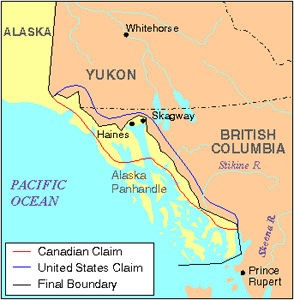
Chief moderator of the crisis was Lord Alverstone, Lord Chief Justice of England, who after some compromise sided with the American delegation.5 This border saw favor given to the United States delegation as the modern border between Canada and Alaska was established. Although the issue was settled peacefully, a letter written by Theodore Roosevelt to Secretary of State John Hay noted Roosevelt’s willingness to go to war over the issue.6 The border was officially established in October of 1903, and had it not been successfully arbitrated; “Haines, Dyea and Skagway would now be Canadian territory as well as the shore approaches to the Chilkat, Chilkoot and White Passes.”7
Sources
1. “The Alaska Purchase: Alaska: Articles and Essays: Meeting of Frontiers: Digital Collections: Library of Congress.” The Library of Congress, 2000, www.loc.gov/collections/meeting-of-frontiers/articles-and-essays/alaska/the-alaska-purchase/.
2. Farr, D. M. L., and Niko Block. “Alaska Boundary Dispute.” The Canadian Encyclopedia, 6 Feb. 2006, www.thecanadianencyclopedia.ca/en/article/alaska-boundary-dispute.
3. Ibid.
4. Library of Congress
5. Farr, Block
6. Roosevelt, Theodore. “Letter from Theodore Roosevelt to John Hay.” Received by John Hay, 21 Sept. 1903. https://www.theodorerooseveltcenter.org/digital-library/o268413/
7. Pedersen, Fran. “The Alaska-Canada Boundary.” The Alaska-Canada Boundary | Geophysical Institute, 18 May 1978, www.gi.alaska.edu/alaska-science-forum/alaska-canada-boundary.
Entry contributed by Isaac Baker – Theodore Roosevelt Center Student Employee