Collections
Notes from the National Park Vagabond – Sullys Hill National Park
Valerie Naylor, our National Parks Vagabond, reports from White Horse Hill National Game Preserve in North Dakota, which was once inhabited by the Dakota people.
(Theodore Roosevelt declared the land Sullys Hill National Park in 1904. This was originally posted to the TR Center blog in two parts in September 2023.)

If you’ve never heard of Sullys Hill National Park, you are not alone. This little gem on the shores of Devils Lake in North Dakota was established by Theodore Roosevelt, but it is now White Horse Hill National Game Preserve.
I love the place. I have visited many times over the past 42 years. The beautiful hill is covered in deciduous trees – green and lush in summer, colorful in fall, and white in winter. It provides outstanding habitat for many types of wildlife, large and small. This year I was there in mid-June. The birds were fabulous – ducks, pelicans, herons, woodpeckers, and warblers. Every Yellow Warbler in eastern North Dakota must find a nesting spot at White Horse Hill. I spent many hours strolling the trails with my binoculars.

Despite previous visits, I never understood how Sullys Hill became a national park during Roosevelt’s time. I thought maybe TR signed a bill to establish the park because it was in his beloved North Dakota, even though he had never been there. But when I dug into the historic files at White Horse Hill, I finally learned the whole convoluted story.
The story starts long before TR. This was the land of the native Dakota people. Many bands lived in the vicinity of the Spirit Water (Devils Lake.) Starting around 1830, the U.S. Government made numerous treaties with the various bands of Dakota – the Sisseton, Wahpeton, Sacs, Foxes, Cut-Heads and other groups. There is a long trail of treaties and agreements – 1830, 1851, 1858, 1867, 1873 and beyond. Each treaty took more of the Dakota land in exchange for money or other considerations.
In 1865, Sullys Hill was named in honor of General Alfred Sully, who camped nearby but never actually visited the hill. General Sully gained his reputation by fighting Indians and directing a massacre of native men, women, and children at Whitestone Hill in Dakota Territory in 1863.
The Devils Lake Reservation, including Sullys Hill, was assigned in 1867 to the “Devils Lake Sioux Tribe.” Fort Totten was built nearby and served as a military fort until 1890 when it was transformed into an Indian boarding school.
On November 2, 1901, U.S. Indian inspector James McLaughlin made the final agreement with the remaining Dakota people on the Devils Lake Reservation. The agreement required the Indians “to cede, surrender, grant and convey to the United States all their claim, right, title, and interest in and to all that part of the Devils Lake Indian Reservation remaining unallotted, including the tract of land at present known as the Fort Totten Military Reserve, situated within the boundaries of the said Devils Lake Indian Reservation and being a part thereof; except six thousand one hundred and sixty acres required for allotments to sixty-one Indians of said reservation entitled to allotments, but to whom allotments have not yet been made…” In other words, the lands of the Dakota people had been whittled away to just 6160 acres.
An Act of Congress on April 27, 1904 sealed the agreement into law and set the stage for opening all of the remaining lands to homesteading. The Act also authorized the President “to reserve a tract embracing Sullys Hill, in the northeastern portion of the abandoned military reservation, about nine hundred and sixty acres, as a public park.” A President cannot proclaim a National Park, but with this Act of Congress, Theodore Roosevelt was given the authority to “proclaim” a public park. Because the area was under the jurisdiction of the Department of Interior, it was assumed that any federal park must be a National Park.
With the stroke of Theodore Roosevelt’s pen, on June 2, 1904, most of the Devils Lake Indian Reservation was opened to homesteading and Sullys Hill (National) Park was established by proclamation. Sources say the park was supposed to be for the use of the local Native Americans, although that point was left out of the proclamation.
Sullys Hill was established as a National Park in 1904 as part of a proclamation by TR to open the Devils Lake Indian Reservation to homesteading, while reserving a few areas for the Tribal members.
Because the terms of its establishment were unique, the park didn’t get much attention and no money from Congress. The first two Superintendents were actually the Superintendents of the nearby Fort Totten Indian School with the management of Sullys Hill National Park as a collateral duty. They continually asked for funding to maintain the park. Each year the Secretary of Interior would ask for a report on how many people visited and all the projects that had been accomplished. The answer always came that while there were a few people visiting the park, projects could not be accomplished without funding.
On June 30, 1914 Congress provided $6,000 for Sullys Hill to the Department of Agriculture Biological Survey to construct fences, buildings, roads, and corrals necessary for care and maintenance of animals and birds. It also authorized the Secretary of Agriculture to establish bison, elk, deer and “such other wild or rare animals and birds as he may in his discretion decide” in the park. This established Sullys Hill as a Game Preserve with the Department of Agriculture involved, although it was still a National Park under the Department of Interior. In 1921, President Warren G. Harding further reserved Sullys Hill National Park as a refuge and breeding ground for birds. In 1931, an Act of Congress transferred jurisdiction of Sullys Hill from the Department of Interior to the Department of Agriculture to be maintained as a “big game preserve, refuge and breeding grounds for wild animals and birds.” It was also to be made available to the public for recreational purposes consistent with the game preserve. Subsequently, the U.S. Biological Survey morphed into the U.S. Fish and Wildlife Service and the area again was under the jurisdiction of the Department of Interior. The National Park no longer existed.

But that’s not the end of the story. In 1993, the Devils Lake Tribe officially changed its name to the M’ni Waukan (Spirit Water) Tribe and their reservation is now the Spirit Lake Reservation. In December 2019, North Dakota Senator Kevin Cramer introduced a bill to change the name of Sullys Hill to the traditional Dakota name of White Horse Hill. The bill passed the Senate and was signed into law.
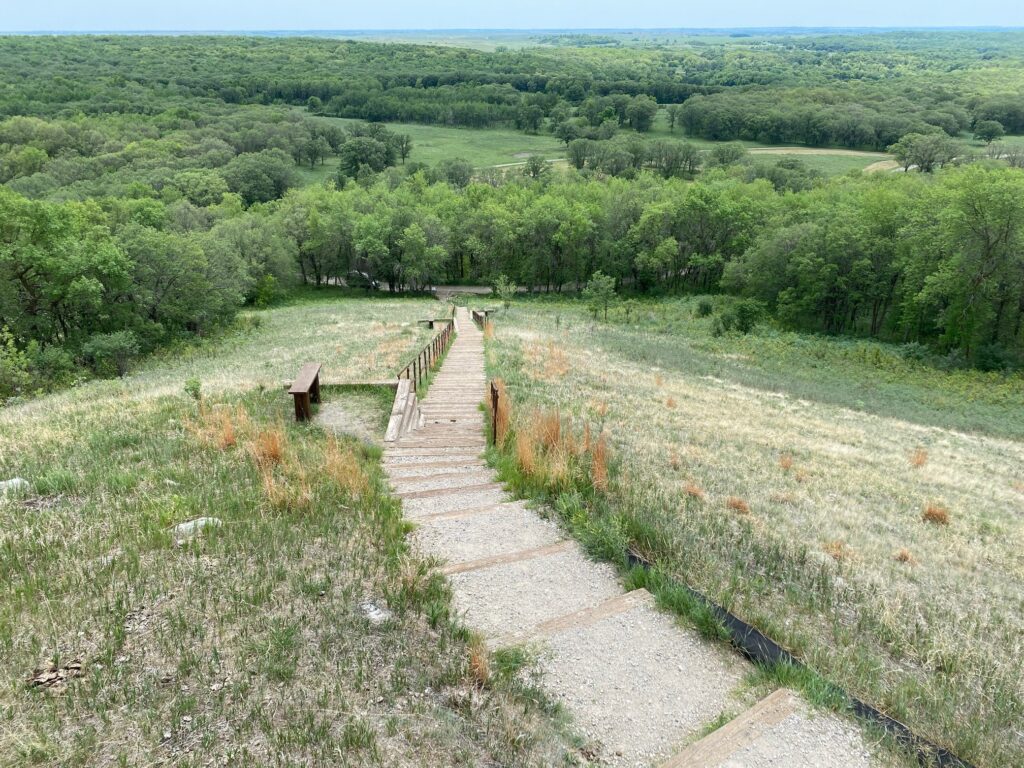
Today, White Horse Hill National Game Preserve consists of 1674 acres. Bison, elk, and even prairie dogs are established in the refuge, and the trees and water attract over 214 species of birds. There is a short drive through the middle of the preserve, and a few hiking trails in the areas where bison don’t roam. There is also an astounding climb to an amazing view at the top of the hill consisting of 193 steps. Or is it 175? By the time people get to the top, they forget the count.
I’m glad I finally understand the convoluted story of Sullys Hill National Park. The long history of diminishing the land of the Dakota is painful, but I’m glad that this spectacular area was preserved as a park and then a refuge. Today, many local Tribal people use this area for hiking and solitude. I was fortunate to spend a couple of days there scanning the archives, watching birds, and enjoying the views. My great-grandparents homesteaded outside the nearby town of Minnewaukan (another spelling for Spirit Water) in the 1880s, long before the Devils Lake Reservation was opened to homesteading. My grandmother was raised there. That region is part of my family history too.
Colleen Graue, Visitor Services Manager at White Horse Hill let me peruse and scan the big box of historic files. She was gracious with her time and provided me a comfortable workspace at the refuge. Both the refuge and the TR Center will benefit from the scans of historic documents dating back to the first park correspondence typed on onion skin paper in 1904. I will continue to visit White Horse Hill as often as I can, and I hope you will visit too.
