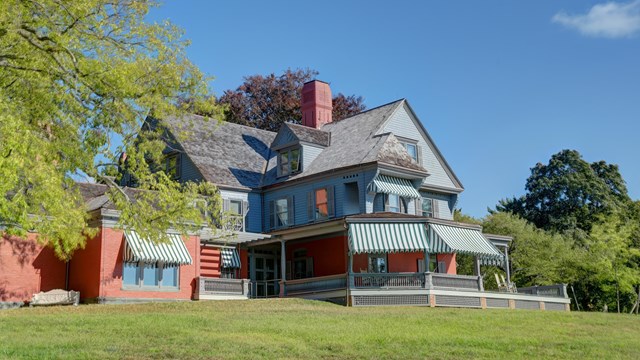
Sagamore Hill was the home of Theodore Roosevelt, 26th President of the United States, from 1885 until his death in 1919. The collections held at Sagamore Hill National Historic Site are a combination of archival and artifact collections. Many of these collections were simply in the house when it was handed over to the National Park Service in 1962.
This collection has been digitized and cataloged on site at Sagamore Hill and then received by digital library staff. Our digital library currently holds four collections from Sagamore Hill, two of which have been reviewed and are included in the digital library. See below to view items from this collection in the digital library.
The Quentin Roosevelt collection contains report cards, school work, and correspondence from Quentin to his parents both from school and during World War I. It also includes the many newspaper articles and letters of condolence received by the family following Quentin’s death in combat in 1918. The Frank Harper collection primarily contains items pertaining to Theodore Roosevelt’s South American trip in 1913. Harper was Theodore Roosevelt’s personal secretary at the time. Menus, programs, tickets, invitations and newspaper articles chronicling Roosevelt’s tour of South American countries are the bulk of that collection.
Digitization of items at the National Park sites was possible through National Park Service Centennial Challenge funding in partnership with Dickinson State University.
George S. Thompson relates his history as a soldier and officer in Cuba and the Philippines. He explains there was an unwarranted revocation of his commission and he wants to serve with Theodore Roosevelt in the war.
Alphonso F. Davidson writes that a bill has passed Congress on “colored soldiers” and offers his services to Theodore Roosevelt. He was a delegate at the Chicago Republican convention. Raised seal on letter.
Proclamation from Alphonso F. Davidson, Grand Chancellor of the Grand Lodge, Knights of Pythias, New Jersey, encouraging members to support the war effort. Enlisted members will be exempt from dues and assessments. Those who cannot enlist in the army should be active in the home service. All members should conserve food resources and should be discreet in conversation.
Article reporting on the patriotic meeting held April 24, 1917, at Fitzgerald’s Auditorium with Winfield Forrest Cozart, Chairman. This event was seen as an opportunity for “colored citizens” to train with the army or navy – an opportunity that was previously “criminally denied.”
A meeting is to be held at Fitzgerald’s Auditorium. Winfield Forrest Cozart will deliver an address on “our duty.” The meeting announcement includes an illustration and a poem titled “The American Flag.”
On behalf of Theodore Roosevelt, W. E. Dame acknowledges W. Scott Brown’s interest in serving with Roosevelt, along with Benjamin O. Davis. Brown’s letter will be filed and taken up if circumstances permit.
On behalf of Theodore Roosevelt, W. E. Dame writes to Frank R. Chisholm regarding Chisholm’s desire to recruit a negro regiment for service under Roosevelt. Roosevelt does not yet know whether he will be permitted to raise a division to fight in the war.
On behalf of Theodore Roosevelt, W. E. Dame replies to Bruce I. Susong’s letter of April 12, 1917. Dame states that the War Department controls decisions regarding “negro troops.”
Bruce I. Susong acknowledges the letter from W. E. Dame of April 28. Susong wishes to serve with Theodore Roosevelt should Roosevelt get his own division.
Bruce I. Susong, managing editor of the Montgomery Journal, writes to ask if Theodore Roosevelt would be interested in having negro regiments in his division.
On behalf of Theodore Roosevelt, W. E. Dame responds to a letter from Griffith M. Gunther dated April 21, 1917. Dame assures Gunther that his application will be filed.
Adjutant General McCain references a telegram of April 12 from Albertus Vogt that was sent to President Woodrow Wilson. The telegram was regarding the organization of an African American regiment. McCain also encloses documents with his letter.
Albertus W. Vogt wishes to form an African American cavalry regiment to serve in France, under Theodore Roosevelt’s command. He also writes that he once heard Roosevelt speak in Lakeland, Florida.