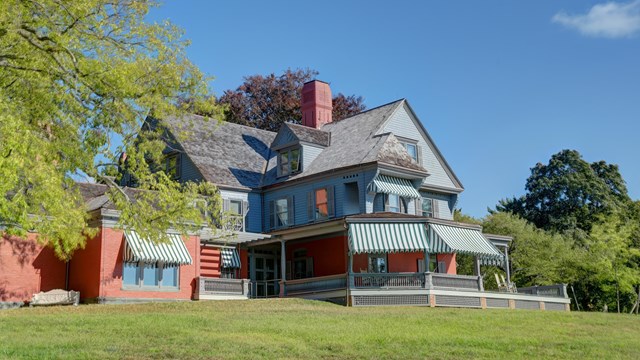
Sagamore Hill was the home of Theodore Roosevelt, 26th President of the United States, from 1885 until his death in 1919. The collections held at Sagamore Hill National Historic Site are a combination of archival and artifact collections. Many of these collections were simply in the house when it was handed over to the National Park Service in 1962.
This collection has been digitized and cataloged on site at Sagamore Hill and then received by digital library staff. Our digital library currently holds four collections from Sagamore Hill, two of which have been reviewed and are included in the digital library. See below to view items from this collection in the digital library.
The Quentin Roosevelt collection contains report cards, school work, and correspondence from Quentin to his parents both from school and during World War I. It also includes the many newspaper articles and letters of condolence received by the family following Quentin’s death in combat in 1918. The Frank Harper collection primarily contains items pertaining to Theodore Roosevelt’s South American trip in 1913. Harper was Theodore Roosevelt’s personal secretary at the time. Menus, programs, tickets, invitations and newspaper articles chronicling Roosevelt’s tour of South American countries are the bulk of that collection.
Digitization of items at the National Park sites was possible through National Park Service Centennial Challenge funding in partnership with Dickinson State University.
W. E. Dame writes that he does not know of “any objections to colored physicians” in the Army. He describes application procedures and height requirements.
Lieutenant Colonel Young details the history of his military service. He was an attaché in Liberia and helped in the “development of my own people of the black race.” He refutes findings of the Medical Board and wishes to serve in Europe.
On behalf of Theodore Roosevelt, W. E. Dame acknowledges H. A. Williamson’s letter and advises that Roosevelt has not yet been authorized to raise a division.
H. A. Williamson writes that the government keeps “ignoring” loyal and patriotic …blacks” in officer training and in the navy. He wishes to know if there are any units in the Roosevelt division for black men.
Theodore Roosevelt writes to Judge Boyd that he forwarded Boyd’s letter to William Jay Schieffelin, who would be in charge of the African American regiment if Roosevelt is allowed to lead a division.
Judge Boyd writes a recommendation for Captain D. J. Gilmer to serve in the war. Boyd writes that Gilmer is “colored” and lists his qualifications as a lieutenant and captain in the Philippines.
John L. Berry, writing on behalf of the Student Committee of Howard University, requests help in making officer training camps available for “colored men” from the University.
The editor of the Journal of Race Development of Clark University, George Washington Ellis, congratulates Theodore Roosevelt on his Chicago address and asks Roosevelt to recruit “colored men” as soldiers and officers when in Illinois.
W. A. Hayne advises W. J. Schieffelin & Co. that 2000 men are available, all with military experience. Hayne says someday they will call for him and Colonel Roosevelt to fight. Two copies of letter included.
The author in this letter requests information for Theodore Roosevelt on the men available for service in “Colored Regiment” W. A. Hayne wrote as being ready to enlist in San Francisco.
On behalf of Theodore Roosevelt, W. E. Dame informs George S. Thompson that Roosevelt has not yet been permitted to recruit a division. Thompson’s letter will be filed for future reference.