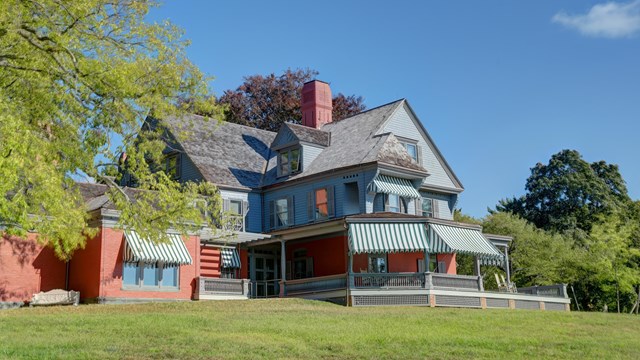
Sagamore Hill was the home of Theodore Roosevelt, 26th President of the United States, from 1885 until his death in 1919. The collections held at Sagamore Hill National Historic Site are a combination of archival and artifact collections. Many of these collections were simply in the house when it was handed over to the National Park Service in 1962.
This collection has been digitized and cataloged on site at Sagamore Hill and then received by digital library staff. Our digital library currently holds four collections from Sagamore Hill, two of which have been reviewed and are included in the digital library. See below to view items from this collection in the digital library.
The Quentin Roosevelt collection contains report cards, school work, and correspondence from Quentin to his parents both from school and during World War I. It also includes the many newspaper articles and letters of condolence received by the family following Quentin’s death in combat in 1918. The Frank Harper collection primarily contains items pertaining to Theodore Roosevelt’s South American trip in 1913. Harper was Theodore Roosevelt’s personal secretary at the time. Menus, programs, tickets, invitations and newspaper articles chronicling Roosevelt’s tour of South American countries are the bulk of that collection.
Digitization of items at the National Park sites was possible through National Park Service Centennial Challenge funding in partnership with Dickinson State University.
Theodore Roosevelt reviews President Wilson’s announcement of refusal to use volunteer forces in France. Roosevelt releases William Jay Schieffelin and his men from all obligations to serve in his division.
W. E. Dame forwards to William Jay Schieffelin letters offering to recruit African American soldiers for service in Theodore Roosevelt’s proposed division.
Theodore Roosevelt discusses why President Wilson declines to permit volunteer divisions to be organized for overseas service. Roosevelt lists various men who volunteered to raise units. He explains why he disagrees with the president’s decision.
Colonel Scott offers Theodore Roosevelt a full regiment of “colored soldiers” for the war front. He is a Spanish-American War veteran and state senator of California.
Asbury Chapel African Methodist Episcopal Church pastor Arthur G. C. Randall offers to raise volunteers in Kentucky “and elsewhere” to serve in France.
The committee members of a Louisville, Kentucky, church ask Theodore Roosevelt to hold to his intention of having his expeditionary force consist of all the “race stocks.”
Theodore Roosevelt thanks Frank O. Lowden for the telegram, dated May 17, 1917, and states that it has been put on file but that he has no idea what he can do.
A patriotic demonstration will take place on Friday, May 18, and a flag purchased by the senior class of 1917 will be raised at Monroe Colored City Public School. Speeches by people of both races will be given.
John Hedge offers his services as “second cook” to Theodore Roosevelt’s officers. Hodge wishes to serve Roosevelt and “our Flag.” He describes himself as a “colored man.”
Wesley L. Sledge requests permission to “muster a regiment of colored soldiers.” Letterhead is from “The Michigan Tailoring Company,” a supplier of military equipment and a state organizer of N.A.A.C.P.
Dr. J. E. Dibble offers the service of “1800 Negroes in Missouri,” many of whom are veterans. “The Black Boys of Missouri” wait for Theodore Roosevelt’s command.
F. S. Stover offers to supply and equip a regiment of 1,000 “colored men” to serve with Theodore Roosevelt. Stover lists equipment he will provide and notes he has influence with “colored people” in Pennsylvania, Delaware, and New Jersey. He will supply specialists; i.e. cooks, stevedores. Letterhead from “The Class & Nachod Brewing Co.,” Philadelphia.
This advertisement contains testimonials to Dr. Newton E. Campbell’s efficacy at curing various diseases, e.g. tuberculosis, nerves, rheumatism, etc. Included are illustrations of various medical equipment and an image of Campbell.
W. M. Johnson requests the position of officer’s cook or in the Quartermaster department with Theodore Roosevelt. Johnson is a veteran of the Spanish American War. The letterhead is from “The Negro Protective and Political League of Burlington County, N.J.”
David Campbell writes that he will notify Fred Campbell if Theodore Roosevelt wishes Fred to cook for him again, as he did in Cuba. He writes that he would consider an appointment as a physician in an African American regiment with Roosevelt.
James T. Simpson, principal of the Belzoni Agricultural and Industrial Institution, asks to serve with Theodore Roosevelt. He can raise a regiment and wishes “representation of the Colored boys” from the Spanish-American War.