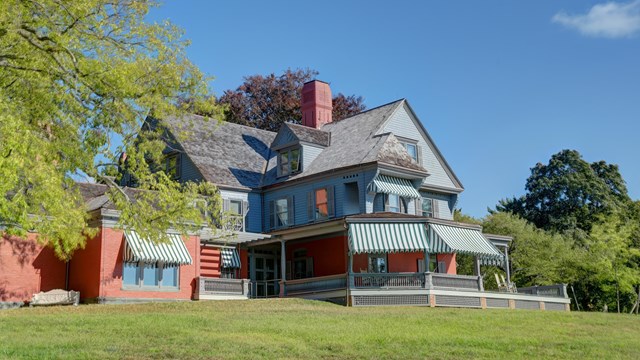
Sagamore Hill was the home of Theodore Roosevelt, 26th President of the United States, from 1885 until his death in 1919. The collections held at Sagamore Hill National Historic Site are a combination of archival and artifact collections. Many of these collections were simply in the house when it was handed over to the National Park Service in 1962.
This collection has been digitized and cataloged on site at Sagamore Hill and then received by digital library staff. Our digital library currently holds four collections from Sagamore Hill, two of which have been reviewed and are included in the digital library. See below to view items from this collection in the digital library.
The Quentin Roosevelt collection contains report cards, school work, and correspondence from Quentin to his parents both from school and during World War I. It also includes the many newspaper articles and letters of condolence received by the family following Quentin’s death in combat in 1918. The Frank Harper collection primarily contains items pertaining to Theodore Roosevelt’s South American trip in 1913. Harper was Theodore Roosevelt’s personal secretary at the time. Menus, programs, tickets, invitations and newspaper articles chronicling Roosevelt’s tour of South American countries are the bulk of that collection.
Digitization of items at the National Park sites was possible through National Park Service Centennial Challenge funding in partnership with Dickinson State University.
Captain Hamilton Coolidge writes to Edith Kermit Carow Roosevelt after the death her son, and his friend, Quentin Roosevelt. Coolidge reflects on Quentin’s efforts in aviation and believes his attitudes helped establish the squadron’s “slight but definite supremacy in the air.” Coolidge hopes to find the time to write a small biography of Quentin.
Mary Goulding Hooff Fawcett has seen Ambler Mason Blackford’s article in The Outlook about Quentin Roosevelt during his time at Episcopal High School at Alexandria, Virginia, and adds to this account her own remembrance of Quentin. Fawcett reflects on the receiving photographs, letters, and kind words remembering her own son, Lieutenant Richard Hartshorne Fawcett, who also was killed while in the Air Service.
Ruth Putnam sends a copy of her book Luxemburg and Her Neighbors. Putnam also includes a “word picture” from 1898 or ’99 inspired by a visit to the New York State Executive Mansion in Albany, where she saw Quentin Roosevelt as a baby.
Pair of gold suspender clips with the initials “TR” engraved on one side and “1912” on the other. The clips were supposedly given to Theodore Roosevelt as a gift.
1902 printing of Proceedings of February 14, 1878, Union Club Meeting in New York City remembering the good works and character of Theodore Roosevelt, Senior. The proceedings include a review of events by William E. Dodge Jr. and a letter, read at the meeting, from Dodge to Joseph Hodges Choate.
Members of President Roosevelt’s Cabinet have advised him not to serve as arbitrator in the Venezuela crisis, but speculation is already underway that he may have to act in that capacity. If he were to do so, possible associates on whom he might rely include Attorney General Philander C. Knox, Judge George Gray, and Assistant Secretary of State David Jayne Hill. Although arbitration by The Hague Convention has been urged on the country, Venezuela is opposed to such arbitration.
Articles titled “The New White House,” “Consular Reform” by John E. Monk, and “Where Statesmen Loiter” by Hal H. Smith are included. The second comments on President Roosevelt’s advocacy of the merit system as the basis on which to appoint and promote members of the diplomatic service, extending the civil service principle into the consular service.
Jackson Tinker, Washington correspondent for the New York Press, describes the numerous visitors that President Roosevelt receives and how Roosevelt and his secretary, William Loeb, deal with them. With 100 to 150 callers per day, the president is hard pressed to have time for the business of the office. (This article appeared in System magazine in April 1905.)
Matted photograph of James Edward Kelly’s 1902 bronze sculpture of Theodore Roosevelt as a Rough Rider on horse. Photograph is signed and inscribed by Kelly to his patron, George Hope Ryder.
Page 30 from a proof copy of a posthumously published booklet on the work of James Edward Kelly, compiled by Robert Bruce in 1934. Excerpt concerns Theodore Roosevelt’s first meeting with Kelly, which occurred on April 19, 1900.
Vice President Roosevelt writes to James Edward Kelly regarding his attire and the horse he rode, along with the saddle. Roosevelt is sending Kelly the saddle and bridle but wants them returned.
Theodore Roosevelt thanks F. S. Stover for his offer of supplies and equipment and asks Stover to communicate with Lieutenant Colonel Young. Roosevelt says he would love to take Stover’s regiment with him if President Woodrow Wilson allows him to go.
A photograph of Brigadier General Theodore Roosevelt Jr., printed in a book, taken while he was in France during World War II. Caption: Died July 12, 1944, in France.