Report card, Quentin Roosevelt, third form

Headmaster Peabody notes “good” on Quentin Roosevelt’s report card for the month.
Collection
Sagamore Hill National Historic Site
Creation Date
1912-06-08
Your TR Source
Sagamore Hill was the home of Theodore Roosevelt, 26th President of the United States, from 1885 until his death in 1919. The collections held at Sagamore Hill National Historic Site are a combination of archival and artifact collections. Many of these collections were simply in the house when it was handed over to the National Park Service in 1962.
This collection has been digitized and cataloged on site at Sagamore Hill and then received by digital library staff. Our digital library currently holds four collections from Sagamore Hill, two of which have been reviewed and are included in the digital library. See below to view items from this collection in the digital library.
The Quentin Roosevelt collection contains report cards, school work, and correspondence from Quentin to his parents both from school and during World War I. It also includes the many newspaper articles and letters of condolence received by the family following Quentin’s death in combat in 1918. The Frank Harper collection primarily contains items pertaining to Theodore Roosevelt’s South American trip in 1913. Harper was Theodore Roosevelt’s personal secretary at the time. Menus, programs, tickets, invitations and newspaper articles chronicling Roosevelt’s tour of South American countries are the bulk of that collection.
Digitization of items at the National Park sites was possible through National Park Service Centennial Challenge funding in partnership with Dickinson State University.
Headmaster Peabody notes “good” on Quentin Roosevelt’s report card for the month.
Sagamore Hill National Historic Site
1912-06-08

Card noting Quentin Roosevelt’s average for the month and that he has been included on Groton School’s Honor List.
Sagamore Hill National Historic Site
1912-06-08

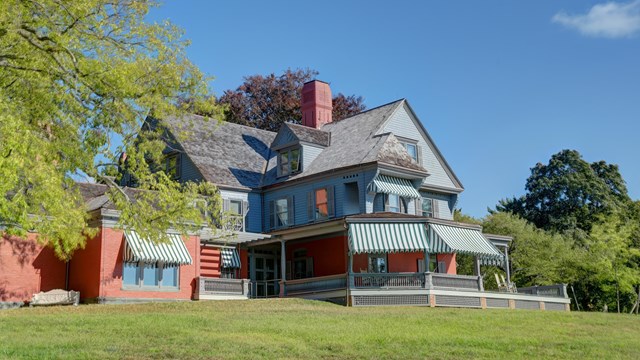
Young Quentin Roosevelt hunts for june bugs among the daisies on the west side of the Roosevelt home.
Sagamore Hill National Historic Site
1904

Two photographs, side-by-side, showing Theodore Roosevelt and Major General Leonard Wood during both the Spanish-American War and World War I.
Sagamore Hill National Historic Site
1919-01-07

This brief headline notes the deleterious effect fever is having on American troops stationed in Santiago, Cuba, and mentions the round robin letter sent by Theodore Roosevelt and several other officers demanding their men be brought north immediately.
Sagamore Hill National Historic Site
1898

A volume summarizing and recording the 1902 restoration and renovation of the White House, including the report by the architectural firm of McKim, Mead & White summarizing the extent of work that was done, historical notes regarding the White House, and many drawings and photographs of the construction work on the White House and Executive offices.
Sagamore Hill National Historic Site
1903

Guangxu, Emperor of China, thanks President Roosevelt for the letter of congratulations presented to Cixi, Empress dowager of China, on her seventieth birthday by Minister to China Edwin H. Conger. Guangxu believes the letter has helped establish a closer relationship between the two nations and wishes Roosevelt happiness and welfare.
Sagamore Hill National Historic Site
1904-12-28

In this message, President Roosevelt recommends that Congress fund an appropriation to search for the remains of Admiral John Paul Jones in Paris, France. Roosevelt believes it is improper for a national hero like Jones to lie in an unmarked grave and urges Congress “to do proper honor to the memory of Paul Jones.” Roosevelt also recommends the erection of monuments to Jones and Admiral John Barry, since they “hold unique positions in the history of the birth of our Navy.” A report from Ambassador to France Horace Porter about the subject is also included.
Sagamore Hill National Historic Site
1905-02-13

A contract between Assemblyman Roosevelt and carpenter John A. Wood & Son to complete first floor beams, shingles on roof and sides, plastering, stairs, and the mantle, among other projects, at Sagamore Hill.
Sagamore Hill National Historic Site
1884-03-01

General Degoutte writes to Theodore Roosevelt about plans to bury fallen troops, including Quentin Roosevelt, in the territory reconquered by the Sixth Army between the Marne and Aisne rivers. This will allow mourning families to recognize the place they are buried, and to stand as a monument for future generations. Degoutte sends a photograph of the place where Quentin died, near the Reddy farm, and expresses his shared grief to Roosevelt, while also praising the common ideals of the United States and France during the conflict.
Sagamore Hill National Historic Site
1918-09-05

Winthrop Chanler writes a letter of condolence after the death of Quentin Roosevelt. Chanler fondly remembers meeting Quentin at the Issoudun airfield. He also recently saw “Archie” Roosevelt in Paris and heard that “Ted” Roosevelt had been hurt. Chanler regrets that it is the young who go to fight rather than the “old ones” like himself. Chanler sends his deepest sympathies to Roosevelt’s wife.
Sagamore Hill National Historic Site
1918-09-09

Mary Elizabeth Whiton Washburn writes a letter of condolence to Edith Kermit Carow Roosevelt after the death of her son Quentin Roosevelt. Washburn remembers when Quentin called on her as a boy and conversed about turkeys and their price. Washburn is glad to have known Quentin.
Sagamore Hill National Historic Site
1918-09-05

H. A. Maxwell writes a note of condolence to Theodore Roosevelt after the death of his son Quentin Roosevelt. Maxwell met Quentin at the Issoudun aviation camp where Quentin was a “Y man,” and Maxwell shares a few fond anecdotes relating his good character. Maxwell did not have time to visit Quentin’s grave site in France.
Sagamore Hill National Historic Site
1918-09-13

Charlotte Schneégans sends a poem in tribute to Quentin Roosevelt.
Sagamore Hill National Historic Site
1918-09-14

A newspaper clipping showing an image of the grave of Quentin Roosevelt found by an American aviator. The Germans had buried him and erected a cross bearing the words, “Roosevelt, American Aviator.” The grave was outlined with stones with the remnants of the wreckage piled at its head.
Sagamore Hill National Historic Site
1918

Chaplain Francis Patrick Duffy conducts religious services over the grave of Quentin Roosevelt in Chamery, France. The photograph shows the crude marking originally made by the Germans as well as the new cross placed by the Americans, with wheels from Quentin’s destroyed machine at its side.
Sagamore Hill National Historic Site
1918-09-15

Edward G. Fischer writes to Theodore Roosevelt that a camp of soldiers have chosen as an informal name of their camp, “Camp Quentin.” The men are “honored by this association with the name of a hero.” Fischer sends this letter to inform Roosevelt of the name and to send sympathy from every member of his camp.
Sagamore Hill National Historic Site
1918-09-19

French Ambassador to the United States J. J. Jusserand writes to Theodore Roosevelt after the death of his son on behalf of the French President Raymond Poincaré to extend the same engraved statement memorial offered to the bereft mothers and fathers of France. Jusserand includes with his note a case containing the document and a letter from President Poincaré. Jusserand also knew Quentin as a child.
Sagamore Hill National Historic Site
1918-09-21

Mary H. A. Allen writes a letter of condolence to Theodore Roosevelt after the death of his son Quentin Roosevelt. Allen cares for wounded infantry men who speak “admiringly and affectionately” of Quentin. Allen relates an amusing anecdote of meeting Quentin as a boy while visiting Leila Roosevelt Reeve-Merritt. Quentin’s early death is reconciled with the thought that he died “before ever sorrow had a chance to touch him.”
Sagamore Hill National Historic Site
1918-10-01

Herbert V. Jones sends Theodore Roosevelt an extract from a letter from his wife’s brother, Edward L. Buford, who was in the same air squadron as Quentin Roosevelt. Buford recounts the events leading up to Quentin’s death.
Sagamore Hill National Historic Site
1918-10-02