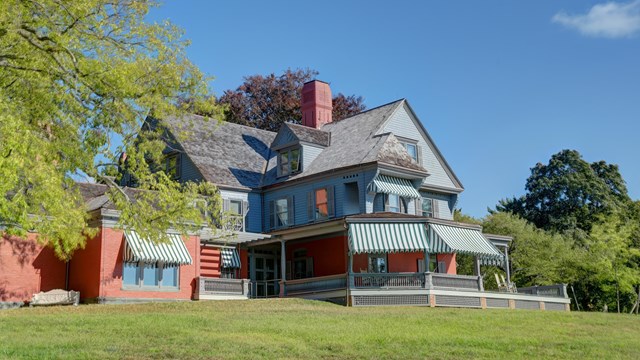
Sagamore Hill was the home of Theodore Roosevelt, 26th President of the United States, from 1885 until his death in 1919. The collections held at Sagamore Hill National Historic Site are a combination of archival and artifact collections. Many of these collections were simply in the house when it was handed over to the National Park Service in 1962.
This collection has been digitized and cataloged on site at Sagamore Hill and then received by digital library staff. Our digital library currently holds four collections from Sagamore Hill, two of which have been reviewed and are included in the digital library. See below to view items from this collection in the digital library.
The Quentin Roosevelt collection contains report cards, school work, and correspondence from Quentin to his parents both from school and during World War I. It also includes the many newspaper articles and letters of condolence received by the family following Quentin’s death in combat in 1918. The Frank Harper collection primarily contains items pertaining to Theodore Roosevelt’s South American trip in 1913. Harper was Theodore Roosevelt’s personal secretary at the time. Menus, programs, tickets, invitations and newspaper articles chronicling Roosevelt’s tour of South American countries are the bulk of that collection.
Digitization of items at the National Park sites was possible through National Park Service Centennial Challenge funding in partnership with Dickinson State University.
A small collection of Quentin Roosevelt’s fifth grade school work from May 1907. Includes poetry, spelling and vocabulary while he was attending Force School.
Two portrait engravings of Theodore Roosevelt and Charles W. Fairbanks enclosed in an envelope from the United States Senate addressed to Quentin Roosevelt.
Principal Blackford from the Episcopal High School of Virginia requests proficiency under Dulin’s instruction which would prepare Quentin for the school’s first form.
Principal Blackford from the Episcopal High School of Virginia writes to admit Quentin Roosevelt to Episcopal without examination based on his previous schoolwork.
Quentin Roosevelt writes a letter to his mother Edith Roosevelt describing his moving into a new school. Stationary on letter imprinted, “The White House, Washington”.
An essay Quentin Roosevelt wrote on his favorite sport, fishing. An envelope to Edith Roosevelt is included; a teacher may have forwarded the essay to her.
Theodore Roosevelt writes to Quentin Roosevelt to tell him about his day ashore at Aden, the different animals and people he saw such as a man with one leg who had been attacked by a shark. He also tells him about a baby gazelle on board his ship that he fed. He discusses glow-in-the-dark watches Kermit and he have been given as gifts and then encourages Quentin to keep up with his studies so he can gain entrance to Groton School.
An excerpt from a letter Quentin Roosevelt wrote about traveling in France during the summer of 1909. He discusses seeing a flying show, Notre Dame, and the Louvre. He does not like French train travel and discusses subjects of photographs he has captured with his camera.
Report from Quentin Roosevelt’s first term at Groton School. Headmaster Peabody notes he has too many black marks but is learning what is expected of him.
A report card from Groton School for Quentin Roosevelt. Headmaster Peabody says he is doing poorly in Latin and wishes he had less black marks but that he seems to be improving since his mother’s visit.
Headmaster Peabody urges Quentin Roosevelt to get as much rest as he can on his break. Roosevelt’s Latin continues poorly and he has not learned how to study well yet.
Quentin Roosevelt writes to his mother, Edith Roosevelt, to inform her that he stood first in his form with his grades. His name is misspelled in the telegram. The back of the telegram is an advertisement for The Western Union Telegraph Company.
Master Billings notes that Quentin Roosevelt’s work continues to be exemplary and that his move into the upper class with Latin means the work is harder.