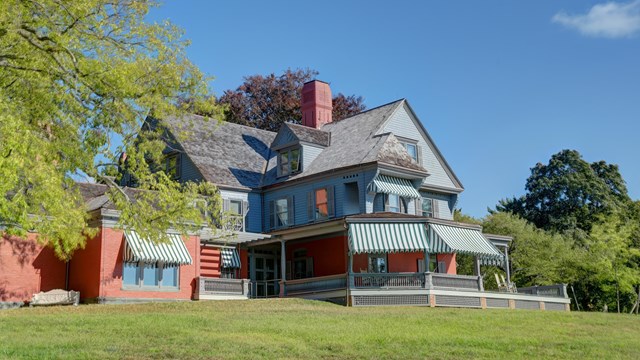
Sagamore Hill was the home of Theodore Roosevelt, 26th President of the United States, from 1885 until his death in 1919. The collections held at Sagamore Hill National Historic Site are a combination of archival and artifact collections. Many of these collections were simply in the house when it was handed over to the National Park Service in 1962.
This collection has been digitized and cataloged on site at Sagamore Hill and then received by digital library staff. Our digital library currently holds four collections from Sagamore Hill, two of which have been reviewed and are included in the digital library. See below to view items from this collection in the digital library.
The Quentin Roosevelt collection contains report cards, school work, and correspondence from Quentin to his parents both from school and during World War I. It also includes the many newspaper articles and letters of condolence received by the family following Quentin’s death in combat in 1918. The Frank Harper collection primarily contains items pertaining to Theodore Roosevelt’s South American trip in 1913. Harper was Theodore Roosevelt’s personal secretary at the time. Menus, programs, tickets, invitations and newspaper articles chronicling Roosevelt’s tour of South American countries are the bulk of that collection.
Digitization of items at the National Park sites was possible through National Park Service Centennial Challenge funding in partnership with Dickinson State University.
Frederick Herrig’s military record and discharge from the United States Army Volunteer Cavalry in 1898 in which he served under Colonel Roosevelt during the Spanish-American War. Roosevelt gives a glowing review of Herrig stating that there could be no better solider.
In a pamphlet on American naval policy prepared by Assistant Secretary of the Navy Roosevelt, the past and present presidential opinions on improving the United States Navy are detailed.
Theodore Roosevelt writes about the merits of the New York Police, not only their improvement over the years but also specific policemen and events in which they were involved.
Theodore Roosevelt addresses the Naval War College of Newport, Rhode Island, discussing the need for a strong and growing Navy in order for the United States to be prepared for the future.
Cover from a collection of poems by Surville J. DeLan, including the inscription “To the President with the fervent respects of the Author Ex Major of Glenwood Springs Colo May 7, 1903.”
Commissioner Roosevelt writes to Gertrude Tyler Carow informing her of the recent birth of his son, Archibald Bulloch Roosevelt. The birth went well and Roosevelt describes the excitement and reactions of his children.
Theodore Roosevelt discusses cross-country hunting and riding on Long Island, New York. He places emphasis on the growth of the sport within the United States, its heritage and the types of horse required.
Assemblyman Theodore Roosevelt presents a bill that would allow the governor of New York absolute power in making appointments to various heads of departments within the government. In doing so, the governor would not need the confirmation or the rejection of the aldermen.
On one side is a pencil sketch of the size and shape of the Sagamore Hill House, drawn by Theodore Roosevelt. On the opposite side Roosevelt sketched the estate grounds, labeling various areas (fields, orchards, etc.). It is labeled “Map made by T. R. for his mother and aunt when he first bought this property. Sagamore Hill”
A note on the provenance of a rare broadside printed by Theodore Roosevelt while at Harvard University. Titled Birds of Oyster Bay, it was purchased for the library from the library of Dr. C. Hart Merriam.
Samuel Henshaw of the Museum of Comparative Zoology in Cambridge, Massachuesetts writes to R. W. G. Vail of the Roosevelt House Library and Museum informing him that the museum has the Roosevelt publications he was inquiring about. A handwritten note identifies the articles as “Birds of Adirondacks and Oyster Bay.”
The children’s Christmas book titled A Visit from Saint Nicholas tells the story of Saint Nicholas, or Santa Claus, and his visit to a family’s home on the night before Christmas. The story would later be known as The Night Before Christmas.
The writer describes the success and hardships of the Allotment System, a program designed to deduct money from soldiers’ pay and have it sent home to their families during the Civil War. Theodore Roosevelt, Sr., W. E. Dodge, and Theodore Bailey Johnson were appointed commissioners by the President to visit regiments of volunteer soldiers in New York State.
This article from the “Jewish Advocate” criticizing an article from The Outlook regarding Jews and the Russian passport question. It also criticizes the views of Dr. Lyman Abbott and Theodore Roosevelt’s attempt to throw the issue in The Hague.
Article discusses Theodore Roosevelt’s article “The Trusts, the People, and the Square Deal” in The Outlook, regarding the Steel trust, government control of business, Tennessee Coal, and U.S. Steel. Article is incomplete.
This article from the “Jewish Advocate” discusses the American Jewish Committee meeting and their view that the Russo-American treaty of 1832 should not be abrogated since it might create an outburst of anti-Jewish sentiment. Since Russia will not recognize American passports of Jews, they agree with Theodore Roosevelt that the matter should be arbitrated by the Hague.