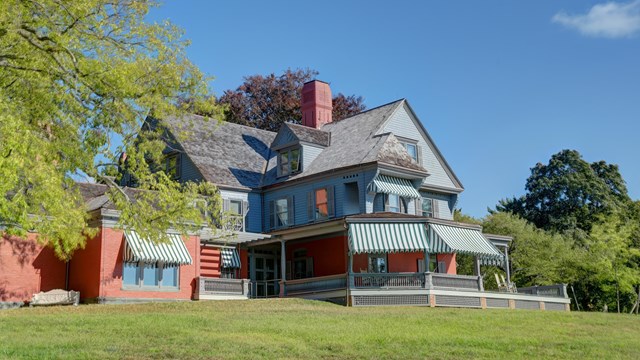
Sagamore Hill was the home of Theodore Roosevelt, 26th President of the United States, from 1885 until his death in 1919. The collections held at Sagamore Hill National Historic Site are a combination of archival and artifact collections. Many of these collections were simply in the house when it was handed over to the National Park Service in 1962.
This collection has been digitized and cataloged on site at Sagamore Hill and then received by digital library staff. Our digital library currently holds four collections from Sagamore Hill, two of which have been reviewed and are included in the digital library. See below to view items from this collection in the digital library.
The Quentin Roosevelt collection contains report cards, school work, and correspondence from Quentin to his parents both from school and during World War I. It also includes the many newspaper articles and letters of condolence received by the family following Quentin’s death in combat in 1918. The Frank Harper collection primarily contains items pertaining to Theodore Roosevelt’s South American trip in 1913. Harper was Theodore Roosevelt’s personal secretary at the time. Menus, programs, tickets, invitations and newspaper articles chronicling Roosevelt’s tour of South American countries are the bulk of that collection.
Digitization of items at the National Park sites was possible through National Park Service Centennial Challenge funding in partnership with Dickinson State University.
This letter is a reply to Parks’ letter from April 4, 1917 from a representative of Theodore Roosevelt. It states that this is a matter with the War Department only.
A representative of Theodore Roosevelt responds to L. J. Lewis’s letter dated April 10, 1917, stating that only the War Department can make the final determination and there has been no decision yet on Theodore Roosevelt’s application to recruit.
On behalf of Theodore Roosevelt, his secretary acknowledges Ira S. Barnett’s letter of April 7, 1917. While Colonel Roosevelt would be pleased to include an African American regiment in a division under his command, only the War Department could authorize the forming of such a regiment.
L. J. Lewis writes to Theodore Roosevelt and expresses his wish to “raise a regiment…of Hampton and Tuskegee men.” He states that those opposed to joining the conflict “fail to grasp the spirit of true Americanism.”
On behalf of Theodore Roosevelt, the author acknowledges John Williams’s letter of April 4, 1917. While Colonel Roosevelt would be pleased to include an African American regiment in a division under his command, only the War Department could authorize the forming of such a regiment
On behalf of Theodore Roosevelt, the author acknowledges E. E. Roland’s letter of April 4, 1917. While Colonel Roosevelt would be pleased to include an African American regiment from Mississippi in a division under his command, only the War Department could authorize the forming of such a regiment.
This letter is a reply to S. D. Owen’s letter from April 3, 1917, by a representative of Theodore Roosevelt. Roosevelt cannot accept Owen’s offer “without authority” from the War Department.
S. D. Owen writes to Theodore Roosevelt to offer to organize and drill African Americans for border protection of Mexico. A photograph was attached to the letter.
This letter is a reply to Captain Whitman’s letter from a representative of Theodore Roosevelt. Theodore Roosevelt does not think he will be allowed to take African Americans if he raises a division of troops but Whitman may take the matter to the War Department.
A representative of Theodore Roosevelt responds to W. H. Randolph’s letter of March 27, 1917, stating that Randolph will be advised if Roosevelt can use his services. There has been no action yet on Roosevelt’s application to Washington.
Organized by Joseph W. Henderson, A National Conference of Colored Men will be held on May 29, 30, 31, 1917 in Providence, Rhode Island, to begin the campaign to mobilize “50,000 Colored Men” for service overseas.
Joseph W. Henderson seeks contributions to the National Conference of Colored Men. He states he is not one of Theodore Roosevelt’s “colored worshipers” but shares Roosevelt’s patriotism.