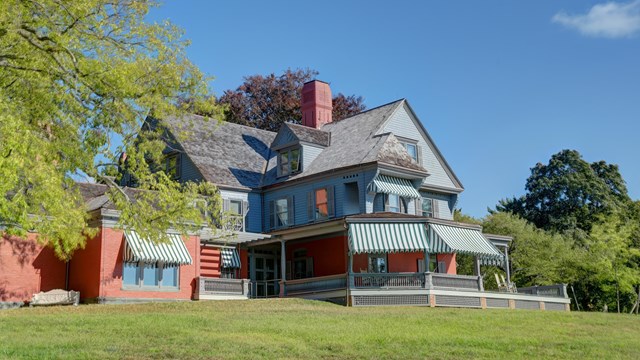
Sagamore Hill was the home of Theodore Roosevelt, 26th President of the United States, from 1885 until his death in 1919. The collections held at Sagamore Hill National Historic Site are a combination of archival and artifact collections. Many of these collections were simply in the house when it was handed over to the National Park Service in 1962.
This collection has been digitized and cataloged on site at Sagamore Hill and then received by digital library staff. Our digital library currently holds four collections from Sagamore Hill, two of which have been reviewed and are included in the digital library. See below to view items from this collection in the digital library.
The Quentin Roosevelt collection contains report cards, school work, and correspondence from Quentin to his parents both from school and during World War I. It also includes the many newspaper articles and letters of condolence received by the family following Quentin’s death in combat in 1918. The Frank Harper collection primarily contains items pertaining to Theodore Roosevelt’s South American trip in 1913. Harper was Theodore Roosevelt’s personal secretary at the time. Menus, programs, tickets, invitations and newspaper articles chronicling Roosevelt’s tour of South American countries are the bulk of that collection.
Digitization of items at the National Park sites was possible through National Park Service Centennial Challenge funding in partnership with Dickinson State University.
William Jay Schieffelin thanks W. E. Dame for “forwarding the letters about the Negro volunteers.” Schieffelin regrets he will not be able to use the material.
Berkley A. Mills asks Theodore Roosevelt to include African American volunteers in his division. He does not want to be “Jim-crowed” and asks to not be segregated in service.
Everett Edward Neeley sends Theodore Roosevelt a photograph of Quentin Roosevelt’s grave. Neeley obtained the photo just a few days after Quentin’s death.
This certificate was awarded to Theodore Roosevelt by the Bey of Tunis Mohammed Lamine, presumably for his service in North Africa during World War II.
The Legion of Merit was awarded posthumously to Theodore Roosevelt for “exceptionally meritorious conduct in the performance of outstanding services” in the North African theater during World War II.
Citation awarded to Theodore Roosevelt by Major General Summerall “for gallant and energetic direction of his regiment during the advance against Mouzon on the Meuse and the subsequent operations against Sedan.”
The Distinguished Service Cross was awarded to Theodore Roosevelt “for extraordinary heroism in connection with military operations against an armed enemy” while fighting in Cantigny, France, in World War I.
This citation was awarded to Theodore Roosevelt by Major General Bullard “for conspicuous gallantry in action during the operations connected with the capture and defense of Cantigny, May 27-31, 1918.”