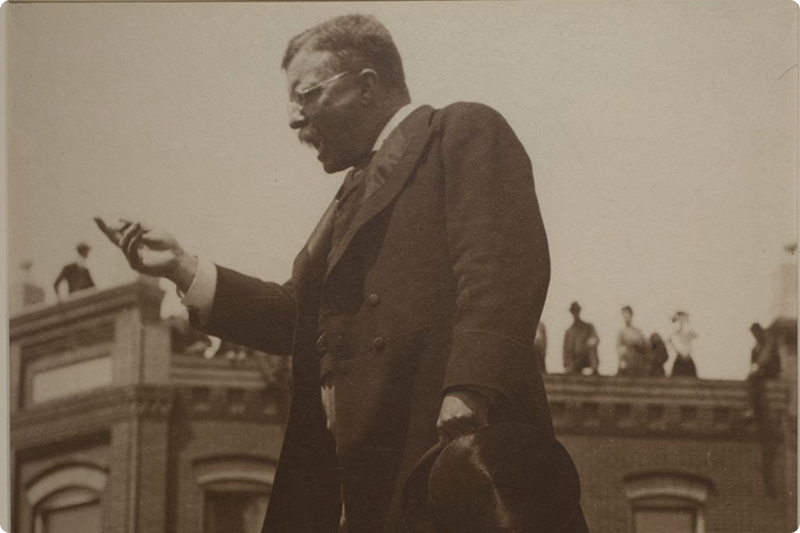
The following is a list of quotations attributed to Theodore Roosevelt. Where a source can be verified, it is noted below along with a brief explanation of the setting or the context for that quote. This list includes a number of quotations for which a source has not been verified in Theodore Roosevelt's writings. The context for many of the quotes included here reflects research that has been conducted throughout the years by curators of the Theodore Roosevelt Collection at Harvard University, which is presented here through a cooperation between Harvard College Library and the Theodore Roosevelt Center. Quotations will be added to this list as staff at both institutions continue their research.
When nearly three centuries ago the first settlers came to the country which has now become this great Republic, they fronted not only hardships and privation, but terrible risk to their lives….It is eminently fitting that once a year our people should set apart a day for praise and thanksgiving to the Giver of Good, and, at the same time that they express their thankfulness for the abundant mercies received, should manfully acknowledge their shortcomings and pledge themselves solemnly and in good faith to strive to overcome them.
From President Theodore Roosevelt’s November 1905 Thanksgiving Proclamation.
When off in the wilderness they were obliged to take a man for what he did, not for what he thought.
Winning of the West, V. II In the Current of the Revolution
When one is in the Badlands, he feels as if they somehow look just exactly as Poe’s tale and poems sound.
Taken from Roosevelt’s book, Hunting Trips and Wilderness Hunter, p. 20.
When one is in the midst of the strife, with the dust, and the blood and the rough handling, and is receiving blows (and if he is worth anything, is returning them), it is difficult always to see perfectly straight in the direction the right lies. Perhaps we must always advance a little by zigzags; only we must always advance; and the zigzags should go toward the right goal.
Roosevelt spoke these words at a New York State Bar Association banquet on January 18, 1899, while he was serving as governor of New York. He was certain of two things: first, that life and politics were a struggle; second, that he knew how to identify the right.
When people have become very prosperous they tend to become sluggishly indifferent to the continuation of the policies that brought about their prosperity.
President Roosevelt spoke these words at the Union League in Philadelphia on November 22, 1902. As a Hamiltonian, Roosevelt believed that economic prosperity was the result of wise government policies, not the inherent efficiency of economic activity.
When people have spoken to me as to what America should do with its ex-Presidents, I have always answered that there was one ex-President as to whom they need not concern themselves in the least, because I would do for myself. It would be to me personally an unpleasant thing to be pensioned and given some honorary position. I emphatically do not desire to clutch at the fringe of departing greatness.
Roosevelt wrote these words to John St. Loe Strachey on November 28, 1908, shortly after William Howard Taft was elected to succeed him as president. Roosevelt was never a rich man, but he found ways to earn a good living after his retirement from the presidency and did not suffer, as had John Adams, Thomas Jefferson, and James Monroe, from straightened circumstances after leaving office.
When the Republican party was founded, and for a decade afterwards, the Democracy favored slavery and said so; and so the Republicans could fight straight on this issue, and later on the Union issue. But our opponents make believe to be in favor of the things which we favor, and it needs a good deal of argument to show the insincerity of their professions.
This statement reveals some of the resentment that Theodore Roosevelt felt throughout his Progressive Party campaign of 1912 toward the similarity of Woodrow Wilson’s campaign platform to Roosevelt’s own.
When we got home, mother went upstairs first and was met by Archie and Quentin, each loaded with pillows and whispering not to let me know that they were in ambush; then as I marched up to the top they assailed me with shrieks and chuckles of delight and then the pillow fight raged up and down the hall.
President Roosevelt writes to his son, Kermit, away at the Groton School, to update him on family life in the White House.
When you and I had the chance we did our duty, although it was on an infinitely smaller scale.
Theodore Roosevelt writes to his friend Robert Harry Munro Ferguson on August 9, 1918, comparing their own time fighting with that of those fighting in World War I, including Roosevelt’s son Quentin who was recently killed in the war.
When you of the Civil War sprang forward at Abraham Lincoln’s call to put all that life holds dear, and life itself, in the scale with the nation’s honor, you were able to do what you did because you had in you, not only the qualities that make good citizens, but in addition the high and intense traits, the deep passion and enthusiasm, which go to make up those heroes who are fit to deal with iron times.
Draft of a speech with handwritten corrections. Vice President Roosevelt praises Vermont and its people for the services they rendered during the American Civil War. He views the war as bringing together a diverse range of people to fight for a “lofty ideal.” At the war’s conclusion, the soldiers returned to civilian life with a sense of duty well done and a feeling of community interest that would eventually extend even to “the gallant men who wore the grey.” Roosevelt holds the Civil War veterans up as a model to follow and shows how recent American conflicts have taught similar lessons in a lesser way.
Whenever hereafter a public building is provided for and erected, it should be erected in accordance with a carefully thought out plan adopted long before; it should be not only beautiful in itself, but fitting in its relations to the whole scheme of the public buildings, the parks, the drives of the District [of Columbia].
Roosevelt delivered these words at a meeting of the American Institute of Architects on January 11, 1905. Like Thomas Jefferson (whom he disliked on most fronts), Roosevelt believed that the American republic needed to be embodied in buildings of taste, beauty, and contextual harmony, and that it was a mistake to throw up buildings in an ad hoc fashion.
Whenever there is tyranny by the majority I shall certainly fight it. But the tyrannies from which we have been suffering in this country have, ninety-nine times out of a hundred, been tyrannies by a minority; that is, tyranny by privilege.
Roosevelt spoke these words in St. Louis on March 28, 1912. He was, at that time, staking out a strongly progressive place in Republican politics, in the hopes of unseating his hand-picked successor William Howard Taft as the Republican nominee for the presidency.
Where possible it is always better to mediate before the strike begins than to try to arbitrate when the fight is on and both sides have grown stubborn and bitter.
Theodore Roosevelt made this remark during a Labor Day picnic in Chicago in 1900. Perhaps he kept it in mind when he brought opposing sides together at the White House in an attempt at mediation during the Anthracite Coal Strike of 1902.
Wherever I stopped at a small city or country town I was greeted by the usual shy, self-conscious, awkward body of local committeemen, and spoke to the usual audience of thoroughly good American citizens–a term I can use in a private letter to you without being thought demagogic!
Excerpt of a letter to John Hay written August 9, 1903, about stops President Roosevelt was making in the Midwest prior to heading to a trip to the California wilderness.
Whether he commits wrong in the name of order or of liberty, of religion or of freedom of thought, matters nothing ; I am against the wrong-doer.
Theodore Roosevelt is disappointed that Thomas E. Watson has such “violent feeling” towards Catholics, which he doesn’t believe is compatible with the “real and full belief in our American institutions.” He would consider himself an unworthy citizen if he failed to treat each citizen with “absolute disregard of his creed.” Roosevelt defends religious freedom and will “fight the battle of decency” without regard for a person’s religion or opposition to him.
While I hope that as the chance occurs each man will get all the fun he can out of life, remember that when it comes not merely to looking back upon it but to living it, the kind of life that is worth living is the kind of life that is embodied in duty worth doing which is well done.
President Roosevelt addresses citizens of Ventura and marvels at the unity of the American people. He also thanks the teachers for “what they have done” and speaks of character building and citizenship.
While I think we live in a pretty good world, I do not think it is all the best possible world, and I hope we shall have an adjustment of rewards, even those of a pecuniary or material kind. Altogether there is much in the way of reward that comes to a certain type of financiers and too little comes to the student, to the scholar, to the teacher, to the man who represents the scholarly side, the side of thought!
President Roosevelt spoke these words at Clark University in Worster, Massachusetts, on June 21, 1905. He was, of course, speaking to the choir. Amen.
While material well-being is never all-sufficient to the life of a nation, yet it is the merest truism to say that its absence means ruin. We need to build a higher life upon it as a foundation; but we can build little indeed unless this foundation of prosperity is deep and broad.
Theodore Roosevelt made this statement in a speech in Charleston, South Carolina, in 1902.
While on this trip Kermit passed his twentieth birthday. While still nineteen he had killed all the kinds of African dangerous game – lion, leopard, elephant, buffalo, and rhino.
Kermit’s twentieth birthday was on October 10, 1909. Theodore Roosevelt boosted of his son’s hunting record when writing the account of their journey, later published as African Game Trails.
While the nation that has dared to be great, that has had the will and the power to change the destiny of the ages, in the end must die, yet no less surely the nation that has played the part of the weakling must also die; and whereas the nation that has done nothing leaves nothing behind it, the nation that has done a great deal really continues, though in changed form, to live forevermore.
Roosevelt spoke these words at the Minnesota State Fair on September 2, 1901. He could not know it at the time, but less than two weeks later he would be the President of the United States. His view of America, as of his own life, was heroic.