A man who means well, but who only means well feebly, rarely stands the strain of serious temptation.
In response to one of President Taft’s speeches, Theodore Roosevelt comments on Taft’s campaign during the Presidential Election of 1912.
Your TR Source
The following is a list of quotations attributed to Theodore Roosevelt. Where a source can be verified, it is noted below along with a brief explanation of the setting or the context for that quote. This list includes a number of quotations for which a source has not been verified in Theodore Roosevelt's writings. The context for many of the quotes included here reflects research that has been conducted throughout the years by curators of the Theodore Roosevelt Collection at Harvard University, which is presented here through a cooperation between Harvard College Library and the Theodore Roosevelt Center. Quotations will be added to this list as staff at both institutions continue their research.
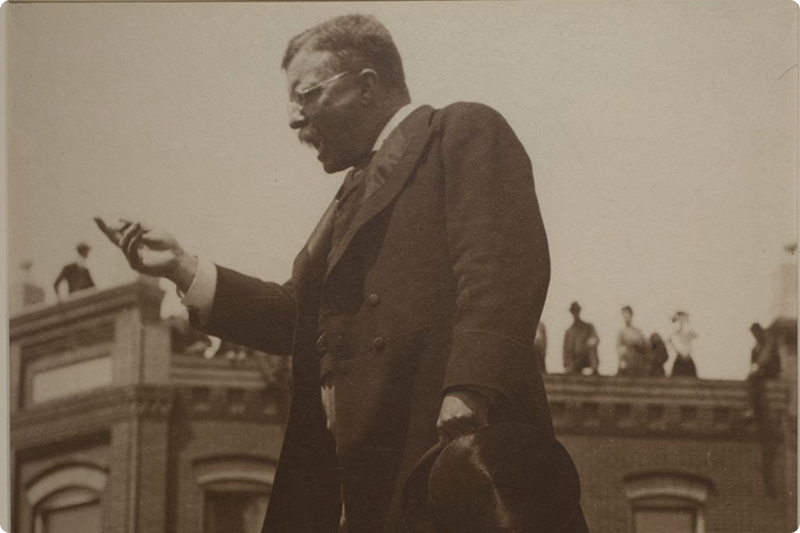
In response to one of President Taft’s speeches, Theodore Roosevelt comments on Taft’s campaign during the Presidential Election of 1912.
Roosevelt wrote these words in his Autobiography in 1913. Although he was as ambitious as any man in American history, Roosevelt had a keen sense of timing, understood that one must be willing to leave the public stage before the public grew tired of him, and worried always lest he stay too long in the arena.
Theodore Roosevelt expressed this sentiment in many places, this time in a speech to the farmers of Maine.
Theodore Roosevelt speaks on civic responsibility in The Strenuous Life, a speech delivered before the Hamilton Club, in 1899.
Roosevelt wrote these words to his friend William Sturgis Bigelow on March 29, 1898. He was justifying his rather rash decision to resign as the Assistant Secretary of the Navy to lead a group of volunteer cavalrymen to war in Cuba. One of Roosevelt’s most important leadership principles was never to ask another to do what he would not do himself.
Seasons greetings letter sent from Theodore Roosevelt to Edward Hale.
Theodore Roosevelt always supported the military, particularly during the first world war. He had cause to be particularly proud of the troops of that war as all four of his sons were included.
Theodore Roosevelt believes a nation must be strong to preserve friendships and respect. He would like the United States and Great Britain to have a “peculiarly close degree of friendship.” Roosevelt is currently out of sympathy with the American public and commands little support.
Theodore Roosevelt’s belief in a strong military presence was emphasized in his address to the Naval War College in 1897.
Theodore Roosevelt took pride in his nation and felt that the history of the United States helped shape the possibilities for its future as is evidenced in this statement from his book, American Ideals.
Theodore Roosevelt expressed this sentiment about political parties in the speech he gave when accepting the Republican nomination for president in 1904.
While most music left him unmoved, poetry could uniquely touch Theodore Roosevelt. He provided financial support to more than one struggling poet in part because he believed in the power of poetic imagery to keep a nation’s sights fixed on lofty ideals.
Roosevelt to Lady Delamere, March 7, 1911, two years after he left the presidency. By his own definition, in his post-presidential years he sometimes played the fool.
Roosevelt was himself a boxer, a pugilist, but he had nothing but disdain for the prize fighting of his day. He wrote these words in the North American Review in August 1890. He believed in amateur rather than professional sports.
Roosevelt wrote these in his 1885 Hunting Trips of a Ranchman. Although he was eager to establish himself as an “authentic cowboy,” Roosevelt understood the important distinction between cow hands and ranchers. As usual, he found a way to write his love of books into this idyllic portrait of life on the Dakota frontier.
Theodore Roosevelt writes on the keys to success which for him include Courage, Honesty and Common Sense. He then goes on to discuss the paths a man can take to success.
Strong men and women of character were admired by Theodore Roosevelt, and he believed that these people should not only be respected by others, but also should respect themselves.
Excerpt from Theodore Roosevelt’s book, “The Strenuous Life.”
Excerpt, letter to Secretary of the Navy Charles J. Bonaparte, February 17, 1906.
Theodore Roosevelt included these words in his Sixth Annual Message to Congress, December 3, 1906. This was one of Roosevelt’s principles that most people find difficult to adopt.