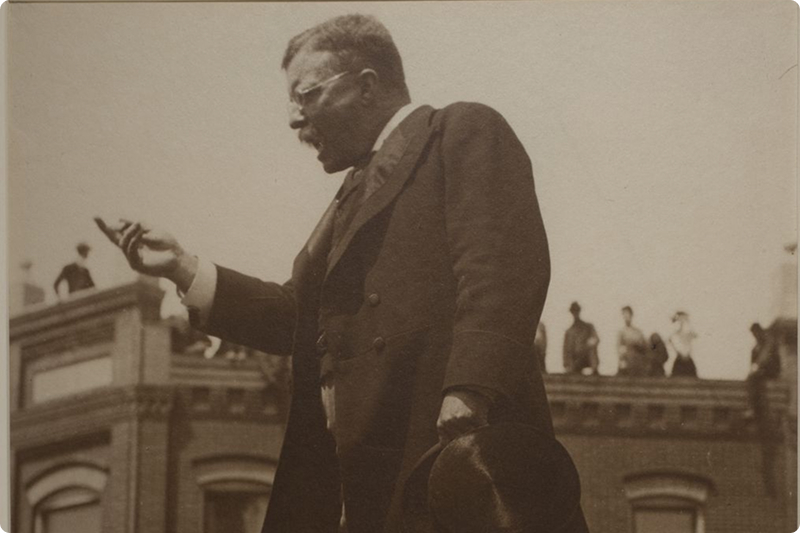
The following is a list of quotations attributed to Theodore Roosevelt. Where a source can be verified, it is noted below along with a brief explanation of the setting or the context for that quote. This list includes a number of quotations for which a source has not been verified in Theodore Roosevelt's writings. The context for many of the quotes included here reflects research that has been conducted throughout the years by curators of the Theodore Roosevelt Collection at Harvard University, which is presented here through a cooperation between Harvard College Library and the Theodore Roosevelt Center. Quotations will be added to this list as staff at both institutions continue their research.
… am very sorry that the right Dante was not sent you. I shall have another search made at once, and if nothing comes of it, I will look after the matter personally as soon as I return to Washington.
When the wrong book was returned to the Cleveland family, Theodore Roosevelt naturally made the search for the right book a presidential priority.
… but there is nothing easier than to belittle the great men of the past by dwelling only on the points where they come short of the universally recognized standards of the present. Men must be judged with reference to the age in which they dwell, and the work they have to do.
… they are to be rangers in fact and not in name, and no excuse will be tolerated for inability to perform the rigorous bodily work of the position any more than lack of courage and honesty would be excused.
Roosevelt describes the type of men who should work in the Forest Reserve in a January 1902 letter to Ethan Allen Hitchcock. Roosevelt wants supervisors in the Forest Reserve to have the authority to select their own employees and would like this system tested by Captain Bullock of the Black Hills reserve in South Dakota and Wyoming.
…a policy of words unbacked by deeds is considerably worse than useless.
Theodore Roosevelt informs Professor J. W. Jenke of Cornell University that he cannot give the expression of opinion regarding the Chinese Republic that Jenke requests nor does he have influence with the current Administration. Roosevelt feels that “a policy of words unbacked by deeds is considerably worse than useless.”
…Abraham Lincoln was a genius, who wrote as only one of the world’s rare geniuses do write, and I am a commonplace man, with energy and a sincere desire to help matters along, with whom writing is really a matter of painful effort. I only wish I could make my pieces shorter and better.
In a letter to author Ethan Allen White, Theodore Roosevelt expresses his appreciation for the criticism of his recent writing and discusses his own struggles to express himself in words.
…Americanism is a matter neither of birthplace or national descent, but of the soul and of the spirit.
Theodore Roosevelt believed in the importance of the American spirit and often spoke about what it means to be an American as portrayed in this open letter to Judge Olson that was written in 1916.
…and a goodly number of the Senators even of my own party have shown about as much backbone as so many angle worms.
President Roosevelt updates his son Theodore Roosevelt on the family. Roosevelt is disgusted by the poor performance of the Harvard football team. The trouble with Panama and Colombia has given President Roosevelt “an idea of the fearful times Lincoln must have had in dealing with the great crises he had to face.”
…and a special and peculiar debt of gratitude is owing to the men and women who are engaged in teaching, who are engaged in educating the body, mind and soul of the younger generation…
Remarks of President Roosevelt at Pocatello, Idaho, May 28, 1903.
…and especially in Texas, I was received with a warmth and heartiness that surprised me; while the Rough Riders’ reunion at San Antonio was delightful in every way.
All in a week’s work, President Roosevelt toured the Midwest, gave speeches, took part in hunting adventures, and met the Rough Riders for their 1905 reunion.
…and I ask two things in connection with our foreign policy — that we never wrong the weak and that we never flinch from the strong.
Theodore Roosevelt praises the work of Meriwether Lewis and William Clark, as well as the pioneers who came to “possess the land.” Roosevelt connects those accomplishments to what Navy battleships have done.
…and it is a very bad thing for every one if we make men feel that the same reward will come to those who shirk their work and those who do it.
Theodore Roosevelt delivered the speech entitled “Citizenship in a Republic” at the Sorbonne in Paris on April 23, 1910. The speech is popularly known as “The Man in the Arena.” His statements at the Sorbonne were part of a larger trip to Europe that also included visits to Vienna, Budapest, and Oslo.
…and there will be some fool who will say: “Well, yes, may be he is a little crooked; but he is ‘dreadful smart.'” That kind of praise speaks ill for the man praised and ill for the man who praises him. We cannot afford, as citizens of this republic, to tolerate the successful scoundrel any more than the unsuccessful scoundrel. Other nations with other forms of government may be able to get along after a fashion without the average citizen being straight and decent. We cannot.
Address of President Roosevelt at Boise, Idaho, May 28, 1903.
…as soon as a man ceases to improve, he goes backward.
Theodore Roosevelt wrote this in reference to advancement in the army in a letter to his son, Archie. Showing courage and valor in war was very important to Roosevelt, and Archie had just exhibited such qualities as to make his father very proud.
…do not make the mistake of thinking that any law, or any administration of the law, can take the place of the fundamental qualities that make a good individual citizens and make a good nation – the qualities of honestly of courage, and of common sense.
…do not mind if some little time every now and then passes without my writing; I think of you just the same
Roosevelt spent the spring months of 1886 at the Elkhorn ranch. At such a remote location, he told his sister not to worry if letters were few and far between.
…for a year and a quarter now I have never (even when hunting) gone to sleep or waked up without thinking of her; and I doubt if an hour has passed that I have not thought of her.
Diary entry from February 13, 1880, about his future wife, Alice Hathaway Lee.
…I am as brown and as tough as a pine knot and feel equal to anything.
Theodore Roosevelt relates the chase and capture of three thieves that had stolen his boat. The thieves were captured along the river and then Roosevelt took them overland to the sheriff in Dickinson, Dakota Territory.
…I am no longer a candidate and am free from the everlasting suspicion and ill natured judgment which being a candidate entails.
Not long after his inauguration in 1905, Theodore Roosevelt toured and hunted throughout many states. Free from the constraints of campaigning, Roosevelt enjoyed his trip thoroughly, even when he was speaking to crowds.
…I am out of doors most of the time, chopping, walking, rowing or riding – always with Edith.
Theodore Roosevelt believed in a physically vigorous existence. He mentioned doing all of these activities in the same sentence as the words “I am so out of condition,” in a letter to his sister.
…I cannot consent to take the position that the door of hope—the door of opportunity—is to be shut upon any man, no matter how worthy, purely upon grounds of race or color. Such an attitude would, according to my convictions, be fundamentally wrong.
Roosevelt made his position clear when he wrote these words to James Adger Smythe in November 1902 concerning the appointment of an African American man to a government position in South Carolina.
…I do not think that Mrs. Roosevelt could stand another pet in the house at present!
This excerpt is from a letter dated March 17, 1902 in which TR graciously declines Susan McFarland’s offer of a pet for the Roosevelt family. TR describes the home as “beginning to feel a little like a Zoo anyhow!”
…I fail to see…how any American can come [to Chattanooga] and see evidences of the mighty deeds done by the men who wore the blue and the men who wore the gray, and not go away a better American, prouder of the country, prouder because of the valor displayed on both sides in the contest—the valor, the self-devotion, the loyalty to the right as each side saw the right.
Theodore Roosevelt’s father had an important role in the Civil War as a member of the Sanitary Commission. He did not take up arms because his wife’s family was from Georgia. TR gave this address in Tennessee in 1902, to listeners who knew or who were Civil War veterans. It is more than conciliation or vote-getting. TR admired soldiers–his Confederate Bulloch uncles and his Union relatives, too.
…I have rather a horror of ex-Presidents traveling around with no real business, and thereby putting unfortunate potentates who think they ought to show courtesy to the United States in a position where they feel obliged to entertain the said ex-Presidents, no matter how great a hero any one of them may be.
Theodore Roosevelt left the country not long after the inauguration of William H. Taft. TR went on a year-long safari in Africa and then toured Europe. The former President was treated like an international celebrity as well as a kind of honorary American king. This letter was written to Britain’s Lord Curzon on August 18, 1908, before he left the United States for the safari.
…I see embodied the spirit upon which we have to rely to make our community great – the spirit of hard work, of self-reliant capacity each to shift for himself and yet of power to unite for the common benefit.
President Roosevelt speaks to a crowd in New Castle, thanking them for the greeting. He also thanks the Senators and Congressmen for cooperating with him in Washington. Roosevelt discusses the character of the citizens, the need for wise legislation, and the problem of irrigation.
…I speak French, I am sorry to say, as if it were a non-Aryan tongue, without tense or gender although with agglutinative vividness and fluency.
Theodore Roosevelt’s French language skills were tested during the events surrounding the 1911 funeral of England’s King Edward VII. He shared this assessment of his abilities in a confidential letter to his friend David Gray.
…if any friends of ours wish to commemorate us after death the way to do it is by some expression of good deeds to those who are still living.
Theodore Roosevelt is willing to support H. Holbrook Curtis’s project to build a hospital as a “protest against the erection of meaningless mausoleums and monuments to the dead.” For most people mausoleums mean nothing and Roosevelt thinks that the Society of Friends have the better custom of plain stone slabs for the dead. The best memorial for a worthy person must be doing good for the living.
…if, justly proud of our achievements, we failed to realize that we have plenty of shortcomings to remedy, that there was a terrible problem before us, which we must work out right, under the gravest national penalties if we fail.
From the essay, “The Two Americas.”
…in a strange land a man who cares for wild birds and wild beasts always sees and hears something that is new to him and interests him. In the dense tropical woods near Rio Janeiro I heard in late October–springtime, near the southern tropic–the songs of many birds that I could not identify.
Theodore Roosevelt acquaints himself with the wildlife of South America in Through the Brazilian Wilderness.
…in addition to courage and honesty we need the saving grace of common sense, for without that a man will make but scant headway in the world.
Address of President Roosevelt at Boise, Idaho, May 28, 1903.
…in the year these distinguished representatives of the French nation come here to be present at the unveiling of a monument to the gallantry of the French soldiers and sailors who fought for America in the Revolution, a picture of my action in Cuba by the brush of so eminent a painter as yourself should hang in the Salon.
Both France and the United States celebrated the Rochambeau Statue, to commemorate the past and strengthen the future of Franco-American relations. However, President Roosevelt had his own reason to celebrate, as he happily received proofs of the artist E. Jean Delahaye’s recent rendition of “The Battle of San Juan Hill.”
…it does not seem to me that it would be honorable for a man who has consistently advocated a warlike policy not to be willing himself to bear the brunt of carrying out that policy.
After advocating war with Spain, Theodore Roosevelt felt that he could hardly avoid going to the war.
…it is a dreadful thing to me to see us as a nation mishandling ourselves as we have been doing.
Theodore Roosevelt wrote this statement to his son Kermit in a letter dated January 27, 1915. Roosevelt had become disenchanted with the government at this time in his life.
…it is always true that while education is not all, without it we would not amount to much.
Theodore Roosevelt highlights that Westfield, Massachusetts, is home to the second oldest normal school in the country. Education is a cornerstone of the United States. Roosevelt mentions the public school system and the importance of education at home. Roosevelt closes with emphasizing the importance of courage, honesty, and common sense for good citizenship.
…it is by no means easy to combine honesty and efficiency; and yet it is absolutely necessary, in order to do any work really worth doing.
Theodore Roosevelt states these words in the preface to American Ideals, a collection of essays for the men who, like Roosevelt, work toward “raising the standard of public life.”
…it is of the greatest importance to develop all of your material resources; but the most important thing of all is to develop the right type of man and woman. That is what counts most. If you do not train up rightly the boy and girl of to-day, you will have a poor kind of man and woman to-morrow.
Address of President Roosevelt at Boise, Idaho, May 28, 1903.
…it is very jolly to get my books again. They made me completely happy this afternoon, taken in conjunction with my easy chair and a bright coal fire.
Theodore Roosevelt writes to his sister Anna saying he finally received the things he had asked to be sent from home. He enjoys his room very much but does not like the way the washerwoman does his cravats. He describes a dinner at the Thayer’s and is doing alright in his studies.
…it knows that common sense is essential above all other qualities to the idealist; for an idealist without common sense, without the capacity to work in hard, practical fashion for actual results, is merely a boat that is all sails, and with neither ballast nor rudder.
Theodore Roosevelt discusses the values and ideals of The Outlook magazine. Roosevelt explains exactly what makes this an exceptional publication to which he is happy to contribute.
…it seems to me that it is of enormously greater consequence to get men who have shown the power of command, the power of handling themselves and others in actual work, than it is to have good scholars. I know that, if I were to raise a brigade I should care very little indeed for the capacity of men as shown by any scholastic examination, while their proved ability in the field, or any place where they have commanded men, would weigh with me far more than anything else.
President Roosevelt would like to review the cases of two service members rejected for promotion. He is of the opinion too much emphasis is placed on their scholastic ability and their service and command records should be given more weight in determining promotions.
…it was a marvel to me to see how easily our mustangs scrambled over the frightful ground which we crossed, while trying to get up to the grassy plateaus, over which we could gallop.
When TR arrived in Dakota Territory to hunt buffalo in the fall of 1883, he was impressed by the hardiness and agility of the ponies he and his party rode over the rugged badlands.
…let us remember that words count only when they give expression to deeds or are to be translated into them.
Throughout his life, Theodore Roosevelt was known for taking action. In 1906, Roosevelt took action to arrange peace negotiations between Russia and Japan, the deed which earned him a Nobel Prize.
…Mother and in the curious and very pleasant position of having enjoyed the White House more than any other President and his wife whom I recall, and yet being entirely willing to leave it, and looking forward to a life of interest and happiness after we leave.
Towards the end of his second term as president, Roosevelt writes his son Kermit that he and Edith are looking forward to life beyond the White House.
…my head will not be turned by what I well know was a mainly accidental success.
Excerpt from a letter to Simon North, April 30, 1884.
…no man should be held excusable if he does not perform what he promises, unless for the best and most sufficient reason.
Excerpt, “Promise and Performance” in The Strenuous Life.
…of course when one does not do what one ought to, the excuse that one erred from thoughtlessness instead of wrong purpose is of small avail.
President Roosevelt realizes just how much his wife’s hospitality and thoughtfulness has made up for his own shortcomings and been a value to the whole family.
…only a third party will relieve the honest and far-sighted man of the necessity of voting either for the puppet of the machine Republicans or for the highly undesirable Democratic Party.
In this letter to Sir Horace Curzon Plunkett, Theodore Roosevelt defends his decision to bolt from the Republican Party in 1912. He truly believed that Taft was not right for the nation’s leadership.
…patriotism means service to the nation; and only those who render such service are fit to enjoy the privilege of citizenship.
Typed draft with handwritten edits of Theodore Roosevelt’s speech at the semi-centennial celebration of Nebraska’s statehood. Roosevelt recalls America’s two wars up to the present, the Revolutionary and the Civil Wars, and says that they were good for the country because they established liberties for its citizens. He warns that World War I is threatening those liberties due to pacifists and a lack of military preparation by the United States. He calls for loyalty to America from its immigrant population and for voluntary service in the military and aid organizations.
…probably next year all I can do is stand to one side as two parties, neither of which are fit to control the destinies of the Republic at this time, struggle for prominence.
After Roosevelt’s third party campaign for president and particularly after President Wilson’s refusal to declare war on Germany, TR became disenchanted with the two main political parties. While he did not believe the Progressive Party could win, he could not see how he could choose either the Republican or Democratic party to support in the 1916 election.
…she turns them out into the world so soft or ease-loving and work-shirking that they are about as well fit to hold their own as a hermit crab which has lost its shell.
To the un-shellfish parent, Roosevelt warns not to spare children too much discomfort in the face of hardship for fear that they may not learn strength and resilience.
…the greatest thought is robbed of an immense proportion of its value if expressed in a mean or obscure manner.
In Through the Brazilian Wilderness, Theodore Roosevelt discusses natural history often. He compares the written style of several naturalist authors, commending Darwin and Huxley for writing in “good English.”
…The last two days I have been alone, as Sewall and Dow went on with boats down stream, while I took the prisoners on to here overland; and I was glad enough to give them up to the Sheriff this morning, for I was pretty well done out with the work, the lack of sleep and the strain of the constant watchfulness, but I am as brown and as tough as a pine knot and feel equal to anything.
Roosevelt wrote these words to his sister, Corinne, from Dickinson, Dakota Territory, on April 12, 1886. When three ruffians stole his boat at the Elkhorn Ranch, TR had a makeshift boat built and he hunted the thieves down. He wrote this important account of the adventure on the day he deposited the thieves at the Sheriff’s office in Dickinson.
…the man who has the power to act is to be judged not by his words but by his acts–by his words in so far as they agree with his acts.
Theodore Roosevelt was a believer in the strenuous life. As a proponent of this type of life, Roosevelt believed that people’s actions were more revealing than their words. He spoke these words in Christiana, Norway, in May 1910.
…the most important type of conservation is the conservation of the manhood and womanhood of the country…
Theodore Roosevelt believed that being of good character and raising your children to be of good character is of vital importance for the future of the nation.
…the most important type of conservation is the conservation of the manhood and womanhood of the country…
Theodore Roosevelt believed that being of good character and raising your children to be of good character is of vital importance for the future of the nation.
…the one absolutely essential quality which we must bring to every problem and to every deed and without which true success is impossible, is intense Americanism – to be American in heart, in soul, in spirit, and in purpose.
President Roosevelt sends on a patriotic message as he declines the invitation to attend an address about civic patriotism to be given by the President of Princeton University, Woodrow Wilson, on December 3, 1903.
…the people who wish to work for decent politics must work practically, and yet must not swerve from their devotion to a high ideal. They must actually do things, and not merely confine themselves to criticising (sic) those that do them.
In this speech titled “True Americanism,” Theodore Roosevelt describes what is required to be a politically responsible American.
…then carry Alice down to breakfast pig-a-back. The last exercise has got Alice into the custom of invoking me, with unintentional reverence, as ‘now, pig!’
Young Alice learned to hitch a ride with her father, Theodore Roosevelt, as he made his morning rounds to the nursery and down to breakfast.
…there are grave signs of deterioration in the English speaking peoples, here and there; not merely in the evident lack of fighting edge in the British soldier, but in the diminishing birthrate here and in English Canada as well as in Australia; in the urban growth; in the love of luxury, and the turning of sport into a craze by the upper classes.
Theodore Roosevelt was deeply concerned over what he considered the “deterioration” of the race. News about a war in South Africa sparked this particular expression of his concern in 1899.
…these men are not to be appointed for political reasons; that they are to be good plainsmen and mountain men, able to walk and ride and lie out at night, as any such first-class man must be able to do.
Early in his presidency, Theodore Roosevelt described the qualities he expected from the men chosen to range the Black Hills Forest Reserve.
…they evidently ignored such a trifling detail as the United States Constitution.
In a letter to Marcus Alonzo Hanna written during the Anthracite Coal Strike of 1902, Roosevelt expresses his vexation over the “hopeless attitude” and “rancor” of the operators and his inability to end the disagreement between the operators and the miners.
…they say a stout, elderly President cannot afford to take chances!
This excerpt is from a letter dated May 3, 1902 to Margaret Cary, from whose father TR hoped to buy a horse that would be willing to jump higher than four feet. He notes that his current horse hesitates, and that while no harm has been done so far, he wants a horse that is more comfortable with jumping.
…to learn any thing from the past it is necessary to know, as near as may be, the exact truth.
In the preface to The Naval War of 1812, Theodore Roosevelt discusses the objective of his first historical work, published less than 60 years after the war ended.
…to speak with a frankness which our timid friends would call brutal. I would regard a war with Spain from two standpoints: first, the advisability on the grounds both of humanity and self-interest of interfering on behalf of the Cubans, and of taking one more step toward the complete freeing of America from European dominion; second, the benefit done our people by giving them something to think of which isn’t material gain, and especially the benefit done our military forces by trying both the Navy and Army in actual practice. I should be very sorry not to see us make the experiment of trying to land, and therefore feed and clothe, an expeditionary force, if only for the sake of learning from our own blunders. I should hope that the force would have some fighting to do. It would be a great lesson, and we would profit much by it.
Roosevelt wrote these words to William Wirt Kimball on November 19, 1897. He soon enough got his war, declared by the United States on April 25, 1898.
…unless we are Americans and nothing else, we are not a nation at all–
Theodore Roosevelt expressed this sentiment in a letter to the Congress of Constructive Patriotism, which was held by the National Security League in Washington on January 25, 26, and 27, 1917. This congress met to promote national spirit.
…vitally important though it is to leave our children a proper heritage, the one thing of supreme importance is that we shall leave the right type of children, children of such character and living their lives under such conditions that they shall be fit to enjoy and make use of their heritage.
While Theodore Roosevelt believed deeply in the conservation of our national resources, he also felt strongly that our most vital resource is our children.
…we all of us feel, most rightly and properly, that we belong to the greatest nation that has ever existed on the earth…
Theodore Roosevelt took great pride in being an American, and he showed that pride in many of his speeches and writings throughout his life. This statement is taken from the speech he gave on Independence Day 1886 in Dickinson, Dakota Territory.
…we began the descent of these sinister rapids of the chasm. Colonel Rondon had gone to the summit of the mountain in order to find a better trail for the burden-bearers, but it was hopeless, and they had to go along the face of the cliffs. Such an exploring expedition as that in which we were engaged of necessity involves hard and dangerous labor, and perils of many kinds.
The Roosevelt-Rondon Expedition faced several perilous portages, during April of 1914. Roosevelt’s account is published in Through the Brazilian Wilderness.
…we had some beautiful singing in which I did not join, remembering the remark of a friend, that I resembled a cormorant in one other particular beside my appetite; viz, my voice.
This statement, which suggests that Theodore Roosevelt was not much of a singer, was included in an 1876 letter to his sister Anna.
…we must equally avoid the errors of the bigotry that persecutes in the name of religion, and of the equally dangerous bigotry that persecutes religion in the name of freedom.
Theodore Roosevelt saw the pitfalls that could occur from both extremes of the question of religion and the state. People have long been aware of the dangers of persecution in the name of religion, but the second problem to which Roosevelt refers is a very real danger that is often overlooked. Persecuting religion in the name of freedom is not giving people religious freedom.
…we ought to agree to arbitrate everything because it is highly probable that we shall not be asked to arbitrate the numerous questions we should refuse to arbitrate. This is merely begging the question, and it is the kind of thing that leads to National dishonesty.
Theodore Roosevelt wrote these words in a letter to Henry Cabot Lodge on September 12, 1911. He is referring to his frustration with his colleagues at the Outlook because of their “unutterably silly” views on the international arbitration treaties.
…when I am fighting to help the poor man, I am also upholding the cause of the rich man, for this country will not permanently be a good place for any man to live in unless it is a good place for all men to live in.
Theodore Roosevelt wrote these words just days before the Republican National Convention of 1912.
…you cannot for a moment forget that you are worthless unless you make yourselves count in the world; also, if you make yourselves count for evil, you are not merely worthless, you are worse than worthless.
These strong words are included in Theodore Roosevelt’s essay “The Key to Success in Life.”
…you will remember that in the war with Spain our regiment was raised, armed, equipped, mounted, dismounted, drilled, kept two week on transports, and put through two victorian aggressive fights in which it lost nearly a quarter of the men engaged, and over one-third of the officers, a loss greater than that suffered by any but two of the twenty-four regular regiments in the same army corps; and all this within sixty days.
Theodore Roosevelt recounts the history of the Rough Riders in a letter to President Taft and offers to gather a similar regiment, if needed.
“On the one hand I wish by my action to avoid stirring up any bitterness; on the other hand, I must not act in a cowardly manner and make the apostles of lawlessness and of brutal disregard of the rights of the black man feel encouraged in their indignity. As always in life, I have to face conditions, not as I would like to have them, but as they actually are, and every course I take is beset with difficulties.”
In this September 14, 1904 letter to John Byrne , Roosevelt talks about factors in his decision making regarding his refusal to accept Indianola, Mississippi postmistress Minnie Geddings Cox’s resignation the year prior, which had become known as the Indianola Affair. Cox, Mississippi’s first African American postmistress, was treated with violence and threats by local whites unhappy with her position of prominence. When they voted for her removal from office, Roosevelt ordered the mail to the town to be stopped until they allowed Cox back into her position.
“Speak softly and carry a big stick—you will go far.” If a man continually blusters, if he lacks civility, a big stick will not save him from trouble; and neither will speaking softly avail, if back of the softness there does not lie strength, power. In private life there are few things more obnoxious than the man who is always loudly boasting; and if the boaster is not prepared to back up his words his position becomes absolutely contemptible. So it is with the nation. It is both foolish and undignified to indulge in undue self-glorification, and above all, in loose-tongued denunciation of other peoples.
Roosevelt uttered these words at the Minnesota State Fair on September 2, 1901. He could not know that two weeks later he would be the president of the United States. The African proverb “Speak softly…” was one of his favorite utterances.
[A]ll the laws that the wit of man can devise will never make a man a worthy citizen unless he has within himself the right stuff, unless he has self-reliance, energy, courage, the power of insisting on his own rights and the sympathy that makes him regardful of the rights of others.
This line from Theodore Roosevelt’s autobiography is a good summation of his life’s philosophy.
[An] enormous damage, [an] incredible damage, is done to the public, by completely misinforming them as to the character of the decent public servant, and also misinforming them as to the character of that man in public life who is an unworthy public servant.
President Roosevelt railed against libelous newspaper reporting, and decried especially the harm it did to the American public because a democracy depends upon an educated citizenry—not upon voters deliberately misled by the press.
[F]or unflagging interest and enjoyment, a household of children, if things go reasonably well, certainly makes all other forms of success and achievement lose their importance by comparison.
Children–his own and others–were the delight of Theodore Roosevelt’s life. He made this statement in Chapter IX of his Autobiography, which was first published in 1913.
[I]n the long run, in the great battle of life, no brilliancy of intellect, no perfection of bodily development, will count when weighed in the balance against that assemblage of virtues, active and passive, of moral qualities, which we group together under the name of character….
Theodore Roosevelt wrote this in 1900, after he had been shaped by his wartime experiences but before he entered the presidency. It was another restatement of what he believed to be the most important determinant for success in life: a moral character.
[O]fficers and men shook hands and said goodbye to each other, and then they scattered to their homes in the North and the South, the few going back to the great cities of the East, the many turning again toward the plains, the mountains, and the deserts of the West and the strange Southwest. This was on September 15th, the day which marked the close of the four months’ life of a regiment of as gallant fighters as ever wore the United States uniform.
In this way Theodore Roosevelt described the disbanding of the Rough Riders after the successful outcome of the Spanish-American War in 1898. Roosevelt led his men into battle in Cuba, and his experiences there contributed to his fame as they helped to launch his national political career. The Rough Riders were disbanded on this date in 1898.
[S]ocial consciousness is the only effective antidote to the class consciousness of the Socialist.
Theodore Roosevelt believed that the Socialist Party in the U.S. was attempting to base itself upon “class consciousness,” which he worried about, but felt would be doomed to failure in this democratic republic.
[S]trength should go hand in hand with courtesy, with scrupulous regard in word and deed, not only for the rights, but for the feelings, of other countries.
Theodore Roosevelt made this assertion on the necessity of balancing a global foreign presence with the responsibilities of international power in a speech in 1903.
[T]he great development of industrialism means that there must be an increase in the supervision exercised by the Government over business-enterprise.
President Roosevelt lectured Philadelphians with this message, but his real audience was Congress. In January 1905, Roosevelt locked horns with stand-pat Republicans who believed Congress should pass appropriations bills and assist businesses. Roosevelt sought firm federal oversight of industries he felt harmed the American people.
[T]he one certain way to invite disaster is to be opulent, offensive, and unarmed.
As the European powers were tumbling into World War I, Theodore Roosevelt was an early advocate of “preparedness.” He believed that the U.S. had to be ready with sufficient material and well-trained men should the country be swept onto the battlefields across the Atlantic. In speeches and articles, he warned Americans and harried President Wilson and Congress about the virtues of preparedness.
[T]here is a growing determination that no man shall amass a great fortune by special privilege, by chicanery and wrong-doing, so far as it is in the power of legislation to prevent; and that a fortune, however amassed, shall not have a business use that is antisocial.
President Theodore Roosevelt spoke these words in 1907. By “antisocial” he meant opposed to the general welfare of Americans as a whole.
[The Boy Scout movement] has already done much good, and it will do far more, for it is in its essence a practical scheme through which to impart a proper standard of ethical conduct, proper standards of fair play and consideration for others, and courage and decency….
The Boy Scouts of America (BSA) began in 1910, after Theodore Roosevelt’s presidential term expired. Nonetheless, Roosevelt so believed in the mission of Boy Scouting that he served as honorary vice president of the Boy Scouts and is the only man ever to have been known as Chief Scout Citizen. This quote is from a 1911 letter to BSA Chief Scout Executive James E. West.
[The historian] must ever remember that while the worst offense of which he can be guilty is to write vividly and inaccurately, yet that unless he writes vividly he cannot write truthfully; for no amount of dull, painstaking detail will sum up the whole truth unless the genius is there to paint the whole truth.
Theodore Roosevelt delivered this advice to professional historians in 1912 at the national gathering of the American Historical Association. Roosevelt wrote just the kind of vivid historical prose he advocated here.
[W]e are stirred to awe and wonder and devotion for [Abraham Lincoln,] the great man who, in strength and sorrow bore the people’s burdens through the four years of our direst need, and then, standing as high priest between the horns of the altar, poured out his own lifeblood for the Nation whose life he had saved.
Of all the presidents who preceded him, Theodore Roosevelt admired Lincoln the most. This is one of many such paeans TR penned. On this occasion, Roosevelt had been inspired by the unveiling of a statue of Lincoln created by Augustus Saint-Gaudens in December 1908.
[W]hen men are thus entirely loyal to this country it is an outrage to discriminate, or permit discrimination against them, because of where their fathers or they themselves were born.
During World War I, many cases of terrible discrimination against Americans of German descent occurred, and this distressed Theodore Roosevelt mightily. This quote came from a public statement he made in opposition to one such act by vigilantes.
A book must be interesting to the particular reader at that particular time. But there are tens of thousands of interesting books, and some of them are sealed to some men and some are sealed to others; and some stir the soul at some given point of a man’s life and yet convey no message at other times. The reader, the booklover, must meet his own needs without paying too much attention to what his neighbors say those needs should be. He must not hypocritically pretend to like what he does not like. Yet at the same time he must avoid that most unpleasant of all the indications of puffed-up vanity which consists in treating mere individual, and perhaps unfortunate, idiosyncrasy as a matter of pride.
Roosevelt wrote these words in his 1913 Autobiography. He loved books, and wrote about his reading habits with considerable frequency. His works and letters contain more reference to his reading habits than those of any other president.
A finer body of men has never been gathered by any nation than the men who have done the work of building the Panama Canal; the conditions under which they have lived and have done their work have been better than in any similar work ever undertaken in the tropics; they have all felt an eager pride in their work; and they have made not only America but the whole world their debtors by what they have accomplished.
In Theodore Roosevelt’s Autobiography, he emphasizes the international significance of the Panama Canal and thanks those men whose strenuous work has made the canal possible.
A flatterer is not a good companion for any man; and the public man who rises only by flattering his constituents is just as unsafe a companion for them.
This piece of wisdom from Theodore Roosevelt was written in 1911, as he was contemplating his political future in regards to the presidential race in 1912.
A foolish optimist is only less noxious that an utter pessimist.
Law of Civilization and Decay
A great democracy has got to be progressive, or it will soon cease to be either great or a democracy …
The Nation and the States, speech before the Colorado Legislature, August 29, 1910
A great many young fellows have an idea that the life of a ranchman, from its very hardships and risks, must have a certain romantic attraction to it…but the romance evaporates after a couple of months spent in a muddy dugout with no amusements whatsoever, and on a steady diet of rancid bacon, sodden biscuits and alkali water.
Excerpt from a piece Theodore Roosevelt wrote for Harper’s Weekly in January 1886.
A great university like this has two especial functions. The first is to produce a small number of scholars of the highest rank, a small number of men who, in science and literature, or in art, will do productive work of the first class. The second is to send out into the world a very large number of men who never could achieve, and who ought not to try to achieve, such a position in the field of scholarship, but whose energies are to be felt in every other form of activity; and who should go out from our doors with the balanced development of body, of mind, and above all of character, which shall fit them to do work both honorable and efficient.
Roosevelt spoke these words at his alma mater, Harvard, on June 28, 1905. The former undergraduate was now the President of the United States. Although he could easily have become a scholar of the first rank, had he chosen that path, undoubtedly he regarded himself as a strenuous exemplar of the second type of Harvard graduate.
A heavily progressive inheritance tax–national and (heavy) only on really great fortunes going to single individuals–would be far preferable to a national income tax.
Excerpt, letter to Henry Cabot Lodge and Anna Lodge, September 10, 1909.
A heavy moral obligation rests upon the man of means and upon the man of education to do their full duty by their country. On no class does this obligation rest more heavily than upon the men with a collegiate education, the men who are graduates of our universities. Their education gives them no right to feel the least superiority over any of their fellow citizens; but it certainly ought to make them feel that they should stand foremost in the honorable effort to serve the public.
During Roosevelt’s lifetime only a small percentage of Americans received a college education. Roosevelt graduated with honors from Harvard College in 1880. All of his life, Roosevelt subscribed to the principle that from those to whom much has been given, much will be expected.
A hunter should not refrain from comfort of a wholesome sort when it is obtainable.
While Theodore Roosevelt enjoyed roughing it, in his book, Outdoor Pastimes of an American Hunter, he talks about how welcome little luxuries were when hunting with a wagon, from a change of clothes to tents to reading material.
A large number of young men from the cities and from the country districts of the East have recently taken to ranching. Many apparently think that this is a business needing no especial skill or training on the part of those who take it up. A greater mistake could not be made. All over the plains there are now plenty of skilled cowhands—men who have been all their lives in the saddle, and who know every trait of the cattle they have to guard, and every phase of the wild life of the wilderness. An outsider, to compete with these men, must not only be naturally well fitted for the life, but he must also spend at least two years in downright hard drudgery learning the business. A great many young fellows—including, by the way, quite a fair proportion of clergymen’s sons—have an idea that the life of a ranchman, from its very hardships and risks, must have a certain romantic attraction to it. So it has; but it is wonderful; how the romance evaporates for many of these same young fellows after a couple of months spent in a muddy dug-out, with no amusements whatever, and on a steady diet of rancid bacon, sodden biscuits, and alkali water.
Roosevelt wrote this passage in an article in Harper’s Weekly in 1886, just as he was finding his stride as a Dakota cowboy and rancher. There is a certain defensiveness in his tone: he was, after all, a privileged young man from the East who found the hardships of ranch life romantic.
A lie is no more to be excused in politics than out of politics.
Theodore Roosevelt never held a politician to a different standard than any other citizen.
A long experience in politics has taught me that one must never dismiss any accusations as impossible of verification, because both in public life as in private life a man of the very highest repute will occasionally go wrong.
Excerpt from a letter from Theodore Roosevelt to Ray Stannard Baker written on July 4, 1903. Roosevelt also knows the danger of the “utterly baseless” gossip along the frontier.
A man can be freed from the necessity of work only by the fact that he or his fathers before him have worked to good purpose.
Theodore Roosevelt defined the values of the “strenuous life” in his famous speech before the Hamilton Club, April 10, 1899.
A man is of no use whatever on a cattle ranch, on the contrary he is a source of expense and trouble, unless he is a first-class rider and knows the West.
Through correspondence with Anna, Mrs. Monson has requested a ranch to which she can send her boy. President Roosevelt responds, explaining that a cattle ranch is not a good place for an untrained eastern boy with some “temptation to drink.”
A man is worthless unless he has in him a lofty devotion to an ideal, and he is worthless also unless he strives to realize this ideal by practical methods.
Roosevelt wrote these words in the Outlook on July 28, 1900. The politician Roosevelt believed that he would be respected even by those who disagreed with his policies if he were true to his word, if he said what he intended to do and then did what he said.
A man must think well before he marries. He must be a tender and considerate husband and realize that there is no other human being to whom he owes so much of love and regard and consideration as he does to the woman who with pain bears and with labor rears the children that are his.
Theodore Roosevelt considered himself an extraordinarily fortunate man to have had a worthy life partner in Edith Kermit Carow Roosevelt. Theirs was a loving marriage which survived the stresses of the presidency intact.
A man of very strong feelings and convictions in political life is almost sure to make an even larger number of violent enemies than of attached friends.
Theodore Roosevelt is proud that his sons, and hopefully grandsons, have attended Groton School. However, he cannot make a speech at this time as he is out of touch with public opinion and doubts he can do any good. Roosevelt’s schedule is also filled with “enormous correspondence and innumerable demands.” He’s also gradually getting over the health impact of his Brazilian trip.
A man who has taken an active part in the political life of a great city possesses an incalculable advantage over his fellow-citizens who have not so taken part, because normally he has more understanding than they can possibly have of the attitude of mind, the passions, prejudices, hopes, and animosities of his fellow-citizens, with whom he would not ordinarily be brought into business or social contact.
The Roosevelt family placed a premium on duty, especially civic duty. Roosevelt learned early in his career in the New York Assembly that those who were the least like him could teach him the most. This quote is from his January 1900 Century magazine article “Fellow-Feeling as a Political Factor.”
A man who means well, but who only means well feebly, rarely stands the strain of serious temptation.
In response to one of President Taft’s speeches, Theodore Roosevelt comments on Taft’s campaign during the Presidential Election of 1912.
A man who stays long in our American political life, if he has in his soul the generous desire to do effective service for great causes, inevitably grows to regard himself merely as one of many instruments, all of which it may be necessary to use, one at one time, one at another, in achieving the triumph of those causes; and whenever the usefulness of any one has been exhausted, it is to be thrown aside. If such a man is wise, he will gladly do the thing that is next, when the time and the need come together, without asking what the future holds for him. Let the half-god play his part well and manfully, and then be content to draw aside when the god appears.
Roosevelt wrote these words in his Autobiography in 1913. Although he was as ambitious as any man in American history, Roosevelt had a keen sense of timing, understood that one must be willing to leave the public stage before the public grew tired of him, and worried always lest he stay too long in the arena.
A man, to be a good citizen, must first be a good breadwinner, a good husband, a good father…
Theodore Roosevelt expressed this sentiment in many places, this time in a speech to the farmers of Maine.
A man’s first duty is to his own home, but he is not thereby excused from doing his duty to the State; for if he fails in this second duty it is under the penalty of ceasing to be a freeman.
Theodore Roosevelt speaks on civic responsibility in The Strenuous Life, a speech delivered before the Hamilton Club, in 1899.
A man’s usefulness depends upon his living up to his ideals in so far as he can. Now, I have consistently preached what our opponents are pleased to call “jingo doctrines” for a good many years. One of the commonest taunts directed at men like myself is that we are armchair and parlor jingoes who wish to see others do what we only advocate doing. I care very little for such a taunt, except as it affects my usefulness, but I cannot afford to disregard the fact that my power for good, whatever it may be, would be gone if I didn’t try to live up to the doctrines I have tried to preach. Moreover, it seems to me that it would be a good deal more important from the standpoint of the nation as a whole that men like myself should go to war than that we should stay comfortably in offices at home and let others carry on the war that we have urged.
Roosevelt wrote these words to his friend William Sturgis Bigelow on March 29, 1898. He was justifying his rather rash decision to resign as the Assistant Secretary of the Navy to lead a group of volunteer cavalrymen to war in Cuba. One of Roosevelt’s most important leadership principles was never to ask another to do what he would not do himself.
A merry Christmas to you!
Seasons greetings letter sent from Theodore Roosevelt to Edward Hale.
A Merry Xmas to all the men of the American Army and Navy, at home and abroad, on sea and shore–to officers and enlisted men, regulars, national guards, national army, sailors, marines, all alike. They are the Americans of whom this Xmas all other Americans have most cause to feel proud.
Theodore Roosevelt always supported the military, particularly during the first world war. He had cause to be particularly proud of the troops of that war as all four of his sons were included.
A nation like an individual usually acts from complex motives.
Theodore Roosevelt believes a nation must be strong to preserve friendships and respect. He would like the United States and Great Britain to have a “peculiarly close degree of friendship.” Roosevelt is currently out of sympathy with the American public and commands little support.
A nation should never fight unless forced to; but it should always be ready to fight. The mere fact that it is ready will generally spare it the necessity of fighting.
Theodore Roosevelt’s belief in a strong military presence was emphasized in his address to the Naval War College in 1897.
A nation’s greatness lies in its possibility of achievement in the present, and nothing helps it more than the consciousness of achievement in the past.
Theodore Roosevelt took pride in his nation and felt that the history of the United States helped shape the possibilities for its future as is evidenced in this statement from his book, American Ideals.
A party fit to govern must have convictions.
Theodore Roosevelt expressed this sentiment about political parties in the speech he gave when accepting the Republican nomination for president in 1904.
A poet can do much more for his country than the proprietor of a nail factory.
While most music left him unmoved, poetry could uniquely touch Theodore Roosevelt. He provided financial support to more than one struggling poet in part because he believed in the power of poetic imagery to keep a nation’s sights fixed on lofty ideals.
A President has a great chance; his position is almost that of a king and a prime minister rolled into one; once he has left office he cannot do very much; and he is a fool if he fails to realize it all and to be profoundly thankful for having had the great chance.
Roosevelt to Lady Delamere, March 7, 1911, two years after he left the presidency. By his own definition, in his post-presidential years he sometimes played the fool.
A prize-fight is simply brutal and degrading. The people who attend it, and make a hero of the prize-fighter, are–excepting boys who go for fun and don’t know any better–to a very great extent, men who hover on the borderline of criminality; and those who are not are speedily brutalized, and are never rendered more manly. They form as ignoble a body as do the kindred frequenters of rat-pit and cock-pit.
Roosevelt was himself a boxer, a pugilist, but he had nothing but disdain for the prize fighting of his day. He wrote these words in the North American Review in August 1890. He believed in amateur rather than professional sports.
A ranchman’s work is, of course, free from much of the sameness attendant upon that of a mere cowboy. One day he will ride out with his men among the cattle, or after strayed horses; the next he may hunt, so as to keep the ranch in meat; then he can make the tour of his outlying camps; or, again, may join one of the round-ups for a week or two, perhaps keeping with it the entire time it is working. On occasions he will have a good deal of spare time on his hands, which, if he chooses, he can spend in reading or writing. If he cares for books, there will be many a worn volume in the primitive little sitting-room, with its log walls and huge fireplace; but after a hard day’s work a man will not read much, but will rock to and fro in the flickering firelight, talking sleepily over his success in the day’s chase and the difficulty he has had with the cattle; or else may simply lie stretched at full length on elkhides and wolfskins in front of the hearthstone, listening in drowsy silence to the roar and crackle of the blazing logs and to the moaning of the wind outside.
Roosevelt wrote these in his 1885 Hunting Trips of a Ranchman. Although he was eager to establish himself as an “authentic cowboy,” Roosevelt understood the important distinction between cow hands and ranchers. As usual, he found a way to write his love of books into this idyllic portrait of life on the Dakota frontier.
A republic can prosper, although the average man is not intellectually brilliant. But it cannot prosper if the average man becomes infirm of mind and soul, if he fears hard work and cares only for the easy avoidance of whatever is rough or unpleasant; or if, although of masterful temperament, he seeks to rise in ways that represent unscrupulous wrong to his weaker and less fortunate fellows.
Theodore Roosevelt writes on the keys to success which for him include Courage, Honesty and Common Sense. He then goes on to discuss the paths a man can take to success.
A self respecting man must insist on his rights; otherwise he neither deserves nor receives the respect of others.
Strong men and women of character were admired by Theodore Roosevelt, and he believed that these people should not only be respected by others, but also should respect themselves.
A sentiment that is easy and natural is far better than one which has to be artificially stimulated.
Excerpt from Theodore Roosevelt’s book, “The Strenuous Life.”
A soldier’s whole life is one continuous, and unceasing battle, and there is no reason why why his responsibilities should vary with the state of the times.
Excerpt, letter to Secretary of the Navy Charles J. Bonaparte, February 17, 1906.
A strong and wise people will study its own failures no less than its triumphs, for there is wisdom to be learned from the study of both, of the mistake as well as of the success.
Theodore Roosevelt included these words in his Sixth Annual Message to Congress, December 3, 1906. This was one of Roosevelt’s principles that most people find difficult to adopt.
About all I would say of myself is that compared with other Presidents, Prime Ministers and the like, I did some work worth doing!
Near the end of his life, while looking back over his work as a conservationist, Theodore Roosevelt felt that at least he had dome some good for the environment while he was president. He did not compare this work to that of other conservationists; rather, he ranked himself with other world leaders.
Above all, I wish to see that farmers develop their strength by co-operation so that the elemental work of the soil will resume its ancient importance among us.
Theodore Roosevelt encourages the people of Baltimore to subscribe to the Fourth Liberty Loan in order to aid the war effort. Roosevelt also advocates for young men to sign up to fight and for everyone to help the war effort in every way they can in order to support American democracy. His speech ends with the idea that universal suffrage can only be justified by universal service.
Above all, let us shrink from no strife, moral or physical, within or without the nation, provided we are certain that the strife is justified, for it is only through strife, through hard and dangerous endeavor, that we shall ultimately win the goal of true national greatness.
These words conclude Theodore Roosevelt’s Strenuous Life speech, April, 1899.
Above all, the administration of the Government, the enforcement of the laws, must be fair and honest.
Speaking at an exposition in South Carolina in 1902, Theodore Roosevelt expounded upon the need for honesty in the government as it began to exercise supervision and regulation throughout the nation.
According to the yearly custom of our people, it falls upon the President at this season to appoint a day of festival and thanksgiving to God. Over a century and a quarter has passed since this country took its place among the nations of the earth, and during that time we have had, on the whole, more to be thankful for than has fallen to the lot of any other people. Now, wherefore, I, Theodore Roosevelt, President of the United States, do hereby designate a day of general thanksgiving and do recommend that throughout the land the people cease from their ordinary occupations, and in their several homes and places of worship render thanks unto Almighty God for the manifold blessings of the past year.
Theodore Roosevelt gave these words to the people of the United States in his 1902 Thanksgiving proclamation.
After all the very highest and most fundamental work of good citizenship is to leave the next generation in right shape…
Theodore Roosevelt shares Charles Frisch’s pride in Frisch’s large family.
After all, fond as I am of the White House and much though I have appreciated these years in it, there isn’t any place in the world like home – like Sagamore Hill, where the things are our own, with our own associations, and where it is real country.
In a June 1906 letter to his daughter Ethel, Theodore Roosevelt expresses his love of home.
President Roosevelt speaks to a crowd at Redfield. He thanks them and the National Guard for greeting him and congratulates them on their prosperity in agriculture, stock raising, and the raising of “good citizens.”
After nightfall the face of the country seems to alter marvelously, and the clear moonlight only intensifies the change. The river gleams like running quicksilver, and the moonbeams play over the grassy stretches of the plateaus and glance off the wind-rippled blades as they would from water. The Bad Lands seem to be stranger and wilder than ever, the silvery rays turning the country into a kind of grim fairy-land. The grotesque, fantastic outlines of the higher cliffs stand out with startling clearness, while the lower buttes have become formless, misshapen masses, and the deep gorges are in black shadow; in the darkness there will be no sound but the rhythmic echo of the hoof-beats of the horses, and the steady, metallic clank of the steel bridle-chains.
Roosevelt wrote these words in his 1885 book Hunting Trips of a Ranchman. Partly because he was grieving for the death of his wife and mother, partly because he was fascinated by the western frontier, Roosevelt found the starkness of the badlands extremely compelling. He said once that the badlands reminded him somehow of the poetry of Edgar Allan Poe.
After one has been a conqueror it is never pleasing to have a second installment of one’s career as leader of a lost cause. On the other hand, I do most sincerely feel that there never was a cause so well worth fighting for as this cause of ours this year.
In a letter to his son, Kermit, Theodore Roosevelt revealed his disappointment at losing the presidential election of 1912. In light of his prior successes, it was difficult to accept this defeat.
After passing the last line of low, rounded scoria buttes, the horse stepped out on the border of the great, seemingly endless stretches of rolling or nearly level prairie, over which I had planned to travel and hunt for the next two or three days. Nowhere, not even at sea, does a man feel more lonely than when riding over the far-reaching, seemingly never-ending plains; and after a man has lived a little while on or near them, their very vastness and loneliness and their melancholy monotony have a strong fascination for him. The landscape seems always the same, and after the traveler has plodded on for miles and miles he gets to feel as if the distance was indeed boundless.
Roosevelt wrote these words in his 1885 book Hunting Trips of a Ranchman. He loved to ride out alone for long stretches, sometimes staying out several days on the endless prairie. Comparisons of the Great Plains and the world’s seas have been a standard feature of writing about the region.
Aggressive fighting for the right is the noblest sport the world affords.
This statement is often attributed to Theodore Roosevelt, but no known source can be found to verify the attribution.
Alas! I am getting to the end of the Pigskin Library! Of course I’ll begin re-reading the volumes at once; but for the Uganda and Nile trip I wish I had another case of books, all in pigskin too.
Of the volumes Theodore Roosevelt brought on safari, many had been rebound in pigskin to survive the elements of the hunting trip. Eight months into the African Safari, the “Pigskin Library” was read through and ready to repeat!
Alice, enjoying Ted’s appearance, announced a strong desire that she too might have her hair cut and wear trousers; also that she no longer desired twins (an unholy aspiration of hers, usually confided to a mixed company in Edith’s presence), but a monkey!
During a family visit described as sad, Theodore Roosevelt shares the spontaneous statements of his young children, Alice and Ted. He claims that “the children are what lighten it.”
Alike for the nation and the individual, the one indispensable requisite is character–character that does and dares as well as endures, character that is active in the performance of virtue no less than firm in the refusal to do aught that is vicious or degraded.
From Theodore Roosevelt’s article entitled “Character and Success,” published in the Outlook magazine on March 31, 1900.
All about us there are innumerable tendencies that tell for good, nd innumerable tendencies that tell for evil.
From the essay, “The Two Americas.”
All civilized Governments are now realizing that it is their duty here and there to preserve certain defined districts, with the wild things thereon, the destruction of which means the destruction of half the charm of wild nature.
Theodore Roosevelt applauds the English Government and the “wise people of Maine” for establishing game preserves, in African Game Trails
All civilized mankind have benefited immeasurably by the French conquest of Algiers, the English conquest of the Soudan, the Russian conquest of Turkestan; by our taking California and the Panama Zone. It would be a calamity at this time to have those conquests undone. It would on the other hand be a calamity to have Belgium, Holland and Switzerland absorbed by any power against their will.
Many of his contemporaries considered Theodore Roosevelt an imperialist, a view which was bolstered by statements such as this. This statement further suggests that Roosevelt believed in the racial superiority of people of Western European descent.
All for each, and each for all, is a good motto; but only on condition that each works with might and main to so maintain himself as not to be a burden to others.
Theodore Roosevelt wrote these words in the foreword of An Autobiography, published in 1913.
All great fundamental truths are apt to sound rather trite, and yet in spite of their triteness they need to be reiterated over and over again.
From, “Promise and Performance” in The Strenuous Life.
All I ask is a square deal for every man, give him a fair chance. Do not let him wrong any one, and do not let him be wronged.
Theodore Roosevelt encouraged hard work from the individual and the fairness of the Square Deal from society. He spoke these words at the Grand Canyon, in 1903.
All men in whose character there is not an element of hardened baseness must admit the need in our public life of those qualities which we somewhat vaguely group together when we speak of “reform,” and all men of sound mind must also admit the need of efficiency.
In Theodore Roosevelt’s opinion, reformers need to exemplify both of these qualities — the quality of striving after an ideal combined with the ability to utilize practical methods as he pointed out in his book, The Strenuous Life.
All of the agricultural improvements, all of the cultivation of the soil, all of the building up of cities and railroads, all the growth of commerce, all the growth of manufactures, will count for nothing if you have not got the right type of men and women in the future. It is upon that that ultimately the fate of the nation depends.
President Roosevelt addresses citizens of Ventura and marvels at the unity of the American people. He discusses his travels through the country and the agriculture of California, a state he describes as “west of the west.” He also thanks the teachers for “what they have done” and speaks of character building and citizenship.
All of this is so obvious that it ought not be necessary to dwell upon it. But our people are shortsighted and have short memories.
Excerpt from a letter to Philander C. Knox from February 8, 1909, about Roosevelt’s concerns about the situation in Japan, an increase of Japanese immigrants, and building naval power. Roosevelt is worried the public has a short term memory and forgets about the dangers ahead “the moment everything is smooth.”
All qualities, good and bad, are intensified and accentuated in the life of the wilderness.
In the Winning of the West, Theodore Roosevelt explains the extreme impact the wilderness can have on a person’scharacter. A mere slanderer becomes a robber and ” general belief in virtue is translated into a prompt and determined war upon vice.”
All that any law can do is to give a man a decent chance; and then he will have to work out his own fate for himself …
President Roosevelt greets a crowd in Tulare, S. D. He congratulates them on their prosperity, which he attributes to their character.
All that the wit of man can devise, all that the wit of man has devised, will not enable us, and never yet has enabled us, to pass in wisdom the Golden Rule.
Even in an era of innovation and constant change, such as the one in which Theodore Roosevelt lived, it behooves us all to remember that “there is nothing new under the sun.” He articulated this theme in a speech in Buenos Aires in 1913.
All the great masterful races have been fighting races, and the minute that a race loses the hard fighting virtues, then, no matter what else it may retain, no matter how skilled in commerce and finance, in science or art, it has lost its proud right to stand as the equal of the best.
The possession of a strong military was of utmost importance to Theodore Roosevelt. He expressed this theory many times as in this address to the Naval War College in 1897.
All through this country we are now enjoying a period of great prosperity. We can keep it or we can throw it away. I earnestly hope that you and I and those like us will remain firm in the determination so to handle ourselves that the prosperity which we have achieved will stay with us and will be used to good advantage.
Theodore Roosevelt praises the people of Kentucky. He hopes that the state will handle itself in such a way that prosperity is maintained.
All young men should take an active part in our political life and should do their full duty as citizens in the exercise of their rights of self-government; they should rank action far above criticism and should understand that he is deserving who actually does things and not he who confines himself to talking about how they ought to be done; they should have a high ideal and strive to realize it; they should show the virtues of uprightness and tolerance and gentleness but they should also show the sterner virtues of courage, resolution and hardihood and the desire to fight unceasingly against the existence of wrong.
President Roosevelt writes to Floyd Bartholomew expressing his feelings toward “active duties of citizenship” for young men and the organizations that help to “fit themselves for these duties”. President Roosevelt discusses the qualities all young men should strive to achieve as active citizens. He concludes by sending good wishes to the Young Men’s Congress banquet.
Although many men must share with the President the responsibility for different individual actions, and although Congress must of course also very largely condition his usefulness, yet the fact remains that in his hands is infinitely more power than in the hands of any other man in our country during the time that he holds the office; that there is upon him always a heavy burden of responsibility; and that in certain crises this burden may become so great as to bear down any but the strongest and bravest man.
Roosevelt wrote these words before he became the 26th president of the United States. Of course he regarded himself as just the sort of leader who could bear up under the giant strains of leadership, and he routinely felt that the other presidents of his time did less well.
Although not a very old man, I have yet lived a great deal in my life, and I have known sorrow too bitter and joy too keen to allow me to become either cast down or elated for more than a very brief period over success or defeat.
Roosevelt wrote these words in a letter to the editor of the Utica Morning Herald in June of 1884.
Altogether it was as fantastically beautiful a place as I have ever seen; it seemed impossible that the hand of man should not have had something to do with its formation. There was a spring of clear cold water a few hundred yards off, with good feed for the horses round it; and we made our camp at the foot of one of the largest buttes, building a roaring pinelog fire in an angle in the face of the cliff, while our beds were under the pine-trees. It was the time of the full moon, and the early part of the night was clear. The flame of the fire leaped up the side of the cliff, the red light bringing out into lurid and ghastly relief the bold corners and strange-looking escarpments of the rock, while against it the stiff limbs of the pines stood out like rigid bars of iron.
Roosevelt wrote these words in his 1885 book Hunting Trips of a Ranchman. He was describing a long hunting trip he made with two other men to the Big Horn Mountains on the border of Wyoming and Montana. Here they stopped to camp in the Medicine Buttes region near today’s Ekalaka, Montana.
Altogether there are few harder tasks than that of filling well and ably the office of President of the United States. The labor is immense, the ceaseless worry and harassing anxiety are beyond description.
Roosevelt wrote these words in 1900, before he became the 26th president of the United States. By all accounts, he found the presidency less oppressive and much more enjoyable than he had expected.
American boyhood should be resourceful and inventive so that the American man of the future may be ever ready to help in the hour of the nation’s need.
Excerpt from a letter to James E. West from February 10, 1911.
American politics are of a kaleidoscopic character. There is no use in looking ahead as regards one’s personal interests, though there is every use in shaping one’s career so as to conduct it along firmly settled great principles and policies.
Theodore Roosevelt concluded that, in a changing political environment, the most important thing was to serve in the most influential position possible. At the time, Roosevelt felt that serving as governor of New York was his most effective place in American politics. His peers felt the same way; that is why they set him up for the vice-presidency.
Americanism is a question of spirit, conviction, and purpose, not of creed or birthplace.
Theodore Roosevelt often spoke about Americanism as in this statement from his book, American Ideals. This statement comes from a discussion about immigrants.
Americanism means the virtues of courage, honor, justice, truth, sincerity, and hardihood–the virtues that made America.
Theodore Roosevelt had very distinct ideas about the meaning of Americanism, ideas which he expounded upon many times, including this letter written to the Congress of Constructive Patriotism on January 26, 1917.
An ardent young reformer is very apt to try to begin by reforming too much. He needs always to keep in mind that he has got to serve as sergeant before he assumes the duties of commander-in-chief. It is right for him from the beginning to take a great interest in national, State, and municipal affairs, and to try to make himself felt in them if the occasion arises; but the best work must be done by the citizen working in his own ward or district.
Roosevelt wrote these words in the Forum in July 1894, just as his great political career was getting started. One senses that he was providing advice for himself as much as for others and that he was already, at 36 years old, longing to be “commander-in-chief.”
An efficient world league for peace is as yet in the future; and it may be, although I sincerely hope not, in the far future.
Theodore Roosevelt wrote these words in 1915 as World War I raged across Europe. He had his own ideas about how to create an effective organization for international peace. It was similar to Woodrow Wilson’s League of Nations, but different enough that when Wilson announced it, Roosevelt could not support it.
And as a body all those connected with the education of our people are entitled to the heartiest praise from all lovers of their country, because as a body they are devoting heart and soul to the welfare of those under them.
Theodore Roosevelt praises the development of the education system. He states that the stability of institutions depends on the development of its citizens. Roosevelt specifically mentions the development of healthy bodies and the importance of playgrounds.
And my life has such absurd contrasts. At one time I live in the height of luxury; and then for a month will undergo really severe toil and hardship—and I enjoy both extremes almost equally.
Sept. 21, 1879 diary entry of Theodore Roosevelt.
And no body of public servants, no body of individuals associated in private life, are better worth the admiration and respect of all who value citizenship at its true worth, than the body composed of the teachers in the public schools throughout the length and breadth of this Union.
Theodore Roosevelt praises the development of the education system. He states that the stability of institutions depends on the development of its citizens. Roosevelt specifically mentions the development of healthy bodies and the importance of playgrounds.
And nowadays we shall win out, as we will win out, in the fight for a loftier life — we will make this twentieth century better and not worse than any century that has gone before it — in proportion as we approach the problems that face us as this society has approached those problems, with a firm resolution that it will neglect neither side of the development of our people, that it will strive to make the young men who will soon lead the older men decent, Godfearing, law-abiding, honor-loving, justice-doing, and will also make them fearless and strong, able to hold their own in the hurly burly of the world’s work, able to strive mightily that the forces of right may be in the end triumphant.
Theodore Roosevelt praises the Young Men’s Christian Association. According to Roosevelt, it’s necessary in our time, with the temptations we have, for men of strong character to group together. Roosevelt believes in the importance of making the men who will lead the country strong in character and body.
And so with all of us here; the days that we care to look back upon, the days we will wish to recall to the minds of our children, are the days in which we did well some work worth doing.
Theodore Roosevelt highlights the importance of hard work in making a good citizen in a speech given in Nevada.
And, friends, there is one point where we are even more fortunate that [sic] we were fifty years ago, and that is that our principles are such that we can appeal for them in every corner of the Union…we are fighting the battle of the plain people of the whole country…
Theodore Roosevelt felt that the Progressive Party campaign of 1912 was waged not only for a certain group of Americans, but for all people across the nation.
Another subject of perpetual wonder is the attitude of certain men who stay at home, and still more the attitude of certain men who travel under easy conditions and who belittle the achievements of the real explorers of, the real adventurers in, the great wilderness…The work of the genuine explorer and wilderness wanderer is fraught with fatigue, hardship and danger.
From “Through the Brazilian Wilderness” page 254.
Any effort is to be welcomed that brings people closer together, so as to secure a better understanding among those whose walks of life are in ordinary circumstances far apart.
President Roosevelt talks about the importance of sincere goodwill in society, specifically referencing the book A Simple Life by Charles Wagner as an inspiration.
Any man in public life, whatever his position be, if he is interested at heart, has the desire to do some kind of substantial service for his country. He must realize that the indispensable prerequisite of success under our institutions is genuineness in the spirit of brotherhood.
Theodore Roosevelt’s use of the phrase “indispensable prerequisite of success” reflects the importance he placed on the spirit of brotherhood in public service, which he discussed in an address before the Grand Lodge of Pennsylvania in November 1902.
Any man who has occupied the office of President realizes the incredible amount of administrative work with which the President has to deal even in time of peace. He is of necessity a very busy man, a much-driven man, from whose mind there can never be absent, for many minutes at a time, the consideration of some problem of importance, or of some matter of less importance which yet causes worry and strain.
By the time he ascended to the presidency, Roosevelt had become an outstanding administrator. Though he preferred action and life in the bully pulpit to administrative paperwork and decision making, he threw himself into the presidency with the same spirit that he used in cattle roundups or in attacking San Juan Hill in Cuba.
Any revolutionary movement must be carried through by parties whose aims are so different, or whose feelings and interests are so divergent, that there is great difficulty in the victors coming to a working agreement to conserve the fruits of their victory. Not only the leaders, but more especially their followers — that is, the mass of the people — must possess great moderation and good sense for this to be possible. Otherwise, after much warfare of factions, some strong man, a Cromwell or a Napoleon, is forced or forces himself to the front and saves the factions from destroying one another by laying his iron hand on all.
Roosevelt wrote these words in his biography of Oliver Cromwell, published in 1900. Roosevelt was gratified that George Washington refused to hold on to power at the end of the American Revolution. Even the English king George III, hearing of Washington’s voluntary retirement, called him the most remarkable man in the world.
Apparently, I am going to be nominated. Of course, I shall have great trouble in the governorship, but there is no use in shirking responsibilities.
Theodore Roosevelt wrote this to his friend Henry Cabot Lodge in September 1898, when it became clear that New Yorkers wanted Roosevelt to be their new governor. Neither the nomination, the campaign, nor–as he had foreseen–the governorship were without difficulties for Roosevelt. His concentration on “responsibilities” here, however, hides his eagerness for the office.
Archaeologists, in order to reach the highest point in their profession, should be not merely antiquarians but out-of-door men, and above all, gifted with that supreme quality of seeing the living body through the dry bones, and then making others see it also.
Roosevelt deplored dry-as-dust academic history. He believed that history should be well-written and as entertaining as it was educational. Thucydides was a Greek historian, Tacitus a Roman historian, Gibbon and Macaulay modern British historians.
Archie and Quentin have been chopping trees with me. So far they have not shed either an arm or a leg.
This lukewarm praise of his children’s ability to chop wood comes from a letter that Theodore Roosevelt sent to his nephew, William Sheffield Cowles, Jr., near the end of December 1912. Roosevelt enjoyed sending amusing stories to his family members.
Archie has celebrated his tenth birthday to-day. Mother gave him a tool chest, and at supper he was as cunning as possible with his ten-candle cake.
Archibald Roosevelt was TR’s fifth child, born on April 9, 1894. In this letter to his son, Kermit, TR describes the birthday party, a ride in the country, the coming of spring, and other events in the family’s day.
Archie is a cunning little polyp, and the children adore him, except Kermit, who looks on him with some suspicion and yesterday announced that he cared less for his brother than for his “dusht pan” – this dust pan being his favorite toy, which his mother gave him at Christmas.
In the spring of 1894, Theodore Roosevelt’s son, Kermit, compared his newborn baby brother to his Christmas presents.
Arrived at my cattle ranche (Chimney Butte Ranche) on the Little Missouri.
After a hiatus of several months following the death of his beloved wife, Alice, Theodore Roosevelt began to write in his journal again. This single sentence entry, dated June 9, 1884, marked the beginning of Roosevelt’s healing in Dakota Territory.
Art, or at least the art for which I care, must present the ideal through the temperament and the interpretation of the painter. I do not greatly care for the representation of landscapes which, in effect, I see whenever I ride or walk. I wish ‘the light that never was on land or sea’ in the pictures that I am to live with.
Letter of March 19, 1904, to P. Marcius Simmons. Simmons (1867-1909) was an American-born symbolist painter best known for the high coloration of his paintings. Although Roosevelt was known as a man of action, he was actually in many regards a Renaissance man. He read the literature of many cultures, often in the original language, and his artistic sensibilities were surprisingly cosmopolitan.
As a matter of fact public sentiment is apathetic and likes to talk about virtue in the abstract, but it does not want to attain the virtue if there is any trouble about it.
Theodore Roosevelt writes about his work as Police Commissioner to his sister Anna Roosevelt Cowles. It has been a strenuous ten months and he feels Governor Morton isn’t strong enough to stand up to Republican boss Thomas Collier Platt and veto the bill that would eliminate Roosevelt’s job.
As a matter of fact, I have always been one of the first to urge that the country stand by the old soldier who has stood by his country in times of peril.
Disproving the rumors of his opponents, Theodore Roosevelt confirms his support for all United States veterans in this letter to Charles T. Hull.
As a nation we have always been short-sighted in providing for the efficiency of the army in time of peace.
President Theodore Roosevelt made this statement in his 1907 annual message, but he was a proponent of military preparedness his entire life.
As a nation we have many tremendous problems to work out, and we need to bring every ounce of vital power possible to their solution. No people has ever yet done great and lasting work if its physical type was infirm and weak.
Theodore Roosevelt overcame serious childhood diseases, including asthma, before becoming an advocate for the strenuous life. He believed that urban and industrial life was making the American people effeminate. These words were published in the North American Review in August 1890.
As a people we have played a large part in the world, and we are bent upon making our future even larger than the past.
In his message to Congress at the beginning of the second legislative session of Fifty-seventh Congress, Theodore Roosevelt outlines his priorities for 1902.
As far as I am personally concerned, I am well ahead of the game, whatever happens. I have had an exceedingly good time; I have been exceedingly well treated by the American people; and I have enjoyed the respect of those for whose I respect I care most.
Roosevelt wrote these words to his friend William Allen White, an Emporia, Kansas, newspaper editor on November 26, 1907. All of his life, Roosevelt argued that he had the best and most adventuresome life of the nine next men, that he had absolutely no cause for complaint, that he was one of the lucky ones of the world, etc.
As far as the eye can see there is no break; either the prairie stretches out into perfectly level flats, or else there are gentle, rolling slopes, whose crests mark the divides between the drainage systems of the different creeks; and when one of these is ascended, immediately another precisely like it takes its place in the distance, and so roll succeeds roll in a succession as interminable as that of the waves of the ocean. Nowhere else does one seem so far off from all mankind; the plains stretch out in deathlike and measureless expanse, and as he journeys over them they will for many miles be lacking in all signs of life. Although he can see so far, yet all objects on the outermost verge of the horizon, even though within the ken of his vision, look unreal and strange; for there is no shade to take away from the bright glare, and at a little distance things seem to shimmer and dance in the hot rays of the sun.
Roosevelt wrote these words in his 1885 book Hunting Trips of a Ranchman. Perhaps no one has ever captured the sleepy monotony of the badlands and plains country on a hot afternoon as well as Roosevelt. He lived in the badlands of Dakota Territory between 1883-1887.
As far as was humanly possible, the appointments and promotions were made without regard to any question except the fitness of the man and the needs of the service.
In Roosevelt’s An Autobiography, he celebrates the civil service reforms he made as Civil Service Commissioner and the opportunity to exercise such reforms as New York City Police Commissioner.
As for Cabot, he is not only the staunchest friend I have ever known, but the very staunchest friend I have ever read of, and the more I see of public life, the more I realize and appreciate what he is and what he has done.
As Governor Roosevelt gained more political experience, he expressed these words of appreciation for the “scholar in politics,” Henry Cabot Lodge.
As for my name it is pronounced as if it was spelled “Rosavelt.” That is in three syllables. The first syllable as if it was “Rose.”
Throughout his life, Theodore Roosevelt was told many times that he mispronounced his name. He was required to explain the pronunciation in many different cases, often using the “rose” analogy. Rose-a-velt, not Ruse-a-velt, Theodore not Teddy. He hated to be called Teddy.
As for my own country, it is hard to say. We are barbarians of a certain kind, and what is most unpleasant we are barbarians with a certain middle-class, Philistine quality of ugliness and pettiness, raw conceit, and raw sensitiveness. Where we get highly civilized, as in the northeast, we seem to become civilized in an unoriginal and ineffective way, and tend to die out. Nevertheless, thanks to the men we adopt, as well as to the children we beget, it must be remembered that actually we keep increasing at about twice the rate of the Russians, and though the commercial and cheap altruistic spirit, the spirit of the Birmingham school, the spirit of the banker, the broker, the mere manufacturer, and mere merchant, is unpleasantly prominent, I cannot see that we have lost vigor compared to what we were a century ago. If anything I think we have gained it. In political matters we are often very dull mentally, and especially morally; but even in political matters there is plenty of rude strength and I don’t think we are as badly off as we were in the days of Jefferson, for instance.
Roosevelt wrote these words to his close and confidential friend Cecil Spring-Rice on August 13, 1897. He would not have written such criticism of the United States for public consumption. His main concern in this long letter was European affairs, particularly the coming struggle between German and Russian civilizations.
As for neutrality, it is well to remember that it is never moral, and may be a particularly mean and hideous form of immorality. . . . It is a wicked thing to be neutral between right and wrong. Impartiality does not mean neutrality.
Theodore Roosevelt wrote these words in 1916, as the Wilson administration strained to keep the United States out of World War I. He was a sharp, sometimes vicious, critic of Woodrow Wilson’s lofty idealism. Roosevelt believed that the world was divided between right and wrong, good and evil, righteousness and pusillanimity.
As for the nomination, I should regard it from my personal standpoint as little short of a calamity.
By the end of 1911, Theodore Roosevelt had become very frustrated with the political climate in the United States. Although he still did not seek the nomination, he had begun to feel that he would not turn it down if it were thrust upon him.
As for the political effect of my actions; in the first place, I never can get on in politics, and in the second, I would rather have led that charge and earned my colonelcy than served three terms in the United States Senate.
Content with his service in Cuba and eager to return home, Theodore Roosevelt wrote these words to his brother-in-law, Douglas Robinson, in 1898.
As for the wretched girls who follow the dreadful trade in question [prostitution], a good deal can be done by a change in economic conditions. This ought to be done. When girls are paid wages inadequate to keep them from starvation, or to permit them to live decently, a certain proportion are forced by their economic misery into lives of vice. The employers and all others responsible for these conditions stand on a moral level not far above the white slavers themselves.
Roosevelt wrote these words in his Autobiography of 1913. He was appalled morally by the fact of prostitution, but he was astute enough to understand the economic underpinnings that supported the industry. TR was so upset by the fact of prostitution that he could not here call it by name.
As I grow older I do not lose my taste for hunting, and I think my fondness for the wilderness increases; but I certainly disbelieve more and more in butchery.
Theodore Roosevelt writes to British conservationist Edward North Buxton about Buxton’s book and states that they share many of the same philosophies about preservation of wildlife. He wrote this letter in December of 1902.
As my horse shuffled forward, under the bright, hot sunlight, across the endless flats or gently rolling slopes of brown withered grass, I might have been on the plains anywhere, from Texas to Montana…
Theodore Roosevelt compared the East African landscape to the prairies, buttes, and mountains he had seen across the American West.
As regards Hawaii I am delighted to be able to tell you that Secretary Long shares our views. He believes we should take the islands, and I have been preparing some memoranda for him to use at the Cabinet meeting tomorrow. If only we had some good man in the place of John Sherman as Secretary of State there would not be a hitch, and even as it is I hope for a favorable action. I have been pressing upon the Secretary, and through him on the President, that we ought to act now without delay, before Japan gets her two new battleships which are now ready for delivery to her in England. Even a fortnight may make a difference. With Hawaii once in our hands most of the danger of friction with Japan would disappear.
Roosevelt wrote these words to Alfred Thayer Mahan, the author of The Influence of Sea Power Upon History, on May 3, 1897. For many years Roosevelt had believed fervently in American annexation of Hawaii. He was certain that the United States would eventually be pitted against Japan, a rising power in the Pacific. The United States annexed Hawaii in 1898.
As soon as a politician gets to the point of thinking that in order to be “practical” he has got to be base, he has become a noxious member of the body politic.
Taken from, “Latitude and Longitude Among Reformers” published in The Outlook in June 1900
As soon as they enter politics, fairly good citizens turn crooks and really good citizens become impracticable cranks.
Near the end of his life, Theodore Roosevelt became disenchanted with politics and decided that politics changed those who entered it.
As soon as we got here he took some ale to get the dust out of his throat; then a milk punch because he was thirsty; a mint julep because it was hot; a brandy smash “to keep the cold out of his stomach”; and then sherry and bitters to give him an appetite.
Theodore Roosevelt writes to his sister Corinne on September 12, 1880, about their brother Eliot’s drinking habits following a return to civilization after a hunting trip.
As we climb the steep sides of the first range of buttes, wisps of wavering mist still cling in the hollows of the valley; when we come out on the top of the first great plateau, the sun flames up over its edge, and in the level, red beams the galloping horsemen throw long fantastic shadows.
Theodore Roosevelt describes searching for cattle in the Little Missouri Badlands in an article entitled The Round Up.
As we found that cleaning dishes took up an awful time we only took two meals a day, which was all we wanted.
In a letter dated June 11, 1905, Theodore Roosevelt writes to his son Kermit about he and Edith’s recent trip to their cabin Pine Knot, where the two largely fended for themselves, including cooking and doing chores.
As you know, I am a man of moderate means, and I should have to live very simply in Washington and could not entertain in any way as Mr. Hobart and Mr. Morton entertained. My children are all growing up and I find the burden of their education constantly heavier, so that I am by no means sure that I ought to go into public life at all, provided some remunerative work offered itself. The only reason I would like to go on is that as I have not been a money maker I feel rather in honor bound to leave my children the equivalent in a way of a substantial sum of actual achievement in politics or letters. Now, as Governor, I can achieve something, but as Vice-President I should achieve nothing. The more I look at it, the less I feel as if the Vice Presidency offered anything to me that would warrant my taking it.
Roosevelt wrote these words to Thomas C. Platt (the Easy Boss) on February 1, 1900. The New York Republican machine, in order to be rid of him, wanted Roosevelt nominated for the Vice Presidency. Roosevelt was sure the Vice Presidency was a dead end politically, but in the end he allowed himself to be nominated. That brought him into the Presidency when William McKinley was assassinated in September 1901.
As you know, I am a straight out adherent of our nonsectarian public school system. I have always opposed any division of the school fund or any compromise whatever about the school system, and I am against the system of appropriations for sectarian institutions of any kind wherever it is possible for the state to do the work it has undertaken; but when I use the words “nonsectarian,” I mean them. I don’t mean that I will stand up for Protestant against Catholic, any more than for Catholic against Protestant; and I feel just the same indignation at any discrimination, political or otherwise, against a Catholic, because of his religion, that I feel if a Protestant is discriminated against for similar reasons.
Roosevelt wrote these words to Bishop John Joseph Keane on October 15, 1894. The Republican Party had been accused of supporting anti-Catholic candidates and discriminating against Catholics. Roosevelt was certain that these allegations were trumped up. He was a nominal Christian who was a staunch advocate of Thomas Jefferson’s wall of separation between church and state.
As you know, I heartily believe in certain labor unions and I would believe in all labor unions if they were wisely and honestly conducted.
After being misrepresented in several newspapers, Theodore Roosevelt sets the record straight for California newspaper publisher, Harrison Gray Otis.
As you may imagine my fur coat and buffalo bag have come in very handily.
Theodore Roosevelt arrived at his ranch in November 1884 and discovered that the temperatures were extremely low. He told his sister Anna that the thermometer had reached twenty below zero while he was riding between his ranches. This statement displays his tendency toward understatement.
At bottom the Bryanite feeling is due to the discontent of the mass of men who live hard, and blindly revolt against their conditions, a revolt which is often aimed foolishly at those who are better off, merely because they are better off; it is the blind man blinding the one-eyed.
Theodore Roosevelt writes to his sister about the presidential election of 1896, and combatting the “dangerous fanaticism” that supported William Jennings Bryan and the Democratic campaign.
At one period, when we were up to our waists in the icy mud, it began to sleet and hail, and I muttered that I would “rather it didn’t storm:” whereat he stopped whistling for a moment to make the laconic rejoinder, “We’re not having our rathers this trip.”
On a hunting trip in Montana, with local guide John Willis, Theodore Roosevelt encountered “freezing cold,” “bitter wind,” and more than one impediment to his goal. Willis calmly whistled throughout their trials, which Roosevelt found admirable, especially as neither of them had the sort of trip they’d “rather” have had.
At the same time I wished the labor people absolutely to understand that I set my face like flint against violence and lawlessness of any kind on their part, just as much as against arrogant greed by the rich, and that I would be as quick to move against one as the other.
Excerpt of a letter to Henry Cabot Lodge, May 27, 1903.
At this moment we are passing through a period of great unrest: social, political, and industrial unrest. It is of the utmost importance for our future that this should prove to be not the unrest of mere rebelliousness against life, of mere dissatisfaction with the inevitable inequality of conditions but the unrest of a resolute and eager ambition to secure the betterment of the individual and the nation. So far as this movement of agitation throughout the country takes the form of a fierce discontent with evil, of a determination to punish the authors of evil, whether in industry or politics, the feeling is to be heartily welcomed as a sign of healthy life.
Roosevelt said this in Washington, D.C. on April 14, 1906. He attempted to differentiate between unprincipled anarchists who sought to damage American institutions and those who wanted to strike at evil to improve conditions for the people, particularly workers, of America. He welcomed righteousness in his allies, provided their work was surgical and principled rather than undisciplined and blind.
At this moment, my small daughter being out, I am acting as nurse to two wee guinea pigs, which she feels would not be safe save in the room with me — and if I can prevent it I do not intend to have wanton suffering inflicted on any creatures.
Elizabeth Stuart Phelps Ward had expressed her concern against conducting research on animals. Roosevelt replied in agreement and lightened his response, telling her about his duty pet sitting.
At this time it is not necessary to discuss nullification as a constitutional dogma; it is an absurdity too great to demand serious refutation. The United States has the same right to protect itself from death by nullification, secession, or rebellion that a man has to protect himself from death by assassination. Calhoun’s hair-splitting and metaphysical disquisitions on the constitutionality of nullification have now little more practical interest than have the extraordinary arguments and discussions of the schoolmen of the Middle Ages.
From Theodore Roosevelt’s 1887 biography of Missouri Sen. Thomas Hart Benton. Nullification was a tactic used by southern states to preclude the U.S. government ending slavery. Born in the mind of Thomas Jefferson, it was routinely employed before the Civil War to enforce states’ rights and resist the national government’s encroachment into southern affairs. John C. Calhoun was a leading South Carolina statesman.
Awful though the crime was against the President, it was a thousand fold worse crime against this Republic and against free government all over the world.
Theodore Roosevelt sent this message to his sister the day after President McKinley was shot. As McKinley was “coming along splendidly,” Roosevelt seemed most concerned with the influence of anarchism.
Base suffrage on service and not on sex. Treat it not as an unearned privilege but as a duty which each of us is to perform in a service to all of us, and as a right which is not to be enjoyed unless the person enjoying it does his or her full duty in peace and war.
Theodore Roosevelt encourages the people of Baltimore to subscribe to the Fourth Liberty Loan in order to aid the war effort. Roosevelt also advocates for young men to sign up to fight and for everyone to help the war effort in every way they can in order to support American democracy. His speech ends with the idea that universal suffrage can only be justified by universal service.
Be honest, and remember that honesty counts for nothing unless back of it lie courage and efficiency.
Honesty meant a great deal to Theodore Roosevelt, and he often stressed the importance of it, as in this address to the students of Groton School in 1904, at the Day Prize Exercises.
Because much has been given to you, therefore we have a right to expect much from you;…
President Roosevelt, in his address at the Day Prize Exercises at the Groton School, discusses the qualities that make a decent boy and man. In particular, the President elaborates on duty, philanthropy, scholarship, and athletics.
This quote is frequently attributed to Theodore Roosevelt. We have not yet encountered it in his personal correspondence, speeches, or other writings.
Beloved by all who knew her; keeping her freshness and beauty to the end; with her children and grandchildren around her…with her duties done, and her joys and sorrows behind her–thus she died, in the fullness of her time.
Theodore Roosevelt wrote this about his mother, Martha Bulloch Roosevelt, who died on Valentine’s Day 1884, the same day that his first wife died. This quote comes from the memorial that he penned to remember them both.
Birds should be saved because of utilitarian reasons; and, moreover, they should be saved because of reasons unconnected with any return in dollars and cents… And to lose the chance to see frigate-birds soaring in circles above the storm, or a file of pelicans winging their way homeward across the crimson afterglow of the sunset, or a myriad of terns flashing in the bright light of midday as they hover in a shifting maze above the beach—why, the loss is like the loss of a gallery of the masterpieces of the artists of old time.
Roosevelt wrote this in A Book Lover’s Holidays in the Open. He was a lifelong lover of birds. His first book, published in 1877, when he was just 19 years old, was entitled The Summer Birds of the Adirondacks in Franklin County, N.Y. It was typical of Roosevelt’s philosophy of conservation to liken American natural beauties to European cultural achievements.
Birds that are useless for the table and not harmful to the farm should always be preserved; and the more beautiful they are, the more carefully they should be preserved. They look a great deal better in the swamps and on the beaches and among the trees than they do on hats.
Theodore Roosevelt wrote this passage in The Outlook on September 16, 1911. As a bird lover and an ornithologist, Roosevelt created the National Wildlife Refuge system, then called Federal Bird Sanctuaries.
Bleistein is really my favorite horse. He is such a gallant, spirited old fellow; but if I have three or four other horses in company and gallop him across fields, it is all I can do to hold him; and though he never refuses a fence, he sometimes goes through one instead of over it.
This humorous description of Theodore Roosevelt’s favorite horse was included in a letter to his son, Kermit, on December 5, 1903.
Bodily vigor is good, and vigor of intellect is even better, but far above both is character.
This sentiment was expressed by Theodore Roosevelt many times in many places; he firmly believed in the importance of good character. This particular version comes from his work, The Strenuous Life.
Books are almost as individual as friends. There is no earthly use in laying down general laws about them. Some meet the needs of one person, and some of another; and each person should beware of the booklover’s besetting sin, of what Mr. Edgar Allen Poe calls “the mad pride of intellectuality,” taking the shape of arrogant pity for the man who does not like the same kind of books.
Roosevelt may have been the readingest president of the United States as certainly he was the writingest. He is said to have read a book a day much of his life. He not only loved to read books, but to write about what he was reading. This passage is from the Autobiography of 1913.
Both are great pets, Manitou in particular; the wise old fellow being very fond of bread and sometimes coming up of his own accord to the ranch house and even putting his head into the door to beg for it.
In The Century Magazine, Theodore Roosevelt describes his Dakota ranch, his favorite pony, Muley, and his horse, Manitou.
Both in the water and on the ice, and on the land, in the brief arctic summer when the sun never sets, the arctic regions teem with life as do few other portions of the globe. Save where killed out by men, whales, seals, walruses, and innumerable fish literally swarm in the waters; myriads not only of water-birds but of land-birds fairly darken the air in their flights; and there are many strange mammals, some of which abound with a plenty which one would associate rather with the tropics.
There was no part of the earth that did not interest Theodore Roosevelt. Even though he had not visited the arctic or the Antarctic, Roosevelt described these places in 1913 for Americans who had never given them much thought.
Brutality by a man to a woman, by a grown person to a little child, by anything strong toward anything good and helpless, makes my blood literally boil.
In a letter to author Hamlin Garland, Theodore Roosevelt explains why respect is due to all women, especially mothers.
Excerpt, “The American Boy,” from The Strenuous Life.
But after all, fundamentally, what counts is the honesty, the courage, the commonsense and the capacity for hard work of the average man. Nothing can take the place of those qualities in the average man.
President Roosevelt speaks to a crowd in New Castle, thanking them for the greeting. He also thanks the Senators and Congressmen for cooperating with him in Washington. Roosevelt discusses the character of the citizens, the need for wise legislation, and the problem of irrigation.
But far more important than the question of the occupation of our citizens is the question of how their family life is conducted. No matter what that occupation may be, as long as there is a real home and as long as those who make up that home do their duty to one another, to their neighbors and to the state, it is of minor consequence whether the man’s trade is plied in the country or city, whether it calls for the work of the hands or for the work of the head.
The third and final draft of President Roosevelt’s speech to the National Congress of Mothers, which was delivered on March 13, 1905, and addressed the role of mothers and fathers in child rearing
But I do not intend to make that doctrine [Monroe Doctrine] an excuse or a justification for us being unpleasant to other powers, for speaking ill of other powers. We want the friendship of mankind. We want to get on well with the other nations of mankind, with the small nation and with the big nation.
Theodore Roosevelt compliments the people in Wisconsin on the quality of citizens they raise. He also defines what makes a good citizen. His speech also highlights how the nation will live up to the Monroe Doctrine.
In a letter Alice, his first wife, Theodore Roosevelt describes his experiences after a week of hunting in the Dakota badlands. This was his first journey to Dakota Territory, in September 1883, and he found the conditions both frustrating and invigorating.
But it is an even finer thing, a more necessary thing, to develop rugged strength and self-reliance, energy, daring, unflinching resolution, the power for sustained effort towards a distant goal, and the unyielding determination to accept and endure hardship and trial in the present as a means to ultimate victory.
Although Theodore Roosevelt always encouraged young people to develop an appreciation for culture and education, he emphasized the necessity of developing strength and perseverance in this article published just weeks after the United State entered World War I.
But it was essential that organized capital and organized labor should thoroughly understand that the third party, the great public, had vital interests and overshadowing rights in such a crisis, as that through which we just just passed.
President Roosevelt writes to J. H. Woodard that the unions and business men should keep in mind the public in their recent labor dispute in the Anthracite Coal Strike.
But justice and generosity in a nation, as in an individual, count most when shown not by the weak but by the strong.
While Theodore Roosevelt felt that the United States needed to be friendly toward other nations, he emphasized the importance of approaching diplomatic relations from a strong position.
But neutrality in the present war is a crime against humanity and against the future of the race.
But our people, the sons of the men of the Civil War, the sons of the men who had iron in their blood, rejoice in the present and face the future high of heart and resolute of will.
In his message to the second session of the fifty-seventh Congress, President Roosevelt discussed the place that the United States was beginning to take in the world. He did not want the nation to become nervous at the thought of global politics, but to face it boldly and confidently.
But qualities may be fundamentally identical and yet so different in their manifestations under different conditions that we fail clearly to recognize even their resemblance, let alone their identity.
Although times may change, industries, workers, employers, and consumers always require the same basic elements of good leadership and respectful relationships.
But save in the case of spies and traitors and preachers of sedition let us insist on a free press and free speech, for a free press and free speech are the foundation stones of self-government by a free people.
But the acquisition of wealth is not in the least the only test of success.
Excerpt, “The Strenuous Life.”
But the feeling has now been completely swallowed in my immense pride in all four of you.
Theodore Roosevelt writes to his son Quentin Roosevelt, on September 1, 1917, that although he is worried and wishes he were there fighting himself, he is extremely proud of the young men fighting in World War I.
But the heaviest weight of condemnation should be reserved for each of us who represents the people and who yet fails to do all in his power in the interest of the people to bring to an end a situation fraught with such infinite danger to the whole commonwealth.
Exhibiting his strong sense of duty and leadership, President Roosevelt did everything within his power to resolve the Anthracite Coal Strike of 1902, which had threatened to cause coal shortages across the nation.
But the reward must go to the man who does his work well; for any other course is to create a new kind of privilege, the privilege of folly and weakness; and special privilege is injustice, whatever form it takes.
Theodore Roosevelt delivered the speech entitled “Citizenship in a Republic” at the Sorbonne in Paris on April 23, 1910. The speech is popularly known as “The Man in the Arena.” His statements at the Sorbonne were part of a larger trip to Europe that also included visits to Vienna, Budapest, and Oslo.
But there are no words that can tell the hidden spirit of the wilderness, that can reveal its mystery, its melancholy, and its charm.
Foreward, African Game Trails
But we must face facts as they are, we must neither surrender ourselves to a foolish optimism nor succumb to a timid and ignoble pessimism. Our nation is that one among all the nations of the earth which holds in its hands the fate of the coming years. We enjoy exceptional advantages and are menaced by exceptional dangers, and all signs indicate that we shall either fail greatly or succeed greatly. I firmly believe we shall succeed.
President Roosevelt warns against being overly optimistic or pessimistic at the beginning of the twentieth century. The United States “holds in its hands the fate of the coming years.” Roosevelt expects they will “succeed greatly.”
But we must have faith that we shall not prove false to the memories of the men and the mighty past. They did their work, they left us the splendid heritage we now enjoy. We in our turn have an assured confidence that we shall be able to leave this heritage unwasted and enlarged to our children and our children’;s children. To do so we must show, not merely in great crises, but in the everyday affairs of life, the qualities of practical intelligence, or courage, of hardihood and endurance, and above all the power of devotion to a lofty ideal, which made great the men who founded this Republic in the days of Washington, which made great the men who preserved this Republic in the days of Abraham Lincoln.
Text of President Roosevelt’s inaugural address given in front of the U. S. Capitol building.
But we should not take part in acting a lie any more than in telling a lie. We should not say that men are equal when they are not equal, nor proceed upon the assumption that there is an equality where it does not exist; but we should strive to bring about a measurable equality, a least to the extent of preventing the inequality which is due to force or fraud.
Theodore Roosevelt delivered the speech entitled “Citizenship in a Republic” at the Sorbonne in Paris on April 23, 1910. The speech is popularly known as “The Man in the Arena.” His statements at the Sorbonne were part of a larger trip to Europe that also included visits to Vienna, Budapest, and Oslo.
By the way, tell mother that everywhere out here from the Mississippi to the Pacific I have seen most of the girls riding astride, and most of the grown up women. I must say I think it very much better for the horses backs. I think by the time that you are an old lady the sidesaddle will almost have vanished – I am sure I hope so.
Theodore Roosevelt wrote these words to his daughter Ethel in May of 1903, while on a trip in the southwestern United States.
Cabot feels that I have a career. The dear old goose actually regards me as a presidential possibility of the future.
Roosevelt writes to his sister Anna on April 30, 1900, that he is “exasperated” at the thought that people will think him full of himself and a “ridiculous personage.”
Certainly I myself hope that I have learned not a little from what I have read of the fine Samurai spirit, and from the way in which that spirit has been and is being transformed to meet the needs of modern life.
Excerpt from a letter written to Kentaro Kaneko, April 23, 1904.
Excerpt from Theodore Roosevelt’s book, “The Strenuous Life.”
Character, which makes a man a good citizen in private life, which make him fit to do his share of the work of the state in public life. Character, into which so many elements enter, into which especially these three elements enter-the elements of courage, of honesty and finally common sense.
Post-Labor Day speech at Worcester, Mass. On Sept. 2, 1902.
Chicago looks at me from the perspective of space, which is almost as satisfactory as looking through the perspective of time; and, as she does not feel my rule, was loud in her denunciation of New York for not being grateful to me.
Theodore Roosevelt was Police Commissioner of New York City when he wrote this sentiment to his sister, Anna Roosevelt Cowles.
Closely entwined with keeping unmarred the beauty of your scenery, of your great natural attractions, is the question of making use of, not for the moment merely, but for future time, of your great natural products.
Combinations in industry are the result of an imperative economic law which cannot be repealed by political legislation. The effort at prohibiting all combination has substantially failed. The way out lies, not in attempting to prevent such combinations, but in completely controlling them in the interest of the public welfare.
Roosevelt spoke these words in his New Nationalism speech at Osawatomie, Kansas, August 31, 1910. By now he believed that anti-trust suits could not alone solve the problem of industrial gigantism, which he saw as inevitable and even good for America. He wanted to greatly increase the executive branch’s regulatory authority to chasten the great corporations, rather than attempt to break them up.
Commencement Day. Received my degree; I actually am an alumnus! I can not imagine any man’s having a more happy and satisfactory four years than I have had.
Quite content with his years at Harvard, Theodore Roosevelt celebrated his graduation in his diary on June 30, 1880.
Common sense teaches us never to pass a law that we do not think can be enforced, never to make a treaty which we do not think a nation will live up to.
Theodore Roosevelt’s speech at a luncheon, held at English Club, Ateneo.
Common sense teaches us that high sounding words are not merely useless but mischievous, unless they are translated into deeds that correspond to them.
Theodore Roosevelt’s speech at a luncheon, held at English Club, Ateneo.
Common sense teaches us that the best theory is useless unless it stands the test of actual experience, and that an ounce of performance is worth a ton of promise.
Theodore Roosevelt’s speech at a luncheon, held at English Club, Ateneo.
Congress has ended. It has not done anything like what it should have done, but it has done some things, and the new outcome of the session is that we have gone forward and not back.
When the 60th Congress wrapped up a long awaited economic legislation, Theodore Roosevelt acknowledged that some progress was better than none.
Congress is now in its last session, and of course I am in a perfect whirl, trying to accomplish dozens of things which I deem essential – and not one in ten of which will be done as I desire, if atall.
Congress of course feels that I will never again have to be reckoned with and that it is safe to be ugly with me.
Theodore Roosevelt writes to his son Kermit Roosevelt on January 14, 1910, updating him on his feelings about his second term as president coming to an end.
Congressmen are very often demagogues; they are very often blind partisans; they are often exceedingly short-sighted, narrow-minded, and bigoted; but they are not usually corrupt.
Theodore Roosevelt was a U.S. Civil Service Commissioner from 1889-1995. Honest government and civil service reform were matters of great importance to him throughout his career. He spoke these words in an address to the Liberal Club in Buffalo, NY, on January 26, 1893.
Courage and honesty even will not avail to save a man who was born foolish.
Speech given by President Roosevelt at Westfield, Mass., on Sept. 2, 1902.
Courage, intellect, all the masterful qualities, serve but to make a man more evil if they are merely used for that man’s own advancement, with brutal indifference to the rights of others. It speaks ill for the community if the community worships those qualities and treats their possessors as heroes regardless of whether the qualities are used rightly or wrongly.
Theodore Roosevelt delivered the speech entitled “Citizenship in a Republic” at the Sorbonne in Paris on April 23, 1910. The speech is popularly known as “The Man in the Arena.” His statements at the Sorbonne were part of a larger trip to Europe that also included visits to Vienna, Budapest, and Oslo.
Daniel Boone will always occupy a unique place in our history as the archetype of the hunter and wilderness wanderer. He was a true pioneer, and stood at the head of that class of Indian fighters, game-hunters, forest-fellers, and backwoods farmers who, generation after generation, pushed westward the border of civilization from the Alleghenies to the Pacific.
Theodore Roosevelt was an ardent and unapologetic expansionist. He regarded Daniel Boone and Davy Crockett as archetypes of what an American man should be, and he feared that the end of the frontier would result in a race of Americans who were not equal to the struggle of life. After his sojourn in the Dakota Bad Lands, he and George Bird Grinnell created the Boone and Crockett Club to protect the American wilderness and promote primordial values in the American character. This passage comes from Hero Tales from American History, published in 1895.
Dante dealt with those tremendous qualities of the human soul which dwarf all differences in outward and visible form and station.
Theodore Roosevelt would write this about Dante’s Divine Comedy in History as Literature.
Day before yesterday, at nine in the morning, I started off, accompanied by two guides, to make the ascent of the Matterhorn. I was anxious to go up it because it was reputed very difficult and a man who has been up it can fairly claim to have taken his degree as, at any rate, a subordinate kind of mountaineer. . . . The mountain is so steep that snow will not remain on the crumbling, jagged rocks, and possesses a certain somber interest from the number of people that have lost their lives on it. Accidents, however, are generally due either to rashness, or else to a combination of timidity and fatigue; a fairly hardy man, cautious but not cowardly, with good guides, has little to fear.
Theodore Roosevelt climbed the Matterhorn on his honeymoon! He wrote this letter to his older sister Bamie from Zermatt in Switzerland on August 5, 1881.
Death by violence, death by cold, death by starvation: these are the normal endings of the stately and beautiful creatures of the wilderness. The sentimentalists who prattle about the peaceful life of nature do not realize its utter merciless; although all they would have to do would be to look at the birds in the winter woods, or even at the insects on a cold morning or cold evening. Life is hard and cruel for all the lower creatures, and for man also in what the sentimentalists call a “state of nature.”
Roosevelt wrote these words in his book African Game Trails, published in 1910, following his return from his yearlong African safari. He was a thoroughgoing Darwinist. He reveled in the pitilessness of raw nature, and drew from it social and political lessons.
Democracy to be successful, must mean self-knowledge, and above all, self-mastery.
Union League Club, Chicago on Washington’s birthday, February 22, 1911.
Dewey, Hong Kong:
Order the squadron, except the Monocacy, to Hong Kong. Keep full of coal. In the event of declaration of war with Spain, your duty will be to see that the Spanish squadron does not leave the Asiatic coast, and then offensive operations in Philippine Islands. Keep Olympia until further orders.
Roosevelt sent this famous cable to George Dewey on February 25, 1898, as the United States moved towards war with Spain. At the time Roosevelt was Assistant Secretary of the Navy. His boss, Secretary of the Navy John D. Long, was out of the office that day. On May 1, 1898, Dewey sank or captured the entire Spanish Fleet in Manila Bay within six hours.
Did I ever tell you about my second small boy’s names for his Guinea pigs? They included Bishop Doane; Dr. Johnson, my Dutch Reformed pastor; Father G. Grady, the local priest with whom the children had scraped a speaking acquaintance; Fighting Bob Evans, and Admiral Dewey.
Theodore Roosevelt recounted this colorful and ecumenical list of his son’s pet names to a friend in 1900. Evans and Dewey were well-known naval commanders.
Do not let play interfere with work. Work hard, and when you do play, play hard.
Theodore Roosevelt praises the development of the education system. He states that the stability of institutions depends on the development of its citizens. Roosevelt specifically mentions the development of healthy bodies and the importance of playgrounds.
Do not lose the sense of proportion. Remember that in life, and above all in the very active practical, workaday life on this continent, the man who wins out must be the man who works.
While speaking to boys at Groton School in 1904, Theodore Roosevelt wished to remind them that they must stay grounded in reality. With this statement, he was specifically referring to sports, reminding the students that while sports are a great way to pass time, no sport should be allowed to take over a student’s life.
Do not make the mistake of thinking that it is possible ever to call in any outside force to take the place of a man’s own individual initiative, a man’s individual capacity to do work worth doing.
Theodore Roosevelt believed that a man must utilize his own qualities for success in life, which he describes in his pamphlet, The Key to Success in Life.
Do what you can, with what you’ve got, where you are.
Although this quote is widely attributed to Theodore Roosevelt, he credits it, in his Autobiography, Chapter IX, to Squire Bill Widener of Widener’s Valley, Virginia.
Do you know how our Constitution was formed? Have you ever read the Federalist? If so, you know that the Constitution could not have been formed at all if questions of expediency had not been given full weight no less than questions of principle. You also know that Alexander Hamilton, the chief champion in securing the adoption of the Constitution, was entirely opposed to most of the provisions incorporated in it. Had he obeyed your principle, and because he could not get everything, refused to support the best of the only two practicable courses, he would have been a mere curse to the country.
Roosevelt wrote these words on October 22, 1895, to Preble Tucker. His subject was his enforcement of the Sunday closing law for New York City saloons. Roosevelt believed that purity of principal was often politically ineffectual, that some concessions must be made to political expediency in a democratic society.
Do you want any action about those Federal officials? I will break their necks with the utmost cheerfulness if you say the word!
This is the entirety of a letter between President Roosevelt and William H. Taft, written January 6, 1908. Taft would assume Roosevelt’s role as President a little over a year later.
Don’t hit a man at all if you can avoid it, but if you have to hit him, knock him out.
From a speech given in Cleveland, November 2, 1916
Don’t you think that you perhaps scarcely allow sufficiently for the extraordinary change made in the habits of the wild animals by experience with man, especially experience continued through generations?
Theodore Roosevelt wrote this in a letter to his friend, famed naturalist John Burroughs, whom he affectionately called Oom John (or Uncle John in Dutch) on March 7, 1903. Roosevelt began the letter writing about talking animals in books, such as Rudyard Kipling’s Jungle Book, and then transitioned into a discussion about whether animals could communicate somehow. He gives evidence of animals in one area being conditioned to be afraid of man hunting them, with similar animals living in an area they were not hunted unafraid. Roosevelt believes that, “inherited instinct must be supplemented by some means of communication among animals.”
Doubtless on the average the most useful citizen to the community as a whole is the man to whom has been granted what the Psalmist asked for –neither poverty nor riches.
Theodore Roosevelt wrote this about the Bible in Addresses and Presidential Messages.
Doubtless the grizzly could be hunted to advantage with dogs, which would not, of course, be expected to seize him, but simply to find and bay him, and distract his attention by barking and nipping. Occasionally, a bear can be caught in the open and killed with the aid of horses. But nine times out of ten the only way to get one is to put on moccasins and still-hunt it in its own haunts, shooting it at close quarters.
Roosevelt wrote this in Hunting Trips of a Ranchman. He killed his first grizzly bear on September 13, 1884, in the Big Horn Mountains in northern Wyoming. On that occasion he was not using dogs. He reported that he shot it between the eyes with such accuracy that it was as if he had used a ruler.
During my term as President I have more than doubled the navy of the United States, and at this moment our battle fleet is doing what no other similar fleet of a like size has ever done—that is, circumnavigating the globe—and is also at this moment in far more efficient battle trim, from the standpoint of battle tactics, and even from the standpoint of gunnery, than when it started out a year ago.
Theodore Roosevelt wrote these words in a letter to British author and critic Sydney Brooks. He was referring to the Great White Fleet, the naval flotilla that President Roosevelt sent on a round the world cruise between 1907 and 1909. When TR became president, the U.S. had the fifth largest navy in the world. By the time he left office, the U.S. had the third or second largest navy.
During the nearly four hundred years that had elapsed since Balboa crossed the Isthmus, there had been a good deal of talk about building an Isthmus canal, and there had been various discussions of the subject and negotiations about it in Washington for the previous half-century.
Theodore Roosevelt was known for turning words into actions. He considered taking on the Panama Canal project to be his “most important action” in international affairs.
During the seven and a half years closing on March 4, 1909, more was accomplished for the protection of wild life in the United States than during all the previous years, excepting only the creation of the Yellowstone National Park.
In Chapter Eleven of An Autobiography, Theodore Roosevelt discusses his presidential accomplishments toward the conservation of natural resources.
During the snowy weather we have had for the last ten days I have been much interested in practicing with Norwegian snow shoes; it would be impossible to have greater fun than a coast down a good hill on them.
During the time I have been president I do not recall having uttered a public word of bitterness about the South. On the other hand I think it would be worse to let them think that they are blameless, to let them cast the blame on anyone else.
In this letter dated October 29, 1903, President Roosevelt describes to Lyman Abbott a recent meeting with Episcopal bishops and clergy, including two African Americans. The two men were received without incident, and Roosevelt finds it odd that he could have these men in the White House without a problem but inspires controversy for dining with Booker T. Washington or appointing an African American in the South. He continues to talk about the role of race relations in national politics.
During the whole period of the marvelous growth of the United States there has been a constant and uninterrupted stream of failure going side by side with the larger stream of success.
Theodore Roosevelt was in most ways a pragmatist. Admitting to mistakes made by the United States was simply being truthful, according to Roosevelt, who believed that great things were possible only with great risk, accompanied by the corresponding potential for failure.
During the years I lived on a ranch in the West I was always hearing and killing rattlesnakes, and although I knew well that no African snake carries a rattle, my subconscious senses always threw me to attention if there was a sound resembling that made by a rattler.
Remembering his encounters with prairie rattlesnakes, Theodore Roosevelt is fooled by the rattle of dry grasses in the wind in African Game Trails.
Each community has the kind of politicians that it deserves. Each community is represented with absolute fidelity by the men whom it chooses to have in public life. Those men represent its virtue or they represent its vice, or, what is more common, they represent its gross and culpable indifference; and gross and culpable indifference may, on some occasions, be worse than any wickedness.
Roosevelt spoke these words before the Independent Club at Buffalo, New York, on May 15, 1899. He could not know that eighteen months later he would be taking the oath of office in the same city, and becoming one of the least indifferent leaders in American history.
Each for each and each for all. Each man must work for himself first, because if he doesn’t carry his own weight he is a burden to the community. Each man must do his duty by himself and by those dependent upon him. Furthermore, if he is to be a good citizens each man must remember his duty to his neighbor.
Speech given by President Roosevelt at Springfield, Mass. on Sept. 2, 1902.
Each man has got to carry out his own principles in his own way. If he tries to model himself on some one else he will make a poor show of it. My own view has been that if I must choose between taking risks by not doing a thing or by doing it, I will take the risks of doing it.
Roosevelt spoke these words at a banquet in Dallas, Texas, on April 5, 1905. To the extent that he modeled his presidency on that of any of his predecessors, it was that of his hero Abraham Lincoln.
Each man must be left free to do as his conscious dictates to him, provided he does not interfere with a like liberty of action on the part of others.
Theodore Roosevelt’s speech at a luncheon, held at English Club, Ateneo.
Each nation has its own difficulties. We have got difficulties enough at home. Now let us start to improving ourselves, let us keep our hearthstone swept and in order, and do our duty wisely when it becomes necessary. Do not shirk our duty, do not shirk any difficulty that is forced upon us, but do not invite it by foolish language. Do not assume a quarrelsome and unpleasant attitude toward other people.
Theodore Roosevelt compliments the people in Wisconsin on the quality of citizens they raise. He also defines what makes a good citizen. His speech also highlights how the nation will live up to the Monroe Doctrine.
Each of us is in a sense his brother’s keeper; each must do what he can for him, and as a man strive to do his own work.
President Roosevelt briefly greets citizens in Clarksville, Missouri, on his way to St. Louis. He remarks on the “conquest of the continent”; in the century after American independence and the material prosperity and industrial progress of the nation.
Each of us who reads the Gettysburg speech or the second inaugural address of the greatest American of the nineteenth century, or who studies the long campaigns and lofty statesmanship of that other American who was even greater, cannot but feel within him that lift toward things higher and nobler which can never be bestowed by the enjoyment of mere material prosperity.
Excerpt of an article Theodore Roosevelt penned about the leadership of George Washington and Abraham Lincoln in 1895 titled, “American Ideals.”
Each one of us then who has an education, school or college, has obtained something from the community at large for which he or she has not paid, and no self-respecting man or woman is content to rest permanently under such an obligation. Where the state has bestowed education the man who accepts it must be content to accept it merely as a charity unless he returns it to the state in full, in the shape of good citizenship.
President Roosevelt addresses a crowd at the University of California at Berkeley. He discusses the educational system of the country, as well as the importance of students leading a life of service after graduation. He highlights the accomplishments of Leonard Wood and William H. Taft.
Edith and I passed it alone, and I drank her health in Madeira which her grandfather had brought over in his own sailing ship in 1813–hard old cati-cornered Huguenot New Yorker that he was, had a good taste in Madeira.
Excerpt of a letter from Theodore Roosevelt to Robert Harry Munro Ferguson and Isabella Ferguson, dated December 05, 1911, about how he and wife Edith celebrated their silver wedding anniversary.
Education in the schools is one, but it is not a substitute for education at home. Let no father and mother lay to their souls the flattering unction that they can shirk their duties and think that those duties will be performed by the school teacher, no matter how good that teacher is.
Speech given by President Roosevelt at Westfield, Mass. On Sept. 2, 1902.
Education is not all. The educated scamp is a scamp still and all the more dangerous to the community. But admitting that, it is always true that while education is not all, without it we would not amount to much.
Speech given by President Roosevelt at Westfield, Mass. On Sept. 2, 1902.
Efficiency in any line from war to business, is a curse if it is not guided by moral sense.
After being criticized near the end of World War I for a statement of admiration regarding the military efficiency of the German nation, Theodore Roosevelt responded by saying that he can’t understand anyone who does not admire that efficiency. While he admired it, Roosevelt was horrified at the use to which that efficiency was put.
Effort and self-sacrifice are the law of worth for the man as for the woman…
At the National Congress of Mothers, Theodore Roosevelt spoke on the duties and roles of men and women as parents, professionals, and proud Americans.
Effort for a worthy end is the crowning happiness of life, and if you are wise you will bring up your children in their turn not trained to shirk obstacles, to shirk difficulties, but to meet them and overcome them; and if you do not only will you have cause to be proud of them, but the state will have cause to be proud of them.
Theodore Roosevelt highlights the importance of hard work in making a good citizen in a speech given in Nevada.
Either a man is an American and nothing else, or he is not an American at all.
Theodore Roosevelt questions American immigrants’ loyalty to the country during the World War. He accuses politicians of not wanting to enter the war in order to appease German voters and accuses “pacifists” that support Germany as traitors. He calls for allegiance to America by anyone living in the country and lists several examples of German-born Americans who are loyal citizens.
England’s treatment of her American subjects was thoroughly selfish; but that her conduct toward them was a wonder of tyranny will not now be seriously asserted; on the contrary, she stood decidedly above the general European standard in such matters, and certainly treated her colonies far better than France and Spain did theirs; and she herself had undoubted grounds for complaint in, for example, the readiness of the Americans to claim military help in time of danger, together with their frank reluctance to pay for it.
Theodore Roosevelt was an Anglophile all of his life. He admired the British constitution, perhaps more than our own, and unhesitatingly approved of the British Empire. He wrote these words in his biography of the American statesman Gouverneur Morris.
Envy is merely the meanest form of admiration, and a man who envies another admits thereby his own inferiority.
Ethel has been not merely absolutely devoted, but a tower of strength.
In October of 1911, Theodore Roosevelt writes to Robert Harry Munro Ferguson and Isabella Ferguson about the health of Edith Kermit Carow Roosevelt after recently being thrown from a horse and knocked unconscious.
Ethel, who is a perfect scamp, and as cunning as she can be, and who does everything and manages everybody, has fearful fights with Kermit; they celebrated my homecoming by a row in which Ethel bit him, and he then stood on his head and thumped her with his steel leg. Alice and Ted have been reveling in Corinne’s children, with whom they are now devoted friends. We have found a large hollow tree, the hollow starting from a huge opening twenty feet up; the other day, with much labor I got up the tree, and let each child in turn down the hollow by a rope.
Roosevelt wrote these words to his sister Bamie from Washington, D.C., on July 29, 1894. At this time Ethel was three years old, and Kermit five. Kermit was at the time wearing a steel leg brace. The hollow tree was probably in Rock Creek Park, where the Roosevelts went to play. Theodore Roosevelt was 35 years old.
Even a necessary war I regard as a lamentable necessity. But it may be a necessity.
Even for those who do not have to look up stray horses, and who are not forced to ride the line day in and day out, there is apt to be some hardship and danger in being abroad during the bitter weather; yet a ride in midwinter is certainly fascinating.
Theodore Roosevelt discusses the ups and downs of ranch life during the wintertime in “The Home Ranch.”
Even more important than ability to work, even more important than ability to fight at need, is it to remember that the chief of blessings for any nation is that it shall leave its seed to inherit the land. It was the crown of blessings in Biblical times; and it is the crown of blessings now. The greatest of all curses is the curse of sterility. The first essential in any civilization is that the man and woman shall be father and mother of healthy children, so that the race shall increase and not decrease.
Roosevelt spoke these words at the Sorbonne in Paris on April 23, 1910, following his yearlong safari in Africa. Throughout his adult life TR was concerned about what he called “race suicide,” the comparatively low birth rate among Anglo-Saxons, and the higher birth rate among other ethnic types.
Even yet there are advocates of religious intolerance, but they are mostly of the academic kind, and there is no chance for any political party of the least importance to try to put their doctrines into effect. More and more, at least here in the United States, Catholics and Protestants, Jews and Gentiles, are learning the grandest of all lessons that they can best serve their God by serving their fellow men, and best serve their fellow men, not by wrangling among themselves, but by a generous rivalry in working for righteousness and against evil.
Roosevelt wrote these words, by way of digression, in his biography of Oliver Cromwell in 1900. Throughout his life TR measured the validity of religious or political movements by the amount of practical good they did in the world.
Ever since I became President eleven years ago I have been prepared to be shot.
When Theodore Roosevelt became president in 1901, three presidents had been assassinated within the past forty years. An assassination attempt was a very real danger for Roosevelt.
Every democratic movement or movement for social or industrial reform, must have its leaders and its martyrs, and unfortunately every such movement also develops a few fools and a few knaves, who give an alloy of base metal to the pure gold of the leadership and the martyrdom.
Roosevelt wrote these words in the Outlook on January 10, 1914. He disliked extremists on both sides of the spectrum, but he had a particular wariness for undisciplined individuals who discredited the reform movements that he espoused.
Every expansion of civilization makes for peace. In other words, every expansion of a great civilized power means a victory for law, order, and righteousness.
The superiority of civilization seemed obvious to Theodore Roosevelt. He had a healthy contempt for barbarism and felt that civilized nations could only improve conditions in barbarous nations as is stated in his book, The Strenuous Life.
Every father and mother here, if they are wise, will bring up their children not to shirk difficulties, but to meet them and overcome them…
Excerpt, “National Duties” from The Strenuous Life.
Every great nation owes to the men whose lives have formed part of its greatness not merely the material effect of what they did, not merely the laws they placed upon the statute-books or the victories they won over armed foes, but also the immense but indefinable moral influence produced by their deeds and words themselves upon the national character.
Roosevelt published these words in the Forum in February 1895. Because he wanted to change the world, Roosevelt tried to live a life “holier than Caesar’s wife.” He believed that moral character was as important as action in America’s leaders.
Every leader of a great reform has to contend, on the one hand, with the open, avowed enemies of the reform, and, on the other hand, with its extreme advocates, who wish the impossible, and who join hands with their extreme opponents to defeat the rational friends of the reform.
Roosevelt wrote these words in the Churchman on March 17, 1900, while he was still the governor of New York. Throughout his life he regarded himself as a conservative reformist, who must chasten even those who shared his views lest the intended reforms actually damage the nation’s economy and social stability.
Every man is to that extent a Progressive if he stands for any form of social justice, whether it be securing proper protection for factory girls against dangerous machinery, for securing a proper limitation of hours of labor for women and children in industry, for securing proper living conditions for those who dwell in the thickly crowded regions of our great cities, for helping, so far as legislation can help, all the conditions of work and life for wager-earners in great centres of industry, or for helping by the action both of the National and State Governments, so far as conditions will permit, the men and women who dwell in the open country to increase their efficiency both in production on their farms and in business arrangements for the marketing of their produce, and also to increase the opportunities to give the best possible expression to their social life.
Roosevelt delivered these words in Louisville, Kentucky, on April 3, 1912, as he began his campaign to unseat incumbent president William Howard Taft. He was essentially laying out the Bull Moose platform.
Every man of us at times stumbles, at times halts; everyone here at times needs a helping hand stretched out to him, and each of us should be glad when the chance comes thus to stretch out a helping hand to his fellow; help him if he stumbles, stand him up, put him where he can walk, but off the man lies down you cannot carry him. He has got to be willing to walk himself. Fundamentally you can help any man only by helping him to help himself. That is the only way in which really permanent help can be given to any man.
Theodore Roosevelt emphasizes that irrigation will change Nevada’s agriculture. He also highlights the importance of hard work in making a good citizen.
Every man owes some [or part] of his time to the upbuilding of the profession to which he belongs. Alternately, “Every man owes a sacred obligation to the profession which gives him his livelihood.”
This statement is often attributed to Theodore Roosevelt, but no known source can be found to verify the attribution.
Every man who fights fearlessly and effectively against special privilege in any form is to that extent a Progressive. Every man who, directly or indirectly, upholds privilege and favors the special interests, whether he acts from evil motives or merely because he is puzzle-headed or dull of mental vision, or lacking in social sympathy, or whether he simply lacks interest in the subject, is a reactionary.
Roosevelt spoke these words in Louisville, Kentucky, on April 3, 1912, as he began his failed campaign to displace William Howard Taft as the Republican nominee for the presidency. This is one of his few attempts to define precisely what progressivism meant.
Every man who has a privilege must remember that he cannot permanently keep it unless he accepts the responsibility that goes with it.
Theodore Roosevelt’s speech at a luncheon, held at English Club, Ateneo.
Every man who wishes well to his country is honor bound to take an active part in political life.
Theodore Roosevelt writes on the keys to success which for him include Courage, Honesty and Common Sense. He then goes on to discuss the paths a man can take to success.
Every one of us slips on some occasion, and shame to his fellow who then refuses to stretch out the hand that should always be ready to help the man who stumbles. It is our duty to lift him up; but it is also our duty to remember that there is no earthly use in trying to carry him.
Every species of lie has been told about me, with minute circumstantiality, again, and again, and again, and each lie is continually repeated. There is nothing from habitual drunkenness to habitual mendacity and ruthless ambition and desire to subvert the liberties of the country of which I have not been continually accused.
The election of 1912 was a very bitter one, in which each candidate was attacked from all sides. The muckraking had begun to wear on Theodore Roosevelt by election day.
Everything is un-American that tends either to government by a plutocracy or government by a mob.
Theodore Roosevelt believed in government by the people, and he expressed the sentiment many times, including this letter to the Congress of Constructive Patriotism in January 1917.
Exactly as we must have but one flag, so we should have but one tongue, the tongue of the Declaration of Independence, of Washington’s Farewell Address, of Lincoln’ Gettysburg Speech and Second Inaugural.
Except in the most densely settled parts much of the beef was still obtained from buffaloes [sic.], and much of the bacon from bears.
Theodore Roosevelt discusses a variety of food sources on the early American frontier in his classic work The Winning of the West.
Expansion is not only the handmaid of greatness, but, above all, it is the handmaid of peace. Every expansion of a civilized power is a conquest for peace. It means not only the extension of American influence and power, it means the extension of liberty and order, and the bringing nearer by gigantic strides of the day when peace shall come to the whole earth.
Roosevelt was an unapologetic imperialist, in spite of his occasional protestations that he had no imperial designs for the United States. He believed that the Great Powers, particularly the Anglo-Saxon peoples, were superior to all others, and that their cultural norms represented a leap forward for all subject peoples. He delivered these words in a speech in Cincinnati on October 21, 1809.
Experience shows that the day of rest is essential to mankind; that it is demanded by civilization as well as by Christianity.
Statement from Theodore Roosevelt sent to Jacob A. Riis on February 10, 1904.
Fall has come. The dogwood berries are reddening, the maple leaves blush, the goldenrod and asters flaunt their beauty; and log fires burn and crumble in the north room in the evenings.
Looking out the windows of Sagamore Hill in the autumn moved the aging Theodore Roosevelt to this descriptive prose in a letter to his son Kermit on 13 September 1918.
Far and away the best prize that life offers is the chance to work hard at work worth doing.
Far better it is to dare mighty things, to win glorious triumphs, even though checkered by failure, than to take rank with those poor spirits who neither enjoy much nor suffer much, because they live in the gray twilight that knows not victory nor defeat.
Theodore Roosevelt spoke these words in The Strenuous Life, a speech presented before the Hamilton Club, 1899.
Fellow-feeling, sympathy in the broadest sense, is the most important factor in producing a healthy political and social life.
Excerpt from Theodore Roosevelt’s book “A Strenuous Life.”
Fenimore Cooper has preserved for always the likeness of these stark pioneer settlers and backwoods hunters…as for Leatherstocking, he is one of the undying men of story.
Theodore Roosevelt wrote this about Cooper in Wilderness Hunter.
Few things have touched and pleased me more than the printing of my message for circulation among the blind. I thank you for the copy you sent me. I shall always preserve it.
Roosevelt wrote this note to Benjamin Bussey Huntoon on March 5, 1902. Huntoon was the superintendent of the Kentucky School for the Blind from 1871-1912. He also served as superintendent of the printing house there and developed methods and apparatus to improve tactile printing. The letter does not relate what message of TR’s was put into print.
Fond tho I am of hunting and of wilderness life I could not thoroly enjoy either if I were not able from time to time to turn to my books.
Theodore Roosevelt read vociferously whenever or wherever he was. He famously read Anna Karenina while bringing boat thieves to justice, and took sixty volumes with him on his African safari.
Foolhardiness does not imply bravery. A prize-fighter who refused to use his guard would be looked upon as exceptionally brainless, not as exceptionally brave.
This quote comes from the last page of Theodore Roosevelt’s book The Naval War of 1812, where he analyzed the actions of the captain of one of the ships involved. His sentiment, however, certainly has a broader and more universal application.
For all the superficial differences between us, down at bottom these men and I think a good deal alike, or at least have the same ideals, and I am always sure of reaching, them in speeches which many of my Harvard friends would think not only homely, but commonplace.
Excerpt of a letter to John Hay written August 9, 1903, about speaking to the “rough-coated, hard-headed, gaunt, sinewy farmers and hired hands” while making speeches in the Midwest.
For generations the great feature in the nation’s history, next only to the preservation of its national life, was to be its westward growth; and its distinguishing work was to be the settlement of the immense wilderness which stretched across to the Pacific.
In The Winning of the West, Theodore Roosevelt writes about the history of frontier struggles between different groups from European nations, the United States, and Native American confederacies during the late 18th century.
For heaven’s sake, do try to get the words “and labor” out of the Department of Commerce Bill. The title is cumbrous, misleading, and slightly ridiculous. You might just as well have the word “capital” put in as “labor.” Let it stand like every other department–simply “Department of Commerce.”
In January 1903, President Theodore Roosevelt wrote emphatically to Senator Marcus Hanna that the new federal department should not be plagued with the long name of the Department of Commerce and Labor. Roosevelt preferred the simple “Department of Commerce.” He lost, however, and Congress passed and he signed a bill creating the agency with the “cumbrous” title.
For I believe there is no body of men who have it in their power to do a greater service to the country than those engaged in the scientific study of, and practical application of, improved methods of forestry for the preservation of our woods in the United States.
Theodore Roosevelt emphasizes the importance of preserving forests, while at the same discussing the role timber plays in industries like mining. Members of the Society of American Foresters must work harmoniously together.
For it is in its essence a practical scheme through which to impart a proper standard of ethical conduct, proper standards of fairplay and consideration for others, and courage and decency to boys who have never been reached and never will be reached by the ordinary type of preacher.
The “practical scheme” which TR refers to is the Boy Scouts. Roosevelt wrote this letter on July 20, 1911, to James E. West, who was the first Chief Scout Executive of the Boy Scouts.
For joy or for sorrow my life has now been lived out.
This precipitous statement was written in Theodore Roosevelt’s journal on February 17, 1884, the day on which his daughter was christened Alice Lee Roosevelt. The statement exudes misery and perfectly describes his desolation at the loss of his first wife and his mother, who were buried together two days earlier.
For many of us life is going to be very hard. For each one of us who does anything it is going to have hard stretches in it. If he does not put himself in the way to encounter, to overcome them, he won’t do anything that is worthy of being done.
Part of Theodore Roosevelt’s belief in living a strenuous life included believing that life would not be easy for those who were doing anything worth doing. While he expressed similar sentiments about the strenuous life throughout his career, in this case he was speaking to the Grand Lodge of the State of Pennsylvania on the 150-year anniversary of the initiation of George Washington as a Freemason. Roosevelt hailed the Masons’ commitment to the equality and brotherhood of its members, as well as the ideals of self-respect and self-help.
For my fellow countrymen, you can never afford to forget at one moment that in the long run anything that is of benefit to one part of our republic is of necessity a benefit to all the Republic. . .
President Roosevelt brings a sense of national unity to an audience in Denver, May, 1903.
For the last week I have been fulfilling a boyish ambition of mine – that is, I have been playing at frontier hunter in good earnest, having been off entirely alone, with my horses and rifle on the prairie. I wanted to see if I could not do perfectly well without a guide, and I succeeded beyond my expectations. I shot a couple of antelope and a deer, and missed a great many more. I felt as absolutely free as a man could feel; as you know I do not mind loneliness; and I enjoyed the trip to the utmost.
Roosevelt wrote these words in a letter to his older sister Bamie on June 23, 1884. Raised in privilege, and used to being waited on by household servants and grooms, he was now beginning to learn the self-reliant ways of the western frontier. He had returned to the North Dakota badlands a few weeks previously.
For us to oppress any class of our fellow citizens is not only wrong to others but hurtful to ourselves; for in the long run such action is no more detrimental to the oppressed than to those who think that they temporarily benefit by the oppression. Surely no man can quarrel with these principles.
Foremost of all American writers on outdoor life is John Burroughs and I can scarcely suppose that any man who cares for existence outside the cities would willingly be without anything he has ever written.
Theodore Roosevelt wrote this about John Burroughs in Wilderness Hunter.
Friends, every man of us stumbles at times. Woe to the man who does not stretch out his hand to help his brother when that brother stumbles. Help him out. Put him on his feet. But when he is on his feet, he has got to walk himself.
Theodore Roosevelt was a believer in helping his fellow man learn to help himself. Roosevelt did not advocate creating a system that allowed individuals to be continually dependent upon the state; rather, he felt that state should help people just enough to get them started again. He encourages balance between “community” effort and “individual self-help” in a speech delivered in Buenos Aires in 1913.
Friends, I ask you now this evening to accept what I am saying as absolutely true, when I tell you I am not thinking of my own success. I am not thinking of my life or of anything connected with me personally. I am thinking of the movement.
The “movement” was the progressive movement. Roosevelt had just been shot by a would-be assassin. He spoke for more than an hour with a bullet in his chest and blood seeping out of the wound. Typically, he saw the shooting as a campaign opportunity!
From the days when civilized man first began to strive for self government and democracy, success has depended primarily upon the ability to steer clear of extremes.
From the greatest to the smallest, happiness and usefulness are largely found, and the joy of life is won in its deepest and truest sense, only by those who have not shirked life’s burden.
From the lowest grade of the public school to the highest form of university training, education in this country is at the disposal of every man, every woman, who chooses to work for and obtain it.
From the major general to the private in the ranks each came back to civil life with the proud consciousness of duty well done, and all with a feeling of community of interest which they could have gained in no other way.
From the standpoint of common sense and decency, I think I have established the proof of what I asserted-but I gather that this has nothing to do with the law.
From the upper branches of the cottonwood-trees overhead–whose shimmering, tremulous leaves are hardly ever quiet, but if the wind stirs at all, rustle and quiver, and sigh all day long–comes every now and then the soft, melancholy cooing of the mourning-dove, whose voice always seems far away and expresses more than any other sound in nature the sadness of gentle, hopeless, never-ending grief.
Roosevelt wrote these words in his 1885 book Hunting Trips of a Ranchman. Here he describes accurately and beautifully the view from the porch of his Elkhorn Ranch cabin, 35 miles north of Medora, Dakota Territory. In describing the “gentle, hopeless, never-ending grief”; of the mourning dove, Roosevelt was almost certainly describing his own state of mind. He was in the badlands to grieve the simultaneous deaths of his wife Alice and mother Mittie on Valentine’s Day 1884.
Fundamentally it is the radical liberal with whom I sympathize. He is at least working toward the end for which I think we should all of us strive; and when he adds sanity and moderation to courage and enthusiasm for high ideals he develops into the kind of statesman whom alone I can whole-heartedly support.
Roosevelt wrote these words to his friend historian George Otto Trevelyan in Great Britain, on October 1, 1911. “Sanity and moderation” meant everything to Roosevelt, who regarded himself sometimes as a progressive, sometimes as a conservative reformist, sometimes as a radical liberal. The folks he could not abide were the ones he called the “lunatic fringe.”
Furthermore, in my judgement, no nation has a right really to call itself a great nation unless in a great crisis it is willing to face the hazard and undergo the effort of taking action on behalf of others, on behalf of the ideal on international good conduct, even although its own material interests are not involved.
Quote from the speech delivered by Theodore Roosevelt before the Brooklyn Institute of Arts and Sciences on January 30, 1916. Roosevelt calls for the United States to carry out its international duties and support military readiness.
Gem is really a very nice small bow-wow, but mother found that in this case possession was less attractive than pursuit.
Theodore Roosevelt’s family were devoted to their pets; however, this statement shows that they didn’t keep every animal they obtained. In a letter written to his son Kermit in October 1902, Roosevelt explained why the dog Gem would be better off with a new owner.
General [Robert E.] Lee has left us the memory, not merely of his extraordinary skill as a general, his dauntless courage and high leadership in campaign and battle, but also of that serene greatness of soul characteristic of those who most readily recognize the obligations of civic duty.
This encomium by Theodore Roosevelt was occasioned by the 100th anniversary of Lee’s birth. Roosevelt esteemed the Confederate general because, as he continued, “Once the war was over he instantly undertook the task of healing and binding up the wounds of his countrymen,” as Lincoln desired. Lee became president of Washington College in Virginia, and resisted rancor and bitterness.
General prosperity is conditioned mainly upon private business prosperity. Such private prosperity, if obtained by swindling in any form, represents general detriment. But it is essential, in the common interest, not to damage legitimate private business by either misdirected or overrapid activity in securing for the public at large or for the less fortunate among our fellows, benefits which ought to be secured but which can only be secured if the community as a whole is in a strong, healthy, and prosperous condition.
Roosevelt wrote these words in the Metropolitan in May 1917. After a period of sharpened progressivism, even radicalism, between 1910 and 1913, he was beginning to move back towards the center in the American debate about the sanctity of property.
Gerard was a great lion-killer, but some of his accounts of the lives, deaths, and especially the courtships of lions, bear much less relation to actual facts than do the novels of Dumas.
Theodore Roosevelt wrote this about author C. B. B. Gerard. Roosevelt sided with John Burroughs in the conflict between science and the booming genre of sentiment in nature writing.
Gifford Pinchot is a dear, but he is a fanatic, with an element of hardness and narrowness in his temperament, and an extremist.
Theodore Roosevelt talks politics with his son Theodore Roosevelt, Jr., in an August 22, 1911 letter.
Give my best love to the sweet little mothering, to the Driving Wheel of Destiny and Superintendent-in-Chief of the Workings of Providence, otherwise known as Bysie, the sweetest sister that ever lived, and to that dear old embodiment of energy, Doug (I am so sorry he didn’t win the tennis prize.)
Theodore Roosevelt signs off a letter to his sister Corinne with loving nicknames for family members.
Good citizenship is not good citizenship if only exhibited in the home.
Theodore Roosevelt delivered the speech entitled “Citizenship in a Republic” at the Sorbonne in Paris on April 23, 1910. The speech is popularly known as “The Man in the Arena.” His statements at the Sorbonne were part of a larger trip to Europe that also included visits to Vienna, Budapest, and Oslo.
Good for the split infinitive! Here I have been laboriously trying to avoid using it in a vain desire to look cultured; and now I shall give unbridled rein to my passions in the matter.
Excerpt, Letter from President Roosevelt to Thomas R. Lounsbury from March 29, 1904.
Good legislation does not secure good government, which can come only through a good administration.
Roosevelt made this statement at a Merchant’s Association Dinner in New York City on May 25, 1900. He was a lifelong advocate of civil service reform. He was a U.S. Civil Service Commissioner from 1889-95. He was not afraid of government, but he expected government to be efficient, frugal, and scrupulously honest.
Government is us – that is all. It is our actions shifted through certain channels and given expression to by our representatives. There is not any patent way to obtain it. You will obtain it just exactly as it always has been obtained in the past – by decency, honesty, courage, and common sense on the part of its citizens.
Speech given by President Roosevelt at Springfield, Mass. on Sept. 2, 1902.
Gracie is the dearest small soul you ever saw and my heart is like water before her.
Theodore Roosevelt was besotted with his grandchildren, including Gracie, the daughter of his oldest son Theodore Roosevelt, Jr, and Eleanor Butler Alexander Roosevelt. “[M]y heart is like water before her” perfectly expresses the overpowering love of a grandfather for his young granddaughter.
Gradually and in spite of great difficulties with two of my colleagues I am getting this force into good shape. . .
Theodore Roosevelt writes about his work as Police Commissioner to his sister Anna Roosevelt Cowles. It has been a strenuous ten months and he feels Governor Morton isn’t strong enough to stand up to Republican boss Thomas Collier Platt and veto the bill that would eliminate Roosevelt’s job.
Gradually I hope to see the wageworker become in a real sense a partner in the enterprise in which he works; and to achieve this end he must develop the power of self-control, the power of recognizing the rights of others no less than insisting upon his own; he must develop common sense; and that strength of character which cannot be conferred from without, and the lack of which renders everything else of no avail.
Theodore Roosevelt encourages the people of Baltimore to subscribe to the Fourth Liberty Loan in order to aid the war effort. Roosevelt also advocates for young men to sign up to fight and for everyone to help the war effort in every way they can in order to support American democracy. His speech ends with the idea that universal suffrage can only be justified by universal service.
Hardness of heart is a dreadful quality, but it is doubtful whether, in the long run, it works more damage than softness of head. At any rate, both are undesirable.
President Roosevelt talks about the importance of sincere goodwill in society, specifically referencing the book A Simple Life by Charles Wagner as an inspiration.
Having just reread Chaucer in consequence of your book, I must protest a little against some of his tales, on the score of cleanliness. It seems to me that the prologue to the Sompnour’s Tale [sic], and the tale itself, for instance, are very nearly indefensible. There are parts of them which will be valuable to the student of the manners of the age simply from the historical standpoint, but as literature I don’t think they have a redeeming feature. On the other hand, I must confess that it was only on account of what you had said that I ever cared for the prologue to the tale of the wife of Bath and the tale itself. I have always regarded them with extreme disfavor, knowing that, as a matter of fact, among the men I knew, of every ten who had read them nine had done so for improper reasons; but after reading what you said I took them up and read them from a changed point of view, and am now a convert to your ideas.
Roosevelt wrote these words in a fan letter to Thomas Lounsbury, the author of a three-volume study of Chaucer’s poetry. Roosevelt was an omnivorous reader, but he objected strenuously to any hint of immorality in the books that he devoured.
Having such an admiration for the great railsplitter, it has been a matter of keen pride to me that I have appealed peculiarly to the very men to whom he most appealed and whom gave him their heartiest support.
Excerpt, letter to Sir George Otto Trevelyan, March 9, 1905, about President Abraham Lincoln’s appeal to the common man.
He [Kermit], and his cousin Jack, and the others of his class at dancing school have all lost so many front teeth that it looks like a class of little ruminants, varied by an occasional narwhal.
In a letter to his sister, Anna, Theodore Roosevelt amusingly describes his seven year old son’s dance class.
He [the historian] must ever remember that while the worst offense of which he can be guilty is to write vividly and inaccurately, yet that unless he writes vividly he cannot write truthfully; for no amount of dull, painstaking detail will sum up the whole truth unless the genius is there to paint the whole truth.
Theodore Roosevelt’s advice to professional historians, delivered in 1912 at the national gathering of the American Historical Association. Roosevelt wrote just the kind of vivid historical prose he advocated here.
He is a bold rider, always cool and fearless, and eager to work all day long.
Theodore Roosevelt writes about the abilities of his son Kermit Roosevelt on their African safari in a letter to his son Theodore Roosevelt, Jr., on May 17, 1909.
He is evidently a maniac, morally no less than mentally.
Theodore Roosevelt wrote these words to his sister Anna about their brother Elliot in a letter dated June 17, 1891.
He is not as important as a group of men, when the group becomes possessed of a common and earnest conviction; but his force of direction under ordinary conditions is great.
In day to day life, the power to progress is in everyone’s hands. To the average person rests the power to define public opinion. In response, the big manager is vested with the power, or force of direction, to make big changes.
He is not quite as careful as he should be, and keeps my heart in my mouth, but he is a good boy, and although he does not shoot very well, he rides hard, fears no risk, cares nothing for fatigue, and is as keen as mustard.
In a letter sent from Nairobi to Deadwood, South Dakota, Theodore Roosevelt tells Seth Bullock about his son, Kermit Roosevelt’s, skill hunting big game in Africa. Roosevelt explains how Kermit killed a charging leopard.
He is useless if he is inefficient. There is nothing to be done with that type of citizen of whom all that can be said is that he is harmless.
Theodore Roosevelt delivered the speech entitled “Citizenship in a Republic” at the Sorbonne in Paris on April 23, 1910. The speech is popularly known as “The Man in the Arena.” His statements at the Sorbonne were part of a larger trip to Europe that also included visits to Vienna, Budapest, and Oslo.
He must be clean-minded and clean-lived, and able to hold his own under all circumstances and against all comers.
Excerpt, “The American Boy” from The Strenuous Life.
He must not be a coward, or a weakling, a bully, a shirk, or a prig.
Excerpt, “The American Boy” from The Strenuous Life.
He was a great fighter, at least, though otherwise I suppose, an almost unmixed evil.
Theodore Roosevelt writes to his sister Anna in September of 1881 during his European honeymoon about a visit to Napoleon’s tomb.
In a letter to Henry Cabot Lodge dated July 11, 1905, President Roosevelt writes that Elihu Root will bring much strength to the cabinet as Secretary of State following the death of John Hay.
He, his cousin Jack, and the others in his class at dancing-school have all lost so many front teeth that it looks like a class of little ruminants, varied by the occasional narwhal.
Theodore Roosevelt writes to his sister Anna Roosevelt Cowles in 1897 about son Kermit and friends’ toothy smiles.
Healthy growth cannot normally come through revolution. A revolution is sometimes necessary, but if revolutions become habitual the country in which they take place is going down-hill.
Roosevelt wrote these words in the journal Churchman on March 17, 1900. Throughout his life, Roosevelt was a tireless advocate of order, the rule of law, civil institutions, and careful reform. He believed that civil service reform, and his Square Deal and New Nationalism would fine-tune American government and capitalism in such a way as to forestall revolutionary activity.
Heaven gives the crown of victory to those only who by habitual preparation win without fighting, and at the same time forthwith deprives of that crown those who, content with one success, give themselves up to the case of peace.
Excerpt, letter to Charles Bonaparte, February 21, 1906.
Here we are working like beavers and we are getting the regiment into shape. It has all the faults incident to an organization whose members have elected their own officers — some good and more very bad — and who have been recruited largely from among classes who, putting it mildly, do not look at life in the spirit of decorum and conventionality that obtains in the East. Nevertheless many of our officers have in them the making of first rate men, and the troopers, I believe, are on the average finer than are to be found in any other regiment in the whole country.
Roosevelt wrote these words to his closest friend Henry Cabot Lodge on May 19, 1898, from San Antonio, Texas, where he was training his Rough Riders. He regarded his volunteer cavalry unit as the most heterogeneous group of cowboys and Indians ever gathered together for a common purpose.
Here, also, I am very fond indeed of the Cathedral at any rate; I think it impresses me more than any other building I have ever seen, more even than St. Peters (I don’t include the old Egyptian and Greek temples). The lofty aisle, with its rows of towering columns, white and shadowy, and the fretted, delicate work above, all seen in the dim half light that comes through the stained glass windows, really awes me; it gives me a feeling I have never had elsewhere except among very wild, chasm-rent mountains, or in the vast pine forests where the trees are very tall and not too close together. I think I care more for breadth, vastness, grandeur, strength, than for technique or mere grace or the qualities that need artistic sense or training to appreciate.
Roosevelt wrote these words after touring the Cathedral at Milan in northern Italy on February 12, 1887. The letter was to his closest friend Henry Cabot Lodge. Roosevelt was on his honeymoon with his second wife Edith Carow Roosevelt. Much later, among the redwoods of northern California, he told the local folks that the great trees and Yosemite and the Grand Canyon are America’s cathedrals.
Here, arriving sunburnt and in rough garb, I suddenly found myself a lion; the “leading citizens” all called on me instantly, in this rotten, shaky hotel, and I was forced to open the campaign here, by a speech last evening at a large and enthusiastic mass meeting, whither I was escorted by a noisy band. Afterwards I was taken up to the Deadwood Club, where I met the (roughly) gilded youth of this golden town; I liked them, and they gave me a breakfast this morning.
After a hunting trip, Theodore Roosevelt arrives in Deadwood, South Dakota, and is swept into political campaigning.
High of heart and with unfaltering soul we must do our part in the grim work of toiling and fighting to bring a little nearer the day when there shall be orderly liberty throughout the world, and when justice and mercy and brotherly love shall obtain between man and man and among all the nations of mankind.
In a world at war, Theodore Roosevelt eloquently defines the duties all Americans must take on in the year ahead, December 31, 1917. Acknowledging the sacrifices of American troops, he calls for those at home to do their duty “with brave hearts.”
His is the attitude that we ought to take. He showed the proper sense of proportion in his relative estimates of capital and labor, or human rights and right of wealth. Above all, in what he thus said, as on so many other occasions, he taught the indispensable lesson of the need of wide kindliness and charity, of sanity and moderation, in the dealing of men one with another.
Theodore Roosevelt conveys the timeless wisdom of Abraham Lincoln to the Ohio Constitutional Convention of 1912.
His name, his reputation, his staunch loyalty, all made him a real asset to the administration.
In a letter to Henry Cabot Lodge dated July 11, 1905, President Roosevelt writes of the recent death of Secretary of State John Hay.
Honesty is not only the best, it is the only policy that can win anything anywhere that is lasting and beneficial.
President Roosevelt disagrees with Mrs. Nicholson as to who is the better candidate, Mr. Wilson or Mr. Hughes. He gives his reason as coming down to that of character.
Honesty, rigid honesty, is a root virtue; if not present, no other virtue can atone for its lack.
In his pamphlet, The Key to Success in Life, Theodore Roosevelt clarifies his position on the importance of character in any civilization. He further expounds on the importance of honesty, which he believes is truly irreplaceable.
How entirely I sympathize with your feelings in the attic! I know just what it is to get up into such a place and find the delightful, winding passages where one lay hidden with thrills of criminal delight, when the grown-ups were vainly demanding one’s appearance at some legitimate and abhorred function; and then the once-beloved and half-forgotten treasures, and the emotions of peace and war, with reference to former companions, which they recall.
Letter to his daughter Ethel Roosevelt, June 17, 1906. Roosevelt was serving his second term as president at the time. Roosevelt was a devoted father. His letters to his six children are among the most delightful things he ever wrote. The boy in Roosevelt was never quite extinguished.
However broad and deep a man’s sympathies, however intense this activities, he need have no fear that they will be cramped by love of his native land.
Theodore Roosevelt delivered the speech entitled “Citizenship in a Republic” at the Sorbonne in Paris on April 23, 1910. The speech is popularly known as “The Man in the Arena.” His statements at the Sorbonne were part of a larger trip to Europe that also included visits to Vienna, Budapest, and Oslo.
However high we rank Washington, I am confident that we err, if anything, in not ranking him high enough, for on the whole the world has never seen a man deserving to be placed above him; but we certainly have over-estimated the actual fighting qualities of the Revolutionary troops, and have never laid enough stress on the folly and jealousy with which the States behaved during the contest.
Roosevelt wrote these words in his magnum opus, The Winning of the West. The perceived inefficiency of militia troops and the Articles of Confederation led Alexander Hamilton and James Madison to initiate the Constitutional Convention of 1787, which created a strong central government of the kind that Roosevelt believed necessary for national security and an efficient and well-funded army.
Human consolation avails us but little in darkest hours; but a merciful God will in time blunt the edge of your grief as He has blunted mine.
Theodore Roosevelt was capable of an immense amount of emotion, and he felt deeply the loss of someone dear to him. This statement comes from a letter to Roosevelt’s friend, Hal Minot, regarding the death of Minot’s mother. The personal pain to which TR refers is the loss of his father two years before.
I abhor wanton or unjust war. I believe with all my heart in peace, if peace can be obtained on terms compatible with self-respect.
Theodore Roosevelt would like to see Harvard “take the lead in every real movement for making our country stand as it should stand.” However, too many “Harvard men” are supporting the pacifist movement. These pacifists belong with the “college sissy who disapproves of football or boxing because it is rough.” Roosevelt describes the pacifist movement as detrimental and ignoble. He argues that the United States needs to prepare materially, spiritually, and morally for war. Roosevelt recommends a course of military training at Harvard.
I agree pretty well with your views on David Copperfield. Dora was very cunning and attractive, but I am not sure that the husband would retain enough respect for her to make life quite what it ought to be with her.
Excerpt of a letter from President to his son, Kermit, written February 3, 1906.
I also enjoyed my trip, though a little disheartened to find that our cattle were not doing well – in fact a good deal disheartened. But I grew burly and sunburned riding over the great plains and sleeping in the open at night.
Theodore Roosevelt spends the last weeks of summer hunting in North Dakota, while his wife and the children enjoy time at Lake Champlain.
I always find something companionable in a man who cares both for the outsides of a horse, and the inside of a book.
Theodore Roosevelt wrote to his son, Kermit, on May 23, 1908, about David Gray coming out to ride horses with Roosevelt recently. Roosevelt enjoyed Gray’s company.
I am a genuine believer of peace; but I believe in righteousness first.
Taken from a letter to Paul Sabatier from March 13, 1915. Roosevelt goes on to say that pacifists who ignore righteousness in the name of peace are fools.
I am a genuine lover of peace. I do not, like my militaristic friends, think war a necessity in order to maintain the virile qualities.
Theodore Roosevelt wrote these words while expressing his thoughts on pacifists and conditions in modern Turkey to Lewis Einstein, who was living in Constantinople in 1915.
I am a great believer in our railway system; and the fact that I am very firm in my belief as to the necessity of the government exercising a proper supervision and control over the railroads does not in the least interfere with the other fact that I greatly admire the large majority of the men in all positions, from the top to the bottom, who build and run them.
Railroads were America’s first big business. Much of Theodore Roosevelt’s legislative agenda concerned curtailing their unfair practices. His first significant victory over the trusts was the Northern Securities Case, aimed at a railroad conglomerate. Roosevelt spoke these words in 1907 in Keokuk, Iowa.
I am a politician, or at least I try to be one, but in a crisis like this or with a subject as important as that of trust regulation, I should be literally incapable of considering aught besides the good of the country as I see it.
Theodore Roosevelt was concerned about the “coal famine” caused by the anthracite coal strike of 1902. He wrote these words to Oswald Garrison Villard in response to Villard’s editorial.
I am a quietly rampant “Cuba Libre” man. I doubt whether the Cubans would do very well in the line of self-government; but anything would be better than the continuance of Spanish rule. I believe that Cleveland ought now to recognize Cuba’s independence and interfere; sending our fleet promptly to Havanna. There would not in my opinion be very serious fighting; and what loss we encountered would be thrice over repaid by the ultimate results of our action.
The importance of this letter is its date: January 2, 1897. That was fifteen months before the United States finally decided to intervene in Cuba. Roosevelt wrote these words to his sister Bamie. He was at least as much interested in America’s going to war (with someone!) as he was in the rights and dignities of the Cuban people. Roosevelt was one of the foremost war hawks of this period.
I am a Republican, pure and simple, neither a “half breed” nor a “stalwart;” and certainly no man, nor yet any ring or clique, can do my thinking for me. As you say, I believe in treating all our business interests equitably and alike; in favoring no one interest or set of interests at the expense of others.
Roosevelt wrote these words to Jonas Van Duzer on November 20, 1883, when he was beginning his long political career. He believed strongly in party loyalty, and refused to jump ship in 1884 when his beloved Republican Party nominated a man he considered corrupt for the presidency. Much later, of course, he left the Republican Party in 1912 to form the Progressive or Bull Moose Party.
I am a strong individualist by personal habit, inheritance, and conviction; but it is a mere matter of common sense to recognize that the State, the community, the citizens acting together; can do a number of things better than if they were left to individual action.
Theodore Roosevelt delivered the speech entitled “Citizenship in a Republic” at the Sorbonne in Paris on April 23, 1910. The speech is popularly known as “The Man in the Arena.” His statements at the Sorbonne were part of a larger trip to Europe that also included visits to Vienna, Budapest, and Oslo.
I am accustomed to both work and worry and I manage to have a pretty good time in spite of everything.
In January of 1903, President Roosevelt writes to his son Kermit that he has his hands full with the Cuban reciprocity treaty, Army relief measures, dealings with the Philippines and other matters, but he is accustomed to the stress and schedule.
I am afraid that I sometimes shock the sensibilities of our people, but I never want to do so in any matters pertaining to the morals or the religious prejudices of the people.
Theodore Roosevelt wrote this in a letter to a colleague who invited him to play tennis on a Sunday. He declined the offer, because in Roosevelt’s era, Sunday, the Christian Sabbath, was held as a day of rest. Stores were closed, vigorous athletics were discouraged, and entertaining was kept to a minimum. If the president broke the tradition of Sunday repose, he risked censure from the public.
I am already an old man, and the chances are very small that I will ever again grow into touch with the people of this country to the degree that will make me useful as a leader; and a man who has been a leader is very rarely useful as an adviser when the period of his leadership has passed.
Roosevelt wrote these words to E.A. Van Valkenberg on September 5, 1916, after he had been out of power for seven years. He had begun to realize two things: first, that his political career was probably over; second, that he was too ambitious and too eager to be “the man in the arena” to accept a role as an adviser to any other leader.
I am always amused and slightly chagrined to think that, as far as I know, she should have only heard me speak on the two occasions when I made the very worst speeches I ever made – the McCollum statue, and that night I was thoroughly fogged out and my throat drawn in New Mexico.
Roosevelt writes to Alford Warriner Cooley in late August of 1911 that he is amused that Mrs. Cooley, Susan Dexter Dalton, is only familiar with Roosevelt’s public speaking abilities from what he considers his worst speeches. Cooley was the United States Civil Service Commissioner and a close friend of Roosevelt.
I am always amused at the queer mistake that Macauley made when fifty years ago he said that the American Constitution was all sail and no ballast or anchor. Our trouble has been that we have tended to permit one set of people to hoist sails for their own amusement, and another set of people to put down anchors for their own purposes, and the result from the standpoint of progress has not been happy.
I am always having to fight the silly reactionaries and the inert, fatuous creatures who will not think seriously; and on the other hand to try to exercise some control over the lunatic fringe among the reformers.
Roosevelt wrote these unguarded words to his British historian friend Sir George Otto Trevelyan on March 19, 1913. TR coined many words and phrases, from “good to the last drop” to “malefactors of great wealth.” This is one of several uses of his phrase “lunatic fringe.”
I am as sure as man can be of anything that I have been following the course which the best interests of this country demand; and under such circumstances, if I had known that the obloquy were to be permanent I should still not have altered this course. But I do not believe that it will be permanent, because I do not believe that there can be a permanent deviation from the lines of policy along which I have worked—that is, if the Republic is to endure at all. If there is such permanent deviation I shall esteem the calamity so great that any thought of my own reputation in the matter will be entirely swallowed up.
Roosevelt wrote these words to his friend William Allen White of Kansas on November 27, 1907. What he was essentially saying was that he was pressing reforms on the United States that were generating considerable backlash. He would persist in such reforms even if it cost him his political career, but TR was sure that the American people would come to see the wisdom of his actions.
I am by inheritance and by education a Republican; whatever good I have been able to accomplish in public life has been accomplished through the Republican Party; I have acted with it in the past, and wish to act with it in the future.
Roosevelt spoke these words in Boston in July 1884. James Blaine had been nominated by the Republican Party at the 1884 Chicago convention. Many reformist Republicans (called Mugwumps) voted for the Democrat Grover Cleveland in that election, and they were offended by Roosevelt’s refusal to cross party lines, even when someone as corrupt as Blaine was the Republican candidate.
I am confining myself to trying to make as good a president as I possibly can. If at the end of my term the people shall approve of me, I shall be glad. If they do not, I shall regret it, but I shall not be cast down, nor shall I have a word of complaint.
This excerpt is from a letter TR wrote to John S. Wise on March 4, 1902. He states that he will never practice “machine politics” and is using his best judgment in regard to Cuba.
I am criticized for interference with Congress. There really is not any answer I can make to this except to say that if I had not interfered we would not have had any rate bill, or any beef-packers bill, or any pure-food bill, or any consular reform bill, or the Panama Canal, or the Employers’ Liability Bill, or in short, any of the legislation which we have obtained during the last year.
President Theodore Roosevelt wrote these words in 1906 to his friend the Dutch reformer Jacob Riis. Roosevelt was unafraid of executive power, frequently disparaged Congress, and often ruled by executive order alone.
I am fifty-six years old; I have led a very active life; I am no longer fit, physical or in any other way, to continue to lead an active life, and I am really glad that it has become my duty to stay quietly at Sagamore Hill and loaf and invite my soul.
Theodore Roosevelt wrote this to his daughter-in-law Belle Roosevelt in 1915, while Belle and Kermit were overseas during World War I.
I am giving certain finishing touches to a book which Scribners will publish next spring; I shall dedicate it to you and Archie, as the opening chapters are those I wrote about our Arizona trip.
In mid-July of 1913, Theodore Roosevelt and his youngest sons, Archie and Quentin, had ventured down to the bottom of the Grand Canyon.
I am having great difficulty in getting down the fences in the public domain, because as always happens in such a case, I find the problem very complicated instead of very simple.
Theodore Roosevelt wrote these words to his friend, Hamlin Garland, about the complex issues surrounding removal of fences from public lands, particularly in the west. In 1885, federal legislation was passed outlawing the enclosure of public lands, but many such fences were already in place, built by struggling ranchers and large corporations alike.
I am hurt and grieved at your evident jealousy of my poetic reputation.
In a letter to James Brander Matthews dated November 21, 1905, Roosevelt writes that although he is no poet himself, Matthews should appreciate Roosevelt’s knowledge about poetry and reviews of noted poets.
I am in this cause with my whole heart and soul. I believe that the Progressive movement is for making life a little easier for all our people; a movement to try to take the burdens off the men and especially the women and children of this country. I am absorbed in the success of that movement.
Roosevelt spoke these words in Milwaukee on October 14, 1912, affirming his commitment to progressivism. What makes this statement particularly powerful is that he delivered it shortly after being shot in the chest by a would-be assassin!
I am inclined to tell him, if he sees any man taking a photograph of him, to run up and smash the camera, but I do not like to do this if you disapprove.
After tabloid reports and unauthorized photos about Theodore Roosevelt, Jr., came out in newspapers, the president wrote to the university president, Charles W. Eliot, about the advice he gave his son. The letter is dated September 29, 1905.
I am just an ordinary man without any special ability in any direction. In most things I am just above the average; in some of them a little under, rather than over. I am only an ordinary walker. I can’t run. I am not a good swimmer, although I am a strong one. I probably ride better than I do anything else, but I am certainly not a remarkably good rider. I am not a good shot. My eyesight is not strong, and I have to get close to my game in order to make any shot at all. I never could be a good boxer, although I like to box and do keep at it, whenever I can. My eyesight prevents me from ever being a good tennis player, even if otherwise I could qualify.
Roosevelt spoke these words in 1909 to Oscar King Davis. They were published posthumously in 1925. This was a common theme in his statements about himself. He regarded himself not as a genius or a man of special capacities, but rather as one who had made the most of a rather commonplace set of physical and mental powers.
I am keenly mortified that any Americans should insult such a people.
President Theodore Roosevelt writes to George Kennan about discrimination of Japanese immigrants in California, adding, “I regard them as highly civilized people.”
I am mad as a wet hen, and I know that you will pardon my democratic soul for wishing the royalties would be a trifle more considerate.
Theodore Roosevelt wrote these words to Arthur Lee on April 13, 1910, after an exhaustive six week itinerary across Europe.
I am mighty glad you like what I have been doing in the governmental field. I do not have to tell you that my great hero is Abraham Lincoln, and I have wanted while President to be representative of the ‘plain people’ in the sense that he was—not, of course, with the genius and power that he was, but, according to my lights, along the same lines.
Theodore Roosevelt confessed this to his friend William Sewall in June of 1906, at a time in his presidency when the political and intellectual gulf separating him from his fellow Republicans in Congress was widening. Roosevelt felt he was a champion for the ‘plain people’ against those congressmen who supported trusts and unfair business practices that harmed average Americans.
I am more and more impressed every day, not only with the man’s wonderful power and sagacity, but with his literally endless patience, and at the same time his unflinching resolution.
During his busiest days as president, Theodore Roosevelt found comfort and inspiration in reading the history and writings of Abraham Lincoln.
I am more pleased than I can say that Kermit is to be married, with such prospects of happiness.
Kermit Roosevelt became engaged to Belle Willard just before beginning the expedition down the River of Doubt with his father. TR was so delighted with Kermit’s engagement that he tried to dissuade Kermit from accompanying him on the expedition, which could have had disastrous results.
I am more proud of you, and of the other three, than I can say. And every one who speaks to me of you boys does it with a look and in a tone that makes my heart swell.
In a 1917 letter to his son, Archie, Theodore Roosevelt mentions how proud he is of having all four sons taking part, through military service, in the Great War.
I am myself a believer in woman suffrage. I do not believe with those who feel that this would make women shirk their essential duties. My experience has been that many of those women who do shirk them are against the suffrage.
Theodore Roosevelt stated this progressive belief to Madame Del Finey just before the he lost the Republican Party primaries and became a Progressive Party candidate.
I am myself at heart as much a westerner as an easterner; I am proud indeed to be considered one of yourselves, and I address you in this rather solemn strain today only because of my pride in you and because your welfare, morale as well as material, is so near my heart.
Theodore Roosevelt truly enjoyed his time in Dakota Territory; he believed that his experience there helped to create the man who became President of the United States.
I am no advocate of senseless and excessive cramming in studies, but a boy should work, and should work hard, at his lessons–in the first place, for the sake of what he will learn, and in the next place, for the sake upon the effect upon his own character of resolutely settling down to learn it.
Excerpt, The Strenuous Life.
I am not a brilliant writer. I have written a great deal, but I always have to work and slave over everything I write. The things that I have done, in one office, or another, are all, with the possible exception of the Panama Canal, just such things as any ordinary man could have done. There is nothing brilliant or outstanding in my record, except, perhaps, this one thing. Whatever I think it is right for me to do, I do. I do the things that I believe ought to be done. And when I make up my mind to do a thing, I act.
Roosevelt spoke these words in 1909 to Oscar King Davis. They were published posthumously in 1925. He regarded himself as a pretty average man with an above average work ethic and will to excel. His writing is much better than he acknowledges here.
I am not a utopian; at least not for the near future; and I emphatically believe that no nation is worthy of respect unless its sons possess a high and fine national loyalty, and the courage, hardihood and mental and physical address which make this loyalty effective.
President Roosevelt writes to Kentaro Kaneko on April 23, 1904 about what he has gained from reading about the samurai spirit.
I am not in the least a hero, my dear fellow. I am a perfectly commonplace man and I know it; I am just a decent American citizen who tries to stand for what is decent in his own country and in other countries and who owes very much to you and to certain men like you who are not fellow countrymen of his.
Roosevelt wrote these words to his friend Sir George Otto Trevelyan, a major British historian. The date was May 29, 1915. Roosevelt was not being coy. All of his life he regarded himself as a man of average capacities but extraordinary energy and will.
I am not in the least surprised about the mental telepathy; there is much in it and in kindred things which are real and which at present we do not understand. The only trouble is that it usually gets mixed up with all kinds of fakes.
Theodore Roosevelt wrote this to his daughter in 1906, when mental telepathy resurfaced as a fad considered the purview of “cranks” and crackpots (like socialist author Sinclair Lewis). TR either voiced a kind response to Ethel or gave evidence that like Hamlet, he believed there were “more things in heaven and on earth than are dreamt of in our philosophies.”
I am not much of a rider, so I only tackle the milder ones; Ferris and Merrifield are both splendid horsemen and the former in especial is afraid of nothing.
In a letter to his sister Anna, Theodore Roosevelt complimented his ranching partners while disparaging his own abilities. The men were breaking 52 horses, which was apparently a good thing to do during the winter on the ranch.
I am not naturally at all a fighter. So far as any man is capable of analyzing his own impulses and desires, mine incline me to amiable domesticity and the avoidance of effort and struggle and any kind of roughness and to the practice of the home virtues. Now, I believe that these are good traits, not bad ones. But I also believe that if unsupported by something more virile, they may tend to evil rather than good. The man who merely possesses these traits, and in addition is timid and shirks effort, attracts and deserves a good deal of contempt. He attracts more, though he deserves less, contempt than the powerful, efficient man who is not at all virtuous but is merely a strong, selfish, self-indulgent brute.
Roosevelt wrote these words to a man named Edward Sanford Martin on November 26, 1900, shortly after he had been elected Vice President. It is not altogether clear that TR was really capable of “analyzing his own impulses and desires.” Martin was an essayist and poet.
I am not only a Protestant, but a member of the Dutch Reformed Church. I am a Mason. But I should hold myself an unworthy citizen of the United States if I failed to treat, and to insist upon the treatment of, every one of my fellow citizens with absolute disregard of his creed. Whether he is Protestant or Catholic, Jew, Gentile or Agnostic is his own concern. He must be the master of his own soul. He must extend to other full liberty of religious belief and he is entitled to receive the same treatment himself.
Theodore Roosevelt is disappointed that Thomas E. Watson has such “violent feeling” towards Catholics, which he doesn’t believe is compatible with the “real and full belief in our American institutions.” He would consider himself an unworthy citizen if he failed to treat each citizen with “absolute disregard of his creed.” Roosevelt defends religious freedom and will “fight the battle of decency” without regard for a person’s religion or opposition to him.
I am not satisfied about the giving up of the Jiudo or Jiu Jitsu at the Naval Academy. It is not physical exercise so much as it is an extraordinary successful means of self-defense and training in dexterity and decision.
In a letter to Secretary of the Navy Charles J. Bonaparte written February 17, 1906, President Roosevelt advocates continuing to train in the martial arts at the Naval Academy.
I am not very sure when you will get this; the postman is a wild savage who runs stark naked with the mail.
Theodore Roosevelt wrote to his friend Henry Cabot Lodge from his African safari in January of 1910 warning him mail may be sporadic.
I am now feeling very well, and am enjoying the life very much. I am every day and all day long on horseback, scrambling over the almost inconceivably rocky and difficult hills of the ‘bad lands,’ or galloping at full speed over the rolling prairie or level bottom.
Theodore Roosevelt writes his wife Alice from his Dakota territory hunting trip. The buffalo are very scarce and every day he scrambles over the rocky terrain of the Badlands on horseback. Roosevelt has killed a good deal of small game.
I am occupied with the problems that I have before me here in the national government. I did not even think of, and of course would never dream of talking about, affairs which concerned purely those entrusted with the management of the State and city governments.
In response to a published newspaper interview, President Roosevelt writes about the misrepresentation of the words and thoughts he had expressed during what was not an interview at all, but actually a social visit.
I am of course in a perfect whirl of work and have every kind of worry and trouble—but that’s what I am here for and down at bottom I enjoy it after all.
Theodore Roosevelt wrote this in a letter to Kermit on December 4, 1902. He also mentions that Kermit will be delighted with the changes made to the White House.
I am of course up to my ears in work, but I should never be so busy as not to be glad to hear how my kinsfolk are getting on in the world.
Although newly thrown into the role of president after William McKinley’s assassination, Roosevelt writes his relative from his mother’s side, Stuart E. Bulloch, that he is never too busy for family.
I am picking up a little in the cattle business, branding a slightly larger number of calves each year, and putting back a few thousand dollars into my capital; but I shall never make good my losses.
Theodore Roosevelt wrote these words in a letter to his friend and ranch hand, Bill Sewall, a few years after the harsh winter of 1886.
Theodore Roosevelt lists various religious groups that have visited the White House. Roosevelt would like John Worrall to know that he doesn’t discriminate for or against anyone because they are Catholic or Protestant.
I am pretty happy, for I have come to the conclusion that I have got mighty nice children, all of them!
Theodore Roosevelt spoke proudly of his six grown children in a letter to his youngest son, Quentin. The letter was signed in Roosevelt’s standard fashion, from “Your loving father…”
I am profoundly moved and touched by the signal honor shown me thru your body in conferring upon me the Nobel peace prize. There is no gift I could appreciate more and I wish it were in my power fully to express my gratitude.
These are the opening words of Theodore Roosevelt’s acceptance speech, presented to the Nobel Committee by Minister Herbert Pierce on December 10, 1906.
I am really proud of Kermit. It is hard to realize that the rather timid boy of four years ago has turned out a perfectly cool and daring fellow.
Letter from Theodore Roosevelt to his son, Theodore Roosevelt, Jr., on May 17, 1909. Roosevelt describes his trip with Kermit in Africa.
I am simply unable to understand how the American people can tolerate Wilson; but then in retrospect, I am simply unable to understand how they could have tolerated Jefferson and Madison in the beginning of the Nineteenth Century.
Theodore Roosevelt wrote to friend Henry Cabot Lodge on July 3, 1916, about military preparedness and his thoughts on the Wilson administration.
I am so glad to be Governor—that is, to be at work doing something that counts, that all the bothers and worries are really of small consequence; but I have just got to make up my mind that while I am Governor, everything has got to bend to my being such, and I can simply snatch occasional holidays as the opportunities arise, without venturing to plan out in advance.
Theodore Roosevelt became governor of New York on January 2, 1899.
I am sometimes asked what books I advise men or women to take on holidays in the open. With the reservation of long trips, where bulk is of prime consequence, I can only answer: The same books one would read at home.
Theodore Roosevelt gives his personal reading advice in A Book-lover’s Holidays in the Open.
I am still looking forward, and not back. I do not know any man who has had as happy a fifty years as I have had. I have had about as good a run for my money as any human being possibly cold have; and whatever happens now I am ahead of the game. Besides, I hope still to be able to do some good work now and then; and I am looking forward to my African trip with just as much eagerness as if I were a boy; and when I come back there are lots of things in our social, industrial and political life in which I shall take an absorbed interest. I have never sympathized in the least with the kind of man who feels that because he has been fortunate enough to hold a big position he cannot be expected to enjoy himself afterward in a less prominent position.
Roosevelt wrote his old friend Frederic Remington, October 28, 1908, before the election that chose Taft as President. This is quintessential Roosevelt—vitality, joy, optimism, and a belief that equally good or better times are ahead. The only statement that one might question is his last: it proved to be exceedingly difficult to see other men at the center of the arena rather than himself.
I am sure that when men and women come to their senses and are able to separate the things that are essential from the things that are non-essential in life, they will go back to the understanding that there is no form of happiness on the earth, no form of success of any kind, that in any way approaches the happiness of the husband and the wife who are married lovers and the father and mother of plenty of healthy children.
Theodore Roosevelt not only said things of this sort often, but he meant them. He regarded family life as the center of human happiness. This passage is taken from his literary essays.
I am the only man in the United States who can speak of the presidency without the thrill that always comes to the man who has never been in the White House. To go to the White House simply for the sake of being President doesn’t interest me in the least. There are so many things that I haven’t yet done and that I want so much to do.
In this statement, recorded by Oscar King Davis, Roosevelt explained that he would not stand for a third term unless there was something extremely important that the people of American wanted him to accomplish. He reckoned that he would not try to achieve something meaningful in ornithology, natural science, or exploration.
I am thoroughly alive to the tremendous responsibilities of my position.
President Roosevelt wrote to his friend George Otto Trevelyan after being elected to his second term on March 9, 1905.
I am thoroughly convinced that American politics in general, but above all New York State politics, are such a kaleidoscopic character, that it is worse than useless for a man of my means and my methods in political life to think of politics as a career.
Ironically, Theodore Roosevelt effectively became a career politician. It is interesting to read his opinions from 1900, the year in which he was elected Vice President of the United States.
I am to lecture before the Geographical Society in Washington next Tuesday night, and if you happen to have a preposterously dull engagement that evening, by all means break it and come and slumber peacefully at my lecture.
Roosevelt’s warmth and wit are apparent in this letter to his dear friend Sir Cecil Spring Rice on May 21, 1914.
I am trying to represent the farmer, the wageworker, in short the man, whatever his position, who represents the backbone not only of the people of the United States, but the people of South Africa, and of all other countries. He is the man in whom I am interested, and too often he fails to receive from the Government the treatment he should receive.
The idea of the common man being the backbone of any nation was expressed by Theodore Roosevelt in several places. In this instance, it was expressed in response to a letter from a citizen of South Africa.
I am trying, however feebly, to make men better, as well as to get better laws, better administration of the laws; and the first is by far the most important.
Theodore Roosevelt responded to journalist Lincoln Steffens’ accusations in this lengthy letter from June 5, 1908.
I am very anxious to see the squadron of iron clads maneuvering, and at gun practice.
In late summer of 1897, Assistant Secretary of the Navy Theodore Roosevelt wrote to his brother-in-law, Captain Cowles, to plan a visit and review of the Hampton Roads Fleet.
I am very fond of dancing; it is my favourite amusement, excepting horseback riding.
Jan. 12, 1880 diary entry of Theodore Roosevelt.
I am very glad our house has an heir at last!
Theodore Roosevelt wrote this statement in celebration of his first son’s birth in 1887. Although Roosevelt would not outlive all of his sons, he did leave behind a large family and an immeasurable legacy when he passed away peacefully on January 6, 1919.
I am very glad to have been in this position; I think I have done good work, and a man ought to show that he can go out into the world and hold his own with men;…
Theodore Roosevelt writes to his sister Anna Roosevelt about recent happenings in Washington. He and wife Edith have been socializing quite a bit. His favorite dinner was at Charles Bonaparte’s where he got meet Cardinal James Gibbons. He continues to fight for civil service reform.
I am well aware that a man with strong convictions is always apt to feel over-intensely the difference between himself and others with slighter convictions, and throughout most of my political career I have been in the position of adhering to one side because, after a general balancing, in spite of my discontent with my own people, I was infinitely more discontented with the other side. But I do think we had the Republican Party in a shape that warranted the practical continuance of just what we were doing.
Roosevelt wrote this to his closest friend Henry Cabot Lodge on April 11, 1910. He was explaining that while the Republican Party did not always support his views, the “fit” was better with the Republicans than it could ever have been with the Democratic Party. By 1910, TR was coming to believe that under Taft’s leadership the Republican Party was straying too far from his core set of principles.
I am well aware that every upholder of privilege, every hired agent or beneficiary of the special interests, including many well-meaning parlor reformers, will denounce all this as “socialism” or “anarchy”—the same terms they used in the past in denouncing the movements to control the railways and to control public utilities. As a matter of fact, the propositions I make constitute neither anarchy nor Socialism, but, on the contrary, a corrective to Socialism and an antidote to anarchy.
Roosevelt spoke this in 1912 as the Bull Moose campaign began. He believed that his suggested reforms—regulation of giant corporations coupled with a significant social safety net—would “save” American capitalism and democracy, and anything less “radical” would probably bring on a genuine socialist revolution in the United States. In this sense he regarded himself as a “conservative reformer.”
I am, if I am anything, an American. I am an American from the crown of my head to the soles of my feet. If I take office I will take it as a freeman, as an equal to my fellow freemen, to serve loyally, honestly, and conscientiously every citizen of this great Commonwealth.
Roosevelt spoke these words at Cooper Union Hall in New York City on October 15 1886. He was, at the time, running unsuccessfully to be mayor of New York. He lost. Throughout his life, Roosevelt railed against what he called “hyphenated Americans.”
I as emphatically object to nothing but heavy reading as I do to nothing but light reading—all that is indispensable being that the heavy and the light reading alike shall be both interesting and wholesome.
Roosevelt loved to read. It was one of the supreme pleasures of his pleasure-seeking life. Although he is usually remembered as one of the great men of action in American history, he was actually a very serious intellectual. He wrote these words in the Outlook on April 30, 1910.
I ask of you the straightforward, earnest, performance of duty in all the little things that come up day by day in business, in domestic life, in every way, and then when the opportunity comes if you have thus done your duty in the lesser things, I know you will rise level to the heroic needs.
President Roosevelt addresses a crowd at the University of California at Berkeley. He discusses the educational system of the country, as well as the importance of students leading a life of service after graduation. He highlights the accomplishments of Leonard Wood and William Howard Taft.
I ask that high ideals be demanded in those that represent you; that you insist upon honesty and courage and uprightness and fair dealing in public life; but I ask in your interest and therefore in the interest of the men who represent you that in addition to honesty and clean and upright living you demand in others and exact from yourself the virtue of common sense.
President Roosevelt’s speech at the Exposition Building in Milwaukee, Wisconsin. He thanks the citizens, mayor, and government officials of the city for setting an example for the country. He discusses the mixing of races and ethnicities in American history and the importance of learning from the past. Roosevelt also discusses the lessons of the Civil War and the virtues of citizenship.
I begin to think that this particular branch of the Roosevelt family is getting to be numerous enough.
Theodore Roosevelt writes to James Branders Matthews about the growing Roosevelt household in a letter from May 5, 1894.
I believe in a strong executive; I believe in power, but I believe that responsibility should go with power, and that it is not well that the strong executive should be a perpetual executive.
Roosevelt wrote these words to his British historian friend Sir Otto George Trevelyan. TR wanted to expand executive power in the United States so that it could grapple with the issues raised by industrialization and urbanization, but he wanted to check that power by maintaining a relatively short presidential tenure.
I believe in courage, hardihood, the spirit that dares, the spirit that endures, the spirit that drives to battle, …
Theodore Roosevelt speaks about knowing the Idaho of old. He compliments the people of Idaho on their ability to lead the strenuous life.
I believe in education. I believe in giving it free to every man and every woman, because I don’t think we can have a successful democracy unless it is an educated one. I believe in making it obligatory so far as primary education is concerned; and I believe in making it possible for every man or woman who really desires it to have a higher education, but that this shall be permissive and not obligatory.
Theodore Roosevelt encourages the people of Baltimore to subscribe to the Fourth Liberty Loan in order to aid the war effort. Roosevelt also advocates for young men to sign up to fight and for everyone to help the war effort in every way they can in order to support American democracy. His speech ends with the idea that universal suffrage can only be justified by universal service.
I believe in honorable peace. I believe in strength of character placed at the service of public good. I believe in the rule of right and justice at home and between nations. I believe in international justice.
From Theodore Roosevelt’s speech at a luncheon held at Government House, Montevideo, Uruguay.
I believe in property rights; I believe that normally the rights of property and humanity coincide; but sometimes they conflict, and where this is so I put human rights above property rights.
Roosevelt wrote these words in the Outlook on November 15, 1913. As a conservative reformer, he was aware that the sanctity of property was one of the bulwarks of American civilization. At the same time, he believed that making a fetish of “private property” produced conditions of servitude and, ultimately, social unrest.
I believe in shaping the ends of government to protect property as well as human welfare. Normally, and in the long run, the ends are the same; but whenever the alternative must be faced, I am for men and not for property, as you were in the Civil War. I am far from underestimating the importance of dividends; but I rank dividends below human character.
Roosevelt uttered these words at Osawatomie, Kansas, on August 31, 1910, in what is regarded as the most radical speech of his career. Here he is reminding his audience that southern slaveholders (following the argument of the Dred Scott decision) regarded their slaves as a species of property not people. That “argument” had been emphatically rejected in the Civil War.
I believe in the eight hour day. It is the ideal toward which we should tend, but I believe that there must be common sense used in achieving the ideal.
While an eight hour work day sounds like an ideal, it is not always practical as Theodore Roosevelt pointed out in a speech entitled “The Square Deal in Industry.” In this speech, TR went on to describe circumstances in which the eight hour day simply does not work well.
I believe in the men who take the next step; not those who theorize about the 200th step.
Theodore Roosevelt penned these memorable words to a journalist, Lincoln Steffens, during a discussion of the personalities of people he knows in politics.
I believe in work and I believe in play. Play hard while you play; and when you work don’t play at all. That is good advice for children, and it is good advice for grown folks too.
Remarks of President Roosevelt to the School Children, Salt Lake City, Idaho, May 29, 1903.
I believe in you; I believe in your future; I believe in the future of this great country to which we are all parts, because I have an abiding faith that the average man, the average woman, has in him or her that lift toward lofty things, that power of devotion to an ideal coupled with the power of realizing it by practical methods, which will assuredly make our great future even greater than our past; which will, before the present century has ended, make America stand not merely as first among the nations of to-day, but as the greatest nation upon which the sun has ever shone.
Address of President Roosevelt at Boise, Idaho, May 28, 1903.
I believe Taft will be elected; but Bryan is much stronger than he was, and mankind even in America is subject to fits of great folly.
Theodore Roosevelt was very invested in the presidential election of 1908, in which William Howard Taft ran against William Jennings Bryan. Roosevelt believed that Taft was the candidate who would continue Roosevelt’s policies.
I believe that Cleveland ought now to recognize Cuban independence and interfere; sending our fleet promptly to Havana.
At the very onset of 1897, Theodore Roosevelt expressed his feelings about Spanish rule in Cuba to his sister. He also suggested that early action on behalf of the U.S. would reduce casualties in the long run.
I believe that human rights are supreme over all other rights; that wealth should be the servant, not the master of the people.
Theodore Roosevelt’s political thinking became steadily more progressive as his life unfolded. He made this statement in Chicago, early in 1912, as he prepared to mount his challenge to the incumbent president—and his friend—William Howard Taft.
I believe that inherited instinct must be supplemented by some means of communication among animals.
I believe that over ninety per cent of the American people are really progressive. Moreover I regard real progressivism as meaning just what you say it does; we want to get Government regulation of big business so that honest business activity, however extensive, may be rewarded with fair returns without oppression either to business men or to the people.
In this letter, Theodore Roosevelt discusses the meaning of progressivism and plans his campaign for the Presidential Election of 1912.
I believe that such an effort made moderately and sanely, but sincerely and with utter scorn for words that are not made good by deeds, will be productive of real and lasting international good.
In one of his last pieces, written in late 1918, Theodore Roosevelt expresses his opinion of President Wilson’s post-war plans. Roosevelt discusses how a League of Nations must act if it is to bring lasting peace.
I believe that the average American citizen wishes nothing save what he can honestly obtain for himself by hard work and decent living.
Theodore Roosevelt always had a high regard for the average American and felt that they were some of the best people in the world.
I believe that the wisdom of all of us amounts to more than the wisdom of any one of us…
In February of 1911, Theodore Roosevelt wrote to Senator Jonathan Bourne about the involvement of the average citizen in creating legislation. Roosevelt encouraged all people to think “seriously” before taking action.
I believe that we are now, at the outset of the twentieth centure, [sic.], face to face with great world problems; that we cannot help playing the part of a great world power, but all we can decided is whether we will play it well or ill.
This comes from a speech given by Theodore Roosevelt to the people in Wisconsin on April 3, 1903. He complements the quality of citizens they raise and highlights how the nation will live up to the Monroe Doctrine.
I believe thoroughly in the sound and vigorous body. I believe still more in the vigorous mind. And I believe most of all in what count for more than body, for more than mind, and that is character.
Theodore Roosevelt shares the conviction that character is the greatest of personal assets at the University of Minnesota, 1903.
I believe with all my heart in decency, morality, justice, square dealing as between man and man, in the spirit which refuses to wrong rich or poor, which treats with absolute justice rich and poor alike, which secures liberty by, through, and under the law.
Theodore Roosevelt speaks about knowing the Idaho of old. He compliments the people of Idaho on their ability to lead the strenuous life.
I believe with all my heart in this Nation playing its part manfully and well. I believe that we are now, at the outset of the twentieth centure [sic.], face to face with great world problems; that we can not help playing the part of a great world power…
Theodore Roosevelt compares the duties of a man in his community to the duties of a nation in the worldwide community. He points out the U.S. has taken on an increasingly great role in the world and that role must be carried out with strength and courtesy.
I believe with all my heart that the better we learn to know one another the less chance there will be of ever any trouble coming between any of us.
Theodore Roosevelt reinforced cooperation and friendship between Brazil and the United States when he became a member of the Historical and Geographical Institute of Brazil in October 1913.
I believe with all of my heart in the Monroe Doctrine.
From the essay, The Two Americas.”
I believed that the Constitution should be treated as the greatest document ever devised by the wit of man to aid a people in exercising every power necessary for its own betterment, and not a straitjacket cunningly fashioned to strangle growth.
Like Founding Father Alexander Hamilton before him, Roosevelt was a broad constructionist who believed that the U.S. Constitution was an enabling document rather than a restraining document. He wrote this defense of his philosophy of government in his 1913 Autobiography.
I believed, therefore, that the time had come when it was greatly to the interest of both combatants to have peace, and when therefore it was possible to get both to agree to peace.
In An Autobiography, Theodore Roosevelt recounts the Russo-Japanese War and the Treaty of Portsmouth, the peace he helped to mediate in 1905.
I bitterly regret that my Government has refused to allow me to raise troops and take them to France. The reasons were not connected with patriotism, or with military efficiency, and so there is no use of my trying to get the decision altered. My four sons and one of my sons-in-law are now in the army that is being trained, and I hope that all five of them will not too long hence go to your country.
Roosevelt wrote these words to French military Captain de Rochambeau on June 1, 1917. Woodrow Wilson has denied TR’s request to lead one last group of harum scarum rough riders to war against Germany. His sons were Theodore Jr., Kermit, Archibald and Quentin, and his son-in-law was Richard Derby, husband of Ethel.
I can hardly say how proud I am of this regiment. It is so typically American! It is just the ideal body for me to lead; and the men are devoted to me, and in the field I can lead and handle them as I think no other man could.
Theodore Roosevelt spoke proudly of his Rough Riders, a few weeks after the Battle of San Juan Hill.
I can neither explain nor justify why I like some novels and do not like others;…
Theodore Roosevelt in Booklover’s Holiday.
I can only say that I will try to do them justice as I have tried to do all other classes justice; or, to speak more properly, according to my lights I will strive to mete [sic] an equal measure of justice to every citizen of this State, no matter what his occupation or nationality…
Theodore Roosevelt defends his stand against a convict labor bill before the New York State Assembly, April, 1883.
Young Theodore Roosevelt writes to his nurse Dora Watkins in 1867 about the fun he is having, and skills he is learning, while away at a family summer home in Barrytown, New York. He included a sketch he drew of the cove where they paddle with his letter.
I cannot give a position to anyone simply because he is a friend and I would like to do him a good turn.
In this January 1902 letter to his brother-in-law Douglas Robinson, TR discusses the number of people who apply to him for employment and the weighty responsibility of placing the right person in the right position. He explains that in most cases, people apply for positions they are not qualified for, and that he must consider both their fitness and reputation.
I cannot imagine it possible for Jefferson to have been ignorant of the real desires of Michaux, and his absolutely tortuous dealings with Genet at the same time, show the lengths to which he was willing to go in deceiving Washington and supporting France. I feel that while one should be sober in judgment, one should avoid above all things being colorless in dealing with matters of right and wrong. In my estimation Jefferson’s influence upon the United States as a whole was very distinctly evil; and, still more, he represented without influencing the very tendencies which have made for evil in our character. He did some very good things, and he of course did not begin to travel as far in the wrong direction as Messrs. Bryan, Altgeld, Peffer, and the like; but here are some very unpleasant points of similarity between them.
Roosevelt wrote this to historian Frederick Jackson Turner, November 4, 1896. Michaux was a French adventurer hoping to explore the American West under Jefferson’s patronage in 1793. Genet was a French minister to the US who tried circumventing the Washington administration to win the support of the American people for the French Revolution. Washington finally demanded Michaux be recalled.
I care nothing for his future, and nothing for my own. But I care immensely for this country, and I wish to have it a land of which my grandchildren will be proud to be citizens.
Theodore Roosevelt was often critical of Woodrow Wilson’s administration, as is evidenced in a letter to John Callan O’Laughlin from April 13, 1917.
I certainly do not know any one quite like Edith. She spent part of the last hour before we left Oyster Bay in reading Shakespeare’s King John aloud with Ethel and Ted, each taking one or more parts – both of the children being delighted when it fell to “Mother” to speak as the executioner!
Theodore Roosevelt discusses life in the White House, including his daily walks and weekend adventures with his wife, Edith.
I certainly would not be willing to hold the Presidency at the cost of failing to do the things which make the real reason why I care to hold it at all. I had much rather be a real President for three years and a half than a figurehead for seven years and a half.
Roosevelt wrote these words to his favorite British historian George Otto Trevelyan on May 28, 1904, as he was preparing to run for a second term. He regarded himself as an accidental president until he was elected in his own right.
I congratulate the country that we have people of your stamp on it. I am glad to see all of you, especially the babies. I have got quite a collection of them myself.
President Roosevelt made reference to the six Roosevelt children the nation watched grow up. When Roosevelt first became president, his youngest son, Quentin, was not quite four years old.
I congratulate you upon all you do in wheat growing and stock raising, but above all, the type of men and women you grow.
President Roosevelt made these remarks in Valley City, North Dakota on April 7, 1903. Roosevelt used similar wording in addresses to other Western citizens while campaigning for president, although concedes in this letter that “I feel at home here in North Dakota.”
I congratulate you! That is the kind of family I like to see a good American citizen possess.
Theodore Roosevelt received many letters from American citizens, and often these letters included photos of the correspondent’s family. TR personally responded to this particular family, and he pronounced this family a good example of American citizenship.
I could have done nothing there; whereas now I have been a real force, and I think I have helped the cause of good government and of the party.
Roosevelt wrote these words to Francis Parkman on July 13, 1889 about being thankful about losing out on the Assistant Secretary of State position.
I could have received on my birthday no present I should have appreciated more than the gift, or rather the gifts, you have sent me – the picture of Jefferson and his framed autograph letter.
October 27, 1902, President Roosevelt thanks art connoisseur V. G. Fischer for a birthday gift. Roosevelt intends to visit Fischer’s gallery, the same gallery that would later display John Singer Sargent’s official portrait of President Roosevelt.
I disclaim any right or duty to intervene in this way upon legal grounds or upon any official relations that I bear to the situation; but the urgency and terrible nature of the catastrophe impending over a large portion of our people in the shape of a winter fuel famine impel me after much anxious thought to believe that my duty requires me to use whatever influence I personally can to bring to an end a situation which has become literally intolerable.
President Roosevelt defends his sense of obligation to settle the Anthracite Coal Strike, 1902.
I do not believe in giving athletic sports an improper prominence. I feel that development of the body comes behind the development of the mind, just as both come behind the development of those moral qualities which we sum up under the name character…
President Roosevelt accepted the position of Honorary Vice President of the San Francisco Public Schools Athletic League. He elaborated on his belief in the balanced development of mind, body, and moral character, reflecting the values his father had taught him.
I do not believe in mischief-doing in school hours…
Excerpt,, “The American Boy,” from The Strenuous Life.
I do not believe in neutrality between right and wrong.
Theodore Roosevelt wishes he were president in order to intervene in Mexico and “interfere in the world war on the side of justice and honesty.” He doesn’t believe in “neutrality between right and wrong.” Roosevelt sympathizes with the allies against Germany and would have taken action after the invasion of Belgium. However, he is currently a political outsider and is ashamed at the inaction of the United States and its leadership.
I do not believe in violent revolutions, but I do believe in steady and healthy growth in the right direction.
In the matter of spelling reform and other cultural changes, Theodore Roosevelt felt that a sudden and immediate change would result in havoc, while a gradual change would achieve the desired effect.
I do not believe that it is wise or safe for us as a party to take refuge in mere negation and to say that there are no evils to be corrected. It seems to me that our attitude should be one of correcting the evils and thereby showing that, whereas the populists, socialists and others really do not correct the evils at all, or else only do so at the expense of producing others in aggravated form, on the contrary the Republicans hold the just balance and set our faces as resolutely against improper corporate influence on the one hand as against demagogy and mob rule on the other.
Roosevelt wrote these words in a carefully worded letter to Senator Thomas Collier Platt, the “easy boss” of New York politics. Governor Roosevelt was defending his actions against Platt’s charge that he was governing in an anti-corporate fashion. All of his life TR believed that if the lovers of capitalism did not reform the system, a socialist backlash or revolution would become inevitable. This letter was written on May 8, 1899.
I do not believe there ever was any life more attractive to a vigorous young fellow than life on a cattle ranch in those days. It was a fine, healthy life, too; it taught a man self-reliance, hardihood, and the value of instant decision—in short, the virtues that ought to come from life in the open country. I enjoyed the life to the full.
Roosevelt wrote these words in An Autobiography of 1913. He spent a considerable portion of his time between 1883 and 1887 in the badlands of western Dakota Territory.
I do not believe you could drive with a club any of my children away from Sagamore Hill this summer. They love the place and now they do not see very much of it.
Theodore Roosevelt wrote these words to Patty Selmes in the summer of 1902.
I do not claim that President McKinley’s admirable administration and the wide legislation passed by Congress which he has sanctioned are solely responsible for our present well-being, but I do claim that it is this administration and this legislation which have rendered it possible for the American people to achieve such well-being.
Vice-presidential candidate Theodore Roosevelt emphasizes the successes of the McKinley administration and campaigns for McKinley’s re-election.
I do not deal with public sentiment. I deal with the law. How I might act as a legislator or what kind of legislation I should advise has no bearing on my conduct as an executive officer charged with administering the law.
Theodore Roosevelt was Police Commissioner of New York City between 1895-1897. He chose to enforce the highly unpopular Sunday Closing law (for saloons) not because he was a prohibitionist, but because he believed that existing laws, however unpopular, must be enforced or repealed.
I do not for a moment believe that suffrage will do all that is claimed for it, whether for women or for men, and I should always introduce it tentatively in new groups of either sex. There are great bodies of women who are unfit for it, just as unquestionably, taking the world as a whole (including Asia and Africa for instance), the great majority of men are unfit to exercise it. Only in the highest country, like our own, is it wise to try universal suffrage. In our own country the gradual betterment of women’s condition has been due to the working of forces which may or may not ultimately find expression through the suffrage. But I think the suffrage would accomplish something.
Roosevelt wrote these words in a long letter to Helen Kendrick Johnson, author of the conservative feminist book Women and the Republic. Roosevelt was in favor of women’s suffrage.
I do not know of any method which will put a complete stop to the evil [prostitution], but I do know certain things that ought to be done to minimize it. One of these is treating men and women on an exact equality for the same act. Another is the establishment of night courts and of special commissions to deal with this special class of cases. Another is that suggested by the Reverend Charles Stelzle, of the Labor Temple—to publish conspicuously the name of the owner of any property used for immoral purposes, after said owner had been notified of the use and has failed to prevent it.
Roosevelt wrote these words in his Autobiography of 1913. Notice that he insisted that women alone should not held responsible for prostitution. In the same passage he argued that the national government cold play a helpful role in stopping prostitution, because human trafficking was clearly an interstate activity.
I do not know of anything that there is lying around loose except advice. Almost everything else you have got to work for.
Advocating the ideals of the strenuous life, Theodore Roosevelt recognizes the hard work of the people in Wakeeney, Kansas.
I do not know that I shall be able to go to Cuba, if there is war. The Army may not be employed at all, and even if it is employed it will consist chiefly of regular troops; and as regards the volunteers only a very small proportion can be taken from among the multitudes who are even now coming forward. Therefore it may be that I shall be unable to go, and shall have to stay here. In that case I shall do my duty here to the best of my ability, although I shall be eating out my heart. But if I am able to go I certainly shall. It is perfectly true that I shall be leaving one duty, but it will only be for the purpose of taking up another. I say quite sincerely that I shall not go for my own pleasure. On the contrary if I should consult purely my own feelings, I should earnestly hope that we would have peace. I like life very much. I have always led a joyous life. I like thought, and I like action, and it will be very bitter to me to leave my wife and children; and while I think I could face death with dignity, I have no desire before my time has come to go out into the everlasting darkness. Moreover, I appreciate thoroughly that in such a war disease, rather than the enemy’s rifles, will be what we shall have to fear, and that it will not be pleasant to die of fever in some squalid hospital without ever having seen an armed foe. So I shall not go into a war with any undue exhilaration of spirits or in a frame of mind in any way approaching recklessness or levity; but my best work here is done.
Roosevelt wrote these words to his friend William Sturgis Bigelow on March 29, 1898, after he determined to resign his position as Assistant Secretary of the Navy to lead a group of rough riders into war in Cuba. His wife Edith, his closest friend Henry Cabot Lodge, Bigelow and many others, and both John D. Long (Secretary of the Navy) and President William McKinley tried to dissuade him.
I do not know that I shall go hunting again while I am President, for all kinds of people crowd after me, and it is too much like hunting with a 4th of July procession.
In the fall of 1902, Theodore Roosevelt described his famous bear hunt to his son, Kermit.
I do not know whether I most pity or most despise the foolish and selfish man or woman who does not understand that the only things really worth having in life are those the acquirement of which normally means cost and effort.
Theodore Roosevelt felt strongly that it is a civic duty to marry and raise children, as is evident in this letter dated October 19, 1902 to Bessie Van Vorst at Everybody’s Magazine.
I do not like hysteria, especially in a grown man. There are plenty of evils, any number of them. Not one of them will be cured by hysterics.
Theodore Roosevelt highlights that Westfield, Massachusetts, is home to the second oldest normal school in the country. Education is a cornerstone of the United States. Roosevelt mentions the public school system and the importance of education at home. Roosevelt closes with emphasizing the importance of courage, honesty, and common sense for good citizenship.
I do not mean that we shall abandon representative government; on the contrary, I mean that we shall devise methods by which our government shall become really representative. To use such measures as the initiative, referendum, and recall indiscriminately and promiscuously on all kinds of occasions would undoubtedly cause disaster; but events have shown that at present our institutions are not representative—at any rate in many States, and sometimes in the nation—and that we cannot wisely afford to let this condition of things remain longer uncorrected. We have permitted the growing up of a breed of politicians who, sometimes for improper political purposes, sometimes as a means of serving the great special interests of privilege which stand behind them, twist so-called representative institutions into a means of thwarting instead of expressing the deliberate and well-thought-out judgment of the people as a whole. This cannot be permitted.
Roosevelt spoke these words in his famous “Confession of Faith,” at the Progressive (Bull Moose) convention in Chicago on August 6, 1912, as he began his historic quest for a third term as President. He was a relatively late convert to the idea of initiative, referendum, and recall.
I do not much admire the Senate, because it is such a helpless body when efficient work for good is to be done.
In 1906, President Theodore Roosevelt fumed as a small handful of senators held up ratification of a treaty he considered important. Roosevelt wrote this confession to a friend in a private letter–not for senatorial consumption!
I do not think ever a man loved a woman more than I love her…
This statement was written in Theodore Roosevelt’s diary on February 13, 1880, the date on which Alice Lee accepted his proposal of marriage.
I do not think that any two people ever got more enjoyment out of the White House than Mother and I. We love the house itself, without and within, for its associations, for its stillness and its simplicity. We love the garden. And we like Washington.
Theodore Roosevelt rhapsodized on life in the White House in a letter to his son Ted in 1904.
I do not think that we ought to take a moving picture machine along. I think we should be hampered by having it along, and I do not think it would serve a sufficiently useful purpose.
Roosevelt wrote this in a letter on January 12, 1909 to Edgar Alexander Mearns. Mearns was a notable American ornithologist and field naturalist who was on the safari with Roosevelt, and had asked if anyone would be filming their trip. Despite Roosevelt’s objection, portions of the safari were still filmed, and remain an important historical record of their travels.
I do not think the average American multimillionaire is a very high type, and I do not much admire him. But in his place he is well enough.
Roosevelt wrote these words to the English historian George Otto Trevelyan on March 9, 1905. TR did not decry wealth per se, but he insisted that wealth was not in itself a reason to admire someone.
I do not think there is a more impressive sepulchre on earth than that tomb; it is grandly simple. I am not very [easily] awestruck, but it certainly gave me a solemn feeling to look at the plain, red stone bier which contained what had once been the mightiest conqueror the world ever saw.
Theodore Roosevelt writes to his sister Anna on September 5, 1881, about the impressive sights he and new wife Alice are seeing during their European honeymoon. Napoleon’s tomb was a highlight of the trip for Roosevelt.
I do not think you would like them as they kiss too much.
In a 1869 letter written to his childhood friend (and future wife) Edith Kermit Carow, a young Theodore Roosevelt describes meeting his European cousins.
I do not undervalue, for a moment, our national prosperity. Like all Americans, I like big things; big parades, big forests and mountains, big wheat fields, railroads – and herds of cattle too; big factories, steamboats and everything else.
This statement comes from a speech given at Dickinson, Dakota Territory, on July 4, 1886. While he begins with this statement about the enjoyment of big things, he goes on to say that “no people were ever yet benefited by riches if their property corrupted their virtue.”
I do not want a man to fail to try to strive for his own betterment, I do not want him to be quick to yield to injustice, but I want him to stand for his rights, and I want him to be very certain that he knows what his rights are, and that he does not make them the wrongs of some one else.
President Roosevelt speaks to the railroad branch of the YMCA in Topeka, Kansas, on “decent living and high ideals.” He praises them for their character, strength, and courage. Roosevelt also discusses the YMCA’s mission and how it helps to develop the character of young men. He also discusses his hopes for the future.
I do not want ever to see us talk ill of other nations. The less boasting we do, the more pleased I shall be. I do not want to see us challenge any difficulty needlessly, but when we have made up our minds that it is necessary for us to take a given position, I want to see us make our words good by deeds.
Address of President Roosevelt at Boise, Idaho, May 28, 1903.
I do not want to say anything that sounds cheap or demagogic, but I have much more trust in the man of moderate means, in the mechanic, the skilled handicraftsman, the farmer, than I do in the millionaire.
Excerpt of a letter between Vice President Theodore Roosevelt and Cecil Spring Rice from July 3, 1901.
I don’t care how patriotic a man was, if he had a slight tendency to run away he was no good.
Post Labor Day speech at Worcester, Mass. On Sept. 2, 1902.
I don’t think that any family has ever enjoyed the White House more than we have.
As the Republican National Convention of 1904 loomed, Theodore Roosevelt waxed reminiscent on his time in the White House thus far to his son, Kermit. Roosevelt claimed uncertainty as to the outcome of the election, but underscored his satisfaction in what he had been able to accomplish already.
I don’t think that any harm comes from the concentration of power in one man’s hands, provided the holder does not keep it for more than a certain, definite time, and then returns to the people from whom he sprang.
Roosevelt wrote these words to his favorite British historian George Otto Trevelyan, on June 19, 1908, during his last year as president. He had vowed in 1904 not to stand for re-election in 1908, and he spent a great deal of time explaining his decision to his friends (and to himself) as his second term wound down.
I don’t think that any harm comes from the concentration of power in one man’s hands, provided the holder does not keep it for more than a certain, definite time, and then returns to the people from whom he sprang.
Roosevelt wrote these words to his favorite British historian George Otto Trevelyan, on June 19, 1908, during his last year as president. He had vowed in 1904 not to stand for re-election in 1908, and he spent a great deal of time explaining his decision to his friends (and to himself) as his second term wound down.
I don’t think the worst politicians or business men reach the level of infamy attained by so many newspaper men.
Theodore Roosevelt often found himself annoyed with newspaper men, whose “malignant mendacity” could be very frustrating.
I dread very much taking up the duties of police commissioner, though I have enough appreciation of the joy of battle to take some comfort out of the duties when they once begin.
Quoted on page 66 of H. Paul Jeffers’ “Commissioner Roosevelt: The Story of Theodore Roosevelt and the New York City Police, 1895-1897.”
I dream of men who take the next step instead of worrying about the next thousand steps.
This statement is often attributed to Theodore Roosevelt, but no known source can be found to verify the attribution.
I earnestly ask that you see to it that your resources by use are perpetuated for the use of the peoples yet unborn. Use them but in using, keep and preserve them. Keep the water; keep the forests; use your lands as you use your bays, your harbors, as you use the cities here, so that by the very fact of the use they will become more valuable as possessions.
Theodore Roosevelt discusses California’s natural resources, especially forests and the water supply. Roosevelt highlights the importance of irrigation to the region. Roosevelt also discusses the importance of education at the Capitol Building in Sacramento on May 19, 1903.
I enjoy being President, and I like to do the work and have my hand on the lever. But it is very worrying and puzzling, and I have to make up my mind to accept every kind of attack and misrepresentation.
In a letter to his son Kermit, Theodore Roosevelt gives some perspective on the life of a busy president (and some words of fatherly advice)!
I enjoy talking to the dear old fellow more than I can tell; he is such a modest high souled old fellow that I just love and respect him.
Theodore Roosevelt greatly admired his mother’s brothers, James Dunwoody Bulloch and Irvine S. Bulloch, both of whom served in the Confederate navy during the Civil War. This passage from a letter to Martha Bulloch Roosevelt written while Theodore and Alice were on their honeymoon in 1881 refers particularly to James Dunwoody Bulloch, whom Roosevelt consulted regarding naval history.
I enter a most earnest plea that in our hurried and rather bustling life of to-day we do not lose the hold that our forefathers had on the Bible. I wish to see Bible study as much a matter of course in the secular college as in the seminary. . . I ask that the Bible be studied for the sake of the breadth it must give to every man who studies it.
Roosevelt spoke these words in the spring of 1911 at the Pacific Theological Seminary. Roosevelt grew up in the Dutch Reformed tradition and eventually became an Episcopalian thanks to the lead of his wife Edith. He was not a particularly religious man, at least in the traditional sense. His mastery of the Bible, however, was complete.
I feel about all my children that it is not wise that they should live with us, but that they cannot possibly make visits that are too long.
Theodore Roosevelt corresponded regularly with his children, including Kermit’s wife, Belle. In May, 1915, Ted and Eleanor stayed at Sagamore Hill with their family, prompting TR to detail the joy he found in the visit.
I feel I have been a useful citizen, and, though this is a point of very much less importance, I think that in the end decent people will realize that I have done a good deal.
After serving as a commissioner for a mere ten months, Theodore Roosevelt celebrates his progress in improving the New York City Police Department.
I feel sad to think the little bear is going out into the world at last with a good many troubles and hard times before him. But you will be twenty-one, Ted; you want to make your own way, and I have the utmost confidence you will succeed.
Theodore Roosevelt wrote to his son, Ted Jr., in May of 1908 as Ted went off on his own in the world, giving him the advice to “buckle to real work” if he hopes to succeed early in his career.
I feel that the lack of patriotism shows an absolutely fatal defect in any national character. I don’t think that the present age is in danger of suffering from too little breadth in its estimate of humanity. I think, on the contrary, that we suffer altogether too much from the ill-regulated milk and water philanthropy which makes us degrade or neglect our own people by paying too much attention to the absolutely futile task of trying to raise humanity at large. Our business is with our own nation, with our own people. If we can bring up the United States we are doing well; yet we can’t bring it up unless we teach its citizens to regard the country, and the flag which symbolizes that country, with the most genuine fervor of enthusiastic love.
Roosevelt wrote these words to a man named Osborne Howes from Washington, D.C., on May 5, 1892. Roosevelt was an ardent patriot, an uncompromising nationalist, and a believer in American exceptionalism.
I feel that the time has come when not only all men who believe in progressive principles, but all men who believe in those elementary maxims of public and private morality which must underlie every form of successful free government, should join in one movement.
Upon losing the Republican nomination in 1912, Theodore Roosevelt addressed progressive Republicans at the Orchestra Hall in Chicago. His leadership of the Progressive Party followed.
I feel very deeply on a great many subjects, as to which I find my powers of expression wholly inadequate.
Theodore Roosevelt wrote these words in a letter to author Ethan Allen White dated January 22, 1912. In the letter, he responds to White’s critique of Roosevelt’s recent writing.
I feel very strongly that the celebration of Lincoln’s birthday has more than any mere historic significance…He strove to bring about that union of kindliness and disinterestedness with strength and courage upon which as a foundation our institutions must rest if they are to remain unshaken by time.
Theodore Roosevelt admired Abraham Lincoln and felt that Lincoln’s policies remained relevant and would continue to do so long after the end of the nineteenth century.
I felt as if I knew most of them already, for they might have walked out of the pages of Kipling.
Theodore Roosevelt wrote this in African Game Trails in reference to the animals in Rudyard Kipling’s works.
I felt at once that he had bad news, and, sure enough, he handed me a telegram saying that the President’s condition was much worse and that I must come to Buffalo immediately.
In An Autobiography, Theodore Roosevelt recalls the events that led to his presidential inauguration in Buffalo, New York on September 14, 1901.
I find it a great comfort to like all kinds of books, and to be able to get half an hour or an hour’s complete rest and complete detachment from the fighting of the moment, by plunging into the genius and misdeeds of Marlborough, or the wicked perversity of James II, or the brilliant battle for human freedom fought by Fox—or in short, anything that Macaulay wrote or that you have written, or any one of the novels of Scott and of some of the novels of Thackeray and Dickens; or to turn to Hawthorne or Poe; or to Longfellow, who I think has been underestimated of late years, by the way.
Roosevelt loved books, and he loved to write about the books he read. This makes it easier to trace his reading habits than those of most other presidents. He wrote these words on January 22, 1906, to his English friend Sir George Otto Trevelyan, the most important British historian of his time.
I find reading a great comfort. People often say to me that they do not see how I find time for it, to which I answer them (much more truthfully than they believe) that to me it is a dissipation, which I have sometimes to try to avoid, instead of an irksome duty. Of course I have been so busy for the last ten years, so absorbed in political work, that I have simply given up reading any book that I do not find interesting. But there are a great many books which ordinarily pass for “dry” which to me possess much interest—notably history and anthropology; and these give me ease and relaxation that I can get no other way, not even on horseback!
Roosevelt wrote these words to the eminent British historian Sir George Otto Trevelyan on May 28, 1904, late in his first term as president. Legend has it that Roosevelt read a book a day throughout his life. This is almost certainly an exaggeration, but he read a book a day often enough, and he was without question one of the readingest of all presidents.
I gave an order to one of my men, who stood up and saluted and then fell over my knees with a bullet through his brain. But then came the order to advance, and with it my “crowded hour”; for there followed the day of my active life. I got my men moving forward, and when the 9th regiment of regulars halted too long firing, I took my men clean through it, and their men and younger officers joined me. At the head of the two commands I rode forward (being much helped because I was the only man on horseback) and we carried the first hill (for this was the first entrenchment carried by any of our troops; the first break in the Spanish line; and I was the first man in) in gallant shape, and then the next and then the third. On the last I was halted and for 24 hours I was in command, on the extreme front of the line, of the fragments of the six cavalry regiments, I being the highest officer left there.
Roosevelt wrote this famous passage in a long letter to his friend Henry Cabot Lodge about his adventures in Cuba. The letter was dated Santiago, July 19, 1898. Soon after his return to New York, Roosevelt wrote his book The Rough Riders. Much of the Roosevelt legend, and some of his great political success, stemmed from his heroics in Cuba.
I get home about five, for afternoon tea and a romp with the children. They are just the dearest little things imaginable, and I cannot well say how I love them and how much they add to our home life – but indeed we really have a perfect home.
Theodore Roosevelt writes his sister-in-law Emily Tyler Carow. He’s pleased the Fergusons have been so kind. Edith is very happy and they have been going out a lot and he lists couples they enjoy being with. Roosevelt romps with the children in the afternoon when he goes home for tea and updates her on each, especially eldest son Ted’s antics.
I had great fun in bringing my two backwoods babies out here. Their absolute astonishment and delight at everything they saw and their really very shrewd, and yet wonderfully simple, remarks were a perpetual delight to me.
Roosevelt refers to his wilderness hunting guides. It was these men, Bill Sewall and Wilmot Dow, who ventured from Maine to Dakota and helped establish the Elkhorn Ranch.
I have a bad headache, a general feeling of lassitude, and am bored out of my life having nothing whatever to do, and being placed in that quintessence of abomination, a large summer hotel at a watering place for underbred and overdressed girls, fat old female scandal mongers, and a select collection of assorted cripples and consumptives.
Excerpt from a letter to sister Corinne Roosevelt on July 1, 1883 in which Theodore Roosevelt gives his opinions on health spa vacations.
I have a definite philosophy about the Presidency. I think it should be a very powerful office, and I think the President should be a very strong man who uses without hesitation every power that the position yields; but because of this very fact I believe that he should be sharply watched by the people, held to a strict accountability by them, and that he should not keep the office too long.
Roosevelt wrote these words to his closest friend Henry Cabot Lodge on July 19, 1908, during the final year of his presidency. Among other things, he was wrestling with his impulsive vow, in November 1904, not to stand for a third term.
I have a great deal of faith in the average American citizen. I think he is a pretty good fellow, and I think he can generally get on with the other average American citizen if he will only know it.
President Roosevelt speaks to the railroad branch of the YMCA in Topeka, Kansas, on “decent living and high ideals.” He praises them for their character, strength, and courage. Roosevelt also discusses the YMCA’s mission and how it helps to develop the character of young men. He also discusses his hopes for the future.
I have a horror of the people who bark but don’t bite.
In a letter to his brother-in-law, Douglas Robinson, Theodore Roosevelt explains his reasoning for wanting to form a regiment for the Spanish-American war.
I have a very strong feeling that it is a President’s duty to get on with Congress if he possibly can, and that it is a reflection upon him if he and Congress come to a complete break.
Roosevelt wrote these words in the early spring of 1909 when his relations with Congress were beginning to break down. There was by then, in his seventh year as president, considerable “Roosevelt fatigue.”
I have always maintained that our worst revolutionaries to-day are those reactionaries who do not see and will not admit that there is any need for change. Such men seem to believe that the four and a half million Progressive voters, who in 1912 registered their solemn protest against our social and industrial injustices, are “anarchists,” who are not willing to let ill alone. If these reactionaries had lived at an earlier time in our history, they would have advocated sedition laws, opposed free speech and free assembly, and voted against free schools, free access by settlers to the public lands, mechanics’ lien laws, the prohibition of truck stores and the abolition of imprisonment for debt; and they are the men who to-day oppose minimum-wage laws, insurance of workmen against the ills of industrial life, and the reform of our legislators and our courts, which can alone render such measures possible. Some of these reactionaries are not bad men, but merely short-sighted and belated.
Roosevelt wrote this passage in his 1913 Autobiography. He believed that it was important to step back from the debate on individual issues at the present moment to study the pattern of reactionary politics through history. It was his view that extreme conservatives always opposed progressive legislation per se, whatever their momentary policy arguments might be.
I have always thought it was a liberal education to any man of the east to come west, and he can combine profit with pleasure if he will incidentally visit this Park—and the Grand Canyon of the Colorado, and the Yosemite, and take the sea voyage to Alaska.
President Roosevelt’s speech while laying a cornerstone at the gateway to Yellowstone National Park. He discusses the creation of the park and its purpose. He also thanks the people for their cooperation to prevent acts of vandalism and destruction in the park.
I have another little son now; both of my boys will in the future make the acquaintance of Island Falls, and I hope will learn to trap muskrats and shoot ducks and partridges under the tuition of yours and Wilmont’s small sons.
In a letter to Bill Sewall, Theodore Roosevelt hopes that one day their sons will follow in their footsteps, camping, hunting, and experiencing the strenuous life of the Maine outdoors.
I have been glad to see your schools; and you cannot afford to neglect them no matter what else you have to neglect. And then you must remember that the school can only supplement the home, that you cannot expect the school teachers to undo what you do if you do your part ill. Remember that you cannot unload everything on the school teacher.
President Roosevelt addresses the citizens of Albuquerque. He is impressed by the irrigation and by the efforts of the New Mexico territory to become a state. Roosevelt speaks of the importance of educating the children into good citizens. He also defines what it truly means to be a man.
I have been having a little difficulty with my left eye, which is dim, it never having gotten over the time, a year and a quarter ago, when one of the blood vessels was ruptured by a blow when I was boxing.
Theodore Roosevelt ended his life blind in one eye. As he told Kermit in this statement from a letter written in March 1906, it happened in 1905 during a boxing match. TR did not admit to blindness publicly until much later.
I have been literally loaded down with gifts of every kind and description. I fear there are only a few of them to which mother will consent to give house room…
Excerpt from a letter from Theodore Roosevelt to his daughter Alice Roosevelt on May 27, 1903.
I have been off on the roundup for five weeks, taking a holiday of a few days when we had a cold snap. I killed two elk and six antelope, all the meat being smoke dried, and now hanging round the trees till the ranch looks like an Indian encampment.
Although Theodore Roosevelt missed his family, he seemed quite content ranching and hunting in Dakota Territory, as expressed in an 1886 letter to his brother-in-law, Douglas Robinson.
I have been reading Chaucer with industry lately, and as I gradually become used to his language I get to enjoy him and more; but I must say I think he is altogether needlessly filthy.
Excerpt from a letter to Cecil Spring Rice, May 3, 1892.
I have been recommended for the colonelcy of this regiment and for the medal of honor – of course, I hope I get both, but I really do not care very much for the thing itself is more important than the reward; and I have led this regiment during the last three weeks – the crowning weeks of its life.
Theodore Roosevelt kept his brother-in-law, Douglas Robinson, up to date regarding the events of the Spanish American War. Although Roosevelt soon became colonel of the regiment, he was only granted the Medal of Honor posthumously.
I have been so busy that I have been unable to get away until after dark, but I went in the fur jacket Uncle Will presented to me as the fruit of his prize money in the Spanish War; and the moonlight on the glittering snow made the rides lovelier than they would have been in the daytime.
In spite of a busy day at work, President Roosevelt found time to get outside and make the most of the scenic winter weather.
I have certain playmates among my friends here in Washington and with them I occasionally take long walks, or rather scrambles through the woods and over the rocks.
In a letter to Pierre de Coubertin written on June 15, 1903, President Roosevelt talks about boys and athleticism, describing the habits of both his sons as well as his own exercising habits since taking office.
I have faith in your energy, your perseverance, your ability, and your power to force yourself to the front when you have once found out and taken your line.
In a letter dated February 6, 1904, Theodore Roosevelt compliments the abilities of his son, Theodore Roosevelt, Jr., upon his son’s wanting to join the Army.
I have finished my career in public life; I have enjoyed it to the full; I have achieved a large proportion of what I set out to achieve; and I am almost ashamed to say that I do not mind in the least retiring to private life.
Roosevelt wrote these words to E.S. Martin on November 6, 1908, as his second term as president was coming to an end. It turns out he did mind returning to private life.
I have found out one reason why Senator Platt wants me nominated for the Vice-Presidency. He is I am convinced, genuinely friendly, and indeed I think I may say really fond of me, and is personally satisfied with the way I have conducted politics; but the big-moneyed men with whom he is in close touch and whose campaign contributions have certainly been no inconsiderable factor in his strength, have been pressing him very strongly to get me put in the Vice-Presidency, so as to get me out of the State.
Roosevelt wrote these words to his closest friend and political adviser Henry Cabot Lodge on February 3, 1900. Although he exaggerated Senator Thomas Platt’s affection for him, he was certainly right about the big money interests in New York. They wanted to rid themselves of the nuisance and reformer Roosevelt. In making him Vice President they inadvertently launched him into the American Presidency.
I have given the best there was in me.
On this day in 1898, Roosevelt writes to Edward Sanford Martin that he is exhausted and expecting defeat. After a difficult few years as police commissioner (without a holiday), followed by the Spanish American War only months earlier, he jumped into an election for Governor of New York. Although he was expecting defeat, Roosevelt ended up winning the election by a slim margin.
I have had a distinctly interesting summer. As you know I believed with all my heart in the war with Spain, and I would have been very discontented if I had not been able to practice what I preached. I had a corking good regiment, although the men were only volunteers. When I came back the Machine, which was decidedly chastened by the Low-Tracy failure last year, took me up and nominated me.
Roosevelt wrote these words to his friend James Bryce on November 24, 1898. Roosevelt spent much of his letter explaining that he did not wish to be beholden to the New York Republican machine, which he knew to be corrupt and cronyist, but that he did not wish to join the Mugwumps who were nominally Republicans but disdained the party, either. This would be the theme of his difficult two years as New York Governor.
I have had a most amusing and interesting time here, but literally, there hasn’t been but a five minutes free.
Theodore Roosevelt writes to Henry Cabot Lodge from London on June 4, 1910.
I have had all kinds of experiences with the envoys and with their Governments, and to the two latter I finally had to write time after time as a very polite but also very insistent Dutch Uncle.
Days before the treaty that ended the Russo-Japanese War was signed, Theodore Roosevelt explained the difficult process of bringing Russia and Japan together to negotiate. It was Roosevelt’s combination of friendliness, stern authority, and hard work that resulted in the peace treaty and a Nobel Peace Prize.
I have had rather too much of dinners lately; we have been to a perfect string of them, and I always eat and drink too much.
During his final months as Civil Service Commissioner, Theodore Roosevelt enjoyed visiting with good company and dealing with “big interests and big men.”
I have had the crown, I have had everything possible, and there is nothing left for me to grasp at.
Theodore Roosevelt wrote these words to friend and advisor Henry Cabot Lodge in March of 1910 upon questions about whether he would run for president again. While Roosevelt said he wanted nothing of the matter, he also concedes in his letter that he will “neither seek nor shirk responsibility.”
I have had the usual difficulties in my civil service work this week; our great enemy is that suave, able, timid, and quite lacking-in-principle Carlisle.
Theodore Roosevelt often described people with whom he met to his sister Anna as he did in this letter from 1894, during which time he was serving as Civil Service Commissioner. This description refers to John G. Carlisle, a Democrat serving as the Secretary of the Treasury.
I have just had to descend with severity upon Quentin because he put the unfortunate Tom into the bathtub and then turned on the water.
Theodore Roosevelt often related amusing incidents that happened with the family pets, such as this episode with young Quentin and a cat. Roosevelt was able to convey a great deal in a short statement.
I have long made up my mind that any successful step I take must be taken on my own responsibility.
In September 1883, Roosevelt traveled to Dakota Territory to hunt. After surveying the country for several weeks, he decided to go into the cattle business and subsequently invested significantly in two ranches in the badlands of what is now western North Dakota. In this letter to his first wife Alice Lee Roosevelt, TR weighs the chances of success in the ranching business.
I have mentioned all these experiences and I could mention scores of others, because out of them grew my philosophy—perhaps they were in part caused by my philosophy—of bodily vigor as a method of getting that vigor of soul without which vigor of the body counts for nothing. The dweller in cities has less chance than the dweller in the country to keep his body sound and vigorous. But he can do so, if only he will take the trouble. Any young lawyer, shopkeeper, or clerk, or shop-assistant can keep himself in good condition if he tries.
Roosevelt wrote these words in his Autobiography in 1913. Probably no passage in all of his voluminous writings epitomizes TR’s worldview and his personal agenda more than this.
I have never claimed to be a total abstainer, but I drink as little as most total abstainers, for I really doubt whether on average, year in and year out, I drink more than is given for medicinal purposes to many people. I never touch whisky, and I have never drunk a cocktail or a highball in my life. I doubt whether I have drunk a dozen teaspoonsful of brandy since I came back from Africa, and as far as I now recollect, in each case it was for medicinal purposes. In Africa during the eleven months I drank exactly seven ounces of brandy; this was under our doctor’s direction in my first fever attack, and once when I was completely exhausted. My experience on these two occasions convinced me that tea was better than brandy, and during the last six months in Africa I took no brandy, even when sick, taking tea instead.
Roosevelt wrote these words to F.C. Iglehart on May 12, 1912. Charges that he was a hard drinker followed him through life. Although it may appear that he here protests too much, there is no evidence that TR was ever drunk after his time at Harvard.
I have never followed any plan in reading which would apply to all persons under all circumstances; and indeed it seems to me that no plan can be laid down that will be generally applicable. If a man is not fond of books, to him reading of any kind will be drudgery. I most sincerely commiserate with such a person, but I do not know how to help him. If a man or a woman is fond of books he or she will naturally seek the books that the mind and soul demand. Suggestions of a possibly helpful character can be made by outsiders, but only suggestions; and they will probably be helpful about in proportion to the outsider’s knowledge of the mind and soul of the person to be helped.
Roosevelt wrote these words in A Book-Lover’s Holidays in the Open in 1916. Reading was one of the supreme pleasures of Roosevelt’s life.
I have never hesitated to criticize Jefferson. He was infinitely below Hamilton: I think the worship of Jefferson a discredit to my country; and I have small use for the ordinary Jeffersonian.
Roosevelt wrote these words to Frederick Scott Oliver in 1906. He regarded Jefferson as both politically and personally flawed: politically because TJ was a believer in limited government, strict construction, and states rights; personally because Jefferson tended to be away from the arena, not in the midst of it, when crisis came.
I have never preached the imposition of an excessive maternity on any woman. I have always said that every man worth calling such will feel a peculiar sense of chivalric tenderness towards his wife, the mother of his children. He must be unselfish and considerate with her. But, exactly as he must do his duty, so she must do her duty. I have said that it is self-evident that unless the average woman, capable of having children, has four, the race will not go forward; for this is necessary in order to offset the women who for proper reasons do not marry, or who, from no fault of their own, have no children, or only one or two, or whose children die before they grow up. I do not want to see us Americans forced to import our babies from abroad.
Roosevelt wrote these words in his late book The Foes of Our Household. Although his concerns about “race suicide” seem silly and intrusive now, in his own time TR worried incessantly that the Anglo-Saxon races were not reproducing themselves in proper numbers.
I have never seen anything like the sordid baseness of the attitude of the average businessman in this campaign and the utter folly of the average intellectual creature of Mugwump antecedents.
Writing on October 31, 1910, to George von Lengerke Meyer, Roosevelt believes “we shall be beaten,” likely referring to upcoming midterm elections. Democrats gained seats in the House, taking control of a chamber of Congress for the first time in nearly 20 years. In the Senate, Republicans continued to control the chamber despite Democratic party gains. Progressives from both parties gained strength that would help support TR’s third party run in 1912. All in all, TR’s letter to Meyer was somewhat prophetic.
I have never worked harder than during the last two weeks; I am down town at nine, and leave the office at six – once at eight. The actual work is hard; but far harder is the intense strain. I have the most important, and the most corrupt, department in New York on my hands.
In a letter to his sister, Anna, Theodore Roosevelt discusses the strain of being police commissioner. In spite of the difficult tasks ahead and the fact that he must pause his writing projects, Roosevelt seems glad to do the work.
I have no idea whether I shall be offered the Assistant Secretaryship of the Navy or not. If so, I shall probably take it, because I am intensely interested in our navy, and know a good deal about it, and it would mean four years work…
The U.S. Navy was a lifelong interest for Theodore Roosevelt. On April 19, 1897, Roosevelt began his work as the assistant secretary of the navy.
I have no power to deal with it myself. Anything that can be done by the national government must be as the result of legislative action.
Regarding a letter he received about protecting wildlife in Wyoming, Theodore Roosevelt wrote these words to Austin Wadsworth in 1902. TR recommended that the matter be turned over to the Boone and Crockett Club.
I have not only been deeply impressed with your extraordinary skill in this formidable art of self-defense, but also by your invariable and courteous care.
President Roosevelt thanks Yoshiaki Yamashita and Mr. Kawaguchi for the judo lessons in this letter from April of 1904.
I have now run up against an ugly snag, the Sunday Excise Law. It is altogether too strict; but I have no honorable alternative save to enforce it, and I am enforcing it, to the furious rage of the saloon keepers and of many good people too; for which I am sorry.
Police Commissioner Roosevelt adamantly enforced the less than popular Sunday Excise Law, a law that Roosevelt identified as a major cause of blackmail and corruption in New York.
I have rarely seen Edith enjoy anything more than she did the six days at my ranch, and the trip through the Yellowstone Park; and she looks just as well and young and pretty and happy as she did four years ago when I married her—indeed I sometimes think she looks if possible even sweeter and prettier, and she is as healthy as possible, and so young looking and slender to be the mother of those two sturdy little scamps, Ted and Kermit. We have had a lovely year, though we have minded being away from Sagamore so much; but we greatly enjoyed our winter at Washington, and our months trip out west was the crowning touch of all. Edith particularly enjoyed the riding at the ranch, where she had an excellent little horse, named Wire Fence, and the strange, wild, beautiful scenery, and the loneliness and freedom of the life fascinated and appealed to her as it did to me. Did she write to you that I shot a deer once while we were riding together?
Roosevelt wrote these words to his wife Edith’s mother Gertrude Tyler Carow on October 18, 1890. Edith only visited Roosevelt’s North Dakota ranches once, in September 1890. Edith’s first impressions of the Dakota badlands were not favorable, in part because the traveling party arrived in a rare badlands rainstorm. But she warmed up to his western home enough to see how much it appealed to him.
I have scant patience with this talk of the tyranny of the majority. Wherever there is tyranny of the majority, I shall protest against it with all my heart and soul. But we are to-day suffering from the tyranny of minorities. . . It is a small minority that lies behind monopolies and trusts.
Roosevelt spoke these words at Carnegie Hall in New York City on March 12, 1912. He was suspicious of capitalists who responded to all suggestions of reform with the claim that their critics were engaged in class warfare.
I have studied history a good deal and it is a matter of rather grim amusement to me to listen to the praise bestowed on our national past at the expense of our national present.
Excerpt, letter to Owen Wister, April 27, 1906.
I have to remember, in order to keep myself fairly good tempered, that even although the wild asses of the desert are mainly in our ranks, our opponents have a fairly exclusive monopoly of the swine.
Theodore Roosevelt compares political parties in his own terms, 1913.
I have very little expectation of being able to keep on in politics; my success so far has only been won by absolute indifference to my future career; for I doubt if any one can realize the bitter and venomous hatred with which I am regarded by the very politicians who at Utica supported me, under dictation from masters who were influenced by political considerations that were national and not local in their scope. I realize very thoroughly the absolutely ephemeral nature of the hold I have upon the people, and the very real and positive hostility I have excited among the politicians. I will not stay in public life unless I can do so on my own terms; and my ideal, whether lived up to or not, is rather a high one.
Roosevelt wrote these words to S.N.D. North on April 30, 1884. Two months previously his wife and mother had died on the same day, Valentine’s Day 1884. The Republican Party was about to nominate a corrupt man, James G. Blaine, for the Presidency. Many reformist Republicans bolted the party, but TR and his new friend Henry Cabot Lodge remained in the fold.
I have written on to Secretary Endicott offering to try to raise some companies of horse riflemen out here in the event of trouble with Mexico. Will you telegraph me at once if war becomes inevitable? Out here things are so much behind hand that I might not hear the news for a week. I haven’t the least idea there will be any trouble; but as my chance of doing anything in the future worth doing seems to grow continually smaller I intend to grasp at every opportunity that turns up. I think there is some good fighting stuff among these harum-scarum roughriders out here; whether I can bring it out is another matter.
Roosevelt wrote these words in August 1886, when it seemed as if there might be trouble with Mexico. This was just the first of many such letters—extending from 1886 until World War I. Notice that Roosevelt is partly motivated by political ambition.
I heard the western meadow lark beside the train up to the time we reached Iowa…
While returning east from adventures out west, Theodore Roosevelt could not escape the song of the Western Meadowlark – the bird song he had described as the sweetest!
I heartily enjoy this life, with its perfect freedom, for I am very fond of hunting, and there are few sensations I prefer to that of galloping over these rolling, limitless prairies, rifle in hand, or winding my way among the barren, fantastic and grimly picturesque deserts of the so-called Bad Lands.
Roosevelt first saw the Bad Lands of western Dakota Territory in 1883, and by June of 1884 had invested in two cattle ranches in the Little Missouri River Valley.
I hold that a great and masterful people forfeits its title to greatness if it shirks any work because that work is difficult and responsible.
President Roosevelt speaks at the University of California, Berkeley, 1903.
I hope in the end to see legislation which will punish the circulation of untruth, and above all of slanderous untruth, in a newspaper or magazine meant to be read by the public; which will punish such action as severely as we punish the introduction into commerce of adulterated food falsely described and meant to be eaten by the public.
Theodore Roosevelt took newspapers to task for personal attacks that had nothing to do with the facts of the case or the truth of the man’s character. This cri de Coeur occurred in 1911, as the 1912 presidential race loomed.
I hope the Republican Party won’t make it impossible for decent men to support them.
Written in March of 1915 from Roosevelt to his close friend Seth Bullock.
I hope we can get an expeditionary force over there, and I hope we shall have a colored regiment in that force.
Theodore Roosevelt and George W. Harris have high hopes for involving all Americans in the Great War, supporting the allied nations on the frontlines in France, 1917.
I hope you will not think I grumble too much or am too much worried; it is not in the least for myself; I am more than satisfied even though I die of yellow fever tomorrow, for at least I feel that I have done something which enables me to leave a name to the children of which they can rightly be proud and which will serve in some sense as a substitute for not leaving them more money. But, as any honorable man must, I feel very keenly my share of the responsibility for this regiment. I am deeply touched by the way the men of the regiment trust me and follow me. I think they know I would do anything for them, and when we got into the darker days I fared precisely as they did. Certainly in battle or in the march or in the trenches I never went anywhere but I found them eager to follow me. I was not reckless; but with a regiment like this, and indeed I think with most regiments, the man in command must take all the risks which he asks his men to take if he is going to get the best work out of them.
Roosevelt wrote these words in a letter to his closest friend Henry Cabot Lodge on July 19, 1898 from Cuba. In the letter he was sharply critical of the way the logistics of the Spanish American War had been handled by the U.S. Army. Roosevelt believed that a leader must never ask his men to do what he would not willingly do himself. He had been a little reckless. In fact, he boasted later that his voluntary regiment had had the highest casualty rate of the war.
I know a good deal of ranching in western North Dakota, eastern Montana, and northeastern Wyoming. My ranch is in the Bad Lands of the Little Missouri, a good cattle country, with shelter, traversed by a river, into which run here and there perennial streams. It is a dry country, but not in any sense a desert. Year in and year out we found that it took about 25 acres to support a steer or cow. When less than that was allowed the ranch became overstocked, and loss was certain to follow. Of course where hay is put up, and cultivation with irrigation attempted, the amount of land can be reduced; but any country in that part of the West which could support a steer or cow on 5 acres would be country which it would pay to attempt to cultivate and it would, therefore, cease to be merely pastoral country.
Roosevelt wrote these words in a letter to big game hunter Frederick Courtney Selous on November 30, 1897. Selous had written TR to report on a hunting trip he made to Montana, Wyoming, and Idaho. Selous was apparently interested in investing, like Roosevelt, in a western ranch.
I know from my experience in the Health Office in New York that this black smoke is throughly deleterious and that it is a nuisance which can be readily abated. From the windows of the White House where I write I can see two chimneys disfiguring the entire landscape.
This excerpt is from a January 1902 letter Theodore Roosevelt wrote to the Commissioners of the District of Columbia concerning the thick black smoke being emitted from chimneys across the city. TR admonishes them to stop the pollution immediately or, if they do not have the power to do so, present a bill to Congress to acquire that power.
I know my fellow Americans well, they are brave and honest, but sometimes they are misguided; and, as with all people, they are subject to fits of reaction.
President Roosevelt thanks Joseph Bucklin Bishop for his letter and comments on the opinion and behavior of Americans during elections.
I know nothing at all, in reality, of art, I regret to say, but I do know what pictures I like. I am not at all fond of Rubens. He is eminently fleshy, a sensuous painter; and yet his most famous pictures are those relating to the Divinity. Above all, he fails in his female figures. Rubens women are handsome animals, excellent as pictures of rich Flemish housewives; but they are either ludicrous or revolting when meant to represent either the Virgin or a saint. I think they are not much better as heathen goddesses; I don’t like a chubby Minerva, a corpulent Venus and a Diana who is so fat that I know she could never overtake a cow, let alone a deer.
Roosevelt wrote this letter to his sister Corinne from Brussels on August 24, 1881, during his yearlong honeymoon in Europe. His taste in art matured as he grew older. Clearly he was not enamored of the fleshy women of Peter Paul Rubens (1577-1640).
I know that at the moment I am being attacked in every way on behalf of the special interests. and by both the more irrational and the more dishonest of the extremists on the other side; and of course this has a certain effect upon the people as a whole. But it does not make any difference. I am sure I am alright.
Roosevelt wrote this to William J. Oliver on January 3, 1911 about recent attacks in the media against him.
I know that the effect on ‘the Four Hundred’ of easy divorce has been very bad. It has been shocking to me to hear young girls about to get married calmly speculating on about how long it will be before they get divorces.
Theodore Roosevelt wrote this to Robert Grant in 1905 upon receipt of an article Grant had sent from the “Public Opinion” magazine. “The Four Hundred” refers to New York’s elite in the early 19th century.
I lay perfectly quiet for about an hour, listening to the murmur of the pine forests, and the occasional call of a jay or woodpecker, and gazing eagerly along the trail in the waning light of the late afternoon. Suddenly, without noise or warning of any kind, a cougar stood in the trail before me. The unlooked for and unheralded approach of the beast was fairly ghost-like.
Theodore Roosevelt recalls a rare wildlife encounter in The Wilderness Hunter.
I made every effort to get the two sides to agree. When I failed, I decided that I would act myself. I held that where the public necessity was national and imperative it became the duty of the Chief of the Nation to act.
Theodore Roosevelt caused controversy by stepping in to resolve an anthracite coal strike in 1902. This was seen by some as an abuse of executive power, but Roosevelt felt it was not only justified but rendered necessary by the limited availability of coal, which endangered the public on a national level. TR explained his decision in a speech named “The Square Deal in Industry.”
I make a few speeches; I loathe making them; among other reasons because I always fear to back up the Administration too strongly lest in turn another somersault.
In a letter to Quentin Roosevelt written September 1, 1917, Theodore Roosevelt updates his son on his recent activities back home, and his feeling about the Wilson administration.
I mean the real war, not the little Spanish war, which however at any rate gave some of us younger fellows a very slight right to claim comradeship with you who proved your metal in the times that tried men’s souls.
While writing to General Bradley T. Johnson, Theodore Roosevelt demonstrated his lifelong regard for those who had honorably served in the Civil War – the “real war.”
I meant literally what I said – that all I wanted was a square deal for the negro. If he is fit to vote by the test we apply to a white man, let him vote. If he is unfit, don’t.
Theodore Roosevelt’s idea regarding African American suffrage was simply that each man should be taken on his own merit as is clarified in this statement from a letter to Rollo Ogden.
This quote has been attributed to Theodore Roosevelt, but it is most often ascribed to Franklin Delano Roosevelt, who is said to have used this statement to see if anyone was actually listening to his greetings at White House functions. The story states that a foreign diplomat responded with “I’m sure she had it coming.” This amusing anecdote about Franklin Delano Roosevelt has not been verified.
I must write you to thank you for your sound common sense, decency and manliness in what you advocate for the education of children. Oversentimentality, oversoftness, in fact, washiness and mushiness are the great dangers of this age and of this people. Unless we keep the barbarian virtues, gaining the civilized ones will be of little avail. I am particularly glad that you emphasize the probable selfishness of a milksop. My experience has been that weak and effeminate men are quite as apt to have undesirable qualities as strong and vigorous men. I thoroughly believe in cleanliness and decency, and I utterly disbelieve in brutality and cruelty, but I feel we cannot too strongly insist upon the need of the rough, manly virtues. A nation that cannot fight is not worth its salt, no matter how cultivated and refined it may be, and the very fact that it can fight often obviates the necessity of fighting.
Roosevelt wrote these words to Granville Stanley Hall on November 29, 1899. Hall (1844-1924 was a pioneer psychologist and expert in child development. Under the supervision of William James of Harvard, Hall received the first Ph.D. in psychology in American history. He was the author of a number of books on childhood, adolescence, and education.
I need hardly say how heartily I sympathize with the purposes of the Audubon Society. I would like to see all harmless wild things, but especially all birds protected in every way. I do not understand how any man or woman who really loves nature can fail to try to exert all influence in support of such objects as those of the Audubon Society. Spring would not be spring without bird songs, any more than it would be spring without buds and flowers, and I only wish that besides protecting the songsters, the birds of the grove, the orchard, the garden and the meadow, we could also protect birds of the sea shore and of the wilderness. . . When I hear of the destruction of a species I feel just as if all the works of some great writer had perished; as if we had lost all instead of only part of Polybius or Livy.
Roosevelt wrote these words to Frank Michler Chapman on February 16, 1899. Chapman (1864-1945) was a prominent American ornithologist and pioneer producer of field guides. Roosevelt’s concern about shore birds was not merely rhetorical. As President he created the National Wildlife Refuge System by executive order. The first of his bird sanctuaries was Pelican Island on the Indian River in Florida.
I need not tell you to do your best to cultivate ability for concentrating your thought on whatever work you are given to do…
Theodore Roosevelt wrote these words in an October 13, 1902 letter to his son Kermit, who was away at Groton School. He also writes that he is pleased that Kermit is doing well.
I never became a good roper, nor more than an average rider, according to ranch standards.
Roosevelt loved his time in Dakota Territory, and regarded it as the principal experience of his life as reflected in his Autobiography from 1913. He reveled in the roughness of frontier life. More than anything else, he wanted to be regarded as uncomplaining and authentic.
I never believed that I had much chance of winning but I thought I should do a little better than I actually did, especially in relation to Taft. However, the Democrats did not expect that I would do as well and the Republicans are bitterly disappointed at my having beaten them.
Theodore Roosevelt was unable to keep from being slightly bitter about the results of the 1912 election in a letter to his son, Kermit, as these results came in.
I never was impressed by anything so much. To wander among those great columns under the same moon that had looked down on them for thousands of years was awe-inspiring. It gave rise to thoughts of the ineffable, the unutterable;
Fourteen year old Theodore Roosevelt wrote these words to his aunt, Anna Bulloch Gracie, in late January of 1873 about his family’s trip to the Temple Karnak, which they saw by moonlight. On their trip throughout Egypt, Syria and the Middle East, Roosevelt did much hunting and other sporting, which he called “injurious” to his trousers.
I only regret that I cannot make the address in your own beautiful tongue. Unfortunately I am not well enough educated, but, thank heavens! my children are getting a better education.
With this statement, Theodore Roosevelt began a speech to the Historical and Geographical Institute of Brazil in Rio de Janeiro by regretting the fact that he could not speak Portuguese. His reference to his children’s better education refers to his son Kermit having lived and worked in Brazil for the previous year, where he had acquired a comfort with Portuguese.
I plead here, everywhere, for that quality of citizenship which recognizes work as the fundamental law of good citizenship in the United States. We have no room in our country for the idler, at whichever end of the social scale he comes. It does not make any difference whether he is a man who has nothing and idles and is classed under the generic title of tramp, or whether he is the rich man’s son who has been cursed by the folly either of his father or himself with the belief that he can get pleasure out of life in the one way most certain to forfeit all chance of obtaining it – the pursuit of it as an object in itself.
Theodore Roosevelt highlights the importance of hard work in making a good citizen in a speech given in Nevada.
I preach to you, then, my countrymen, that our country calls not for the life of ease but for the life of strenuous endeavor.
Theodore Roosevelt felt that all citizens should work at something, even if they were wealthy enough not to have to work for a living. He felt that a life spent completely for pleasure was a life wasted as he stated in his book, The Strenuous Life.
I put myself in the way of things happening, and they happened.
In his book, The Boys’ Life of Theodore Roosevelt, Hermann Hagedorn explains these words as pertaining to Roosevelt’s “deliberate intention” to participate in United States government when he joined the Twenty-first District Republican Association in the fall of 1880.
I rather think you will like Josiah the badger. So far he is very good tempered and waddles around everywhere like a little bear submitting with perfect equanimity to being picked up, and spending much of his time in worrying the ends of anybody’s trousers.
Excerpt, Letter from Theodore Roosevelt to Alice Roosevelt Longworth, May 27, 1903.
I read Turks and Mongols with such thoroughness and assiduity that at the end it was dangling out out of the covers.
In a letter dated July 11, 1905, President Roosevelt writes to Ambassador Jean Jules Jusserand thanking him for loaning him the book. Roosevelt writes that he has sent the book to be rebound before returning it to Jusserand.
I realize very thoroughly the absolutely ephemeral nature of the hold I have upon the people, and a very real and positive hostility I have excited among the politicians.
Excerpt from a letter to Simon North dated April 30, 1884.
I really believe my men would follow me anywhere now; and all the regulars treat us as standing entirely on their plane.
In a letter written in Santiago, Theodore Roosevelt reflects on the war in Cuba and his volunteer regiment of Rough Riders.
I really like her; but I think that her much-battered old spouse is rather a bore.
Excerpt of a letter Theodore Roosevelt wrote to his sister Anna Roosevelt on August 21, 1881, from his honeymoon trip to Europe with his first wife. The couple in question was General and Mrs. Cullum.
I recommend a careful reading of ‘Martin Chuzzlewith’ to the pessimists of today, to the men who, instead of fighting hard to do away with abuses…insist that all our people…are at a lower ebb than ever before.
Theodore Roosevelt wrote this about Charles Dickens’ novel Martin Chuzzlewith in Booklover’s Holiday.
I saw all those men; I consulted with them; I tried to get on with them; but I did not let them be my masters. And whenever there was a line-up between them and the people, I stood for the people.
While on campaign in 1912, Theodore Roosevelt often pointed out the differences between his presidency and Taft’s. This particular statement described the people whom TR resisted and Taft allowed to take control, illuminating Taft’s weakness and highlighting TR’s strength.
I see no reason why we should undertake the task of policing Europe and interfering in squabbles with which we have no real concern, of which our knowledge must be incomplete, and where our interference may unite all factions against us.
With hopes that the men in the family will return home from the war in Europe “as soon as peace is definitely assured,” Theodore Roosevelt concludes a letter to his son-in-law, Richard Derby, December, 1918.
I shall accept the progressive nomination on the progressive platform and shall fight to the end, win or lose. And I want every honest citizen, no matter what his former party affiliation may have been, to join with us in this movement.
In late June of 1912, Theodore Roosevelt prepared for his progressive party candidacy in the presidential election.
I shall not soon forget the first one [grizzly bear] I killed. We had found where he had been feeding on the carcass of an elk; and followed his trail into a dense pine forest, fairly choked with fallen timber. While noiselessly and slowly threading our way through the thickest part of it I saw Merrifield, who was directly ahead of me, sink suddenly to his knees and turn half round, his face fairly ablaze with excitement. Cocking my rifle and stepping quickly forward, I found myself face to face with the great bear, who was less than twenty five feet off—not eight steps. He had been roused from his sleep by our approach; he sat up in his lair, and turned his huge head slowly towards us. At that distance and in such a place it was very necessary to kill or disable him at the first fire; doubtless my face was pretty white, but the blue barrel was as steady as a rock as I glanced along it until I could see the top of the bead fairly between his two sinister looking eyes; as I pulled the trigger I jumped aside out of the smoke, to be ready if he charged; but it was needless, for the great brute was struggling in the death agony, and as you will see when I bring home his skin, the bullet hole in his skull was as exactly between his eyes as if I had measured the distance with a carpenters rule.
Roosevelt wrote these words to his sister Bamie on September 20, 1884, at the end of his successful hunting trip to the Bighorn Mountains. His guide and ranch hand Bill Merrifield later spoke rather scathingly about TR’s hunting habits and prowess, but there is no question that Roosevelt killed his first grizzly in the fall of 1884.
I shall pray for you every night; good bye my doubly dear wife.
Roosevelt closed a letter to his first wife Alice Lee Roosevelt with these words in September 1883. Alice was expecting the couple’s first child.
I shall read the “Poor Priest” with the greatest interest, but I do not know whether I shall try the experiment of telling exactly what I think of it or not.
To protect friendships and feelings, Roosevelt had become reluctant to give open and honest criticism to friends. He explained his philosophy on the matter before reading and responding to Annie Nathan Meyer’s new book Robert Anny’s: Poor Priest.
I shall think of you very often, riding over the immense rolling plains, with their mat of short, sun-scorched grass; for it has always seemed to me that we two felt those plains as no one else I have ever seen does.
Assistant Secretary of the Navy Theodore Roosevelt writes in reminiscence of his early ranching days, in a letter to Patty Selmes.
I should be sorry to lose the Presidency, but I should be a hundredfold more sorry to gain it by failing in every way in my power to try to put a stop to lynching and to brutality and wrong of any kind; or by failing on the one hand to make the very wealthiest and most powerful men in the country obey the law and handle their property in the public interest; or, on the other hand, to fail to make the laboring men in their turn obey the law.
Roosevelt wrote these words in September 1903, one year before he stood for re-election. Lynching was still a serious national problem during TR’s presidency. By one count, at least 140 lynchings were taking place per year in the United States, south and north.
I should go quite crazy if I had to stay more than a very few days in New York; and I am more grateful than I can say that I have Sagamore Hill at which permanently to reside. But every fortnight or so I like to get in town for a day or a night to see a few people in whom I am interested.
This sentiment regarding Theodore Roosevelt’s birth city was expressed in a letter to his son Kermit on February 8, 1915, and was likely inspired by a meeting and supper held by Grace Vanderbilt that Roosevelt had recently attended. Roosevelt decided there that he liked Grace Vanderbilt.
I should like mightily to see the great African fauna, and to kill one or two rhino or buffalo and some of the big antelopes, with the chance of a shot at a lion.
In preparation for his trip to Africa after his second term as president, Theodore Roosevelt writes to John H. Patterson seeking advice.
I sleep, eat and work as I never could do in ten years’ time in the city.
Roosevelt wrote these words in a letter to his first wife Alice Lee Roosevelt while he was on his first hunting trip in Dakota Territory in September 1883. He was feeling in excellent health and was quite invigorated by the fresh air and exercise he enjoyed while on the hunt.
I stand for decency and humanity; and I stand against crime and brutality committed in the name of liberty exactly as I stand against crime and brutality committed in the name of religion;…
Theodore Roosevelt is disappointed that Thomas E. Watson has such “violent feeling” towards Catholics, which he doesn’t believe is compatible with the “real and full belief in our American institutions.” He would consider himself an unworthy citizen if he failed to treat each citizen with “absolute disregard of his creed.” Roosevelt defends religious freedom and will “fight the battle of decency” without regard for a person’s religion or opposition to him.
I still read a number of Scott’s novels over and over again.
Theodore Roosevelt would write this about author Sir Walter Scott in Autobiography.
I strongly object to hardness of heart, but I object quite as much to the softness of head, and if our people are awake to the all-importance of the training of the future generation scant will be our need of feeling nervous as to this country’s future.
President Roosevelt addresses the citizens of Albuquerque. He is impressed by the irrigation and by the efforts of the New Mexico territory to become a state. Roosevelt speaks of the importance of educating the children into good citizens. He also defines what it truly means to be a man.
I suppose few presidents can form the idea whether their policies have met with approval or not – certainly I can not. But as far as I can see these policies have been right, and I hope that time will justify them.
After spending the summer months at Oyster Bay, Theodore Roosevelt was ready to return to Washington. Roosevelt expressed confidence in his work but uncertainty in what lay ahead as the Election of 1904 neared.
I suppose few Presidents can form the slightest idea whether their policies have met with approval or not-certainly I can not. But as far as I can see these policies have been right, and I hope that time will justify them. If it does not, why, I must abide the fall of the dice, and that is all there is about it.
President Roosevelt writes to his sister and describes the summer he has spent with Edith Kermit Carow Roosevelt and their children in Oyster Bay. Roosevelt is unsure if he has enough support to overcome the opposition to his reelection, but hopes his policy making will justify itself.
I suppose I had a natural tendency to become a Progressive, anyhow. That is, I was naturally a democrat, in believing in fair play for everybody. But I grew toward my present position, not so much as the result of study in the library or the reading of books, although I have been very much helped by such study and by such reading as by actually living and working with men under many different conditions and seeing their needs from many different points of view.
Roosevelt wrote these words in the Outlook on October 12, 1912, just two days before he was shot by a would-be assassin in Milwaukee.
I suppose that war always does bring out what is highest and lowest in human nature. The contractors who furnish poor materials to the army or the navy in time of war stand on a level of infamy only one degree above that of the participants in the white-slave traffic.
Roosevelt wrote these words in his 1913 Autobiography. He did not criticize the profits of defense related industries during war, but he had nothing but contempt for profiteering or the deliberate manufacture of shoddy goods.
I tell you, the more I see of public and social life, the more I believe in a genuine democracy of spirit, and the more I feel that the least desirable form of an aristocracy is a plutocracy.
President Roosevelt observed the careless sons of great business leaders and shared, with his own son, that perhaps wealth is a poor replacement for good leadership.
I therefore most earnestly advise that the Russian and Japanese plenipotentiaries meet and confer to see whether it is not possible for them to agree as to terms of peace.
Theodore Roosevelt shared his plans to resolve the Russo-Japanese War with George von Lengerke Meyer, the U.S. Ambassador to Russia. Although the plans were difficult to arrange, the Portsmouth Peace Conference convened on August 9, 1905.
I think all of you will realize that no tie can be quite as close as the tie which binds a man to the others with whom he has marched, with whom he has lain in the trenches, with whom he has shared hardtacks (and was mighty glad to get them) and who have a claim on him that no other can have.
President Roosevelt briefly speaks in Williams, Arizona.
I think I enjoyed Egypt the most, and after that I had the most fun while camping out in Syria. While camping out we were on horse back for several hours of each day, and so I like riding ever so much, and as the Syrian horses are very good we had a splendid time.
In an 1873 letter, marked from “Teedie to Edie,” Theodore Roosevelt writes to his friend and future wife, Edith Kermit Carow, about his family’s adventures in the Middle East.
I think I should have had rather a rough time had I been obliged to put up with the hotel accommodation (in Mandan); for it was a vile building entered through an underground drinking saloon, and my room contained two beds, and two fellow boarders – one of them my old friend the horse thief Calamity Joe, now out on bail.
Roosevelt was in town for the business of indicting the boat thieves. To his luck, he met some familiar faces and was invited to stay with the Selmes family, a crowd much more elegant than that at the hotel.
I think I will beat Taft, that he will carry half a dozen small states, and I a dozen large ones. But the odds in Wilson’s favor are so enormous that I do not see how they can be overcome. However, I shall fight just as hard as I know how up to the last minute.
Theodore Roosevelt shared his thoughts on the Presidential Election of 1912 with his son, Kermit. Roosevelt vowed to be a fighter even in the days before he survived a would-be assassin’s bullet on October 14, 1912.
I think that an immense proportion of whatever was given, was given simply with the idea that I and the forces I represented stood for the good of the country; that I would give a square deal to every man; that I would protect the poor man in his rights and the man of means in his (and do not forget that the protection is as much needed for the latter as the former); and that in short it was to the interest of the country, and therefore to the interest of both the man of large means and the man of small means that I should be continued as President.
Theodore Roosevelt responds to allegations about the motives of some of the donators to his 1904 presidential campaign in this letter to journalist Lincoln Steffen from September 25, 1905.
I think that if there is one thing we ought to be careful about it is in regard to interfering with the liberty of the press. We have all of us at times suffered from the liberty of the press, but we have to take the good and the bad. I think we certainly ought to hesitate very seriously before passing any law that will interfere with the broadest public utterance. I think it is a great deal better to err a little on the side of having too much discussion and having too virulent language used by the press, rather than err on the side of having them not say what they ought to say, especially with reference to public men and measures.
Roosevelt spoke these words in the New York State Assembly in Albany on March 27, 1883, near the beginning of his public career. From this position he never wavered, though he, like most presidents, frequently found the press exasperating and irresponsible.
I think that no greater calamity can happen now to this country at present than to stop building up the navy.
Roosevelt writes in a letter to Senator William E. Chandler on November 2, 1902, that he disagrees with Chandler about building additional battleships and amping up naval preparedness. While costly, doing so is necessary, and trying to make cuts in this area would result in a “period of national humiliation.”
I think that the love of the really happy husband and wife–not purged of passion, but with passion heatened to a white heat of intensity and purity and tenderness and consideration, and with many another feeling added thereto–is the loftiest and most ennobling influence that comes into the life of any man or woman, even loftier and more ennobling than wise and tender love for children.
Theodore and Edith Roosevelt enjoyed such a relationship–as far as historians can tell–for all of their married life. They wed in December of 1886, and Theodore died in January of 1919. Edith outlived him by more than a quarter of a century. She never remarried and died in September 1948.
I think the average liquor-seller would infinitely rather see a prohibitory law passed, which he knows he can avoid, than see some practical measure passed which he knows would be enforced, and the enforcement of which he fears. You do not frighten the liquor-seller by telling him his traffic will be annulled in New York; he knows better; he knows you can’t stop it entirely, and he is willing to have you try, because he knows you will fail.
Roosevelt spoke these words to the New York State Assembly on January 24, 1884, just a few weeks before the birth of his first child and the simultaneous deaths of his wife and mother on Valentine’s Day 1884. Roosevelt believes that laws on the books should be rigorously enforced, but that unenforceable laws should be repealed or rewritten.
I think the Yosemite should be under national control. A lot of good people in California think so too but until there is a strong sentiment – if possible a predominant sentiment – to that effect, I should do damage by advocating it, for I should merely arise hostility.
In the spirit of true democracy, President Roosevelt seeks local support before taking federal act on conservation matters.
I think very little of mere oratory. I feel an impatient contempt for the man of words if he is merely a man of words. The great speech must always be the speech of a man with a great soul, who has a thought worth putting into words, and whose acts bear out the words he utters; and the occasion must demand the speech.
Roosevelt penned these words in a letter to his best friend, Henry Cabot Lodge, on July 19, 1908, in the last years of his presidency. This is one of those handful of passages in Roosevelt’s works that epitomize his view of life. The key to leadership, he reckoned, was muscular words delivered forcefully by a strenuous man coupled with genuine action.
I think Washington will be a rather better winter home than New York for the children and I believe Edith will enjoy it.
Theodore Roosevelt anticipates his young family’s first winter in Washington, during his first year as civil service commissioner, 1889.
I think we certainly ought to hesitate very seriously before passing any law that will interfere with the broadest public utterance. I think it is a great deal better to err a little bit on the side of having too virulent language used by the press, rather than to err on the side of having them not say what they ought to say, especially with reference to public men and measures
Theodore Roosevelt spoke these words as part of testimony before the New York Assembly on March 27, 1883. Roosevelt supported gagging a bill that would have suppressed freedom of the press and argued to, “take the good with the bad.”
I think we have made a particularly good record as a volunteer organization, and certainly I am as proud of these men as I well can be, and I believe they would follow me anywhere.
On May 15, 1898, Theodore Roosevelt met up with the Rough Riders at training camp near San Antonio, Texas. Nearly two months later and following victory in Cuba, Roosevelt wrote of their casualties and disease but he continued to commend his soldiers for their pride and dedication.
Theodore Roosevelt expresses his thinking about Sir Spring Rice and “Lady Springy”, regards success and failure, striving, speaks of “essentials of happiness”, the oncoming election, and his children and wife.
I told him that unless the accusation appeared in public, I would take no notice of it; that of course if any public accusation was made it should be promptly and effectively met, but that it was always a mistake to refute private slander by public statement.
Theodore Roosevelt revealed his opinion of dealing with personal accusations in his relation of a conversation with King George V of Great Britain in a letter to David Gray.
I took Anna Karenina along on the trip and have read it through with very great interest. I hardly know whether to call it a very bad book or not. There are two entirely distinct stories in it; the connection between Levin’s story and Anna’s is of the slightest, and need not have existed at all. Levin’s and Kitty’s history is not only very powerfully and naturally told, but is also perfectly healthy. Anna’s most certainly is not, though of great and sad interest; she is portrayed as being a prey to the most violent passion, and subject to melancholia, and her reasoning power is so unbalanced that she could not possibly be described otherwise than as in a certain sense insane.
Roosevelt read Tolstoy’s great novel Anna Karenina during the ten days he hunted down boat thieves in Dakota Territory and lead them to justice. Legend is, he read passages aloud to the boat thieves in March and April 1886. Because he was so morally stern, TR did not like the theme of adultery in Tolstoy’s novel. This passage comes from a letter to his sister Corinne on April 12, 1886.
I traveled through a large part of both Dakotas, of Wyoming and of Montana in a Studebaker wagon; for I never had any other on the ranch – I think I should have been cut out of the round-up if I had had any other!
In a letter to Mr. Studebaker, President Roosevelt remembers the wagons used during his Dakota ranching days.
I treated anarchists and the bomb-throwing and dynamiting gentry precisely as I treated other criminals. Murder is murder. It is not rendered one whit better by the allegation that it is committed on behalf of a ’cause.’
Roosevelt was a law and order man. Today he might have substituted terrorist for anarchist. He was appalled that a man as great as Thomas Jefferson could blithely say, “I like a little rebellion now and then.” This statement was from Roosevelt’s 1913 Autobiography.
I urge that in such cases where the courts construe the due process clause as if property rights, to the exclusion of human rights, had a first mortgage on the Constitution, the people may, after sober deliberation, vote, and finally determine whether the law which the court set aside shall be valid or not.
Roosevelt said this during the 1912 Bull Moose Campaign at Carnegie Hall. He was advocating judicial referendum—i.e. the power of the people to overturn acts of the courts, including federal courts, when they were holding back progressive legislation. This idea was so radical that it temporarily drove a wedge between Roosevelt and his oldest political friend, Henry Cabot Lodge of Massachusetts.
I urge you to have the widest toleration in matters of opinion, but to have no toleration at all when it comes to matters of the Ten Commandments and the Golden Rule.
Theodore Roosevelt called these “the fundamental, essential principles, which must live in the heart of every American citizen, and by which every man asking place or political power must be tested” in an 1899 speech in New York.
I usually tell Mr. Loeb that he is the ant and I am the butterfly, especially when I play tennis outside the office, while he is still working inside; but this week we have both of us been ants.
In a letter to his son Kermit, Theodore Roosevelt pointed out how busy he had been, comparing himself and his secretary to ants. He had been having trouble with the Senate at that time.
I utterly disbelieve in and disapprove of second marriages; I have always considered that they argued weakness in a man’s character. You could not reproach me one half as bitterly for my inconstancy and unfaithfulness as I reproach myself.
Theodore Roosevelt writes to his sister Anna expressing anger over the published news of his engagement to Edith Kermit Carow. He does not know how anyone found out, but it is true and Anna is the first he is telling. He was not ready to make this announcement and asks for her blessing and understanding.
I want the land preserved so that the pasturage will be, not merely for a man who wants to make a good thing out of it for two or three years, but for the man who wishes to see it preserved for the use of his children and his children’s children. That is the way to use the resources of the land.
During his speaking tour in 1903, Theodore Roosevelt speaks to an audience in Santa Fe about managing natural resources for the next generation.
I want to avoid being a fool of the goo-goo or mugwump kind and be perfectly practical, and face men and events as they are. At the same time I want to make things better and not worse.
President Roosevelt believes an editorial from William Allen White would be very useful. He suggests that William Loeb and Nicholas Murray Butler can provide information. Roosevelt was touched by what White and Jacob A. Riis wrote about him. He simply wants to make things better and treat everyone according to their merits.
I want to do nothing but what a policeman has to do in San Domingo. As for annexing the island, I have about the same desire to annex it as a gorged boa constrictor might have to swallow a porcupine wrong-end-to. Is that strong enough?
In a 1904 letter to Joseph Bucklin Bishop, President Theodore Roosevelt clarified his position on the annexation of the island now known as the Dominican Republic.
I want to include everybody, so as to rub up their memories about the existence of a man named Theodore Roosevelt, who is going to bring a pretty Boston wife back to New York next winter.
As Theodore Roosevelt plans to marry Alice Lee, he writes a letter to his mother discussing the guest list for the wedding. He wants to send invitations to everyone he knows “or ought to know.”
I want to let in light and air, but I do not want to let in sewer-gas. . . . In other words, I feel that the man who in a yellow newspaper or in a yellow magazine makes a ferocious attack on good men or even attacks bad men with exaggeration or for things they have not done, is a potent enemy of those of us who are really striving in good faith to expose bad men and drive them from power.
Roosevelt wrote these words to one of America’s principal muckrakers, Ray Stannard Baker, on April 9, 1906. TR feared that some investigative journalists were finding so much pleasure in their work that they were losing sight of fairness and good sense.
I want to say that if anything is right, I don’t care who backs it up…
While on the campaign trail, Theodore Roosevelt had received criticism on the Progressive Party Platform. TR replied by pointing out that he was dedicated to making decisions based on right and wrong, regardless of political ideology.
I want to see that if possible we never appoint a man who desires the position as a soft job.
Theodore Roosevelt wrote these words to Secretary of the Navy William H. Moody in June 1902. TR wanted to change the manner in which chaplains were appointed to the armed forces.
I want you to tell him everything, good, bad, and indifferent. Don’t spare me the least bit. Give him the very worst side of me you can think of, and the very best side of me that is truthful.
Theodore Roosevelt writes to his friend William “Bill” Sewall that Sewell has his permission to be frank and open with Roosevelt’s biographer Hermann Hagedorn.
I was bent upon making the government the most efficient possible instrument in helping the people of the United States to better themselves in every way, politically, socially, and industrially. I believed with all my heart in real and thoroughgoing democracy, and I wished to make this democracy industrial as well as political.
Roosevelt made this assessment of his presidency in his 1913 Autobiography. TR believed in government, and was not afraid to speak unapologetically about its capacity to improve the lives of the American people.
I was fortunate enough in having a father whom I have always been able to regard as an ideal man. It sounds a little like cant to say what I am going to say, but he really did combine the strength and courage and will and energy of the strongest man with the tenderness, cleanness and purity of a woman. I was a sickly and timid boy. He not only took great care and loving care of me—some of my earliest remembrances are of nights when he would walk up and down with me for an hour at a time in his arms when I was a wretched mite suffering acutely from asthma—but he also most wisely refused to coddle me, and made me feel that I must force myself to hold my own with other boys and prepare to do the rough work of the world. I cannot say that he ever put it into words, but he certainly gave me the feeling that I was always to be both decent and manly, and that if I were manly nobody would long laugh at my being decent.
Roosevelt wrote these words to poet and essayist Edward Sanford Martin on November 26, 1900. The letter contained one of Roosevelt’s most beautiful tributes to his father Theodore Roosevelt, Sr., whom TR called the greatest man he ever knew and the only one he ever feared.
I was immensely amused the other day to see an article in the Philadelphia Ledger in which the writer stated that as I had had a very picturesque career, and as it was probably now at an end, it would really be a fitting, and on the whole a happy, conclusion if I came to my death in some striking way on the African trip! I do not think Mother thought it quite as humorous as I did.
Theodore Roosevelt did not always take life so seriously and was able to find amusement in things that others did not, such as in this case. Roosevelt’s life continued to be picturesque even though he returned from his African safari unscathed.
I was just in time to see the last of the real wilderness life and real wilderness hunting.
Theodore Roosevelt laments to his friend, British explorer and naturalist Frederick Courteney Selous, that the American wilderness is dwindling, and he is sad that his children will not know the same hunting as he had known. Roosevelt writes that he is disappointed the hunting in America was not better for Selous on his recent trip.
I was much put out at the Scribners changing the name of the book; for it seemed to me very much a change for the worse.
In a letter to his son, Kermit, Theodore Roosevelt discusses careers, politics, and the title of his 1914 publication Through the Brazilian Wilderness, a book about the Amazon adventure Kermit had been a part of.
I was, naturally, deeply touched, old man, by the whole tone of your note and especially by your thinking now that I was justified in coming. Somehow or other I always knew that if I did not go I never would forgive myself; and I really have been of use. I do not want to be vain, but I do not think that anyone else could have handled the regiment quite as I have handled it during the last three weeks and during these weeks it has done as well as any of the regular regiments and infinitely better than any of the volunteer regiments, and indeed, frankly, I think it has done better than the regulars with the exception of one or two of the best regular regiments.
Roosevelt wrote these words to his closest friend Henry Cabot Lodge on July 19, 1898, after the combat phase of his Cuban adventures were over. Lodge had been deeply skeptical of Roosevelt’s decision to quit his job as Assistant Secretary of the Navy in order to lead a volunteer unit in Cuba.
I went down in it chiefly because I did not like to have the officers and enlisted men think I wanted them to try things I was reluctant to try myself.
In a letter to Hermann Speck von Sternberg dated September 8, 1905, President Roosevelt writes in a postscript about his recent decent into the submarine “The Plunger.”
I will never assent to the servile doctrine that I must praise and bow down to every man in a given office, simply because of the office he holds. … In other words I stand for the man and not for the President.
In a speech to the St. Louis City Club, Theodore Roosevelt clarified his position on the respect due the office of President of the United States. He refused to praise any man simply because of the office he held; he felt the man himself must be worthy of praise in order to receive it.
I wish always to do all that I can to make the workingman feel that it should be a matter of personal pride with him to do work of the highest quality, and to show himself in skilled proficiency a master of his trade.
After discussing his support of a workers’ compensation act, secure living wages, and employee profit sharing in a letter to Leon C. Sutton on May 25, 1911, Roosevelt also stresses that not all rewards are financial.
I wish Clark University would stand, not for a debate between the forces of good and evil, of courage and cowardice, but for the strongest kind of insistence that this nation be on the side of good against evil and of courage against cowardice.
Theodore Roosevelt argues that the United States needs to be taught of the extreme wickedness and folly of pacifism. He compares pacifism to treason and believes fighting against military readiness is the same as fighting against the United States.
I wish I were with you out among the sage-brush, the great brittle cottonwoods, and the sharply-channeled, barren buttes; but I am very glad to have had you along with the squadron; and I can’t help looking upon you as an ally from henceforth on in trying to make the American people see the beauty and majesty of our ships, and the heroic quality which lurks somewhere in all those who man and handle them.
TR wrote this to artist Frederic Remington, September 15, 1897. Newsman William Randolph Hearst hired Remington to visit Cuba to report on the civil war that led to American intervention. Remington allegedly cabled Hearst: “Everything is quiet. There is no trouble. There will be no war. I wish to return.” Hearst ostensibly said: “Please remain. You furnish the pictures and I’ll furnish the war.”
I wish to express always the debt of gratitude which all good citizens must feel that they owe to the men and women who make their special work the training of the children. Our whole future of course depends primarily upon how the next generation turns out.
President Roosevelt addresses citizens of Ventura and marvels at the unity of the American people. He discusses his travels through the country and the agriculture of California, a state he describes as “west of the west.” He also thanks the teachers for “what they have done” and speaks of character building and citizenship.
Theodore Roosevelt wishes he were president in order to intervene in Mexico and “interfere in the world war on the side of justice and honesty.” He doesn’t believe in “neutrality between right and wrong.” Roosevelt sympathizes with the allies against Germany and would have taken action after the invasion of Belgium. However, he is currently a political outsider and is ashamed at the inaction of the United States and its leadership.
I wish to see our people hardy, vigorous, strong, able to hold their own in whatever test may arise. I wish to see them able to work and able to play hard.
President Roosevelt addresses citizens of Ventura and marvels at the unity of the American people. He discusses his travels through the country and the agriculture of California, a state he describes as “west of the west.” He also thanks the teachers for “what they have done” and speaks of character building and citizenship.
I wished to give France immediate help, and to use the volunteers in order to establish an army of at least 100,000 men at the front, and to keep it growing until the regular draft army could be shipped across.
During World War I, Theodore Roosevelt’s request to lead a volunteer division was turned down. Roosevelt expressed his disappointment to Georges Clemenceau, one world leader who supported Roosevelt’s hopes to be involved in the war in Europe.
I won’t be able to afford to take them on long hunting trips in the west, unless they can do as I do, and pay for them with their pens…
After experiencing such devastating losses in his ranching venture in 1887, Theodore Roosevelt was not a wealthy man. Upon the birth of his second son Kermit, Roosevelt felt bad that he could no longer afford to take his two sons on long trips; however he could still take them up to Maine.
I wonder if I won’t find everything in life too big for my abilities. Well, time will tell.
Theodore Roosevelt continues to inform his sister Anna of his honeymoon travels with Alice Lee Roosevelt. He describes coming down the Rhine and seeing “robber knight” castles. At Cologne, they met General and Mrs. Cullum who introduced him to Colonel Baldwin. He begins to wonder if he will find everything in life “too big for him.”
I wonder if you know how much good you do when you go into this active, practical work. It is a help to every man in the country who is striving for decent politics.
In this letter dated May 22, 1902, Theodore Roosevelt conveys his pleasure that G. S. Conway accepted an important and challenging position.
I wonder if you recall one verse of Micah that I am very fond of—”to do justly and to love mercy and to walk humbly, with thy God”—that to me is the essence of religion. To be just to all men, to be merciful to those to whom mercy should be shown, to realize that there are some things that must always remain a mystery to us, and when the time comes for us to enter the great blackness, to go smiling and unafraid. That is my religion, my faith.
Roosevelt spoke these words in a private conversation with John J. Leary in the summer or fall of 1916. That he was familiar with the Book of Micah is just one proof of TR’s extremely wide and serious reading. In practice, TR’s life philosophy turned out to be somewhat more “strenuous” than the verse from Micah suggests.
I wonder whether there ever can come in life a thrill of greater exaltation and rapture than that which comes to one between the ages of say six and fourteen, when the library door is thrown open and you walk in to see all the gifts, like a materialized fairyland, arrayed on your special table?
The Roosevelt family celebrated Christmas with gusto, and every member carried glowing memories of happy times. Children were the center of the celebration in the Roosevelt home. Christmases included gift giving, church going, entertaining neighbors and relatives, snowball fights, sledding, feasting, and story telling. The quote comes from a 1903 letter from TR to his sister Corinne.
I would like a couple of good, stout, quiet horses for my own use. They must not be gun shy; they must be trained and bridlewise-any of course no bucking or anything of the kind-for I will have no time to fool with anything but a broke horse.
Excerpt from a letter to John Moore from April 28, 1898, written while Roosevelt was preparing the Rough Riders departure the following month.
I would not do wrong to the great corporation, but I don’t intend to rely only the big corporation’s good nature to see that the corporation doesn’t do harm against us.
This comes from Theodore Roosevelt’s New Nationalism program, the ideas he put forth as a governing platform in the 1912 presidential campaign. Roosevelt believed in using the power of the federal government to regulate businesses that did not have the best interests of the public in mind.
I would not for all the world have had him fail fearlessly to do his duty, and to tread his allotted path, high of heart; even altho (sic) it led to the gates of death.
Theodore Roosevelt wrote these words to his daughter-in-law Belle Roosevelt following his son Quentin’s death in WWI. Quentin’s plane was shot down in aerial combat over Chamery, France.
I would not wring a boy’s neck; but I certainly would thrash him heartily for cruelty and have once or twice followed exactly this course. I am as intolerant of brutality and cruelty to the weak as I am intolerant of weakness or effeminacy. I want to see boys able to box, wrestle, play football and hold their own stoutly, not only in games, but when called upon to fight or resist oppression; and I also want them brought up to feel that it is incumbent upon every true man to be gentle and tender with the weak—with women and young children, and with dumb animals.
Roosevelt wrote these words to Edwin Kirby Whitehead on January 13, 1899. Whitehead was the author of a book on how to treat animals. He was enlisting Roosevelt in his campaign against animal cruelty.
I would rather not be called Excellency, and this partly because the title does not belong to me, and partly from vanity! The President of the United States ought to have no title; and if he did have a title it ought to be a bigger one.
Roosevelt wrote these words to British historian George Otto Trevelyan on May 13, 1905. Notice that while he decries the idea of titles for the U.S. president, he candidly admits that “Excellency” would not be equal to his sense of himself or of the true power of the office.
I wrote Elliott about my successful trip after the three thieves, and so will not give you the particulars. I have been absent just a fortnight. It has been very rough work, as we got entirely out of food and had an awful time in the river, as there were great ice gorges, the cold being intense. We captured the three men by surprise, there being no danger or difficulty about that whatever, as it turned out; and for the last ten days I have hung to them, through good and evil fortune, like a fate, rifle always in hand. The last two days I have been alone, as Sewall and Dow went on with boats down stream, while I took the prisoners on to here overland; and I was glad enough to give them up to the Sheriff this morning, for I was pretty well done out with the work, the lack of sleep and the strain of the constant watchfulness, but I am as brown and as tough as a pine knot and feel equal to anything.
Roosevelt wrote this to his sister Corinne from Dickinson, Dakota Territory, April 12, 1886. When three thieves stole his boat at the Elkhorn Ranch, TR had a makeshift boat built to hunt them down. The “boat thieves” tale became one of the great adventures of his life in Dakota Territory. He wrote this account of the adventure the day he deposited the thieves at the Sheriff’s office in Dickinson.
I’d give all I’m worth to be just two days in supreme command. I’d be perfectly willing then to resign, for I’d have things going so that nobody could stop them.
This statement was written not long before Theodore Roosevelt resigned his position as Assistant Secretary of the Navy to form a volunteer cavalry unit to take to the Spanish-American War. One can only assume the level of frustration TR must have felt to yearn for supreme command at that time.
I’m as strong as a bull moose and you can use me to the limit.
This quote is believed to have originated in a June 1900 letter to Mark Hanna.
I’m no orator, and in writing I’m afraid I’m not gifted at all, except perhaps that I have a good instinct and a liking for simplicity and directness. If I have anything at all resembling genius it is the gift for leadership.
Roosevelt wrote these words to American newspaperman and author Julian Street. He was being unnecessarily hard on himself. He was a fine orator and at times a superb writer of English prose. But his point about leadership is uncontestable.
I’ve had eight years of the Presidency. I know all the honor and pleasure of it and all of its sorrows and dangers. I have nothing more to gain by being President again and I have a great deal to lose. I am not going to do it, unless I get a mandate from the American people.
Roosevelt spoke these words in a conversation with Herbert Knox Smith in 1911. He should have hearkened to his words. He stood for the Republican nomination in 1912 and the presidency, and managed only to discredit himself and elect the Democrat Woodrow Wilson to the presidency.
If [William Jennings] Bryan wins, we have before us some years of social misery, not markedly different from that of any South American Republic. The movement behind him is most formidable, and it may well be that he will win. Still, I cannot help believing that the sound common sense of our people will assert itself prior to the election, and that he will lose. One thing that would shock our good friends who do not really study history is the fact that Bryan closely resembles Thomas Jefferson; whose accession to the Presidency was a terrible blow to this nation.
Roosevelt wrote these words to his British friend Cecil Spring-Rice on August 5, 1896, three months before William McKinley defeated Bryan for the Presidency by 51% to 47%, and half a million votes. Roosevelt could never muster praise for Thomas Jefferson, a man he considered wholly unfit for the American Presidency.
If a given scheme is proposed, look at it on its merits, and, in considering it, disregard formulas. It does not matter in the least who proposes it, or why. If it seems good, try it. If it proves good, accept it; otherwise reject it.
Theodore Roosevelt delivered the speech entitled “Citizenship in a Republic” at the Sorbonne in Paris on April 23, 1910. The speech is popularly known as “The Man in the Arena.” His statements at the Sorbonne were part of a larger trip to Europe that also included visits to Vienna, Budapest, and Oslo.
If a man does not have an ideal and try to live up to it, then he becomes a mean, base and sordid creature, no matter how successful.
In a letter to his son, Kermit, Theodore Roosevelt reflects upon the lifelong compromise between doing what one likes and doing what one must.
If a man does not work, if he has not got in him not merely the capacity for work but the desire for work, then nothing can be done with him. He is out of place in our community. We have in our scheme of government no room for the man who does not wish to pay his way in life, to pay his way through life by what he does, by what he does for himself and his community. If he has leisure which makes it unnecessary for him to devote his time to earning his daily bread, then all the more he is bound to work just as hard in some way that will make the community the better off for his existence. If he fails in that, he fails to justify his existence.
President Roosevelt speaks to the railroad branch of the YMCA in Topeka, Kansas, on “decent living and high ideals.” He praises them for their character, strength, and courage. Roosevelt also discusses the YMCA’s mission and how it helps to develop the character of young men. He also discusses his hopes for the future.
If a man is bad, if he is evil, if he is unjust and brutal, then the stronger he is the more dangerous he is, and I wish to face him and overcome him. But in order to do so, in order that justice may triumph, good citizens must abhor timidity and weakness and folly, and must recognize that strength and courage are prime essentials to good citizenship.
Theodore Roosevelt’s speech at a luncheon, held at English Club, Ateneo.
If a war should occur while I am still physically fit, I should certainly try to raise a brigade, and if possible a division, of cavalry, mounted riflemen, such as those in my regiment ten years ago.
Roosevelt wrote these words to John St. Loe Strachey on November 28, 1908, towards the end of his Presidency. TR hungered for the command of “rough riders” all of his life. As late as World War I, he went hat in hand to President Wilson in hope of getting one last regiment of harum scarum cowboys and Indians.
If ever there was a Heaven-sent treasure to small boys, that sand-box is the treasure.
Theodore Roosevelt updated his son on family happenings while Kermit was away at Groton School. While he wrote this letter, Roosevelt was watching his younger sons happily playing in the sand-box.
If government action places too heavy burdens on railways, it will be impossible for them to operate without doing injustice to somebody. Railways cannot pay proper wages and render proper service unless they make money. The investors must get a reasonable profit or they will not invest, and the public cannot be well served unless the investors are making reasonable profits. There is every reason why rates should not be too high, but they must be sufficiently high to allow the railways to pay good wages.
Roosevelt was neither pro-labor nor pro-business. He sought to strike the right balance between capitalism and commonwealth issues, between the free market and careful protection of the lives and interests of consumers. He wrote these words in his Autobiography of 1913.
If however you wish to keep her write her letters-interesting letters, and love letters-at least three times a week. Write no matter how tired you are, no matter how inconvenient it is; write if you’re smashed up in a hospital; write when you are doing your most dangerous stunts; write when your work is most irksome and disheartening; write all the time! Write enough letters to allow for being half lost.
On Christmas Eve of 1917, Theodore Roosevelt begged his son Quentin, away fighting in World War I, to write to his wife Flora more often, as no one in the family had heard updates from him. Roosevelt writes that his other son, Archie, writes his wife Gracie a few times per week.
If I am ever to accomplish anything worth doing in politics, or ever have accomplished it, it is because I act up to what I preach, and it does not seem to me that I would have the right in a big crisis not to act up to what I preach.
Assistant Secretary Roosevelt writes about his conviction to be actively involved in the upcoming war, if possible. Roosevelt writes that his position as Assistant Secretary of the Navy is useful in peaceful times, but in times of war is relegated to an “unimportant bureau chief”. Roosevelt advocates acting according to the policies he has supported.
If I finish anything by Miss Austen I have a feeling that duty performed is a rainbow to the soul.
Written by Theodore Roosevelt in Autobiography about works by Jane Austen.
If I stand for anything it is for this kind of substantive achievement, and above all, for treating public affairs with courage, honesty and sanity; for keeping our Army and Navy up; for making it evident that as a nation we do not intend to inflict wrong or submit to wrong, and that we do intend to try to do justice within our borders and so far as it can be done by legislation, to favor the growth of intelligence and the diffusion of wealth in such a manner as will measurably avoid the extremes of swollen fortunes and grinding poverty. This represents the ideal toward which I am striving. I hope we can fairly realize it.
Roosevelt wrote these words to Jacob Riis on June 26, 1906. Implicit is the Square Deal, the idea that the United States government should be a completely neutral umpire in national events. Riis was a reformer, a friend of TR, and the author of the important book How the Other Half Lives.
If I were President, this country would now be at war with Germany, unless Germany had completely backed down, which, as a matter of fact, I think she probably would have done.
Theodore Roosevelt often expressed displeasure in Woodrow Wilson’s administration, as he does in this letter to his son Kermit dated May 27, 1915. In other sources, Roosevelt shows annoyance at Wilson’s hesitance to enter the war, but here his criticism is aimed at how unprepared the country was for war.
If in a given community unchecked popular rule means unlimited waste and destruction of the natural resources—soil, fertility, water-power, forests, game, wild life generally—which by right belong as much to subsequent generations as to the present generation, then it is sure proof that the present generation is not yet really fit for self-control; that it is not yet really fit to exercise the high and responsible privilege of a rule which shall be both by the people and for the people.
Theodore Roosevelt wrote these words in 1916 in A Book Lover’s Holidays in the Open, one of his most charming books. The more one studies Roosevelt’s commitment to conservation of America’s natural resources, the more remarkable it seems. Virtually alone among presidents of his era, he regarded conservation as one of the principal needs of the United States.
If in peace the soldier and the sailor abandon themselves to ease and sloth, when war comes they will go down before rivals who have been less self-indulgent.
Excerpt, letter to Secretary of the Navy Charles J. Bonaparte, February 17, 1906.
If in this mighty battle our allies win it will be due to no real aid of ours; and if they should fail, black infamy would be our portion because of the delay and the folly and the weakness and the cold, time-serving timidity of our government to which this failure would be primarily due.
During the final year of World War I, Theodore Roosevelt continues to encourage Americans to provide military support to allied nations.
If it comes to putting down a riot, make up your mind that the person with whom to feel sympathy is the law-abiding citizen, not the lawless. When people put themselves in opposition to law, start to put them down with a healthy desire to see that they get put down quick, and if any damage comes, let it come on them and not on the men who have refrained from violating the law.
Roosevelt spoke these words before the Liberal Club of Buffalo, New York, on September 19, 1895. He was a lifelong advocate of law and order. He disliked disorder in all of its forms.
If next November my countrymen confirm at the polls the action of the convention you represent, I shall, under Providence, work with an eye single to the welfare of all our people.
From Theodore Roosevelt’s speech to the Republican National Committee after he was confirmed as the party’s nominee in 1907.
If on the whole we have good men and sensible men as citizens we will have good government and the nation will go forward; and if the average standard of citizenship falls than no law and no constitution will make this government a success.
Speech given by President Roosevelt at Springfield, Mass. On Sept. 2, 1902.
If our population decreases; if we lose the virile, manly qualities, and sink into a nation of mere hucksters, putting gain above national honor, and subordinating everything to mere ease of life; then we shall indeed reach a condition worse than that of the ancient civilizations in the years of their decay.
Roosevelt wrote these words in the Forum in January 1897. He was quick to note that he did not think the United States was on the road to dissolution, but he was certain that we needed to tone up our national manliness. A little more than a year later, he would lead the charge up Kettle and San Juan hills in Cuba.
If the average man has the right stuff in him we will succeed. If he has not the right stuff in him, then you cannot get it out of him, because it is not there.
Theodore Roosevelt emphasizes the importance of individual character in building a strong nation.
If the man does his duty as a man, if he is fearless and honorable, upright in his dealings with his fellows, if he does his duty to his family, to the state, that is all that we have the right to ask about him. If he does those things he is entitled to our regard, to our esteem. If he does not do them, then he has forfeited all right to the respect of decent men.
President Roosevelt’s speech at the Exposition Building in Milwaukee, Wisconsin. He thanks the citizens, mayor, and government officials of the city for setting an example for the country. He discusses the mixing of races and ethnicities in American history and the importance of learning from the past. Roosevelt also discusses the lessons of the Civil War and the virtues of citizenship.
If the man works for evil, then the more successful he is the more they should be despised and condemned by all upright and far-seeing men. To judge a man merely by success is an abhorrent wrong; and if the people at large habitually so judge men, if they grow to condone wickedness because the wicked man triumphs, they show their inability to understand that in the last analysis free institutions rest upon the character of citizenship, and that by such admiration of evil they prove themselves unfit for liberty.
upright and far-seeing men. To judge a man merely by success is an abhorrent wrong; and if the people at large habitually so judge men, if they grow to condone wickedness because the wicked man triumphs, they show their inability to understand that in the last analysis free institutions rest upon the character of citizenship, and that by such admiration of evil they prove themselves unfit for liberty. Theodore Roosevelt delivered the speech entitled “Citizenship in a Republic” at the Sorbonne in Paris on April 23, 1910. The speech is popularly known as “The Man in the Arena.” His statements at the Sorbonne were part of a larger trip to Europe that also included visits to Vienna, Budapest, and Oslo.
If the men of the nation are not anxious to work in many different ways, with all their might and strength, and ready and able to fight at need, and anxious to be fathers of families, and if the women do not recognize that the greatest thing for any woman is to be a good wife and mother, why that nation has cause to be alarmed about its future.
Theodore Roosevelt had very distinct ideas regarding the characteristics of the type of people that are needed to create a strong nation. In his estimation, good citizens were also responsible parents.
If the national legislators were wise, they would place the heaviest burden of taxation on the unmarried; they would relieve every mother or father of a substantial sum of taxes for each child that they have; and they would so arrange the law that there would be no relief from taxes for a married couple without children and a very substantial additional and cumulative relief from taxes for the third child and the fourth child.
Roosevelt was a lifelong enemy of birth control. A deep Anglophile, he feared that the Anglo-Saxon peoples would be swallowed up by the high birth rates among Latin and Slavic races. He called voluntary birth control among fertile couples “the capital sin of civilization.” These words were printed in the Outlook on September 27, 1913.
If the utterly unexpected happens and I am nominated, I may very probably be defeated, in which case I shall be not only assailed but derided.
Even as late as January 1912, Theodore Roosevelt denied interest in running for a third term as President of the United States. He was well aware of the consequences if he did not win and clearly expected that this third campaign would be a difficult and quite possibly fruitless one.
If there is any human being in this country with whom I do not sympathize, it is the type of office individual who has a roll of red tape in place of a gizzard.
President Roosevelt is frustrated with the bureaucracy that has been slowing down the distribution of funds to the Sierra Forest Reserve for supplies. He insists that Commissioner Richards make sure the money arrives “by the middle of May, not by the middle of November, when all chance of using it will have gone.” He also asks Richards to “stir up Newhall on the cattle question,” and make the cattle owners conform to regulations whether they like them or not. Finally, Roosevelt explains that he will not appoint “any supervisors who are not A1 men,” and asks if local rangers can be given more power to make decisions without having to always ask officials for permission.
If there is one lesson taught by history it is that the permanent greatness of any State must ultimately depend more upon the character of its country population than upon anything else. No growth of cities, no growth of wealth can make up for a loss in either the number or the character of the farming population. In the United States more than in almost any other country we should realize this and should prize our country population.
Theodore Roosevelt spoke these words at a celebration of the founding of agricultural colleges in Lansing, Michigan, on May 31, 1907. Although he is usually regarded as a statesman who resonated with urbanization and the industrial revolution, here he sounds positively Jeffersonian.
If there is one office I do not want it is the vice presidency. If I am not re-elected as Governor, I can go out with entire good humor, but I certainly do not want to hold a position of titular dignity and of no earthly practical importance for four years.
Theodore Roosevelt expresses his opinion of the seemingly lackluster political position of vice-president, the position of “no earthly practical importance” that would eventually make Roosevelt the President of the United States!
If there is one thing for which we stand in this country, it is for complete religious freedom and for the right of every man to worship his Creator as his conscience dictates. It is an emphatic negation of this right to cross-examine a man on his religious views before being willing to support him for office. Is he a good man, and is he fit for the office? These are the only questions which there is a right to ask. . . In my own Cabinet there are at present Catholic, Protestant and Jew—the Protestants being of various denominations. I am incapable of discriminating between them, or of judging any one of them save as to the way in which he performs his public duty.
Roosevelt wrote these words in a letter to his closest friend Henry Cabot Lodge on October 16, 1908. Although he despised Thomas Jefferson in most respects, TR entirely agreed with Jefferson’s insistence on a wall of separation between church and state.
If there is one thing more than another which we need to have impressed upon the children of immigrants who come hither it is that they must forget their Old World national antipathies and become purely Americanized, and in no way can this result be better achieved than by teaching them early a genuine and fervid devotion to the flag. I very firmly believe that if you could persuade our people that the flag is nothing but a mere textile fabric, and that there should be no acceptance of it as a symbol and ideal that you would have gone a long way to darken the future of this country. We emphatically do want to get rid of all foreign influence. We want to make our children feel, as they ought to feel, that the mere fact of being American citizens makes them better off than if they were citizens of any European country.
Roosevelt wrote these words to a man named Osborne Howes from Washington, D.C., on May 5, 1892. Throughout his life TR insisted that immigrants leave their ethnicities and national allegiance at the gates of America and hasten to become 100% Americans in habit, thought, and devotion.
If they fail at first, and if they fail again, let them merely make up their minds to redouble their efforts and perhaps alter their methods; but let them keep on working.
President Roosevelt writes about his beliefs concerning how every American should become involved in politics, joining the party of their choice or creating an organization that reflects their beliefs. Roosevelt then discusses the nature of political compromise.
If war came, I would certainly wish you in my division; but it would not be possible to say in advance in just what position I could use you; and moreover the Administration would be apt to try either not to employ me at the front or not to give me a free hand.
Roosevelt wrote these words to Robert Bacon on July 7, 1916, as the United States edged towards war against Germany. Roosevelt was right. President Wilson refused to give TR a regiment in France when World War I came. He told the former President that war had changed and that TR would only get in the way at the front.
If we are a true democracy, if we really believe in government of the people, by the people and for the people, if we believe in social and industrial justice to be achieved through the people, and therefore in the right of the people to demand the service of all the people, let us make the army fundamentally an army of the whole people.
Roosevelt wrote this in November 1915. At about the same time he warned against a professional army, worrying that “the government has to go into the labor market for its soldiers, and compete against industrialism.”
If we are beaten my own disappointment will not be a drop in the ocean to my bitter regret and alarm for the Nation.
Although Theodore Roosevelt had not originally wanted to be vice president, he accepted the nomination to run with William McKinley in 1900. He firmly believed their administration would be good for the nation.
If we are men and not children, if we have the right stuff of mankind in us, we will look facts in the face, however ugly they be, and profit by them.
Theodore Roosevelt was convinced that the United States was not prepared for World War I and that, furthermore, the administration mishandled America’s participation in the war. He felt that facing these facts was something that the American government needed to do.
If we are not all of us Americans and nothing else, scorning to divide along lines of section, of creed, or of national origin, then the Nation itself will crumble to dust.
When Theodore Roosevelt wrote this sentence to his friend Sen. Henry Cabot Lodge In 1916, Europe had been at war nearly two years. Roosevelt was an outspoken advocate of military preparedness, but he believed that the citizens of the United States had to put aside their differences in order to battle together against outside threats.
If you are in sympathy with the Progressive Platform, then I hold that it is your duty to yourself, your duty to your State, and your duty to the Nation, not merely to support the Platform but to give your share of the leadership of the new party which has brought forth that platform.
The Progressive Party campaign became very important to Theodore Roosevelt. He felt very strongly that if people supported the party, they should prove that support.
If you are rich and are worth your salt, you will teach your sons that though they may have leisure, it is not to be spent in idleness.
Theodore Roosevelt felt that all citizens should work at something, even if they were wealthy enough not to have to work for a living. He felt that a life spent completely for pleasure was a life wasted as expressed in The Strenuous Life.
If you are to play any part in the world, if you are to have great happiness, you must make up your mind that you are not going to shrink from risks, that you are going to face the fact that effort, and painful effort, will often be necessary, and you must count for your happiness, not on avoiding everything else that is unpleasant, but of possessing in you the power to overcome and trample it under foot.
The speech of TR’s thoughts about the secret to happiness, given to a crowd in Los Angeles, California, in 1911, mirrors similar sentiments about life that he espoused elsewhere. The man definitely did not “shrink from risks.”
If you can bring them up, boys and girls alike, so that as men and women they shall tell the truth, be fearless, be able to hold their own, and yet scorn to wrong a neighbor; if they shall be fearless each in assorting his or her own rights against oppression, and yet scrupulously each above all things do his or her duty and try to bear to some extent the brother’s or sister’s burden, if you can do that you will have done something, you will have rendered a service as no other people in the country can have rendered.
President Roosevelt greets the school children of Santa Fe. He thanks the teachers for their work and speaks of the qualities of character that he hopes are being fostered in the children.
If you like the zebra skin one fourth as much as I like the rocking chair, I am more than pleased; I use it all the time. It is just the right shape and kind.
Theodore Roosevelt was notoriously fond of rocking chairs. During the Holiday Season of 1910, his sister found the perfect gift to give him.
If you live in the presence of miracles you gradually get accustomed to them.
When he addressed an audience in San Bernardino, President Roosevelt referred to the unprecedented development of civilization across California during the latter half of the nineteenth century.
If, on the other hand, he does not work practically, with the knowledge that he is in the world of actual men and must get results, he becomes a worthless head-in-the-air creature, a nuisance to himself and to everybody else.
Theodore Roosevelt was not only a man of ideals. He was very conscious of the need for practicality as he describes in a letter to his son Kermit dated January 27, 1915.
Immediately after leaving college I went to the legislature. I was the youngest man there, and I rose like a rocket.
This comes from a letter from Theodore Roosevelt to his son Ted, on October 20, 1903. After he graduated from Harvard College, Theodore Roosevelt won election to the New York State Assembly and was successful enough to be reelected in 1882 and in 1883. He earned his first sustained and public praise as a reformer in Albany.
In 1896, 1898, and 1900 the campaigns were waged on two great moral issues: the imperative need of a sound and honest currency; the need, after 1898, of meeting in manful and straightforward fashion the extraterritorial problems arising from the Spanish War. On these great moral issues the Republican Party was right, and the men who were opposed to it, and who claimed to be radicals, and their allies among the sentimentalists, where utterly and hopelessly wrong. This had, regrettably but perhaps inevitably, tended to throw the party into the hands not merely of the conservatives but of the reactionaries; of men who, sometimes for personal and improper reasons, but more often with entire sympathy and uprightness of purpose, distrusted anything that was progressive and dreaded radicalism.
Roosevelt wrote these words in his 1913 Autobiography. He wrote that memoir shortly after his defeat in the 1912 Bull Moose campaign. Here he seems to be saying that the Republican Party had become stuck in policies that were necessary at the turn of the century, but which had brought out some of the less desirable elements in the party’s members.
In a certain sense, no man can absolutely make an opportunity. . . Nevertheless, when the chance does come, only the great man can see it instantly and use it aright. In the second place, it must always be remembered that the power of using the chance aright comes only to the man who has faithfully and for long years made ready himself and his weapons for the possible need.
Roosevelt wrote these words in McClure’s Magazine in October 1899. Although he was writing generally about the need for preparedness and hard study, he was surely referring to his recent adventures in Cuba in the Spanish-American War of 1898.
In a democracy it is essential that each man should think of his rights but it is even more essential that he thinks of his duties.
One year after the U.S. entered World War I, Theodore Roosevelt spoke about the necessity of military service and active preparedness in both times of peace and times of war.
In a fight with savages, where the savages themselves perform deeds of hideous cruelty, a certain proportion of whites are sure to do the same thing. This happened in the warfare with the Indians, with the Kaffirs of the Cape and with the aborigines of Australia. In each individual instance where the act is performed it should be punished with merciless severity; but to withdraw from the contest for civilization because of the fact that there are attendant cruelties, is, in my opinion, utterly unworthy of a great people.
Roosevelt wrote these words in an indignant letter to William Bayard Cutting, who had apparently quoted TR out of context about a speech the Governor made about “the white man’s burden” in the Philippines. The letter is dated from Albany on April 18, 1899. Roosevelt is here reiterating one of the central themes of his magnum opus, The Winning of the West.
In a republic, to be successful we must learn to combine intensity of conviction with a broad tolerance of difference of conviction.
Roosevelt spoke these words at the Sorbonne in Paris on April 23, 1910. His theme was citizenship. The speech at the Sorbonne is most famous for his passage about “the man in the arena.”
In a very little over four months I shall see you, now. When you get this three fourths of the time will have gone. How very happy we have been for the last 23 years!
In loving words, Theodore Roosevelt counted down the months on safari until he would see his “sweet” wife again.
In addition to honesty you must have strength and courage. We live in a rough world and good work in it can be done only by those who are not afraid to do their part in the dust and smoke of the arena.
President Roosevelt’s speech at the Exposition Building in Milwaukee, Wisconsin. He thanks the citizens, mayor, and government officials of the city for setting an example for the country. He discusses the mixing of races and ethnicities in American history and the importance of learning from the past. Roosevelt also discusses the lessons of the Civil War and the virtues of citizenship.
In addition to the law and its enforcement we must have the public opinion which frowns on the man who violates the spirit of the law even though he keeps within the letter. I cannot tell you any one way in which that feeling can be made to carry weight. I think it must find expression in a dozen different ways. We should strive to create in the community the sense of proportion which will make us respect the decent man who does well, and condemn the man who does not act decently and who does wrong.
Roosevelt delivered these words at Pacific Theological Seminary in the spring of 1911. In his quest for civil service reform, Roosevelt sought to enlist popular opinion to change the tone of the country, and to encourage civic mindedness, even among the rich.
In all my childhood he never laid hand on me but once, but I always knew perfectly well that in case it became necessary he would not have the slightest hesitancy to do so again, and alike from my love and respect, and in a certain sense, from my fear of him, I would have hated and dreaded beyond measure to have him know that I had been guilty of a lie, or of cruelty, or of bullying, or of uncleanliness, or of cowardice. Gradually I grew to have the feeling on my own account, and not merely on his. There were many things I tried to do because he did them, which I found afterwards were not in my line.
Roosevelt wrote these words to the poet and essayist Edward Sanford Martin on November 26, 1900. In the course of the long letter he revealed a great deal about his childhood, his relations with his father, and his theory of the proper character for a man.
In all the world there could be no better material for soldiers than that afforded by these grim hunters of the mountains, these wild rough riders of the plains.
Theodore Roosevelt describes the recruitment and training of his Spanish-American War volunteer division in his published account The Rough Riders.
In all these matters I have to do the best I can with the Congress. I have just as much difficulty in preventing the demagogues from going too far as in making those who arc directly or indirectly responsive to Wall Street go far enough.
Excerpt, letter to Sir George Otto Trevelyan, March 9, 1905.
In American affairs I treat each of my fellow-citizens, whatever his creed, whatever his wealth or poverty, whatever his occupation, exactly and precisely on his conduct.
Theodore Roosevelt is disappointed that Thomas E. Watson has such “violent feeling” towards Catholics, which he doesn’t believe is compatible with the “real and full belief in our American institutions.” He would consider himself an unworthy citizen if he failed to treat each citizen with “absolute disregard of his creed.” Roosevelt defends religious freedom and will “fight the battle of decency” without regard for a person’s religion or opposition to him.
In any expedition there are bound to be unforeseen difficulties of every kind, and it is often absolutely impossible for the outside public to say whether a failure is due to some lack of forethought on the part of those engaged in the expedition, or to causes absolutely beyond human control. There is not and cannot be certainty in an affair of this kind—probably there cannot be certainty in any affair, but above all in what by its very nature is so hazardous. The slack or rash man is more likely to fail than the man of forethought; but the hand of the Lord may be heavy upon the wise no less than upon the foolish.
Theodore Roosevelt wrote these somewhat apprehensive words before his famous and late-life expedition on the River of Doubt in the Amazon basin. On that journey, which turned out to be an ordeal, things went terribly wrong. The failures of the expedition were largely beyond human control.
In any moment of decision, the best thing you can do is the right thing, the next best thing is the wrong thing, and the worst thing you can do is nothing.
This statement is often attributed to Theodore Roosevelt, but no known source can be found to verify the attribution.
In civil life, when there isn’t a great crisis, we shall do well or ill accordingly as we do or do not show some measure of the spirit you showed then, a recognition of the fact that it is important to win material well-being, but more important to build righteousness, mortality, decency upon it; a recognition of the fact that you need the milder virtues and the stronger virtues also.
Post Labor Day speech at Worcester, Mass. on Sept. 2, 1902.
In civilized societies the rivalry of natural selection works against progress. Progress is made in spite of it, for progress results not from the crowding out of the lower classes by the upper, but on the contrary from the steady rise of the lower classes to the level of the upper, as the latter tend to vanish, or at most barely hold their own.
Roosevelt wrote these words in the North American Review in July 1895. He was a thoroughgoing Hamiltonian. He believed that the state must play a central role in creating a just society. He was not a laissez faire believer in social Darwinism, though he acknowledged the dynamics of Darwinism in his social analysis.
In every Revolution some of the original adherents of the movement drop off at each stage, feeling that it has gone too far; and at every halt the extremists insist on further progress. As stage succeeds stage, these extremists become a constantly diminishing body, and the irritation and alarm of the growing remainder increase. If the movement is not checked at the right moment by the good sense and moderation of the people themselves, or if some master-spirit does not appear, the extremists carry it ever farther forward until it provokes the most violent reaction; and when the master-spirit does stop it, he has to guard against both the men who think it has gone too far and the men who think it has not gone far enough.
Roosevelt penned this in his biographical study of Oliver Cromwell, published in 1900. Roosevelt was well aware that most revolutions get out of hand and go much further than most patriots wish. In some ways Cromwell proved to be the master spirit who checked the extremists before they took the English Revolution too far. Still, in 1660, the Stuart monarchy was restored under Charles II.
In great crises it may be necessary to overturn constitutions and disregard statutes, just as it may be necessary to establish a vigilance committee, or take refuge in lynch-law; but such a remedy is always dangerous, even when absolutely necessary; and the moment it becomes the habitual remedy, it is a proof that society is going backward. Of this retrogression the deeds of the strong man who sets himself above the law may be partly the cause and partly the consequence; but they are always the signs of decay.
Roosevelt wrote these words in his biography of the English revolutionary Oliver Cromwell in 1900. TR himself tried to join a vigilance committee in western Dakota Territory and Montana to check the horse thievery that was plaguing the open range. Fortunately for TR’s later political career, the leader of the vigilance committee rejected his request to join.
In international matters to make believe that nations are equal when they are not equal is as productive of far-reaching harm as to make the same pretence about individuals in a community.
A true citizen of the world, Theodore Roosevelt understood the implications of events that occurred in many places throughout the world.
In life as in a football game, the principle to follow is: Hit the line hard; don’t foul and don’t shirk, but hit the line hard.
The Strenuous Life
In making a journey over ground we know, during the hot weather we often prefer to ride by moonlight. The moon shines very brightly through the dry, clear night air, turning the gray buttes into glimmering silver; and the horses travel far more readily and easily than under the glaring noonday sun. The road between my upper and lower ranch-houses is about forty miles long, sometimes following the river-bed, and then again branching off inland, crossing the great plateaus and winding through the ravines of the broken country. It is a five hours’ fair ride; and so, in a hot spell, we like to take it during the cool of the night, starting at sunset.
Roosevelt wrote this passage in his 1885 book Hunting Trips of a Ranchman. The lower ranch was called the Chimney Butte or Maltese Cross, located seven miles south of the Northern Pacific Railroad tracks. The upper ranch was the Elkhorn, TR’s home place in Dakota Territory.
In my case the exploration was its own reward…
Adventure in itself was all the reward Theodore Roosevelt needed for working with Candido Rondon in exploring the River of Doubt. Roosevelt wrote this to a fellow explorer who wanted to formally recognize Rondon’s accomplishments.
In order to get good citizenship the average man must have honesty, he must have courage, and united to them he must have the saving grace of common sense.
Speech given by President Roosevelt at Westfield, Mass. on Sept. 2, 1902.
In ordinary life we are so apt to be divided by artificial distinctions. Our lives are so hemmed round that we often do not have the chance to test a man on his worth as a man.
President Roosevelt speaks of “ordinary life” in contrast to the rare circumstances in which men are tested for the basic values of valor and loyalty; he commends Civil War veterans in particular.
In our government we cannot permanently succeed unless the people really do rule. We have tried the other experiment. The present system means the rule of the powers of political and industrial privilege, and for that we propose to substitute the right of the people to rule themselves and their duty to rule so as to bring nearer the day when every man and every woman within the boundaries of this great land of ours shall have fair play, equal rights, shall receive and shall give justice, social and industrial, justice for every man, for every woman within our borders.
Roosevelt spoke these words in St. Louis on March 28, 1912 at the time when he finally threw “his hat into the ring” to challenge incumbent president William Howard Taft for the Republican nomination.
In our modern industrial civilization there are many and grave dangers to counter balance the splendors and the triumphs.
The third and final draft of President Roosevelt’s speech to the National Congress of Mothers, which was delivered on March 13, 1905, and addressed the role of mothers and fathers in child rearing. This draft was cut into sections by the printer and contains notes made by Roosevelt.
In private life we all of us look down upon the man who brawls, who threatens and who when the pinch comes fails to make his words good by deeds. I ask that this nation conduct itself with regard to foreign affairs on the same principle which we admire if shown by the private citizen. Speak courteously of other peoples. Treat them well. Do no injustices to the weak; and suffer no injustices to be done to us by the strong.
President Roosevelt speaks to the citizens of Indianapolis and thanks them for their greeting. He discusses his travels and expansionism. Roosevelt also discusses the character of the American people.
In private most of the beneficiaries of special privilege and not a few other persons, freely defend it; advancing the usual argument, that only a limited number of persons are fit to lead humanity, and that these persons should be permitted to accumulate wealth and power without let or hindrance, because this is really to the benefit of everybody—a position by the way, fundamentally identical with that of the laissez faire school of economists who until recently held unchecked sway in so many institutions of learning.
Roosevelt wrote these words in the Outlook on January 28, 1911. Roosevelt generally did not begrudge the wealthiest Americans their wealth, but he believed that there must be some checks on unlimited accumulation in the hands of the few, and that the state should not serve as the handmaiden and cheerleader for the most privileged classes.
In public as in private life a bold front tends to insure peace and not strife. If we possess a formidable navy, small is the chance indeed that we shall ever be dragged into a war to uphold the Monroe Doctrine. If we do not possess such a navy, war may be forced on us at any time.
Address to Naval War College, June 1897. TR regarded a good offense as the best defense. His commitment to the Monroe Doctrine led him to advocate war against Spain in Cuba in 1898. As president, he decreed the Roosevelt Corollary: since the U.S. would not tolerate European meddling in Central and South America, the U.S. would police the Western Hemisphere in times of lawlessness and chaos.
In Sao Paulo I visited the excellent museum, and I visited the very remarkable institution where dangerous snakes are being studied and practical measures for the reduction of mortality by them devised.
Throughout his trip to Brazil, Theodore Roosevelt was impressed by the progress of intellect and industry. He foresaw a prosperous future for its people.
In short, I preach to you the doctrine of realizable idealism. I preach to you the doctrine that whether you go into business as a career, or into literature, art, the trades or professions-that wherever you work, you must set before yourselves high ideals, and you must set them before you in realizable fashion. You will amount to nothing unless you have these ideals, and you will amount to nothing unless in good faith you strive to realize them.
Theodore Roosevelt writes on the keys to success which for him include Courage, Honesty and Common Sense. He then goes on to discuss the paths a man can take to success.
In short, in this life I honor beyond measure those who do their full duty, but I do not pity them, I admire them – and all the more because the doing of duty generally means pain, hardship, self-mastery, self-denial, endurance of risk, of labor, of irksome monotony, wearing effort, steady perseverance under difficulty and discouragement.
Theodore Roosevelt had traditional expectations of each person’s duty to family and society; he held an admiration for the men and women who met those expectations at all costs.
In the dazzling light, under the brilliant blue of the sky, every detail of the magnificent forest was vivid to the eye: the great trees, the network of bush ropes, the caverns of greenery, where thick-leaved vines covered all things else.
Roosevelt describes the expedition’s location along the River of Doubt on March 23, 1912.
In the end, I firmly believe that some method will be devised by which the people of the world as a whole, will be able to insure peace, as it can not now be insured. How soon that end will come, I do not know: it may be far distant;…
Theodore Roosevelt discusses the United States’ involvement in the Spanish-American War and its ongoing commitment to the new republic of Cuba in his 1910 speech at the Nobel Peace Committee Dinner. Roosevelt also describes other incidents of U.S. intervention.
In the event of being allowed to raise a division, I should of course strain every nerve to have it ready for efficient action at the earliest moment, so that it would be sent across with the first expeditionary force, if the Department were willing.
Before the U.S. officially entered World War I, Theodore Roosevelt requested to lead a volunteer division and prepare them for war in Europe.
In the hot noontide hours of midsummer the broad ranch veranda, always in the shade, is almost the only spot where a man can be comfortable; but here he can sit for hours at a time, leaning back in his rocking-chair, as he reads or smokes, or with half-closed, dreamy eyes gazes across the shallow, nearly dry river-bed to the wooded bottom opposite, and to the plateaus lying back of them. Against the sheer white faces of the cliffs, that come down without a break, the dark-green tree-tops stand out in bold relief. In the hot, lifeless air all objects that are not near by seem to sway and waver. There are few sounds to break the stillness. From the upper branches of the cottonwood-trees overhead—whose shimmering, tremulous leaves are hardly ever quiet, but if the wind stirs at all, rustle and quiver, and sigh all day long—comes every now and then the soft, melancholy cooing of the mourning-dove, whose voice always seems far away and expresses more than any other sound in nature the sadness of gentle, hopeless, never-ending grief.
In Hunting Trips of a Ranchman, Roosevelt describes beautifully the view from the porch of his Elkhorn Ranch cabin, 35 miles north of Medora, Dakota Territory. Describing the “gentle, hopeless, never-ending grief” of the mourning dove, Roosevelt was certainly describing his own state of mind as he grieved the dual deaths of his wife Alice and mother Mittie on Valentine’s Day, 1884.
In the last analysis a healthy state can exist only when the men and women who make it up lead clean, vigorous, healthy lives; when the children are so trained that they shall endeavor, not to shirk difficulties, but to overcome them; not to seek ease, but to know how to wrest triumph from toil and risk.
Theodore Roosevelt emphasizes the importance of the individual in maintaining the greatness of the nation in The Strenuous Life.
In the last analysis the welfare of the state depends absolutely upon whether or not the average family, the average man and woman and their children represent the kind of citizenship fit for the foundation of a great nation; and if we fail to appreciate this we fail to appreciate the root morality upon which all healthy civilization is based.
The third and final draft of President Roosevelt’s speech to the National Congress of Mothers, which was delivered on March 13, 1905, and addressed the role of mothers and fathers in child rearing. This draft was cut into sections by the printer and contains notes made by Roosevelt.
In the last analysis what American stands for more than for aught else is for treating each man on his worth as a man; if he acts well in whatever walk of life, whatever his ancestry, his creed, his color, give him a fair chance; if he acts badly let nothing protect him from the hand of the law; treat him well, give him every chance, and see that he treats others well in return.
President Roosevelt takes particular pleasure in greeting the people of a town where the railroad plays a large part in the community. Roosevelt is also glad to see that Indians are starting to send their children to school, as well as owning cattle and property. According to Roosevelt, the highest type of citizenship is to be found in the home.
In the long run, the only kind of help that really avails is the help which teaches a man to help himself.
President Roosevelt talks about the importance of sincere goodwill in society, specifically referencing the book A Simple Life by Charles Wagner as an inspiration.
In the middle of one story Jack, who was on the sofa, began to whine dismally, whereupon Archie ran over and literally sat upon him, assuring me that to do so always comforted Jack greatly. Astounding to relate, such seemed to be the effect.
While Theodore Roosevelt read his sons Norse folk tales, Archie interrupted to teach the President the secret remedy to comfort “First Dog” Jack.
In the morning I get out of bed into my wheel chair and wheel myself to the front room and there I sit all day long reading, talking to pretty mother, or consulting with members of the cabinet over everything from the coal strike to the situation in Cuba.
In a 1902 letter to his son, Kermit, President Roosevelt describes his daily routine at the White House, while his leg injuries heal after a carriage accident.
In the morning we left…for the Pyramids….We saw great numbers of birds while going out there viz, kingfishers, hooded crows, sparrows, warblers, kites, herons, pigions, and larks, whose habits I was able to watch quite well through my spectacles. All of these birds were very tame especially the crows or kites who would stay till the carraige had come within thirty feet of them before they would fly off.
This passage from his boyhood diary demonstrates how early Theodore Roosevelt’s fascination with the natural world began. The entry is dated 3 December 1872, and he was 14 years old when he and his family were on this grand tour in Egypt.
In the morning we went to the church of the Holy Sepulcher….What I did awe for, was to think that on the very hill which the church covers was the place where Jesus was crucified.
Young Theodore Roosevelt wrote this in his boyhood diary when he was fourteen years old. His family was in Jerusalem on February 26, 1873, one of many stops on a lengthy trip abroad. TR was an engaged and interested traveler, but what he “did awe for” most often was the wildlife he was able to shoot, catalogue, and preserve.
In the principle involved there will of course be no compromise. The question is not in my judgment one in which it is possible for a moment to consider reconciling of conflicting claims by mutual concessions. It is to determine whether the theory…is right in its entirety or wrong in its entirety.
President Roosevelt instructed his most trusted advisors to serve as judges rather than advocates, using impartial judgment and historic precedence, to settle disputed borders in the Alaska Boundary Tribunal of 1903.
In the soft springtime the stars were glorious in our eyes each night before we fell asleep; and in the winter we rode through blinding blizzards, when the driven snow-dust burnt our faces.
Roosevelt recalls his cattle ranching days in “In Cowboy Land,” published in his 1913 book, An Autobiography.
In the thirst, the march goes on by day and night. The longest halt is made in the day, for men and animals both travel better at night than under the blazing noon. We were
fortunate in that it was just after the full of the moon, so that our night treks were made in good light.
Theodore Roosevelt describes the journey through waterless country, “the thirst,” during his African safari.
In the world of politics, it is easy to appeal to the unreasoning reactionary, and no less easy to appeal to the unreasoning advocate of change, but difficult to get people to show for the cause of sanity and progress combined the zeal so aroused against sanity by one set of extremists and against progress by another set of extremists.
Roosevelt was always disgusted by the lunatic fringe. “”The best lack all conviction, while the worst / Are full of passionate intensity,” wrote William Butler Yeats. Roosevelt, in this 1911 book review, called for the reasonable ones to show equal passion and intensity.
In this country we are long past the stage of regarding it as any part of the state’s duty to enforce a particular religious dogma; and more and more the professors of the different creeds themselves are beginning tacitly to acknowledge that the prime worth of a creed is to be gauged by the standard of conduct it exacts among its followers toward their fellows. The creed which each man in his heart believes to be essential to his own salvation is for him alone to determine; but we have a right to pass judgment upon his actions toward those about him.
Roosevelt, like Thomas Jefferson before him, was an advocate of the separation of church and state. He wrote these words in Century magazine in October 1900. Like Jefferson TR believed that we will be judged according to our actions, not our doctrinal creed.
In this country we cannot permanently succeed except upon the basis of treating each man on his worth as a man.
Theodore Roosevelt describes in detail the challenging issue of race in the Progressive Party, as well as the Republican and Democratic Parties. He says “We have made the Progressive issue a moral, not a racial issue.” Roosevelt concludes that the Progressive Party, as well as Southern black men, will be best served by appealing to Southern white men who support civil rights.
In this country we must have but one flag, the American flag; but one language, the English language; and above all, but one loyalty, an exclusive and undivided loyalty to the United States, with no Lot’s wife attitude, no looking back to the various old world countries from which our ancestors have severally come.
Typed draft with handwritten edits of Theodore Roosevelt’s speech at the semi-centennial celebration of Nebraska’s statehood. Roosevelt recalls America’s two wars up to the present, the Revolutionary and the Civil Wars, and says that they were good for the country because they established liberties for its citizens. He warns that World War I is threatening those liberties due to pacifists and a lack of military preparation by the United States. He calls for loyalty to America from its immigrant population and for voluntary service in the military and aid organizations.
In this country we rightly go upon the theory that it is more important to care for the welfare of the average man than to put a premium upon the exertions of the exceptional. But we must not forget that the establishment of such a premium for the exceptional, though of less importance, is nevertheless of very great importance. It is important even to the development of the average man, for the average of all of us is raised by the work of the great masters.
Roosevelt spoke these words at his alma mater, Harvard University, on June 28, 1905. Roosevelt accepted the equalitarian ideals of the American system, but he wanted some provision for men and women of special merit and excellence, too. At Harvard he was surrounded by people who regarded themselves as unquestionably exceptional.
In this life, no matter how much energy and ability and foresight we show, we are often certain to be trampled upon by men and events.
Theodore Roosevelt shared this insight with his son Kermit in a letter dated March 15, 1908. He was disappointed with his son, Ted, and worried that Ted had not learned this fact of life.
In this part of Africa, where flowers bloom and birds sing all the year round, there is no such burst of bloom and song as in the northern spring and early summer.
In Theodore Roosevelt’s account of his 1909 safari, African Game Trails, he finds a new appreciation for the bird songs that arrive with warm weather across North America every spring.
In time of trouble, the unconsciousness of children is often a great comfort.
Theodore Roosevelt found a measure of solace in his grandchildren after his son, Quentin, was killed in action in France during WWI. He wrote these words to his daughter-in-law Belle Roosevelt about his grandchildren Richard and Edie on August 11, 1918, just short of a month after Quentin was shot down over France.
In view of the fact that Germany is now actually engaged in war with us, I again earnestly ask permission to be allowed to raise a division for immediate service at the front. My purpose would be after some six weeks preliminary training here to take it direct to France for intensive training so that it could be sent to the front in the shortest possible time to whatever point was desired. I should of course ask no favors of any kind except that the division be put in the fighting line at the earliest possible moment. If the Department will allow me to assemble the division at Fort Sill, Oklahoma, and will give what aid it can, and will furnish arms and supplies as it did for the early Plattsburg camps, I will raise the money to prepare the division until Congress can act, and we shall thereby gain a start of over a month in making ready.
This is TR’s actual formal request to Secretary of War Newton Baker for permission to lead a group of rough riders into France against Germany in World War I. His request was politely denied. Although this broke TR’s heart, he managed to live vicariously through his four sons, all of whom served in World War I. All were wounded, and his youngest, Quentin, was killed. Thank you, Veterans.
Incidentally I may add that I do not know a white man of the South who is as good a man as Booker Washington today.
In a April 27, 1906 letter to his friend Owen Wister, President Roosevelt discusses differences between Northerners and Southerners and common misconceptions about race. Despite his praise of Washington, other sections of his letter describe African Americans in a negative light, echoing common arguments among eugenists at the time about the inferiority of the black population.
Indeed, it is a sign of marked political weakness in any commonwealth if the people tend to be carried away by mere oratory, if they tend to value words in and for themselves, as divorced from the deeds for which they are supposed to stand.
Theodore Roosevelt delivered the speech entitled “Citizenship in a Republic” at the Sorbonne in Paris on April 23, 1910. The speech is popularly known as “The Man in the Arena.” His statements at the Sorbonne were part of a larger trip to Europe that also included visits to Vienna, Budapest, and Oslo.
Inevitably and naturally ignorant good men, under the lead of men who are either ignorant nor good, tend to hold me responsible for this position.
President Roosevelt wrote to his friend Cecil Spring Rice on December 21, 1907, about the recent depression and unemployment.
Instead of speaking softly and carrying a big stick, President Wilson spoke bombastically and carried a dish rag.
Address at Louisville, Kentucky, October 18, 1916
Intellect is fit to be the most useful of servants; but it is an evil master, unless itself mastered by character.
During Theodore Roosevelt’s visit to Brazil, in October of 1913, he emphasized the importance of character over intellect and strength over beauty.
Is a man permits largeness of heart to degenerate into softness of head, he inevitably becomes a nuisance in any relation of life. If sympathy becomes distorted and morbid, it hampers instead of helping the effort towards social betterment.
Excerpt from Theodore Roosevelt’s book, “The Strenuous Life.”
Is America a weakling, to shrink from the work of the great world powers? No! The young giant of the West stands on a continent and clasps the crest of an ocean in either hand. Our nation, glorious in youth and strength, looks into the future with eager eyes and rejoices as a strong man to run a race.
From TR’s speech nominating McKinley at the 1900 Phildelphia convention, NOT in an 1897 letter to John Hay, as it is sometimes attributed
Isn’t it nice to think how closely our two nations have come together this year? We must make every effort to see that they stay together.
Theodore Roosevelt wrote these words to his friend, British diplomat and later British Ambassador to the United States, Cecil Spring Rice, on November 25, 1898.
It always seemed to me that the men who fought in the great war and the men who won the west by their courage and hardihood, their physical and moral daring, did feats that were fundamentally the same.
President Roosevelt greets a crowd in Moorcroft, W.Y. and remembers his days at the 101 ranch.
It can be made equally true in industry by leaders with a like generosity of soul, and the results will be equally beneficial…
Roosevelt observes that General Lee was respected by his soldiers as a father figure. Roosevelt proceeds to suggest that a similar rapport, between industry leaders and workers, will benefit everyone.
It does not seem to me that we can afford to invite responsibility and shirk the burden that we thus incur; we cannot justify ourselves for retaining Alaska and annexing Hawaii unless we provide a Navy sufficient to prevent all chance of either being taken by a hostile power; still less have we any right to assert the Monroe Doctrine in the American hemisphere unless we are ready to make good our assertion with our warships. A great navy does not make for war, but for peace. It is the cheapest kind of insurance. No coast fortifications can really protect our coasts; they can only be protected by a formidable fighting navy. If through any supineness or false economy on our part, we fail to provide plenty of ships of the best type, thoroughly fitted in every way, we run the risk of causing the nation to suffer some disaster more serious than it has ever before encountered—a disaster which would warp and stunt our whole national life, for the moral effect would be infinitely worse than the material.
Roosevelt wrote this in a formal proposal to his boss, Secretary of the Navy John D. Long, on September 30, 1897. Roosevelt was always a big navy advocate, particularly after he read Alfred Thayer Mahan’s Influence of Sea Power Upon History. Thanks in part to Roosevelt’s efforts, the United States had the second or third largest navy in the world by the time he left the Presidency in 1909.
It gives me an awful idea of what a floating hell of filth, disease, tyranny and cruelty a warship was in those days.
Theodore Roosevelt would write this about Tobias Smollett’s novel, The Adventures of Roderick Random. In the novel Smollett exposes the brutality, incompetence, and injustices of the Royal Navy at the Battle of Cartagena in 1741.
It happens that in the matter of drinking I am an extremely abstemious man; I suppose that no man not a total abstainer could well drink less than I do; and whisky and brandy I practically never touch. The accusation that I ever have been addicted in the slightest degree to drinking to excess, or to drinking even wine—and liquor, as I say, I practically never touch—in any but the most moderate way, is not only the blackest falsehood but an utterly ridiculous falsehood; it does not represent any distortion or exaggeration; it has no slightest base in fact; it is simply malignant invention—just as sheer an invention as if they had said that at the age of five I had poisoned my grandmother or had been mixed up in the assassination of Lincoln by Wilkes Booth. One accusation would be exactly as infamous and exactly as ludicrous as the other.
Roosevelt wrote these words in a letter of February 25, 1909. He was dogged with rumors of drunkenness, including public drunkenness, throughout his career, but particularly as he espoused more radical political views after 1910. Eventually he sued an editor who had published such views and entirely vindicated himself. One of TR’s friends said he only seems drunk.
It has been as hideous a tragedy all through as one often sees.
Theodore Roosevelt writes his sister Anna on August 12, 1894, about their brother Elliott’s continued struggles with alcoholism.
It has been difficult for me to keep every manifestation of interest in abeyance, but I have been most scrupulous to do so lest I should offend some timid mugwump or independent democrat.
Roosevelt writes to Seth Low on October 19, 1903, about recent elections in New York.
It has been emphatically a man’s work, worth doing from every aspect.
TR refers to the grueling work of reforming the New York Police Department in a letter to his sister Bye (Anna Roosevelt Cowles), dated February 25, 1896. He had been Police Commissioner for ten months, and faced continued opposition from the press, the public, and the politicians.
It has been wisely said that the most valuable work done by any individual in a nation, from the standpoint of the nation itself, is apt to be, from that individual’s own standpoint, non-remunerative work. The statesman and soldiers who have really rendered most service to the country were not paid, and indeed, according to our theories, ought not to have been paid, in a way that represented any adequate material reward as compared, for instance, to the sums earned by the most successful business and professional men. Great scientists, great philosophers, great writers, must also get most of their reward from the actual doing of the deed itself; for any pay they receive, measured in money, is of necessity wholly inadequate compared to the worth of the service.
Roosevelt wrote these words in the Outlook on December 9, 1911. Born into wealth and privilege, TR always had a sense of noblesse oblige. There were times when he needed the income from his government positions to take care of his family, but he prized men and women who did great work for psychic rather than monetary gain.
It is a bad thing for a nation to raise and to admire a false standard of success; and there can be no falser standard than that set by the deification of material well-being in and for itself.
Theodore Roosevelt delivered the speech entitled “Citizenship in a Republic” at the Sorbonne in Paris on April 23, 1910. The speech is popularly known as “The Man in the Arena.” His statements at the Sorbonne were part of a larger trip to Europe that also included visits to Vienna, Budapest, and Oslo.
It is a curious fact that while the ownership of a fishing rod tends to produce a feeling of respectability no such effect is brought about by a gun, especially if said gun be rusty.
As the son of a gentleman, Theodore Roosevelt was conscious of social rules. This conclusion about the relative respectability of a rusty gun compared with that of a fishing rod was conveyed to his sister Anna in 1876.
It is a dreadful thing to come into the Presidency in this way; but it would be a far worse thing to be morbid about it. Here is the task, and I have got to do it to the best of my ability; and that is all there is about it.
On this day in 1901, Theodore Roosevelt penned these sentences to his long-time friend Henry Cabot Lodge. Roosevelt was a practical man, and although not immune to sentimentality, his letter to Lodge so soon after President William McKinley’s assassination demonstrates his pragmatism. In the next sentence, Roosevelt expresses the hope that Lodge will approve of the start he has made.
It is a fine thing to acquire love of beauty and a power of enjoyment divorced from all that is coarse or vulgar or cheap and horrid or even merely frankly materialistic; and true culture gives this love and this power.
Theodore Roosevelt suggested that parents encourage their children, the next generation, to appreciate beauty, culture and education beyond the opportunities they may have had themselves.
It is a good lesson for nations and individuals to learn never to hit it if can be helped and never to hit soft.
President Roosevelt speaks at a ceremony to break ground for a monument to former President McKinley in San Francisco on May 13,1903. McKinley represented the virtues of the soldier and embodied the ideals of good citizenship.
It is a good thing for a boy to have captained his school or college eleven, but it is a very bad thing if, twenty years afterward, all that can be said of him is that he continued to take an interest in foot-ball, base-ball, or boxing, and has with him the memory that he was once captain.
While Theodore Roosevelt felt that sports added much to a young person’s education, he also believed that continued emphasis on that sport was not good for a person’s maturity.
It is a good thing that life should gain in sweetness, but only provided that it does not lose in strength. Ease and rest and pleasure are good things, but only if they come as the reward of work well done, of a good fight well won, of strong effort resolutely made and crowned by high achievement.
President Roosevelt praises the Puritans for their “iron sense of duty” and “will to do the right.” Everyone should strive for a “life of effort” and the Puritan’s descendants must try to shape modern industrial civilization with the same “justice and fair dealing.” These altered conditions call for different laws and government methods, including greater control over business and corporations.
It is a good thing that the guard around the tomb of Lincoln should be composed of colored soldiers. It was my own good fortune at Santiago to serve beside colored troops. A man who is good enough to shed his blood for the country is good enough to be given a square deal afterward. More than that no man is entitled to, and less than that no man shall have.
Speech at the Lincoln monument, Springfield, Illinois, June 4, 1903
It is a good thing to have a sound body, it is a better thing to have a sound mind; but what we need is that which is great than body or mind – character.
A speech given to a group of children in Sioux Falls, SD.
Address of President Roosevelt to the school children at Sioux Falls, S. D., April 6, 1903. April 4, 1903 Theodore Roosevelt Papers. Library of Congress Manuscript Division. http://www.theodorerooseveltcenter.org/Research/Digital-Library/Record.aspx?libID=o289688. Theodore Roosevelt Digital Library. Dickinson State University.
It is a good thing to keep in memory the greatness of the nation’s past; but it is only a good thing if it spurs us on to make greater the nation’s present.
President Roosevelt briefly greets citizens in Clarksville, Missouri, on his way to St. Louis. He remarks on the “conquest of the continent” in the century after American independence and the material prosperity and industrial progress of the nation.
It is a good thing to look back upon what has been said and compare it with the record of what has actually been done.
In this early 1903 speech, Theodore Roosevelt assesses the recent outcomes of the Philippine American War and goals for the future of the administration and the Filipino people.
It is a great comfort to me to read the life and letters of Abraham Lincoln. I am more and more impressed every day, not only with the man’s wonderful power and sagacity, but with his literally endless patience, and at the same time his unflinching resolution.
Theodore Roosevelt wrote this to his children in Letters to his Children.
It is a great historical expedition, and I thrill to feel that I am part of it. If we fail, of course we share the fate of all who do fail, but if we are allowed to succeed (for we certainly shall succeed, if allowed) we have scored the first great triumph in what will be a world movement. All the young fellows here dimly feel what this means; though the only articulate soul and imagination among them belong rather curiously, to ex-sheriff Captain “Buckey” O’Neil of Arizona. We have school for the officers and under-officers, and we drill the men a couple of hours in the manual, especially for firing. Everyone seems happy, now that we are going: though our progress is so slow that we may be a week before we reach Santiago, if we are going there.
Roosevelt wrote this passage in a journal letter to his sister Corinne beginning June 15, 1898, and extending to June 27th. It is not clear what he means by “a world movement.” Presumably, he believes that the liberation of Cuba and the final enforcement of the Monroe Doctrine will inaugurate a new era in the history of the people of the Western Hemisphere. He might equally well be predicting a new era once the United States exhibits it capacity to be an imperial power. At the time he wrote this he was unaware that the expeditionary force would land well away from Santiago. In fact, he was not sure it would go to Cuba at all, at this point.
It is a mark of folly not to profit by the experience of others, and it is no less a mark of folly to try to imitate others on all points instead f intelligently adapting what has been taken to one’s own special use.
Theodore Roosevelt’s speech at a luncheon, held at English Club, Ateneo.
It is a melancholy fact that many of the worst laws put upon the statute-books have been put there with the best of intentions by thoroughly well-meaning people.
Excerpt, “The Best and the Good” from The Strenuous Life.
It is a mere truism to say that what we wish to do in this country is not merely to develop it for our own use, but while using it to leave it as a better heritage than we received, a better heritage to the generation that is to come after us.
President Roosevelt speaks at Cedar Falls, Iowa, about national greatness and higher education. He speaks to students about good citizenship as a way to show gratitude for higher education.
It is a mistake for any nation to merely copy another; but it is even a greater mistake, it is a proof of weakness in any nation, not to be anxious to learn from one another and willing and able to adapt that learning to the new national conditions and make it fruitful and productive therein.
Theodore Roosevelt delivered his “Citizenship in a Republic” speech at the Sorbonne, on April 23, 1910.
It is a poor type of school nowadays that hasn’t got a good play ground attached.
Theodore Roosevelt praises the development of the education system. He states that the stability of institutions depends on the development of its citizens. Roosevelt specifically mentions the development of healthy bodies and the importance of playgrounds.
It is a very bad thing to be morally callous, for moral callousness is a disease. But inflammation of the conscience may be just as unhealthy so far as the public is concerned; and if a man’s conscience is always telling him to do something foolish he will do well to mistrust its workings.
Roosevelt was a strange mix of righteousness and pragmatism. Although he usually clothed his actions in an aura of righteousness, he was critical of individuals who stood on the sidelines wringing their hands or condemning all political compromise. He had respect for “the man in the arena,” where compromise and a certain degree of moral flexibility were necessary to move reform forward.
It is a very bad thing, a very bad thing, for the public man to not perform what he has promised. A man who lies on the stump will lie off the stump; and a promise made in public life should be held as binding on every honest man as a promise made in private life.
President Roosevelt’s speech at the Exposition Building in Milwaukee, Wisconsin. He thanks the citizens, mayor, and government officials of the city for setting an example for the country. He discusses the mixing of races and ethnicities in American history and the importance of learning from the past. Roosevelt also discusses the lessons of the Civil War and the virtues of citizenship.
It is a very desolate place, high barren hills, scantily clad with grass, and here and there, in sheltered places a few stunted cottonwood trees.
In a letter dated September 8, 1883, Theodore Roosevelt describes the landscape of the badlands to his first wife Alice Lee Roosevelt. It was Roosevelt’s first visit to Dakota Territory.
It is almost as irritating to be patronized as to be wronged.
President Roosevelt talks about the importance of sincere goodwill in society, specifically referencing the book A Simple Life by Charles Wagner as an inspiration.
It is almost equally dangerous either to blink at evils and refuse to acknowledge their existence, or to strike at them in a spirit of ignorant revenge, thereby doing far more harm than is remedied. The need can be met only by careful study of conditions, and by action which while taken boldly and without hesitation is neither heedless nor reckless.
Roosevelt issued these words in his annual statement as the Governor of New York, on January 3, 1900. He recognized many conditions in New York life that called urgently for reform, but he sought to address those problems where he could actually make a difference, and not to strike out at corruptions and “evils” in a way which produced no useful public results.
It is always a difficult thing to state a position which has two sides with such clearness as to bring it home to the hearers. In the world of politics it is easy to appeal to the unreasoning reactionary, and no less easy to appeal to the unreasoning advocate of change, but difficult to get the people to show for the cause of sanity and progress combined the zeal so easily aroused against sanity by one set of extremists and against progress by another set of extremists.
Roosevelt wrote these words in the Outlook on December 2, 1911. His attempts to bring about sane and practical reforms in the United States faced as much opposition from the zealous advocates of complete and immediate reform as from the reactionaries who opposed those reforms.
It is an even graver offence to sin against the commonwealth than to sin against an individual.
Theodore Roosevelt was a firm believer in living a virtuous life. This statement from his work, American Ideals, affirms his commitment to this idea.
It is an excellent thing to win a triumph for good government at a given election; but it is a far better thing gradually to build up that spirit of fellow-feeling among American citizens, which, in the long run, is absolutely necessary if we are to see the principles or virile honesty and robust common sense triumph in our civic life.
Excerpt from Theodore Roosevelt’s book “A Strenuous Life.”
It is an incalculable added pleasure to any one’s sum of happiness if he or she grows to know, even slightly and imperfectly, how to read and enjoy the wonder-book of nature.
Theodore Roosevelt was an accomplished naturalist. He built Sagamore Hill in part to be sure that his children grew up around nature. He took a keen delight in understanding the workings of nature and to the end of his life, contemplation of the natural world brought him great joy.
It is an incalculable added pleasure to any one’s sum of happiness if he or she grows to know, even slightly and imperfectly, how to read and enjoy the wonder-book of nature
Roosevelt wrote these words in Outdoor Pastimes of an American Hunter in 1905. TR understood that one must read books to prepare for life in nature, but that all the library study in the world could not fully prepare one for the kinds of insight that can only be gained in the field.
It is awfully hard work keeping one’s temper in public life. Such infamous lies are told.
In an April 1904 letter to his son, Kermit, TR vents his frustration about the media’s intrusion on his personal life and misrepresentation of family members. He resolves to keep his temper in check and “to refuse to be drawn into any personal controversy or betray any irritation” for the remaining seven months until the election.
It is bitter that the young should die; for the old it is natural.
Theodore Roosevelt writes to his friend Robert Harry Munro Ferguson on August 9, 1918 following the death of Roosevelt’s son Quentin, recently killed in the war.
It is both weak and wicked to permit any of our citizens to hold a dual or divided allegiance; and it is just as mischievous, just as un-American, to discriminate against any good American, because of his birthplace, creed or parentage
Theodore Roosevelt questions American immigrants’ loyalty to the country during the World War. He accuses politicians of not wanting to enter the war in order to appease German voters and accuses “pacifists” that support Germany as traitors. He calls for allegiance to America by anyone living in the country and lists several examples of German-born Americans who are loyal citizens.
It is but rarely that great advances in general social well-being can be made by the adoption of some far-reaching scheme, legislative or otherwise; normally they come only by gradual growth, and by incessant effort to do first one thing, then another, and then another. Quack remedies of the universal cure-all type are generally as noxious to the body politic as to the body corporal.
Roosevelt wrote these words in the Review of Reviews in January 1897. Roosevelt was a conservative progressive or a progressive conservative (in most of his moods). He disliked spasmodic change. Order and gradualism were his watchwords as a reformer.
It is by no means necessary that a great nation should always stand on the heroic level. But no nation can be called really great unless it can sometimes rise to the heroic mood.
Text of the speech delivered by Theodore Roosevelt before the Brooklyn Institute of Arts and Sciences on January 30, 1916. Roosevelt calls for the United States to carry out its international duties and support military readiness.
It is difficult for me to understand why there should be this belief in Wall Street that I am a wild-eyed revolutionist. I cannot condone wrong, but I certainly do not intend to do aught save what is beneficial to the man of means who acts squarely and fairly.
Roosevelt wrote these words to Jacob Schiff on March 28, 1907. Although he is well-known as a “trust buster,” Roosevelt only wanted to chasten, not destroy big business, and his quarrel was not with men of wealth but what he called “malefactors of great wealth.” Typically, the wealthy industrialists and bankers painted him as an enemy to capital.
It is difficult to express the full measure of obligation under which this country is to the men who from ’61 to ’65 took up the most terrible and vitally necessary task which has ever fallen to the lot of any generation of men in the western hemisphere. Other men have rendered great service to the country, but the service you rendered was not merely great—it was incalculable.
Draft of a speech with handwritten corrections. Vice President Roosevelt praises Vermont and its people for the services they rendered during the American Civil War. He views the war as bringing together a diverse range of people to fight for a “lofty ideal.” At the war’s conclusion, the soldiers returned to civilian life with a sense of duty well done and a feeling of community interest that would eventually extend even to “the gallant men who wore the grey.” Roosevelt holds the Civil War veterans up as a model to follow and shows how recent American conflicts have taught similar lessons in a lesser way.
It is easy to say what we ought to do, but it is hard to do it
From the essay, “The Two Americas.”
It is enough to give any one a sense of sardonic amusement to see the way in which the people generally, not only in my own country but elsewhere, gauge the work purely by the fact that is succeeded.
Theodore Roosevelt tells Archie that he and Edith Roosevelt will be traveling west the next day. He assures Archie that he will speak to Gracie (Archie’s wife) about Archie’s service in the army and the importance of Archie’s serving in a fighting role, not a staff position. He trusts Archie and Ted to decide whether to serve in the same regiment. Colonel Roosevelt expresses his pride in what he hears of Archie, and reflects on his own military service in Cuba, noting that he was “better than any colonel save one in the regulars before Santiago.” He closes by lamenting the lack of preparedness of the American military, which he attributes to the “criminal misconduct” of President Woodrow Wilson.
It is enough to give anyone a sense of sardonic amusement to see the way in which the people generally, not only in my own country but elsewhere, gauge the work purely by the fact that it succeeded.
In a letter to his daughter, Alice, Theodore Roosevelt described his summer of negotiating with the Japanese and Russians, remarking that people only seem to be impressed with these negotiations once the whole affair was favorably concluded.
It is essential to the continuance of our healthy national life that we should recognize this community of interest among our people. The welfare of each of us is dependent fundamentally upon the welfare of all of us, and therefore in public life that man is the best representative of each of us who seeks to do good to each by doing good to all; in other words, whose endeavor it is, not to represent any special class and promote merely that class’s selfish interests, but to represent all true and honest men of all sections and all classes and to work for their interests by working for our common country.
Roosevelt spoke these words at the New York State Fair at Syracuse on September 7, 1903, during his first term as President. Here he spoke as a utilitarian, seeking to represent the entire American population, not the interests of any special interest.
It is far better to try experiments, even when we are not certain how these experiments will turn out, or when we are certain that the proposed plan contains elements of folly as well as elements of wisdom. Better “trial and error” than no trial at all.
Theodore Roosevelt believed in action. He was not afraid to strive and fail, though he much preferred to succeed in the arena. He wrote these words a few years after he left the presidency.
It is good to be brave, it is good to have courage, it is good to have hardihood, but he has got to have the spirit that when he meets difficulties he does not feel badly and want to go home, but sets out to overcome them and trample them down and win success in spite of them.
President Roosevelt speaks to a crowd in New Castle, thanking them for the greeting. He also thanks the Senators and Congressmen for cooperating with him in Washington. Roosevelt discusses the character of the citizens, the need for wise legislation, and the problem of irrigation.
It is hard to fail, but it is worse never to have tried to succeed. In this life we get nothing save by effort.
In his book, The Strenuous Life, Theodore Roosevelt expounded on the need to work for what one has. He believed that there was no good reason to spend time in idleness; if one did not need to work for his livelihood, he should work to show he deserved his good fortune.
It is idle now to argue whether women can play their part in politics, because in this convention we saw the accomplished fact…
During the Presidential Election of 1912, Theodore Roosevelt commended Jane Addams for showing how women could be an active part of the Progressive Movement. He also requested her support in keeping women involved in the political movement across the nation.
It is in my mind equally an outrage against the principles of our party and of our government to appoint an improper man to a position because he is a Negro, or with a view of affecting the Negro vote; or on the other hand, to exclude a proper man from an office or as a delegate because he is a Negro. I shall never knowingly consent to either doctrine.
This letter, written to Republican National Committee member James S. Clarkson in 1902, speaks to Theodore Roosevelt’s impatience with “lily-white” Republicanism. Clarkson’s obituary credits him with helping 500 slaves escape as a conductor on the Underground Railroad. Clarkson used Roosevelt’s words to reassure African Americans in North Carolina about the rightness of the president’s views.
It is just the same thing in citizenship. The vital thing to know east or west, north or south, is not as to how the man worships his Maker, not as to his birthplace, but as to whether he has in him those qualities which make a good husband and father, a good neighbor and friend, a good citizen.
President Roosevelt speaks to a crowd at Redfield. He thanks them and the National Guard for greeting him and congratulates them on their prosperity in agriculture, stock raising, and the raising of “good citizens.”
It is no easy job being president. But I am thoroughly enjoying it and I think so far I have done pretty well.
President Roosevelt is very sorry to hear that Ted Roosevelt has broken his collarbone playing football. He hopes Ted is getting on well with his studies. Although it is not an easy job being president, Roosevelt is enjoying it and the family is finding time for fun.
It is no easy matter to draw the line between the necessary yielding, the refusal to be irritated by trifles, the striving after the other’s point of view, and doing all of these things cheerfully; and, on the other hand, the abandonment of duty which lies in the acceptance of tyranny or folly or selfishness, and which therefore puts a premium on the repetition of the misdeed.
Equal partnership is the foundation of a good marriage, and Theodore Roosevelt had very clear ideas of good and bad behavior on the part of husbands and wives.
It is not easy for a masterful man to remember the limitations of good men who are under him; not to speak of being patient with dull or suspicious or cantankerous men. But it must be done.
Great men must be patient and respectful to those less great; Theodore Roosevelt always emphasized the value of respect.
It is not enough to parry a blow. The surest way to prevent its repetition is to return it.
Theodore Roosevelt did not believe that a navy should exist just for defensive tactics as he specified in an address before the Naval War College in 1897.
Theodore Roosevelt delivered the speech entitled “Citizenship in a Republic” at the Sorbonne in Paris on April 23, 1910. The speech is popularly known as “The Man in the Arena.” His statements at the Sorbonne were part of a larger trip to Europe that also included visits to Vienna, Budapest, and Oslo.
It is not only your right to vote, but it is your duty if you are indeed free men and American citizens. I want to see every man vote. I would rather have you come to the polls even if you voted against me than have you shirk your duty.
Theodore Roosevelt at Richland, NY, 29 October 1898.
It is not possible to lay down an inflexible rule as to when compromise is right and when wrong; when it is a sign of the highest statesmanship to temporize, and when it is merely a proof of weakness. Now and then one can stand uncompromisingly for a naked principle and force people up to it. This is always the attractive course; but in certain great crises it may be a very wrong course.
This is Theodore Roosevelt—before he became President—reflecting upon leadership. During his time in office, his abilities to compromise would be tested many times. As he developed his own legislative agenda, compromise with conservative legislators became more difficult to achieve.
It is not the man who sits by his fireside reading the evening paper, and saying how bad our politics and politicians are, who will ever do anything to save us; it is the man who goes out into the hurly-burly of the caucus, the primary, and the political meeting, and there faces his fellows on equal terms.
Theodore Roosevelt writes on the keys to success which for him include Courage, Honesty and Common Sense. He then goes on to discuss the paths a man can take to success.
It is not what we see, but what our children are to see and we, the people of today may not see Dakota in all her glory and grandness, but the people of coming years will witness the power and glory of this country in its fullness.
Theodore Roosevelt became enamored of Dakota Territory upon the occasion of his first trip to the location in 1883. This statement, which expresses his delight in the land, was included in his Independence Day oration at Dickinson, Dakota Territory, in 1886.
It is of course a mere truism to say that the stability and future welfare of our institutions of government depend upon the grade of citizenship turned out from our public schools.
Theodore Roosevelt praises the development of the education system. He states that the stability of institutions depends on the development of its citizens. Roosevelt specifically mentions the development of healthy bodies and the importance of playgrounds.
It is of course a mere truism to say that the stability of and future welfare of our institutions of government depend upon the grade of citizenship turned out from our public schools.
Speech at the dedication of a new high school in Philadephia
It is of course the merest truism to say that a party is of use only so far as it serves the nation, and that he serves his party best who serves the nation best.
In an essay entitled “The Mission of the Republican Party,” Theodore Roosevelt expounds upon the purpose of a political party.
It is of far more importance that a man shall play something himself, even if he plays it badly, than that he shall go with hundreds of companions to see some one else play well. . . We can not afford to turn out of college men who shrink from physical effort or from a little physical pain. In any republic courage is a prime necessity for the average citizen if he is to be a good citizen.
Roosevelt delivered these words at his alma mater Harvard on February 23, 1907. He was at the time serving his second term as president. After a rash of football-related injuries and deaths at the nation’s colleges and universities, a number of college presidents, including Charles Elliot at Harvard, considered canceling their football programs. Roosevelt fought hard to reform the sport in order to save it.
It is of no use telling the children to tell the truth if they see their elders not telling the truth; no use trying to teach the child to be unselfish if the father or mother is selfish. There is no use in trying to teach the small folks not to shirk their duty if the bigger ones shirk theirs.
It is one thing to listen in perfunctory fashion to tales of overcrowded tenements, and it is quite another actually to see what that overcrowding means, some hot summer night, by even a single inspection during the hours of darkness.
Theodore Roosevelt recalled his days as Police Commissioner in his autobiography of 1913. As Police Commissioner of New York, Roosevelt made rounds at night (sometimes with his friend, Jacob Riis) to watch over his department, watch over the tenements, and see exactly how the other half lives.
It is only through labor and painful effort, by grim energy and resolute courage, that we move on to better things.
Theodore Roosevelt writes on the keys to success which for him include Courage, Honesty and Common Sense. He then goes on to discuss the paths a man can take to success.
It is our boast that we admit the immigrant to full fellowship and equality with the native born. In return we demand that he shall share our undivided allegiance to the one flag which floats over all of us.
Typed draft with handwritten edits of Theodore Roosevelt’s speech at the semi-centennial celebration of Nebraska’s statehood. Roosevelt recalls America’s two wars up to the present, the Revolutionary and the Civil Wars, and says that they were good for the country because they established liberties for its citizens. He warns that World War I is threatening those liberties due to pacifists and a lack of military preparation by the United States. He calls for loyalty to America from its immigrant population and for voluntary service in the military and aid organizations.
It is out of the question of course that any community can permanently succeed if corruption eats into the fibre of its citizens. There must be honesty in the individual relations of life. There must be honesty in business. There must be honesty in public life. The man who swindles in business, and the public servant who does not adhere to a standard of rigid integrity should alike be objects of contempt and abhorrence. Any failure to condemn them, and above all any cynical indifference to their wrong-doing, are marks of national decadence.
Theodore Roosevelt’s speech at a luncheon, held at English Club, Ateneo.
It is rare for a boy with his refined tastes and his genuine appreciation of literature—and of so much else—to be an exceptionally bold and hardy sportsman. He is still altogether too reckless; but by my hen-with-one-chicken attitude, I think I shall get him out of Africa uninjured; and his keenness, cool nerve, horsemanship, hardihood, endurance, and good eyesight make him a really good wilderness hunter.
The catalyst for this bit of pardonable paternal pride was Kermit’s feat of killing a leopard. Kermit accompanied Theodore Roosevelt on the African safari in 1909. He had just turned twenty years old when Roosevelt wrote of his accomplishments to his (TR’s) daughter Ethel.
It is really a perfectly delightful little place; the nicest little place of its kind you could imagine.
Theodore Roosevelt writes to his son Kermit Roosevelt on June 11 ,1905, about he and Edith’s recent trip to their cabin Pine Knot.
It is sheer unmanliness and cowardice to shrink from the contest because at first there is failure, or because the work is difficult or repulsive.
In an undated speech titled “True Americanism,” Theodore Roosevelt expounds on his beliefs about what is required to be a politically active American.
It is so easy for a man to deceive himself into doing what others want him to do when it coincides with his own wishes. In my own case, I could so easily have persuaded myself that I was really needed to carry out my own policies. I sometimes felt that it was weakness which made me adhere to my resolution, taken nearly four years ago now. Nine-tenths of my reasoning bade me accept another term, and only one-tenth, but that one-tenth was the still small voice, kept me firm.
This statement by Roosevelt was recorded in the correspondence of his aide-de-camp Archie Butt. Butt wrote out this statement on October 10, 1908, as TR was wrestling with his vow not to stand for a third term.
It is sometimes very attractive and very pleasant to make any kind of promise without thinking whether or not you can fulfill it; but in the after event it is always unpleasant when the time for fulfilling comes; in the long run the most disagreeable truth is a safer companion than the most pleasant falsehood.
Theodore Roosevelt emphasizes the importance of “spirit and hardihood” in the work that has been done in Montana. He believes in the qualities of average citizenship.
It is the clear duty of the United States to make it evident in all its relations that it treats these republics on a basis of full equality and of mutual self-respect.
This statement refers to relations between the United States and republics in South America and was written after Theodore Roosevelt visited Uruguay.
It is the doer of deeds who actually counts in the battle for life, and not the man who looks on and says how the fight ought to be fought, without himself sharing the stress and the danger.
Theodore Roosevelt’s life was characterized by this emphasis on action. While he authored over two dozen books, an enormous number of articles on an astounding variety of subjects, and around 155,000 letters, TR nevertheless esteemed those men and women who, in modern parlance, “walked the walk.”
It is the life of men who live in the open, who tend their herds on horseback, who go armed and ready to guard their lives by their own prowess, whose wants are very simple, and who call no man master. Ranching is an occupation like those of vigorous, primitive pastoral peoples, having little in common with the humdrum, workaday business world of the nineteenth century; and the free ranchman in his manner of life shows more kinship to an Arab sheik than to a sleek city merchant or tradesman.
Roosevelt wrote these words in his book Ranch Life and the Hunting Trail, in 1888. He went to the badlands of Dakota Territory partly to kill a buffalo, but partly also to immerse himself in the primitive frontier life that he (and Frederick Jackson Turner) believed had created the distinctive American character.
It is therefore of the utmost benefit to have men thrown together under circumstances which force them to realize their community of interest; especially where the community of interest arises from community of devotion to a loft ideal.
Draft of a speech with handwritten corrections. Vice President Roosevelt praises Vermont and its people for the services they rendered during the American Civil War. He views the war as bringing together a diverse range of people to fight for a “lofty ideal.” At the war’s conclusion, the soldiers returned to civilian life with a sense of duty well done and a feeling of community interest that would eventually extend even to “the gallant men who wore the grey.” Roosevelt holds the Civil War veterans up as a model to follow and shows how recent American conflicts have taught similar lessons in a lesser way.
It is to our discredit as a nation that our governmental buildings should so frequently be monuments of sordid ugliness. Only too often the Government does less to advance the standards of architecture, and therefore of public taste, than has been done by many big private corporations.
Roosevelt wrote these words in a letter to the American Institute of Architects. The letter was read to the convention on December 7, 1916. Although Roosevelt’s personal tastes were largely masculine and monumental, he possessed a surprising range of aesthetic appreciation.
It is to the interest of all of us that there should be a premium put upon individual initiative and individual capacity, and an ample reward for the great directing intelligence alone competent to manage the great business operations of today.
Theodore Roosevelt’s assertion here comes from his message to Congress in 1908, and the context is his commitment to the federal regulation of businesses whose practices he deemed harmful to the majority of the American population.
It is true of the Nation, as of the individual, that the greatest doer must also be a great dreamer. Of course, if the dream is not followed by action, then it is a bubble; it has merely served to divert the man from doing something.
Roosevelt was a few months into his second term when he delivered these words to an audience at Clark University in Worcester, Massachusetts, June 21, 1905.
It is unpatriotic to refuse to do the best possible, merely because the people have not put us in the position to do what we regard as the very best.
Theodore Roosevelt spoke these words to the Progressive National Committee during the election year of 1916.
It is wicked not to try to live up to high ideals and better the condition of the world. It is folly, and maybe worse than folly, not to recognize the actual facts of existence while striving thus to realize our ideals.
In a letter to Major Putnam dated December 5, 1918, Theodore Roosevelt described his feelings regarding the theory behind the League of Nations.
It makes small odds to any of us after we are dead whether the next generation forgets us….[I]t seems to me that the only important thing is to be able to feel, when our time comes to go out into the blackness, that those survivors who care for us and to whom it will be a pleasure to think well of us when we are gone shall have that pleasure.
Theodore Roosevelt died peacefully in his sleep on January 6, 1919. He led a full life: author, cattle rancher, big game hunter, ornithologist, reformer, U.S. president, explorer, husband, father, grandfather. His interests ranged from Icelandic folk tales to naval history. In 1904, he wrote this to a friend, suggesting one’s true legacy was in the hearts of others.
It must be distinctly understood that under no circumstances will you quote me. What I say must be said over my own signature and not second hand.
Theodore Roosevelt wrote these words to James Thornton in 1915 to make sure that Thornton knew that if he were to visit Sagamore Hill, anything discussed would remain confidential and not be printed.
It often happens that the good conditions of the past can be regained, not by going back, but by going forward. We cannot re-create what is dead; we cannot stop the march of events; but we can direct this march, and out of the new conditions develop something better than the past knew.
Roosevelt wrote these words in the Outlook on August 27, 1910. All of his life he preferred to look to the future rather than to the past. He was impatient with those whose politics were based on nostalgia rather than a rigorous analysis of present and future social conditions.
It represented the first effort on a large scale to translate abstract formulas of economic, social and industrial justice into concrete American Nationalism; the effort to apply the principles of Washington and Lincoln to the need of the United States in the twentieth century. No finer effort was ever made to serve the American people, in a spirit of high loyalty to all that is loftiest in the American tradition.
In a speech to the Progressive National Committee in 1916, Theodore Roosevelt explained the importance of the 1912 Progressive campaign.
It seems rather odd that it should be necessary to insist upon the fact that the essence of a book is to be readable; but most certainly the average scientific or historical writer needs to have this elementary proposition drilled into his brain. Perhaps if this drilling were once accomplished, we Americans would stand a greater chance of producing an occasional Darwin or Gibbon.
Roosevelt frequently expressed his distaste for academic prose. He did not regard himself as a very good writer, but in fact he was a writer of extraordinary clarity and narrative force, a master story teller, and someone who could keep the reader’s attention even when writing about topics of complexity.
It seems to me folly to throw away one’s vote or to fail to use it in the only effective manner.
Police Commissioner Theodore Roosevelt wrote these words to his friend Patty Selmes on October 11, 1896, about the necessity of defeating William Jennings Bryan for the good of the country, and to elect William McKinley at any cost.
It seems to me that the man has the right to call himself thrice blessed who combines the power and the purpose to use his wealth for the benefit of our people at large in a way that shall do them real benefit; and in no way can more benefit be done than through the gift of libraries such as this – a free library where each man, each woman, has the chance to get for himself or herself the training that he or she has the character to desire and to acquire.
Theodore Roosevelt emphasizes the importance of a free library in giving people the training they have the character to desire. He is referring to Andrew Carnegie.
It shall be my purpose, so far as I am given strength, to administer my office with an eye single to the welfare of all the people of this great commonwealth.
Theodore Roosevelt spoke of the highest civic ideals and his personal mission as governor of New York, when he was sworn into that office, on January 2, 1899.
It shows a thoroughly unhealthy state of mind when the public pardons with a laugh failure to keep a distinct pledge, on the ground that a politician cannot be expected to confine himself to the truth when on the stump or the platform.
Excerpt, “Promise and Performance” in The Strenuous Life.
It takes more than that to kill a Bull Moose.
On October 14, 1912, presidential nominee Theodore Roosevelt was shot at close range on the campaign trail in Milwaukee. The press had dubbed his Progressive Party the “Bull Moose Party” in August 1912. The would-be assassin’s bullet passed through his coat, his folded speech, and his glasses case and lodged in his body, where it stayed for the duration of his speech, including this famous line.
It therefore behooves us of this Republic to show that we possess the intelligence, the strength and the foresight to put discipline at the service of liberty, at the service of democracy.
During World War I, Theodore Roosevelt often argued that the American military could learn something from the discipline of the German military.
It was a serious matter taking this great mass of forest reservations away from the settlers. That it needed to be done admits of no question, but the great bulk of the people themselves strongly objected to its being done; and a great deal of nerve and a good deal of tact were needed in accomplishing it. I am exceedingly glad that President Cleveland issued the order; but none of the trouble came on him at all. He issued the order at the very end of his administration, practically to take effect in the next administration. In other words, he issued an order which it was easy to issue; but difficult to execute, and which had to be executed by his successor.
Roosevelt wrote this to his conservationist friend George Bird Grinnell, August 24, 1897. The Forest Reserve Act was passed by Congress in 1891. President Harrison designated 13 million acres of National Forest; Cleveland designated 25 million acres and McKinley designated 7 million acres before his 1901 assassination. Roosevelt designated 150 million acres during his 7 year, 171-day Presidency.
It was a very great temptation to me to go; and of course I drew the sharpest line between what is done for you and what is done for everyone else; but the trouble is I have been asked to so many such affairs by good people who regards themselves as my friends, and who have been my great supporters, that if I went to one I would hurt the feelings of many people if I did not go to the others.
In a letter dated March 30, 1915, Theodore Roosevelt explains to his friend Louisa Lee Schuyler, whom with he regularly corresponded, the reason he was unable to attend her recent luncheon.
It was beautiful to see the red dawn quicken from the first glimmering gray in the east, and then to watch the crimson bars glint on the tops of the fantastically shaped barren hills when the sun flamed, burning and splendid, above the horizon.
Theodore Roosevelt, describing sunrises on the North Dakota prairie in his book, “The Deer Family”, on page 117.
It was delightful to catch a glimpse of your familiar handwriting, but it makes me a little melancholy to think that you are away from Washington in all probability for the entire time we shall be here.
Theodore Roosevelt writes to Bellamy Storer that he, Edith, and especially the children, will miss having Bellamy Storer around in a letter dated August 19, 1897.
It was like going up and down enormous stairs on your hands and knees for nine hours.
Theodore Roosevelt writes to his sister Anna about his mountain climbing experience on the Matterhorn during his honeymoon with Alice Lee Roosevelt. He expresses how difficult it was, but also how refreshing it felt.
It was no affair of the moment to make myself the Colonel of the Rough Riders. When I left Harvard I joined the national guard, for precisely the same reasons that I began to take an active part in politics. I wanted to feel that if foreign or domestic strife arose I would be entitled to the respect that comes to the man who actually counts in the conflict.
Vice President Roosevelt thanks Eleanora Kissell Kinnicutt for her letter. He explains his decision to get into politics and the actions he took to run for various offices.
It was probable that hardship lay in the future; but the day was our own, and the day was pleasant.
Roosevelt wrote this on Christmas Day of 1913, while on the Roosevelt Rondon Expedition.
It was still the Wild West in those days, the West of Owen Wister’s stories and Frederic Remington’s drawings, the West of the Indian and the buffalo-hunter, the soldier and the cow-puncher. That land of the West has gone now, “gone, gone with lost Atlantis,” gone to the isle of ghosts and of strange dead memories. It was a land of vast silent spaces, of lonely rivers, and of plains where the wild game stared at the passing horseman. It was a land of scattered ranches, of herds of long-horned cattle, and of reckless riders who unmoved looked in the eyes of life or of death.
Roosevelt wrote this passage in his 1913 Autobiography, in a chapter called “In Cowboy Land.” It was then, 26 years after he left the North Dakota badlands, that he found his best expression of the significance of that set of adventures.
It was very bitter for me to see the Republican Party, when I had put it back on the Abraham Lincoln basis, in three years turned over to a combination of big financiers and unscrupulous political bosses.
Roosevelt wrote these words to Sir Henry Lucy on December 18, 1912, just a month after he lost his bid for a third term as President. Abraham Lincoln was TR’s favorite President. TR believed that he, like Lincoln, had championed social justice and the “common man,” rather than special interests or big business.
It was very interesting going through New Mexico and seeing the strange old civilization of the desert, and next day the Grand Canyon of Arizona, wonderful and beautiful beyond description. I could have sat and looked at it for days. It is a tremendous chasm, a mile deep and several miles wide, the cliffs carved into battlements, amphitheatres, towers and pinnacles, and the coloring wonderful, red and yellow and gray and green.
In a letter to his daughter Ethel dated May 10, 1903, Theodore Roosevelt described the beauty of the New Mexico, the Grand Canyon, the Sierras, and California.
It would be but a poor-spirited man who would resent such a letter as yours or fail to be moved as I am moved both by the spirit which prompts it and by its references to me individually.
Excerpt from a letter to George F. Hoar, June 16, 1902.
It would be hopeless to try to enumerate all the books I read or even all the kinds.
Theodore Roosevelt would say this about his reading in Booklover’s Holiday.
It would be idle for me to thank you, old man. As I have said before, if I began to thank you I should have to take up so much time that there would be very little time left for anything else. You are the only man whom, in all my life, I have met who has repeatedly and in every way done for me what I could not do for myself, and what nobody else could do, and done it in a way that merely makes me glad to be under obligation to you. I have never been able to do, and never shall be able to do, anything in return, I suppose, but that is part of the irony of life in this world.
Roosevelt wrote this heartfelt tribute to his closet friend Henry Cabot Lodge on January 30, 1900. Since 1884 he and Lodge had been friends and political collaborators. Though the effete and patrician Lodge never quite understood Roosevelt’s interest in strenuous sport and seeking to bond with the common men and women of America, he recognized TR’s immense political gifts and for many years he groomed Roosevelt for the Presidency. They later broke politically during the Bull Moose crisis of 1912 and their friendship never really recovered.
It would not do me any good to pretend that I like Hamlet as much as Macbeth, when, as a matter of fact, I don’t.
Theodore Roosevelt would choose his favorite of the two Shakespeare plays in Autobiography.
John Milton said it all in his defense of freedom of the press: “Let truth and error grapple. Who ever knew truth to be beaten in a fair fight.”
Theodore Roosevelt would write this in The Great Adventure.
Just as essential as strength and courage, are honesty and fair dealing.
Theodore Roosevelt’s speech at a luncheon, held at English Club, Ateneo.
Just as in battle it is the man behind the gun who counts most, so in civil life it is the average citizen back of the law who counts most.
President Roosevelt speaks to a crowd in New Castle, thanking them for the greeting. He also thanks the Senators and Congressmen for cooperating with him in Washington. Roosevelt discusses the character of the citizens, the need for wise legislation, and the problem of irrigation.
Just as there are differences in character between any two individuals, so there are differences between any two nations, and these differences exist even when the nations are closely allied in blood. We must recognize that there are these differences, and yet, in my judgment, we must also recognize that the resemblances, the points of likeness, are more striking and more important.
Theodore Roosevelt’s speech at a luncheon, held at English Club, Ateneo.
Just at the moment I am anxiously awaiting details as to the smashing overthrow of the Russian fleet.
President Roosevelt expressed his interest in the naval tactics used at the Battle of Tsushima. On the day he wrote this letter, Roosevelt was secretly asked to mediate negotiations between the warring nations, Russia and Japan.
Just the same arguments that were advanced against giving women the suffrage were advanced in favor of keeping the man the absolute tyrant of the household. As a rule the headship of the man is most complete the lower we go in the social and ethnic scale, and the higher and nobler the race is, the more nearly the marriage relation becomes a partnership on equal terms—the equality, of course, consisting not in the performance of the same duties by the two parties, but in the admirable performance of utterly different duties, and in mutual forbearance and respect.
Roosevelt wrote these words to Helen Kendrick Johnson, author of the book Women and the Republic. He was attempting to prove that he was a true feminist—one who believes in the equality of women, but not necessarily the complete liberation of women from traditional roles.
Keep in our hearts the rugged manly virtues which have made our people formidable as foes and valuable as friends throughout the century and a quarter of our national life. Do all that; and having done it remember that it is a sensible thing to speak courteously of others.
President Roosevelt concludes his speech to the people of Waukesha, Wisconsin, with these words of wisdom.
Keep your eyes on the stars, but remember to keep your feet on the ground.
President Roosevelt, in his address at the Day Prize Exercises at the Groton School, discusses the qualities that make a decent boy and man. In particular, the President elaborates on duty, philanthropy, scholarship, and athletics.
Kermit and I have been given two interesting watches; the hands and a spot over each number have radium on them; so that it shines and we can tell the time in the dark.
The effects of radium poisoning were largely unknown early in the 20th century, and radium was used for many purposes, including making clocks or watches glow. Theodore and Kermit Roosevelt were given these watches near the beginning of their trip to Africa.
Killing a deer from a boat while the poor animal is swimming in the water, or on snow-shoes as it flounders helplessly in the deep drifts, can only be justified on the plea of hunger…Whoever indulges in any of these methods save from necessity, is a butcher, pure and simple, and has no business in the company of true sportsmen.
In The Wilderness Hunter, Theodore Roosevelt illustrates the principle of fair chase.
Kipling is an underbred little fellow, with a tendency to criticize America to which I put a stop by giving him a very rough handling, since which he has not repeated the offense; but he is a genius, and is very entertaining. His wife is fearful however.
Roosevelt wrote these sharp words to his sister Bamie from Washington, D.C., on April 1, 1894, shortly after he entertained Rudyard Kipling for dinner. Kipling was wryly impressed by Roosevelt. After listening to him at the Cosmos Club, Kipling wrote, “I curled up on the seat opposite and listened and wondered, until the universe seemed to be spinning around, and Theodore was the spinner.”
Kit Carson and his comrades were men of real marks, and their work was of the utmost consequence, and should not be allowed to be forgotten.
Civil Service Commissioner Roosevelt inquires if anything on Kit Carson’s life is to be published. Roosevelt describes Carson with admiration and writes that he should not be forgotten. He also suggests that Henry Cabot Lodge would write an article and makes several other suggestions regarding possible articles. Roosevelt promises to writes his three articles about hunting and expresses hope that the copyright bill will go through.
La Guerre et La Paix [War and Peace], like all Tolstoi’s work, is very strong and very interesting. The descriptions of the battles are excellent, but though with one or two good ideas underneath them, the criticisms of the commanders, especially of Napoleon, and of wars in general, are absurd. Moreover when he criticizes battles (and the inequity of war) in his capacity of author, he deprives himself of all excuse for the failure to criticize the various other immoralities he portrays. In Anna Karenina, he lets each character, good or bad, speak for itself; and while he might better have shown some reprobation of evil, at least it could be alleged in answer that he simply narrated, putting the facts before us that we ourselves might judge them. But when he again and again spends pages in descanting on the wickedness and folly of war, and passes over other vices without a word of reproach he certainly in so far acts as the apologist for the latter, and the general tone of the book does not seem to me to be in the least conducive to morality.
Roosevelt wrote these words in a letter to his sister Bamie from Medora, Dakota Territory, on June 19, 1886. He borrowed a French translation of War and Peace from Medora von Hoffman, the wife of the French cattle baron the Marquis de Mores. He loved Tolstoy in spite of what he regarded as the author’s failure to condemn immoral behavior.
Labor Day is rightly an American holiday, for every American who is worth his salt works, and if he doesn’t there is something wrong with him.
Speech given by President Roosevelt at Springfield, Mass. on Sept. 2, 1902.
Last evening, when the moon rose, from the ranch veranda we could see the river-bed almost dry, the stream having shrunk under the drought till it was little but a string of shallow pools, with between them a trickle of water that was not ankle deep…
Roosevelt wrote these words describing the nearly-dry Little Missouri River that ran through his Elkhorn Ranch in the badlands of Dakota Territory. This excerpt is from a magazine article TR wrote in 1888 entitled, “Sheriff’s Work on a Ranch.”
Last week Capt. Tommy Hitchcock asked me over to the Mineola aviation ground, to see our new motor. It had just been fitted into one of the planes; and Blakeley took me up for half an hour in it – an enjoyable ride.
During World War I, Theodore Roosevelt wrote about a new plane engine. The letter was sent to his son, Quentin, in the Aviation Section of the Signal Corps.
Lawless violence inevitably breeds lawless violence in return, and the first duty of the government is relentlessly to put a stop to the violence and then to deal firmly and wisely with all the conditions that led up to that violence.
Roosevelt wrote these words to Victor A. Olander, at the Illinois State Federation of Labor, on July 17, 1917. TR was, all of his life, obsessed with law and order. He feared anarchy and lawlessness. He wrote these words when social unrest in America was high because of the nation’s controversial entry into World War I.
Learn by your mistakes.
This is one of four quotes attributed to Theodore Roosevelt on an undated postcard featuring a photograph of TR and his signature.
Leave it as it is. You can not improve on it. The ages have been at work on it, and man can only mar it. What you can do is to keep it for your children, your children’s children, and for all who come after you, as one of the great sights which every American if he can travel at all should see.
With the Grand Canyon as his backdrop for this speech, President Theodore Roosevelt pleaded the case for the “unparalleled” natural wonder on May 6, 1903. On January 11, 1908, Roosevelt designated the Grand Canyon a national monument.
Let him play; let him have as good a time as he can have. I have a pity that is akin to contempt for the man who does not have as good a time as he can out of life. But let him work. Let him count in this world
President Roosevelt, in his address at the Day Prize Exercises at the Groton School, discusses the qualities that make a decent boy and man. In particular, the President elaborates on duty, philanthropy, scholarship, and athletics.
Let me insist again, for fear of possible misconstruction, upon the fact that our duty is twofold, and that we must raise others while we are benefiting ourselves.
This idea of helping others for the benefit of all was embraced by most Progressive Era reformers. The National Association of Colored Women’s Clubs featured it in their motto “Lifting as We Climb,” and it was the bedrock belief of settlement house workers, temperance activists, civil service activists, and others who hoped to bring about a more equitable society in the U.S.A.
Let me recapitulate: the first 60 days I followed Mr. Wilson. I then become convinced that he was not merely wrong, but unpardonably wrong. I forthwith made a straight out fight to have this country take the proper stand for Belgium, for preparedness, for international justice, and for democracy against absolutism in the great war.
In this popular letter, Theodore Roosevelt reflects on the development of his own views on World War I. He also evaluates President Wilson’s messages before and after U.S. entry.
Let the audience see you smile always, because I feel that your nature shines out so transparent when you do smile–you big, generous, high-minded fellow.
In a letter to William Howard Taft dated September 11, 1908, President Roosevelt wishes Taft good luck in the upcoming election.
Let them organize and work, undaunted by any temporary defeat. If they fail at first, and if they fail again, let them merely make up their minds to redouble their efforts and perhaps alter their methods; but let them keep on working.
Speaking to the “ardent young reformer,” Theodore Roosevelt suggests that this type of person should gather with other like-minded people to put into effect the changes they desire to make.
Let us demand the service from women as we do from men, and in return give the suffrage to all men and women who in peace and war perform the service, and to no others. Base suffrage on service and not on sex. Treat it not as an unearned privilege but as a duty which each of us is to perform in a spirit of service to all of us, and as a right which is not to be enjoyed unless the person enjoying it does his or her full duty in peace and war.
Let us keep untarnished, unstained, the honor of the flag.
Fear God and Take Your Own Part
Let us make it evident that we intend to do justice. Then let us make it equally evident that we will not tolerate injustice being done to us in return.
Vice President Roosevelt spoke these words at the Minnesota State Fair, two weeks before becoming president. He prescribed the way our nation should approach international affairs.
Let us therefore boldly face the life of strife, resolute to do our duty well and manfully; resolute to uphold righteousness by deed and by word; resolute to be both honest and brave, to serve high ideals, yet to use practical methods.
This statement, from his book The Strenuous Life, exemplifies the characteristics of a good citizen as Theodore Roosevelt would define the term. Roosevelt felt that being a good citizen was a key to success in life.
Let us try to level up, but let us beware of the evil of leveling down.
Theodore Roosevelt delivered the speech entitled “Citizenship in a Republic” at the Sorbonne in Paris on April 23, 1910. The speech is popularly known as “The Man in the Arena.” His statements at the Sorbonne were part of a larger trip to Europe that also included visits to Vienna, Budapest, and Oslo.
Let us, the children of the men who proved themselves equal to the mighty days, let us, the children of the men who carried the great Civil War to a triumphant conclusion, praise the God of our fathers that the ignoble counsels of peace were rejected;
Theodore Roosevelt fully believed that the Civil War was part of a glorious past and that all Americans should be proud that the nation survived it. This statement comes from his book, The Strenuous Life.
Life is a long campaign where every victory merely leaves the ground free for another battle, and sooner or later defeat comes to every man, unless death forestalls it. But the final defeat does not and should not cancel the triumphs, if the latter have been substantial and for a cause worth championing.
Roosevelt wrote these words to British historian George Otto Trevelyan on March 9, 1905. Nothing was more characteristic of Roosevelt than to see life as a battle in which there were clear winners and clear losers.
Life is as if you were traveling a ridge crest. You have the gulf of inefficiency on one side and the gulf of wickedness on the other, and it helps not to have avoided one gulf if you fall into the other. It shall profit us nothing if our people are decent and ineffective. It shall profit us nothing if they are efficient and wicked.
Theodore Roosevelt ruminated on life during an address that he gave to boys at Groton School in 1904.
Life on a cattle ranch, on the great plains or among the foot-hills of the high mountains, has a peculiar attraction for those hardy, adventurous spirits who take most kindly to a vigorous out-of-door existence, and who are therefore most apt to care passionately for the chase of big game. The free ranchman lives in a wild, lonely country, and exactly as he breaks and tames his own horses and guards and tends his own branded herds, so he takes the keenest enjoyment in the chase, which is to him not merely the pleasantest of sports, but also a means of adding materially to his comforts, and often his only method of providing himself with fresh meat.
Roosevelt wrote these words in The Wilderness Hunter, one of three books he wrote about his sojourn in the badlands of Dakota Territory. He arrived in the Little Missouri River Valley in western North Dakota in September 1883, acquired two ranches, and spent part of his time for the next four years ranching and hunting in the West.
Like all Americans, I like big things; big prairies, big forests and mountains, big wheat-fields, railroads,–and herds of cattle, too,–big factories, steamboats, and everything else. But we must keep steadily in mind that no people were ever yet benefited by riches if their prosperity corrupted their virtue.
Roosevelt spoke these words at the first-ever Fourth of July celebration in Dickinson, Dakota Territory, in 1886. Today a new statue graces the spot where he delivered what historians regard as his first great national speech, on the lawn of the Stark County Court House in Dickinson, North Dakota. It is the work of the Theodore Roosevelt Center.
Like every other efficient instrument—like courage or love of peace—discipline can be used to promote evil. But that is no argument against using it to promote good.
During World War I, many Americans were denouncing all things German, particularly the efficiently disciplined military machine that was so effectively conquering Europe at that time. Theodore Roosevelt often pointed out that it wasn’t the discipline that made the German military wrong; in fact, an equally disciplined British or American military should be able to resist the German advance.
Like most Americans interested in birds and books, I know a good deal about English birds as they appear in books. I know the lark of Shakespeare and Shelley and Ettick Shepers; I know the nightingale of Milton and Keats; I know Wordsworth’s cuckoo; I know Mavis and Merle singing in the merry green wood of the old ballads; I know Jenny Wren and Cock Robin in the nursery books.
Roosevelt talks about his love for both books and nature in a chapter in his autobiography called “Outdoors and Indoors.” This quote is followed by three pages that detail the birds Roosevelt (finally) saw on a trip to England in 1910.
Like myself, you have a wife who will persist in refusing to think of herself.
In a letter dated October 29, 1912, Theodore Roosevelt writes that has had an extraordinary campaign and continues to recover after being shot. He encourages Robert Harry Munro Ferguson to go on vacation with his wife, Isabella Ferguson.
Lincoln was the plain man of the people, the people’s President; homely, gaunt, ungainly; and this homely figure, clad in ill-fitting clothes of the ugly modern type, held one of the loftiest souls that ever burned within the breast of mankind.
Theodore Roosevelt wrote this after viewing the sculpture of Abraham Lincoln created by Augustus Saint-Gaudens at the Corcoran Art Gallery in December 1908. Roosevelt greatly admired Lincoln and he liked Saint-Gaudens’s portrayal of the martyred president.
Little Edie is the busiest person imaginable, and runs around exactly as if she was a small mechanical toy.
Theodore Roosevelt thoroughly enjoyed spending time with his grandchildren and described them in his correspondence, such as this letter to his sister Anna written on December 28, 1918.
Liverpool has all the dirt of New York (and a good deal of its own besides).
After being told he needed a witness to buy arsenic, young Theodore Roosevelt may have been slightly miffed with Liverpool, prompting this statement in his diary that day.
Long before the first Continental Congress assembled, the backwoodsmen, whatever their blood, had become Americans, one in speech, thought, and character, clutching firmly the land in which their fathers and grandfathers have lived before them.
In Roosevelt’s classic work The Winning of the West, he tracks the history of Americans and their relationship to the frontier. Here, Roosevelt identifies “Americans” as those who had left behind old world ideals to develop new common values, as they pursued the strenuous life on the early North American frontier.
LOVE MERCY; treat prisoners well; succor the wounded; treat every woman as if she was your sister; care for the little children, and be tender with the old and helpless.
A few weeks after the Selective Service Act of 1917 was passed, Colonel Roosevelt published a message to the troops through the New York Bible Society. Roosevelt reiterated honorable values to troops who would soon be on the European war front.
Man needs to know the truth about himself—as much of it, that is, as he can grasp—if he is to make the most of himself. It is only by the painstaking collection of the details of old civilizations, by the patient working out of the rude racial and cultural beginnings which led up to the ancient civilizations, and by studying races yet in their childhood, that the modern investigator can comprehend the nature of the remote past from which we of today have sprung, and from which we are separated by a wide gulf of time and change.
Roosevelt wrote these words in 1916, as the introduction to a volume called Harvard African Studies. Although he was a towering intellectual, TR usually confined his writing to subjects of practical application. This is unusually theoretical for Roosevelt.
Many and grave problems confront us. We need to face them with all the intelligence, all the cool sanity, there is at our command. But let us bear steadily in mind that fundamentally the only way by which this country can be made and kept great is by keeping high the standard of average citizenship, by keeping high the standard of manhood and womanhood in the nation.
Speech given by President Roosevelt at Springfield, Mass. on Sept. 2, 1902.
Many birds were around us; I saw some of them, and Cherrie and Miller many, many more. They ranged from party-colored macaws, green parrots, and big gregarious cuckoos down to a brilliant green-and-chestnut kingfisher, five and a quarter inches long, and a tiny orange-and-green manakin, smaller than any bird I have ever seen except a hummer.
Theodore Roosevelt and fellow naturalists observed South American birdlife on their way to the River of Doubt in early January of 1914. Roosevelt recalls the adventure in Through the Brazilian Wilderness.
Many regions in the United States where life is now absolutely comfortable and easy-going offered most formidable problems to the first explorers a century or two ago. We must not fall into the foolish error of thinking that the first explorers need not suffer terrible hardships, merely because the ordinary travelers, and even the settlers who come after them, do not have to endure such danger, privation, and wearing fatigue.
Theodore Roosevelt knew whereof he spoke. He had come to Dakota Territory in 1883 when the industrial infrastructure could deliver him, in some comfort, to one of the last frontier regions. In 1914, his journey down the River of Doubt in South America was harrowing and it exacted most of his vitality (and almost his life) before he emerged from the wilderness.
Mark Twain at his best stands a little apart.
Theodore Roosevelt would write this about Mark Twain in Booklover’s Holiday.
May all good fortune attend you and yours throughout the year that is opening.
In a letter thanking his friend Jacob Riis for a new year’s gift, Theodore Roosevelt added this wish. Roosevelt and Riis had become close during Roosevelt’s tenure as a police commissioner in New York City.
May I ask that you have sent to Sargent the letter which has gone to him in your care? I was greatly pleased that he said he would paint my picture for the White House. He is of course the one artist who should paint the portrait of an American President.
Through letters such as this, to the Secretary of the U.S. Embassy in London, Roosevelt was able to arrange for artist John Singer Sargent to visit the White House and create Roosevelt’s official portrait.
Meanwhile I have enlisted forty men, for the most part gentlemen rankers from Harvard, Yale, the Knickerbocker club, etc., and ship them off tomorrow night.
Theodore Roosevelt begins recruiting for the Rough Riders, to be shipped off to training in San Antonio, May, 1898.
Men forget that constructive change offers the best method of avoiding destructive change; and that reform is the antidote to revolution; and that social reform is not the precursor but the preventive of Socialism.
Roosevelt spoke these words at Cairo, Illinois, on October 3, 1907, well into his second term as president. Here, in the briefest compass, he spells out his theory of reform: that no reform or too much “reform” will ruin the country, and that to do nothing will precipitate a violent revolution.
Men must be judged with reference to the age in which they dwell, and the work they have to do.
On the occasion of the laying of the cornerstone of the Pilgrim Monument in Provincetown, Massachusetts, President Theodore Roosevelt ruminated on the effect that the pilgrims have had on the history of the United States. While people have since judged pilgrims rather harshly, one cannot discount the importance of this effect.
Men who understand and practice the deep underlying philosophy of the Lincoln school of American political thought are necessarily Hamiltonian in their belief in the people as the ultimate authority, and in the welfare of the people as the end of government.
Roosevelt wrote these words in his 1913 Autobiography. He was much more of a Hamiltonian than a Jeffersonian. He despised Jefferson both politically and personally, though he was aware of Jefferson’s extraordinary cultural mastery and his capacity as a penman.
Mere desire to do right can no more by itself make a good statesman than it can make a good general.
Excerpt, “The Best and the Good” from The Strenuous Life.
Merely to recall our ambassador if men, women and children are being continually killed on the high seas and to take no further action would be about as effective as the conduct of a private individual who, when another man slappe his wife’s face, retaliated by not bowing to the man.
During 1916, Theodore Roosevelt observed the continuation of German submarine warfare; he explained to the nation why preparedness was increasingly necessary.
Mockingbirds are, to my mind, the most attractive birds that there are.
Theodore Roosevelt, an avid bird lover, wrote to Mrs A. W. Taggart about his love for mockingbirds in July of 1911. Roosevelt marveled at Taggart’s mockingbird that attacked a cat, and mentions a mockingbird encounter he wrote about in his book, The Wilderness Hunter.
Modern life is both complex and intense, and the tremendous changes wrought by the extraordinary industrial development of the last half century are felt in every fiber of our social and political being.
In Theodore Roosevelt’s second inaugural address, he compares the trials of modern life to the challenges our nation’s Founding Fathers had faced.
Money is a good thing. It is a foolish affectation to deny it. But it is not the only good thing, and after a certain amount has been amassed it ceases to be the chief even of material good things. It is far better, for instance, to do well a bit of work which is well worth doing, than to have a large fortune.
Roosevelt spoke these words before the Young Men’s Christian Association in New York City on December 30, 1900. He had just been elected Vice President of the United States.
Morally, our ability to do good work in the world depends almost absolutely upon our prepared military ability, and upon our readiness to use such ability in a just cause together with the assurance that we will not use it except in a just cause.
During the early years of World War I, Theodore Roosevelt assured “lovers of peace and lovers of righteousness” that preparedness was a worthy cause.
More and more our people have waked to the fact that farming is not only a practical, but a scientific pursuit, and that there should be the same chance for the tiller of the soil to make of his a learned profession that there is in any other business.
President Roosevelt addresses the citizens of San Luis Obispo on May 9, 1903, and remarks on the abundance of their crops.
More and more we are learning that to love one’s country above all others is in no way incompatible with respecting and wishing well to all others.
Taken from a speech Roosevelt gave at the opening of the Pan-American Exposition in Buffalo in 1901 called, “The Two Americas.”
Moreover, I believe that the education shall be an education not only of the mind but also of the soul and body. I think we should educate men and women toward and not away from what is to be their life work, toward the home, toward the farm, toward the shop-and not away from them.
Theodore Roosevelt encourages the people of Baltimore to subscribe to the Fourth Liberty Loan in order to aid the war effort. Roosevelt also advocates for young men to sign up to fight and for everyone to help the war effort in every way they can in order to support American democracy. His speech ends with the idea that universal suffrage can only be justified by universal service.
Moreover, if the Monroe doctrine means anything, it means that European powers are not to acquire additional territorial interests on this side of the waters.
Theodore Roosevelt writes to his brother-in-law, Captain Cowles, about what could have happened during the Spanish-American war if the Panama Canal had existed and what might happen if European nations are permitted to interfere in South America.
Moreover, let them realize the truth, which is that for all your gentleness and kindliness and generous good nature, there never existed man who was better fighter when the need arose.
In a letter to William Howard Taft dated September 11, 1908, President Roosevelt wishes Taft good luck in the upcoming election, and reminds him of why he would make a good president.
Moreover, the preacher of ideals must remember how sorry and contemptible is the figure which he will cut, how great the damage he will do, if he does not himself, in his own life, strive measurably to realize the ideals that he preaches for others. Let him remember also that the worth of the ideal must be largely determined by the success with which it can in practice be realized.
Theodore Roosevelt delivered the speech entitled “Citizenship in a Republic” at the Sorbonne in Paris on April 23, 1910. The speech is popularly known as “The Man in the Arena.” His statements at the Sorbonne were part of a larger trip to Europe that also included visits to Vienna, Budapest, and Oslo.
Most emphatically I am not your enemy ; if I were you would know it
Excerpt from a letter to the Marquis de Mores from September 6, 1885.
Most emphatically I should regret being the cause of injustice to any one and would never want any recommendation of mine heeded if it means injustice to somebody else.
Theodore Roosevelt was a firm believer in justice. Although he liked to help people that he knew or had worked with, TR did not want someone promoted to a position for which that person was not qualified.
Most of the great captains of war have been leaders who made their glory also the glory of the men who followed them, and who felt for these men a peculiar comradeship.
Theodore Roosevelt recognizes that great leaders throughout history have shared their strength, sympathy, and victory with the men who supported them. He encourages business leaders to do the same, following in the footsteps of Alexander the Great.
Most of these people habitually led rather gray lives, and they came in to see the president much as they would have come in to see the circus. It was something to talk over and remember and tell their children about.
In a letter to John Hay written August 9, 1903, President Roosevelt writes about rural residents in the Dakotas traveling to come see him speak on his trip West.
Mother has gone off for nine days, and as usual I am acting as vice-mother.
In the absence of Mrs. Roosevelt, President Roosevelt describes his adventures reading stories, reciting hymns, and scrambling down Rock Creek with his youngest sons.
Theodore Roosevelt possessed a high regard for his wife, Edith Kermit Carow Roosevelt, throughout their years of marriage. He used this statement to describe her while on a speaking trip through the west in the spring of 1911.
Mr. Walcott, Director of the Geological Survey, has just been in to see me, having seen the President. He has shown me some interesting photographs of Professor Langley’s flying machine. The machine has worked. It seems to me worthwhile for this government to try whether it will not work on a large enough scale to be of use in the event of war. For this purpose, I recommend that you appoint two officers of scientific attainments and practical ability, who in conjunction with two officers appointed by the Secretary of War, shall meet and examine into the flying machine, to inform us whether or not they think it could be duplicated on a large scale, to make recommendation as to its practicability and prepare estimates as to the cost.
Roosevelt wrote these words to Secretary of the Navy John D. Long on March 25, 1898. Samuel Pierpont Langley (1834-1906) was experimenting with airplane flight at the end of the nineteenth century. Roosevelt eventually became the first President to fly in an airplane, though the experimental flight occurred in 1910, two years after he left the Presidency.
Mrs. Maddox was “a very capable and forceful woman, with sound ideas of justice and abundantly well able to hold her own. “
Roosevelt wrote these words in his autobiography, talking about a Mrs. Maddox from the Badlands whom Roosevelt commissioned as a seamstress to make his famed buckskin shirt.
Much can be done by law towards putting a woman on a footing of complete and entire equal rights with man – including the right to vote, the right to hold and use property, and the right to enter any profession she desires on the same terms as the man.
Typed excerpt from Chapter V of Theodore Roosevelt’s Autobiography, Applied Idealism, in which he discusses gender relations and roles in society.
Much can be done by the aid of the government, by the aid of the state; but after all, the fundamental thing in bringing success to any community is the quality of the average man, the average woman, in that community.
Address of President Roosevelt at Boise, Idaho, May 28, 1903.
Much good has gone hand in hand with the evil of the tremendous industrial development of the day.
Excerpt, letter to Sir George Otto Trevelyan, March 9, 1905.
Much of the fall of the Roman Republic we can account for. For one thing, I do not think historians have ever laid sufficient emphasis on the fact that the widening of the franchise in Italy and the provinces meant so little from the governmental standpoint because citizens could only vote in one city, Rome; I should hate at this day to see the United States governed by votes cast in the city of New York, even though Texas, Oregon, and Maine could in theory send their people thither to vote if they chose. But the reasons for the change in military and governmental ability under the empire between, say, the days of Hadrian and of Valens are hardly to be guessed at.
Roosevelt wrote this in a letter to British opposition leader, A.J. Balfour, March 5, 1908. Americans have long fretted about the fall of the Roman republic and the rise of the Roman empire because our form of government was indirectly modeled on ancient republican Rome. Roosevelt explains that America’s federalist system of national and state jurisdictions is a reason why our republic endures.
Much will depend upon the outcome at Baltimore, but I am in this fight to the end, win or lose, no matter who is nominated there.
Theodore Roosevelt keeps an eye on the Democratic National Convention as he prepares his own campaign for the Progressive Party in the summer of 1912.
My being in politics is in a sense an accident; and it is only a question of time when I shall be forced out.
Theodore Roosevelt wrote these words to his sister, Anna, while considering the possibilities of being re-nominated as governor of New York or running as vice-president with William McKinley.
Although Theodore Roosevelt was inclined to make a similar statement at any point in his life, he wrote these words during his first semester at Harvard.
My disappointment at not going myself was down at bottom chiefly reluctance to see you four, in whom my heart was wrapped, exposed to danger white I stayed at home in do-nothing ease and safety.
Theodore Roosevelt write to his son Quentin Roosevelt on September 1, 1917, about how much he worries with the young Roosevelts at war. Quentin would lose his life fighting in World War I.
My dread is that, having no regular business or trade, I shall someday soon find myself an idle man.
In writing to his friend Patty Selmes in October of 1896 about his work, Police Commissioner Theodore Roosevelt mentions he is thankful to be busy, even if it means being away from his family recently. He goes on to say that an idle man at the head of a large family would be a disgrace.
My fellow citizens, men and women of Colorado, the men of the great war taught us by their lives another lesson besides what they taught us in battle and campaign – – they taught us the lesson which we need to apply now in time of peace, at this stage of our industrial development at the outset of the twentieth century, the essential lesson of brotherhood and of treating each man on his merits as a man.
President Roosevelt addresses the citizens of Pueblo, thanking them for their greeting. He also speaks of the lessons learned from the men of the Civil War about brotherhood.
My fellow citizens, the truth as regards in the present situation is simply that the American people now have to decide whether or not they will play the part of a great Nation nobly and well.
While campaigning for President McKinley in 1900, Roosevelt pointed out that the status of the United States as a world power was up to the voters.
My fellow countrymen, bad laws are evil things, good laws are necessary; and a clean, fearless, common-sense administration of the laws is even more necessary;
From the essay, “The Two Americas.”
My great concern is, of course, to break the famine; but I must not be drawn into any violent step which would bring reaction and disaster afterward.
Roosevelt juggled ways to resolve the Coal Strike of 1902, as the strike created a coal shortage and challenges to the authority of the president.
My great usefulness as President came in connection with the Anthracite Coal Strike, the voyage of the battle fleet around the world, the taking of Panama, the handling of Germany in the Venezuela business, England in the Alaska boundary matter, the irrigation business in the West, and finally, I think, the toning up of the Government service generally.
Roosevelt wrote this analysis of his presidency to E.A. Van Valkenburg on September 5, 1916, when he had been out of power for almost a decade. His intervention in the coal strike occurred in 1902. His insistence that Germany not bombard or invade Venezuela laid the groundwork for the Roosevelt Corollary to the Monroe Doctrine in 1905.
My hat is in the ring, the fight is on, and I am stripped to the buff.
In this way, on February 21, 1912, Theodore Roosevelt famously described to reporters his entrance to that year’s presidential race. His desire for the Republican Party nomination would be thwarted; nor would his third-party candidacy succeed. In late February, however, everything looked possible to Roosevelt, whose reasons for joining the race were—for the most part–principled.
My hope is, if we are drawn into this European war, to get Congress to authorize me to raise a Cavalry Division, which would consist of four cavalry brigades each of two regiments, and a brigade of Horse Artillery of two regiments, with a pioneer battalion, or, better still, two pioneer battalions, and a field battalion of signal troops in addition to a supply train and a sanitary train. I would wish the ammunition train and the supply train to be both motor trains; and I would also like a regiment or battalion of machine guns; although I should want to consult you as to just the way in which this organization should be maintained, for of course the machine guns would be distributed among the troops.
Roosevelt wrote these words to Captain Frank McCoy on July 10, 1916. Having led a volunteer cavalry of rough riders in the Spanish American War in 1898, now, with World War I looming for the United States, he clearly had worked out his fantasy division in great detail.
My impression is that we had better broaden the locks to 125 feet.
In a letter to Joseph Bucklin Bishop, President Roosevelt discusses plans for the building of the Panama Canal. Today, over 100 years later, the locks of the Panama Canal continue to be expanded for improved travel.
My memory is that at that time I urged that Spain should be notified that we would treat the sailing of the Spanish armed vessels and torpedo boats as an act of war, and take our measures accordingly.
Roosevelt recalls speaking before President McKinley and his cabinet, prior to the Spanish-American War.
My own belief is that there never was a war in which the right was so wholly on one side, and yet that there never yet was a war in which the wrong side believed so absolutely that it was fighting for righteousness and justice.
Roosevelt wrote these words in a fan letter to British historian George F.R. Henderson, author of a Civil War masterpiece, Stonewall Jackson and the American Civil War. For Roosevelt the Civil War was emphatically about slavery—not constitutional questions or state’s rights and sovereignty.
My own children and their cousins have the fond belief, which I would not for anything unsettle, that there is a peculiarly delicious flavor in the beefsteaks and sliced potatoes which I fry in bacon fat over a camp fire.
In a letter to Edward Sanford Martin written July 30, 1903, President Roosevelt describes a recent camping outing with the Roosevelt children and cousins.
My own forebears were fighting good Admiral Blake on the high seas, or at least those on my father’s side were; and those on my mother’s side I suppose were serving in the Covenanting armies which Cromwell crushed.
Military history was very important to Theodore Roosevelt; so much so that he pointed out his ancestors’ military deeds when discussing genealogy.
My position as regards the moneyed interests can be put in a few words. In every civilized society property rights must be carefully safeguarded; ordinarily, and in the great majority of cases, human rights and property rights are fundamentally and in the long run identical; but when it clearly appears that there is a real conflict between them, human rights must have the upper hand, for property belongs to man and not man to property.
Roosevelt spoke these words at the Sorbonne on April 23, 1910, in the same speech in which he spoke of the “man in the arena.” He was following his hero Abraham Lincoln in insisting that human rights must be preferred to an unyielding commitment to the sanctity of private property.
My ranch was in North Dakota, close to the eastern edge of Montana, and I could not begin to put on the map all my travels around there. I made two trips to the Big Horn, although only in one did I really penetrate the mountains and make a regular hunt. The other time I was buying horses. Nowhere did I find wapiti so plentiful as south of the Yellowstone Park, and moreover my hunt there was the last I have taken in the mountains. There very little shooting I have been able to do for the last five years was after deer, antelope, and very rarely, sheep, in the neighborhood of my ranch, or southward up the Little Missouri to the Black Hills.
Roosevelt wrote these words to the big game hunter Frederick Courtney Selous on May 18, 1897. He sent Selous a map of his hunting and exploring adventures in Montana and Idaho—now unfortunately lost. Historians would be thrilled to discover Roosevelt maps of his time in the Little Missouri country of western North Dakota.
My theory has been that the presidency should be a very powerful office, and the President a powerful man, who will take every advantage of it; but, as a corollary, a man who can be held to accountability to the people after a term of four years, and who will not in any event occupy it for more than a stretch of eight years.
Toward the end of his second term, Roosevelt shares with his sister Corinne his belief that a president should read his job description in the most expansive way possible—not just to preside but to rule—and then relinquish that power and return to private life. For TR, the well-known limit to any president’s power gives that individual the right to use what power he has to the maximum.
My week’s railroading in the west put the finishing touch and I am now feeling completely tired out. I hope o have six weeks of practically solid rest before me, for I have worked pretty hard during the last four years.
Excerpt from a letter to Henry Cabot Lodge on July 1, 1899.
My whole career in politics is due to the simple fact that when I came out of Harvard I was firmly resolved to belong to the governing class, not to the governed, and as soon as I set to work to realize this idea, I found that I could belong to the governing class in just one way, and that was by taking the trouble to put myself in a position where I could hold my own in the decisive struggles for or against those who really did govern.
Vice President Roosevelt thanks Eleanora Kissell Kinnicutt for her letter. He explains his decision to get into politics and the actions he took to run for various offices.
My whole work brings me in contact with every class of people in New York, as no other work possibly could; and I get a glimpse of the real life of the swarming millions.
Theodore Roosevelt explained the many reasons why he enjoyed being a New York Police Commissioner. His reasons ranged from connecting with a variety of social classes to being so busy he could “hardly think.”
Never again must we be caught so utterly unprepared as we have been caught this time. For myself personally I hold that there is but one efficient method, and that is to introduce as our permanent national policy, the principle of basing universal suffrage on universal service; on universal service in and universal service in war; and therefore on the military training of all our young men in time of peace so that they may be ready if the nation calls to perform the tasks of war.
Military preparedness was a theme expounded by Theodore Roosevelt throughout his life, but particularly during World War I. He spoke on this topic in many places, including this speech in Portland, Maine, on March 28, 1918.
Never has philanthropy, humanitarianism, seen such development as now; and though we must all beware of the folly, and the viciousness no worse than folly, which marks the believer in the perfectibility of man when his heart runs away with his head, or when vanity usurps the place of conscience, yet we must remember also that it is only by working along these lines laid down by the philanthropists, by the lovers of mankind, that we can be sure of lifting our civilization to a higher and more permanent plane of well being than was ever attained by any preceding civilization.
Roosevelt spoke these words in a lecture at the University of Berlin in 1910. He was just entering the most progressive phase of his long career. He did not wish to be seen as a sentimentalist, a romantic, or a utopian. He did not believe in the perfectibility of man. But he thought philanthropic ideals, coupled with a strong spirit of pragmatism, would create a better American society.
Nevertheless many of our officers have in them the making of first rate men, and the troopers, I believe, are on the average finer than are to be found in any other regiment in the whole country. It would do your heart good to see some of the riding.
Roosevelt wrote these words to his closest friend Henry Cabot Lodge on May 19, 1898, from San Antonio, Texas, where he was training his rough riders. He regarded his volunteer cavalry unit as the most heterogeneous group of cowboys and Indians ever gathered together for a common purpose.
Nevertheless, exactly as strength comes before beauty, so character must ever stand above intellect, above genius. Intellect is fit to be the most useful of servants; but it is an evil master, unless itself mastered by character. This is true of the individual man.
From a speech given by Theodore Roosevelt in Sao Paolo, Brazil, on October 27, 1913.
Nevertheless, I do not think there is any one of us – not even the dead – who would not gladly have given everything to take part in doing what we have done.
Celebrating his first chance to get paper, Theodore Roosevelt writes to General Johnson about the experience of the Rough Riders in camp near Santiago.
Next morning there was to have been a great rodeo, or round-up, and we determined to have a hunt first, as there were still several kinds of beasts of the chase, notably tapirs and peccaries, of which the naturalists desired specimens.
Through the last days of December, 1913, Theodore Roosevelt had a variety of things to do before continuing up river, as written in his account of the Roosevelt-Rondon Expedition, Through the Brazilian Wilderness.
Next year you must come to the Yellowstone with me; then I can start you home, and take a little hunt after you have gone, and so not be away from you so long.
As Theodore Roosevelt wraps up one autumn hunting trip in Montana, he writes to his wife with suggestions for next year’s adventure.
Night had fallen; a cold wind blew up the valley; the torrent roared as it leaped past us, and drowned our words as we strove to talk over our adventures and success; while the flame of the fire flickered and danced, lighting up with continual vivid flashes the gloom of the forest round about.
This is the conclusion to Theodore Roosevelt’s first chapter, “Hunting the Grisly,” in his book of the same name. It is a lovely example of Roosevelt’s ability to write descriptive prose. Here he draws a word-picture of the end of the hunt and the companionable conversation around the camp fire that stands between the men and the wilderness.
Nine tenths of wisdom consists in being wise in time!
Theodore Roosevelt bitterly regretted America’s lack of preparedness for military action in the Great War. Speaking in Nebraska in June 1917, he could not help lamenting the nation’s past shortcomings before urging strenuous action and sacrifice. The speech was published under the title “The Foes of Our Own Household.”
Nine-tenths of wisdom is to be wise in time, and at the right time…
Theodore Roosevelt made this statement about handling international crises in an article published both in The Outlook and among the chapters of his autobiography.
No action by the State can do more than supplement the initiative of the individual…
Theodore Roosevelt felt that the qualities of “hard work, keen intelligence and unflinching will” were the keys to a successful life and that no law could replace these qualities in helping an individual become successful. He expressed this sentiment in an address at Providence, Rhode Island, on August 23, 1902.
No boy can afford to neglect his work, and with a boy work, as a rule, means study.
Excerpt, The Strenuous Life.
No boy can effectively champion what is right unless he trains himself so as to stand up fearlessly against what is wrong.
Theodore Roosevelt states that the Boy Scouts should be trained to make them “first-class citizens” in peace and to be available to defend the country during war. No one can defend the right if they aren’t prepared to “stand up fearlessly against what is wrong.”
No community is healthy where it is ever necessary to distinguish one politician among his fellows because “he is honest.” Honesty is not so much a credit as an absolute prerequisite to efficient service to the public.
Excerpt, “The Strenuous Life.”
No democracy can afford to overlook the vital importance of the ethical and spiritual, the truly religious, element in life; and in practice the average good man grows clearly to understand this, and to express the need in concrete form by saying that no community can make much headway if it does not contain both a church and a school.
Roosevelt wrote this in his book Through the Brazilian Wilderness in 1914. When he saw tribal peoples living in something like a “state of nature,” he stepped back to reflect on the vital institutions of civilization. Although he was an advocate of the separation of church and state, TR believed that the institutional church was an essential building block of American frontier civilization.
No distinction is made in the examinations, or in any proceedings under the [Civil Service] Commission, between men and women. They compete on precisely the same basis.
As Civil Service Commissioner, Theodore Roosevelt receives high marks from historians for his commitment to make no distinction between men and women as applicants and to appoint women to the civil service. This was remarkable in the 1890s. This quote is from a letter from TR to Wellesley graduate Carrie Harrison in 1895. She ultimately went to work for the Smithsonian Institution as a botanist.
No great success can ever be won save by accepting the fact that, normally, sacrifice of some kind must come in winning the success.
Theodore Roosevelt has been called “the last romantic,” but as this statement shows, he was extremely pragmatic too.
No greater wrong can ever be done than to put a good man at the mercy of a bad, while telling him not to defend himself or his fellows; in no way can the success of evil be made surer and quicker…
In his famous work, The Winning of the West, Theodore Roosevelt illustrates why even peaceful people must learn the strength and courage to face hostility.
No horse could by any chance get across; we men have a boat, and even then it is most laborious carrying it out to the water; we work like arctic explorers.
Theodore Roosevelt describes travel along the icy Little Missouri River.
No law that ever was devised or ever can be devised will make a coward brave, or a fool wise, or a weakling strong.
Theodore Roosevelt speaks to veterans and pioneer families in South Dakota, stating that through hard work, they have proven to be made of the “right stuff.”
No law that the wit of man has ever devised ever can make or ever will make a fool wise, or a coward brave, or a weakling strong. All that the law can do is to try to secure a fair deal, to try to give each man a chance to show the stuff that is in him; And if the stuff is not in him you cannot get it out of him, because it is not there.
Remarks of President Roosevelt at Glenns Ferry, Idaho, May 28, 1903.
No man and no woman really worthy of the name can care for the life spent solely or chiefly in the avoidance of risk and trouble and labor.
The third and final draft of President Roosevelt’s speech to the National Congress of Mothers, which was delivered on March 13, 1905, and addressed the role of mothers and fathers in child rearing.
No man can associate with sheep and retain his self-respect. Intellectually, a sheep is about on the lowest level of the brute creation; why the early Christians admired it, whether young or old, is to a good cattleman always a profound mystery.
Theodore Roosevelt was only in his twenties when he denounced sheep in this way. His experiences as a cattle rancher in the Dakota Territory predisposed him to side with other cattlemen and disparage the domesticated sheep. Big-horn sheep, however, he considered excellent hunting.
No man can be a really good citizen unless he takes a lively interest in politics from a high standpoint.
Excerpt, “The Strenuous Life.”
No man can be guaranteed success. Men who are not prepared for labor and effort and rough living, for persistence and self-denial, are out of place in a new country.
This quote, from his 1916 book entitled A Book Lover’s Holiday in the Open, speaks to the individual effort—and corresponding risk—that Theodore Roosevelt believed was necessary for both personal and community improvement.
No man can be of any service to the State, no man can amount to anything from the standpoint of usefulness to the community at large, unless first and foremost he is a decent man in the close relations of life. No community can afford to think for one moment that great public service, that great material achievement, that ability shown in no matter how many different directions, will atone for the lack of a sound family life.
Roosevelt spoke these words at the Pacific Theological Seminary in the spring of 1911. He practiced what he preached; no one has ever successfully alleged personal malfeasance in TR’s private life.
No man can render very great service to himself, and usually no man can render any service at all to the nation, unless he acts in a spirit of common sense.
Theodore Roosevelt’s speech at a luncheon, held at English Club, Ateneo.
No man is fit to live unless he is ready to quit life for adequate cause.
Theodore Roosevelt appreciates the editorial responding to the statement in President Taft’s Decoration Day address that the horrors of war necessarily outweigh the benefits that may come of it. Roosevelt agrees with James Andrew Drain in opposing such a statement. He also states that death is not the worst of all possible evils.
No man is justified in doing evil on the ground of expediency.
Cutting corners, compartmentalizing one’s morals, justifying, shifting responsibility, lying: Theodore Roosevelt regarded all of these acts of cowardice with the same disdain.
No man is more apt to be mistaken than the prophet of evil.
History as literature
No man was ahead of me when we charged, or rushed to the front to repel a charge; and now I think my men would follow me literally anywhere. In the hard days I fared absolutely as they did, in food and bedding – or rather the lack of both.
Roosevelt proved himself to be a fearless and humble leader, leading by model and experiencing the strenuous life, during the Spanish-American War and throughout his life.
No man, not even the soldier who does his duty, stands quite on the level with the wife and mother who has done her duty.
Theodore Roosevelt wrote these words in the The Outlook on April 8, 1911. He was prone to this sort of family sentimentalism.
No matter how honest a man may be, if he is timid there is but little chance of his being useful to the body politic.
President Roosevelt’s speech at the Exposition Building in Milwaukee, Wisconsin. He thanks the citizens, mayor, and government officials of the city for setting an example for the country. He discusses the mixing of races and ethnicities in American history and the importance of learning from the past. Roosevelt also discusses the lessons of the Civil War and the virtues of citizenship.
No matter what that occupation may be, as long as there is a real home and as long as those who make up that home do their duty to one another, to their neighbors and to the state, it is of minor consequence whether the man’s trade is plied in the country or the city, whether it calls for the work of the hands or for the work of the head.
The third and final draft of President Roosevelt’s speech to the National Congress of Mothers, which was delivered on March 13, 1905, and addressed the role of mothers and fathers in child rearing. This draft was cut into sections by the printer and contains notes made by Roosevelt.
No nation has ever achieved permanent greatness unless this greatness was based on the wellbeing of the great farmer class, the men who live on the soil; for it is upon their welfare, material and moral, that the welfare of the rest of the nation ultimately rests.
Theodore Roosevelt wrote to Walter Page Hines in August 1908 to discuss the importance of improving conditions for farmers.
No one can too strongly insist upon the elementary fact that you can not build the superstructure of public virtue save on private virtue. The sum of the parts is the whole, and if we wish to make that whole, the State, the representative and exponent and symbol of decency, it must be so made through the decency, public and private, of the average citizen.
Theodore Roosevelt opened with this sentiment as he spoke before a banquet of the Union League Club in San Francisco in 1903. His brief remarks centered on the importance of character.
No one has arisen to do for the far western plains and Rocky Mountain trappers quite what Hermann Melville did for the South Sea whaling folk in Omoo and Moby Dick.
Theodore Roosevelt would write this about Herman Melville in Wilderness Hunter.
No one in the navy should be allowed to forget that a seaman’s prime duty is to be at sea, and that all other work is merely in preparation for this.
Theodore Roosevelt had very specific ideas regarding each branch of the military. In this letter to the Secretary of the Navy, Roosevelt clarifies his position regarding the purpose of the navy.
No one of us can make the world move on very far, but it moves at all only when each one of a very large number does his duty.
Excerpt from Theodore Roosevelt’s book, “The Strenuous Life.” in a chapter about civic duty and philanthropy.
No one quality or virtue is enough; vigor, honesty, sound judgement – all are needed in order to succeed.
Theodore Roosevelt writes on the keys to success which for him include Courage, Honesty and Common Sense. He then goes on to discuss the paths a man can take to success.
No ordinary work done by a man is either as hard or as responsible as the work of a woman who is bringing up a family of small children; for upon her time and strength demands are made not only every hour of the day but often every hour of the night.
The third and final draft of President Roosevelt’s speech to the National Congress of Mothers, which was delivered on March 13, 1905, and addressed the role of mothers and fathers in child rearing. This draft was cut into sections by the printer and contains notes made by Roosevelt.
No other animal, not the lion himself, is so constant a theme of talk, and a subject of such unflagging interest round the camp-fires of African hunters and in the native villages of the African wilderness, as the elephant. Indeed the elephant has always profoundly impressed the imagination of mankind. It is, not only to hunters, but to naturalists, and to all people who possess any curiosity about wild creatures and the wild life of nature, the most interesting of all animals.
Theodore Roosevelt saw no contradiction between his love of the natural world, including majestic creatures like the elephant, and his passion for hunting big game. During his yearlong Africa safari, Roosevelt and his son Kermit killed eleven elephants. This passage comes from Roosevelt’s book, African Game Trails, published in 1910.
No people on earth have more cause to be thankful than ours, and this is said reverently, in no spirit of boastfulness in our own strength, but with gratitude to the Giver of Good who has blessed us with the conditions which have enabled us to achieve so large a measure of well-being and happiness.
During a grand celebration and in the company of his most esteemed friends, President Roosevelt opens his inaugural address with these words, 1905.
No President ever enjoyed himself in the Presidency as much as I did; and no President after leaving the office took as much joy in life as I am taking.
Roosevelt to Lady Delamere on March 7, 1911. Superlatives were central to TR’s spirit. They are always a little problematic, but it is hard to disagree with either of these statements.
No prosperity and no glory can save a nation that is rotten at heart.
Draft of a speech with handwritten corrections. Vice President Roosevelt advocates for a vigorous policy at home and abroad of seeking justice and battling “barbarism” exemplified by the proverb, “Speak softly and carry a big stick–you will go far.”
No ranchman has time to make such extended trips as are made by some devotees of sport who are so fortunate as to have no every-day work to which to attend. Still, ranch life undoubtedly offers more chances to a man to get sport than is now the case with any other occupation in America, and those who follow it are apt to be men of game spirit, fond of excitement and adventure, who perforce lead an open-air life, who must needs ride well, for they are often in the saddle from sunrise to sunset, and who naturally take kindly to that noblest of weapons, the rifle. With such men hunting is one of the chief of pleasures; and they follow it eagerly when their work will allow them.
Roosevelt wrote these words in Hunting Trips of a Ranchman in 1885, in the first of the three books he wrote about his time in Dakota Territory. Although he was a rancher, a cowboy, and a deputy sheriff in Dakota Territory, TR’s primary interest was always big game hunting.
No single sentence or two is sufficient to explain a man’s full meaning, any more than in a sentence or two it would be possible to treat the question of the necessity for, and the limitations of, proper party loyalty…
Orators and authors of the Progressive Era were much more verbose than those of today. TR explained this in his book, The Strenuous Life, when he stated that “[t]here is always a danger of being misunderstood” by “unhealthy extremists” who will twist any statement into what they wish.
Nobody cares how much you know until they know how much you care.
This quote is often attributed to Theodore Roosevelt, but no known source can be found to verify the attribution.
None of us can really prosper permanently if masses of our fellows are debased and degraded, if they are ground down and forced to live starved and sordid lives, so that their souls are crippled like their bodies and the fine edge of their every feeling blunted. We ask that those of our people to whom fate has been kind shall remember that each is his brother’s keeper, and that all of us whose veins thrill with abounding vigor shall fell our obligation to the less fortunate who work wearily beside us in the strain and stress of our eager modern life.
Roosevelt spoke these words in Chicago on June 17, 1912. This was the most progressive period of his life and career.
Normally a representative should represent his constituents. If on any point of real importance he finds that he conscientiously differs with them, he must, as a matter of course, follow his conscience, and thereby he may not only perform his highest duty, but also render the highest possible service to his constituents themselves. But in such case he should not try to achieve his purpose by tricking his constituents or by adroitly seeking at the same time to thwart their wishes in secret and yet apparently to act so as to retain their good-will. He should never put holding his office above keeping straight with his conscience, and if the measure as to which he differs with his constituents is of sufficient importance, he should be prepared to go out of office rather than surrender on a matter of vital principle.
Roosevelt wrote these words in the Outlook on January 21, 1911. He repeated this principle of representation throughout his political career—that what the public most wanted from its leaders was candor not unwavering compliance with its wishes.
Normally I only care for a novel if the ending is good, and I quite agree with you that if the hero has to die he ought to die worthily and nobly, so that our sorrow at the tragedy shall be tempered with the joy and pride one always feels when a man does his duty well and bravely. There is quite enough sorrow and shame and suffering and baseness in real life, and there is no need for meeting it unnecessarily in fiction.
Theodore Roosevelt wrote these sentiments to his son Kermit in 1905. Kermit had just completed Nicholas Nickleby, the novel about the long-suffering but gallant young man written by Charles Dickens.
Not only should there be complete liberty in matters of religion and opinion, but complete liberty for each man to lead his life as he desires, provided only that in so he does not wrong his neighbor.
Theodore Roosevelt delivered the speech entitled “Citizenship in a Republic” at the Sorbonne in Paris on April 23, 1910. The speech is popularly known as “The Man in the Arena.” His statements at the Sorbonne were part of a larger trip to Europe that also included visits to Vienna, Budapest, and Oslo.
Not the fairest cultivation ever appeals to me quite as much as the wild loneliness of the wilderness.
President Roosevelt appreciates the letter and shares Louisa Lee Schuyler’s love for the desert. Roosevelt is pleased with the convictions in the post office cases.
Nothing could offer higher promise for the future of our country than an intelligent interest in the best ideals of citizenship, its privileges and duties, among the students of our common schools.
President Roosevelt commends William W. Justice on establishing civics teachings originating from Wilson L. Gill in the city of Philadelphia. President Roosevelt feels that “nothing could offer higher promise for our future” than for students to learn the ideals of citizenship.
Nothing is better for us than to keep in mind the great deeds done by the Americans in past times to act as a spur to us in our turn as the chance arises to do our duty.
Address of President Roosevelt at Boise, Idaho, May 28, 1903.
Nothing, it seems to me, can do more good in a community than a free library which offers to each man and to each woman the opportunity to help himself or herself to the wisdom that he or she has the ability or the desire to acquire.
President Roosevelt sends his best wishes upon the dedication of Santa Cruz, California’s new public library. President Roosevelt believes that nothing can do more good for a community then a free library.
Now and then there is a powerful but sad story which really is interesting and which really does good; but normally the books which do good and the books which healthy people find interesting are those which are not in the least of the sugar-candy variety, but which, while portraying foulness and suffering when they must be portrayed, yet have a joyous as well as a noble side.
This opinion of novels reflected Theodore Roosevelt’s sense that fiction should be didactic and uplifting, but also true enough to life so as to be believable.
Now as to what you say about the Vice Presidency. Curiously enough Edith is against your view and I am inclined to be for it. I am for it on the perfectly simple ground that I regard my position as utterly unstable and that I appreciate as well as anyone can how entirely ephemeral is the hold I have for a moment on the voters. I am not taken in by the crowds in the west or by anything else in the way of vociferous enthusiasm for the moment. It would be five years before it would materialize and I have never yet known a hurrah to endure five years; so I should be inclined to accept any honorable position; that the Vice Presidency is.
Roosevelt wrote these words to his friend and political confidante Henry Cabot Lodge on July 1, 1899. Lodge was urging Roosevelt to agree to be nominated for the Vice Presidency. Roosevelt’s wife Edith thought it was a bad idea. Roosevelt was clearly trying to determine his most likely pathway to the Presidency. Few Vice Presidents had risen afterwards to the Presidency. Throughout his life, TR was certain his immense popularity with the American people would fade rather quickly. It never did.
Now how shall I acknowledge the box containing the Buddha, and the big white silk Katag? What kind of a present should I send him in return? I have not the vaguest idea what the Tale Lama would like.
Theodore Roosevelt wrote to diplomat William Woodville Rockhill in 1908, congratulating him on being the first Westerner to befriend and advise a Dalai Lama of Tibet (Tale Lama is synonymous with Dalai Lama). In the letter, Roosevelt also seeks advice as to what kind of gift he should offer the holy man.
Now I am being much overpraised by everybody, and though I suppose I like it, it makes me feel uncomfortable too.
After the resolution of the Anthracite Coal Strike, Theodore Roosevelt wrote these words in a letter dated October 18, 1902 to Joseph Bucklin Bishop in response to an editorial Bishop wrote.
Now I hold that it is not worth while being a big nation, if you cannot do a big task; …
Theodore Roosevelt discusses the United States’ involvement in the Spanish-American War and its ongoing commitment to the new republic of Cuba in his 1910 speech at the Nobel Peace Committee Dinner. Roosevelt also describes other incidents of U.S. intervention.
Now of course you may not keep Flora anyhow. But if you wish to lose her, continue to be an infrequent correspondent.
This fatherly advice was given by TR to Quentin Roosevelt on Christmas Eve, 1917, in a letter that admonished Quentin for not writing to any of the family or even his intended, Flora Payne Whitney.
Now our republic has as one of its cornerstones the education of the citizen.
Speech in Westfield, Massachusetts, home to the second oldest normal school in the country.
Now that I am on the subject of dress I may as well mention that the dress of the inhabitants up to ten years of age is–nothing. After that they put on a shirt descended from some remote ancestor and never take it off till the day of their death.
While touring Egypt, young Theodore Roosevelt exhibited his talent of humorous observation, which could be rather biting.
Now the average man’s mental condition is certain to oscillate between too much and too little hope and confidence, and no legislation can ever be devised that will prevent this oscillation.
In a letter to his sister Anna, Theodore Roosevelt discusses the relationship between business cycles and the average man’s mental condition and confidence.
Now, about the Vice Presidency. It seems to me that the chance of my being a presidential candidate is too small to warrant very serious consideration at present. To have been a good Colonel, a good Governor and a good Assistant Secretary of the Navy is not enough to last four years. If McKinley were to die tomorrow I would be one of the men seriously considered as his successor—I mean that and just no more. But four years hence the Spanish War will be in the very remote past and what I have done as Governor will not be very recent. Nobody can tell me who will be up by that time. Of course, I should like to feel that I would still be in the running, but I do not regard it as sufficiently probable to be worth receiving very much weight.
Roosevelt wrote these words to his closest friend and political adviser Henry Cabot Lodge on December 11, 1899. Roosevelt wanted to be the President of the United States, and he understood that timing is everything in Presidential politics. He did not think the Vice Presidency a very promising stepping stone to the Presidency.
Now, as Governor, I can achieve something, but as Vice-President I should achieve nothing.
Roosevelt wrote these words to Thomas C. Platt (the Easy Boss) on February 1, 1900. The New York Republican machine, in order to be rid of him, wanted TR nominated for the Vice Presidency. TR was sure the Vice Presidency was a dead end politically, but in the end he allowed himself to be nominated. That brought him into the Presidency when William McKinley was assassinated in September 1901.
Now, fortunately I always play the political game with the cards on the table, so far as any honest and intelligent man who wants to know the truth is concerned.
Roosevelt wrote these words in a January 1902 letter to Puck magazine’s founders Joseph Ferdinand Keppler and Adolph Schwartzmann, thanking them for the magazine’s attitude toward his administration. TR also invites them for interviews any time they would like.
Now, friends, there is no use in crying over spilt milk. But it is even worse to make believe that the milk was not spilt. The important thing is to face the fact of the spilling, and resolve that it shall not be spilt again.
Theodore Roosevelt recalls America’s two wars up to the present, the Revolutionary and the Civil Wars, and says that they were good for the country because they established liberties for its citizens. He warns that World War I is threatening those liberties due to pacifists and a lack of military preparation by the United States. He calls for loyalty to America from its immigrant population and for voluntary service in the military and aid organizations.
Nowhere else does one seem so far off from all mankind; the plains stretch out in deathlike and measureless expanse, and as he journeys over them they will for many miles be lacking in all signs of life. Although he can see so far, yet all objects on the outermost verge of the horizon, even though within the ken of his vision, look unreal and strange; for there is no shade to take away from the bright glare, and at a little distance things seem to shimmer and dance in the hot rays of the sun.
Roosevelt wrote these words in his 1885 book Hunting Trips of a Ranchman. Perhaps no one has ever captured the sleepy monotony of the badlands and plains country on a hot afternoon as well as Roosevelt.
Occasionally I talk pretty to the gentlemen; occasionally I thump them with a club; and by generally doing each the right time and in the right way, I have been able to get along better than could reasonably have been expected.
In a letter to his sister, Theodore Roosevelt explains how he was able to get things done while he was governor of New York.
Of all kinds of hunting, the chase of the antelope is pre-eminently that requiring skill in the use of the rifle at long range. The distance at which shots have to be taken in antelope hunting is at least double the ordinary distance at which deer are fired at. I have myself done but little hunting after antelopes, and have not, as a rule, been very successful in the pursuit.
Roosevelt was a lifelong and unapologetic hunter. He killed his first pronghorn antelope (Antilocapra Americana) in June 1884 in what is now southwestern North Dakota, not far from today’s Bowman. Roosevelt had poor eyesight. He said that his success in hunting came not from shooting well but shooting often.
Of all miserable creatures the idler in whatever rank of society is in the long run the most miserable. I do not care from which end he comes.
President Roosevelt speaks to the railroad branch of the YMCA in Topeka, Kansas, on “decent living and high ideals.” He praises them for their character, strength, and courage. Roosevelt also discusses the YMCA’s mission and how it helps to develop the character of young men. He also discusses his hopes for the future.
Of all miserable people and of all useless people the most miserable and the most useless are those who think that they will find enjoyment out of life by shirking its duties, striving only after what is pleasant therein.
Theodore Roosevelt highlights the importance of hard work in making a good citizen in a speech given in Nevada.
Of course I enjoy making a fight for a cause in which I thoroly believe, and I am free as never before to state principles as they ought to be stated and to battle for them with the whole heartedness of intense conviction; and there is always something inspiring in a fight against heavy odds. But the odds are just a little too heavy!
Theodore Roosevelt’s beliefs had caused him to leave the Republican Party in 1912, and he was prepared to work very hard as the candidate for the Progressive Party. However, he recognized that he was unlikely to win the race because of the rift in the Republican party.
Of course in any of our American institutions of learning, even more important than the production of scholarship is the production of citizenship. That is the most important thing that any institution of learning can produce.
President Roosevelt addresses a crowd at Leland Stanford University in Palo Alto. He discusses his travels in California, scholarship, citizenship, industrialization, higher education, and preserving their land. Roosevelt especially discusses preserving the redwoods and forest conservation, as well as irrigation.
Of course it is a mere truism to say that the fate of any commonwealth depends primarily not upon its natural resources, not even upon the kind of laws enforced therein, but upon the quality of its average citizenship. If the average man and the average woman are what they should be we are going to get the right results out of the state; and if they are not you cannot expect to get what we ought to have.
Theodore Roosevelt shows his appreciation and knowledge of Montana. It is the quality of average citizenship that is the most important thing in any state.
Of course it may be that we have had our day; it is far more likely that this is true in my case than in yours, for I have no hold on the party managers in New York. Blaine’s nomination meant to me pretty sure political death if I supported him; this I realized entirely, and went in with my eyes open. I have won again and again; finally chance placed me where I was sure to lose whatever I did; and I will balance the last against the first. I have stood a good deal; and now that the throw has been against me, I shall certainly not complain. I have not believed and do not believe that I shall ever be likely to come back into political life; we fought a good winning fight when our friends the Independents were backing us; and we have both of us, when circumstances turned them against us, fought the losing fight grimly out to the end. What we have been cannot be taken from us; what we are is due to the folly of others and to no fault of our own.
Roosevelt wrote this to his new friend Henry Cabot Lodge on November 11, 1884. When corrupt Maine politician James G. Blaine was nominated for the presidency in 1884, many reform Republicans (Mugwumps) supported Democrat Grover Cleveland. Roosevelt and Lodge reluctantly remained within the Republican fold to campaign for Blaine. Cleveland won the election. TR believed he had lost either way.
Of course Japan will ask more than she ought to ask, and Russia to give less than she ought to give. Perhaps both sides will prove impractical. Perhaps one will. But there is a chance that they will prove sensible and make a peace, which will really be in the interest of each as things are now.
President Roosevelt updates his son Kermit on upcoming negotiations between Russia and Japan, which Roosevelt had a hand at organizing.
Of course our common-school system lies at the foundation of our educational system. But it is the foundation only. Of those who are to stand preeminent as the representatives of the culture of the community the enormous majority must educate themselves.
Theodore Roosevelt emphasizes the importance of a free library in giving people the training they have the character to desire.
Of course, first class customers only stay such when the goods and services are also first class, and it is necessary to consult not merely the needs but the preferences and even the prejudices of the customers…
After a trip to Bahia, Brazil, Theodore Roosevelt detailed important points that he felt should be remembered by international businessmen.
Of course, I was delighted to get your cable, and I knew you would be pleased with my success. I have played it in bull luck this summer. First, to get into the war; then to get out of it; then to get elected. I have worked hard all my life, and have never been particularly lucky, but this summer I was lucky, and I am enjoying it to the full. I know perfectly well that the luck will not continue, and it is not necessary that it should. I am more than contented to be Governor of New York, and shall not care if I never hold another office; and I am very proud of my regiment, which was really a noteworthy volunteer organization.
Roosevelt wrote these words to his British friend Cecil Spring-Rice on November 25, 1898, shortly after he had been elected Governor of New York. It was typical of Roosevelt to believe that his political luck would soon give out, and that the people would grow tired of him. They never did.
Of course, in a government like ours, a man can accomplish anything only by acting in combination with others, and equally, of course, a number of people can act together only by each sacrificing certain of his beliefs or prejudices.
President Roosevelt writes about his beliefs concerning how every American should become involved in politics, joining the party of their choice or creating an organization that reflects their beliefs. Roosevelt then discusses the nature of political compromise.
Often by the time I get to five o’clock in the afternoon I will be feeling like a stewed owl…
Theodore Roosevelt included this colorful phrase in a letter to his son Ted, to explain why, when he concluded his current course of “Japanese wrestling” in the White House, he was going to be done with it completely. The president considered “an eight hour’ grapple with Senators, Congressmen, etc.,” quite wearing enough.
Oh, my darling, I do so hope and pray I can make you happy. I shall try very hard to be unselfish and sunny tempered as you are, and I shall save you from every care I can.
Letter to his then fiancé, Alice Lee, on October 17, 1880. The two would marry ten days later, and remain married until her death in 1884.
On election night Edith intends to have the members of the Cabinet around, and we intend to have a little feast which can be turned into a festival of rejoicing or into a wake, as circumstances warrant!
With a hint of humor, Theodore Roosevelt expresses his uncertainty in the outcome of the presidential election of 1904.
On returning from the mountains I was savagely irritated by seeing in the papers the statement that I was engaged to Edith Carow; from what source it could have originated I can not possibly conceive. But the statement itself is true. I am engaged to Edith and before Christmas I shall cross the ocean and marry her.
Theodore Roosevelt’s sister learned about his secret engagement to family friend Edith Carow before he had a chance to break the news tactfully.
On Sunday I struck Sioux Falls and began to get into the real West, the Far West, the country where I had worked and played for many years, and with whose people I feel a bond of sympathy which could not be broken by very manifest shortcomings on either part.
Excerpt of a letter President Roosevelt wrote to John Hay on August 9, 1903, about his recent trip out West.
On the average the woman has a harder time than the man, and must have, from the mere fact that she must bear, nurse and largely rear her children. There is no use in blinking this fact. It must simply be accepted as war or any necessarily hazardous profession must be accepted. The first duty of woman is the duty of motherhood, just as the first duty of the man is breadwinning—homemaking. Marriage is, of course, just as much the duty of one as of the other.
Roosevelt wrote this passage in a long letter to writer Helen Kendrick Johnson, the author of an important book called Women and the Republic. He believed that able bodied men and women who chose not to have families were betraying the social contract.
On the frontier, more than anywhere else, a man needs to rely on himself and to remember that on every frontier there are innumerable failures.
While describing the frontier in Brazil, Theodore Roosevelt revealed his admiration for frontiersmen.
On the Upper Missouri the grizzly is to-day, as I have found personally, one of the wariest of animals—a century ago Lewis and Clarke[sic.] found it one of the most ferocious, fearless and least shy.
In a letter to naturalist John Burroughs, Theodore Roosevelt shares his own experience while discussing the impact of humans on animal behavior.
On the whole I am friendly to England. I do not at all believe in being over-effusive or in forgetting that fundamentally we are two different nations; but yet the fact remains, in the first place, that we are closer in feeling to her than to any other nation; and in the second place, that probably her interest and ours will run on rather parallel lines in the future.
Theodore Roosevelt was an Anglophile, within limits. He believed the “Anglo-Saxon peoples” had a special destiny in the world. At the same time, he let nothing cloud his 100% Americanism. He wrote these words in a letter to Henry Cabot Lodge on June 19, 1901, a few months before he ascended to the presidency.
On the whole the New Englanders have exerted a more profound and wholesome influence upon the development of our common country than has ever been exerted by any other equally numerous body of our people.
In The Winning of the West, Theodore Roosevelt proceeds to explain that although New Englanders led the nation toward independence, they did not lead the way across the western frontier.
On the whole, we think that the greatest victories are yet to be won, the greatest deeds yet to be done, and that there are yet in store for our peoples, and for the causes that we uphold, grander triumphs than have ever yet been scored. But be this as it may, we gladly agree that the one plain duty of every man is to face the future as he faces the present, regardless of what it may have in store for him, turning toward the light as he sees the light, to play his part manfully, as a man among men.
Roosevelt wrote these words as a young man, in August 1894, in the Sewanee Review. All of the great Rooseveltian themes are present here: duty, manliness, life as a struggle, and a future of boundless possibilities.
Once about every six or seven years we have a season when these storms follow one another almost without interval throughout the winter months, and then the loss among the stock is frightful.
Theodore Roosevelt observed the trends of bad winters on the range in light of the winter of 1886-87, during which Roosevelt lost many cattle in Dakota Territory.
One great problem that we have before us is to preserve the rights of property; and these can only be preserved if we remember that they are in less jeopardy from the Socialist and the Anarchist than from the predatory man of wealth. It has become evident that to refuse to invoke the power of the Nation to restrain the wrongs committed by the man of great wealth who does evil is not only to neglect the interest of the public, but it is to neglect the interest of the man of means who acts honorably by his fellows.
Roosevelt spoke these words at Indianapolis, Indiana, on May 30, 1907. He was well aware that men of great wealth insisted that private property must be protected from socialists and anarchists. In fact, Roosevelt said here, the principal enemy to private property was what on another occasion he called the “malefactor of great wealth.”
One of the best and most beautiful features of our national life to-day is the acceptance by all our people, north and south, of the memories of the great deeds done alike by the men who wore the blue and the men who wore the gray, as part of the heritage of all Americans.
Theodore Roosevelt expressed these sentiments to Commander Edward Owen in a letter dated January 1, 1903.
One of the commonest taunts directed at men like myself is that we are armchair and parlor jingoes who wish to see others do what we only advocate doing. I care very little for such a taunt, except as it affects my usefulness, but I cannot afford to disregard the fact that my power for good, whatever it may be, would be gone if I didn’t try to live up to the doctrines I have tried to preach. Moreover, it seems to me that it would be a good deal more important from the standpoint of the nation as a whole that men like myself should go to war than that we should stay comfortably in offices at home and let others carry on the war that we have urged.
Roosevelt wrote these words to his friend William Sturgis Bigelow on March 29, 1898, as he made the decision to resign from the position of Assistant Secretary of the Navy to join the Spanish-American War. One of TR’s most important leadership principles was never to ask another to do what he would not do himself.
One of the features of my holiday which I have most enjoyed has been the fun with the children. I took twelve of them on a picnic the other day.
Assistant Secretary of the Navy Theodore Roosevelt takes a break from Washington, D.C. to enjoy a late summer picnic, August of 1897.
One of the most important things to secure for each man is the right to hold and express the religious views that best meet his own soul needs. Any political movement directed against any body of our fellow citizens because of their religious creed is a grave offense against American principles and American institutions. It is a wicked thing either to support or to oppose a man because of the creed he professes. This applies to Jew and Gentile, to Catholic and Protestant, and to the man who would be regarded by as unorthodox by all of them alike.
Roosevelt spoke these words before the Knights of Columbus, a Catholic fraternal organization, in New York City on October 12, 1915. The last clause is the most important, since it extends a broad umbrella of tolerance beyond the confines of the then-accepted religious creeds of America.
One of the prime dangers of civilization has always been its tendency to cause the loss of virile fighting virtues, of the fighting edge.
Theodore Roosevelt was worried about the evils of too much civilization, and he often spoke about these dangers such as this statement from an address delivered to the University of Berlin on May 12, 1910.
One of the principal needs in any civilization is to keep always open to certain men an opportunity for doing non-remunerative work, work which, from the very nature of things, will be totally unpaid, or paid in a manner altogether out of proportion to its value when accomplished. I think it would hardly be too much to say that the lives of those men whose work has been of the greatest value to this and every country have been in a material sense absurdly, ridiculously, underpaid. Since Milton received five pounds for one of the greatest epics ever written, the story has always been the same. The reward of the men who have left great names, whether as soldiers, statesmen, or in other walks, was always the work they did. The work which is on the whole best worth doing for any great people is work which from its very nature cannot pay for itself.
Governor Roosevelt spoke these words at the opening of the medical school at Cornell University on December 29, 1900. Although he was paid for all the public offices he held, Roosevelt was well aware that in becoming a public servant he was making it impossible for himself to earn the salaries of men of business and industry.
One of the things one must learn, unfortunately, as President or Governor or any like position, is not to jeopardize one’s power for doing the good that is possible by efforts to correct evils over which one has no control…
Theodore Roosevelt wrote these words to Ethelbert Talbot in October 1902 concerning an “unnamed outrages” with which he was unfamiliar and, thus, unwilling to denounce.
One seemingly very necessary caution to utter is, that a man who goes into politics should not expect to reform everything right off, with a jump. I know of many excellent young men who, when awakened to the fact that they have neglected their political duties, feel an immediate impulse to form themselves into an organization which shall forthwith purify politics everywhere, national, State, and city alike; and I know of a man who having gone round once to a primary, and having, of course, been unable to accomplish anything in a place where he knew no one and could not combine with any one, returned saying it was quite useless for a good citizen to try to accomplish anything in such a manner.
Roosevelt spoke these words to the Liberal Club in Buffalo, New York, on January 26, 1893, at the beginning of his political career. He was, of course, just such an impatient young man who sought to reform everything at once, and he had to learn the art of political patience to be an effective state or national leader.
One thing I have been bothered about everywhere is having men presented by the machine who are not bad enough for me to get anything tangible against them, and yet not good enough for me to feel satisfied if I appoint them.
Newly thrown into the position of president, Roosevelt writes William Allen White that he struggles to find good, quality candidates and is instead being overrun with requests from machine politicians to appoint mediocre men to the positions.
One thing I want definitely understood before we go into this work, and that is the question of expedition. Without fail we must have the last piece of work completed by December first, and we must have the office building and all of the present living apartments finished completely by October first.
In a letter to architect Charles Follen McKim, President Roosevelt discusses plans and deadlines for the renovation of the White House.
One treasure, by the way, is a very small badger, which I named Josiah, and he is now called Josh for short. He is very cunning and I hold him in my arms and pet him.
In a May 1903 letter to Kermit, Theodore Roosevelt described a new pet he had found on his trip to the western United States.
Only a man of Dr. Merriam’s remarkable knowledge and attainments and ability can ever make such groupings. But I think he will do his work, if not in better shape, at least in a manner which will make it more readily understood by outsiders, if he proceeds on the theory that he is going to try to establish different species only when there are real fundamental differences, instead of cumbering up the books with hundreds of specific titles which will always be meaningless to any but a limited number of technical experts, and which, even to them, will often serve chiefly to obscure the relationships of the different animals by overemphasis on minute points of variation. It is not a good thing to let the houses obscure the city.
TR wrote to Henry Fairfield Osborn May 18, 1897, gently criticizing the taxonomical work of C Hart Merriam, who found sufficient differences among animals to designate whole new species. Taxonomy has lumpers and splitters. Merriam a splitter, Roosevelt a lumper. Later, Merriam cleverly named an elk subspecies Cervus canadensis roosevelti. Roosevelt did not dispute this exquisite species splitting.
Only that woman is self-respecting who performs her full duty to the commonwealth and the race, in the same time that she demands the respect and the fair treatment which of right should be hers.
Strong men and women of character were admired by Theodore Roosevelt, and he believed that these people should not only be respected by others, but also should respect themselves.
Optimism is a good characteristic, but if carried to an excess it becomes foolishness.
The Progressive Era, over which Theodore Roosevelt presided, was undergirded by a fundamental optimism and a belief that substantial, positive, and systemic change was possible. TR balanced that optimism with a healthy dose of pragmatism.
Order without liberty and liberty without order are equally destructive; …
Theodore Roosevelt encourages the people of Baltimore to subscribe to the Fourth Liberty Loan in order to aid the war effort. Roosevelt also advocates for young men to sign up to fight and for everyone to help the war effort in every way they can in order to support American democracy. His speech ends with the idea that universal suffrage can only be justified by universal service.
Ordinarily, the man who loves the woods and the mountains, the trees, the flowers, and the wild things, has in him some indefinable quality of charm which appeals even to those sons of civilization who care for little outside of paved streets and brick walls. John Muir was a fine illustration of this rule.
Roosevelt spent three glorious days with Muir in Yosemite National Park in May 1903. Muir died on December 24, 1914. Roosevelt wrote these words in the Outlook on January 6, 1915.
Other republics have fallen, because the citizens gradually grew to consider the interests of a class before the interests of the whole; for when such was the case it mattered little whether it was the poor who plundered the rich or the rich who exploited the poor; in either event the end of the republic was at hand.
Roosevelt once said he had a Greek-like fear of extremes. He spoke these words at the Jamestown Exposition in Virginia on April 26, 1907.
Other things I might like to be, but not a king. The constitutional monarch of the present time comes nearer to being a cross between a perpetual Vice-President and the leader of the four hundred than anything else I know. Mind you, I am not saying anything against the job of a king, but I just wouldn’t have it.
In Hathaway, Montana, in September 1912, Theodore Roosevelt made clear he had no desire to be a king, stuck as kings seemed to be in a job combining the thankless role of the U.S. vice-president and the trussed-up, ostentatious showiness of the Four Hundred, the name given to New York’s social elite in the late nineteenth century.
Our aim is to secure the real and not the nominal rule of the people.
Taken from a speech given by Theodore Roosevelt while campaigning for president as a Progressive Party candidate on April 3, 1912.
Our aim must be to hand over to our children not an impoverished but an improved heritage. That is the part of wisdom for our people. We wish to hand over our country to our children in better shape, not in worse shape, than we ourselves get it.
President Roosevelt addresses the citizens of San Luis Obispo and remarks on the abundance of their crops. Roosevelt also remarks on the pastoral aspects of his travels.
Our comrade who is in difficulties has written me already about the trivial incident you mention. His explanation was that though he had killed his sister-in-law, it was a pure accident such as might happen to any gent, because he was really shooting at his wife. I have a certain sympathy with your view that you wish he had killed the man. In fact, there were a good many men whose deaths would not arouse any overwrought feeling in my mind, at least under certain circumstances.
Roosevelt wrote these words to William H. Llewellyn (1851-1927), one of the Rough Riders. Roosevelt was being playful here, but he did always have a soft spot for murderers, certainly if they were basically good men who did a bad thing, and also if they were his friends from his time in the American West. This letter is dated December 24, 1900.
Our country has been populated by pioneers; and therefore it has in it more energy, more enterprise, more expansive power than any other in the wide world.
This discussion about pioneers comes from a speech Vice President Theodore Roosevelt gave at the Minnesota State Fair in Minneapolis, on Sept. 2nd, 1901. In the speech Roosevelt advocates for a vigorous policy at home and abroad of seeking justice and battling “barbarism” exemplified by the proverb, “Speak softly and carry a big stick—you will go far.”
Our country will never be safe until the time comes when it will be an insult to any man in public place to think it necessary to say that he is honest.
Roosevelt spoke these words at the Mount Pleasant Military Academy in Sing Sing, New York, on June 3, 1899, while he was serving as Governor of New York. Righteousness, even moral absolutism, was the heart of Roosevelt’s worldview.
Our destiny entails upon us the acceptance of certain great responsibilities. Exactly as our respect is reserved for the man in private life who does his duty, who does not flinch from work, who does not see mere ease, but who endeavors to find his account in doing a deed worth doing and doing it well, so nationally our respect goes to the nation which seeks neither to invite nor to avoid troubles, but to take it as it comes, if it is an incident in working out its mighty career.
President Roosevelt speaks to the citizens of Indianapolis and thanks them for their greeting. He discusses his travels and expansionism. Roosevelt also discusses the character of the American people
Our duties are those of peace and not of war. Nevertheless they are of the utmost importance; of importance to ourselves, and of still greater importance to the children who in a few years will take our places as the men and women of this Republic. If we wish to show ourselves worthy heirs of the men of the Civil War, we must do our tasks with the thoroughness with which they did theirs.
Theodore Roosevelt addressed a 1907 Memorial Day celebration in Indianapolis, during the unveiling of a statue to General Lawton, who fought as a youth in the Civil War and rose through the ranks to serve in Cuba and the Philippines. Roosevelt reminded his listeners not to be lulled into a peacetime complacency and stressed the duty of military preparedness.
Our fiscal system is not good from the purely fiscal side. I am inclined to think that from this side, a central bank would be a good thing. Certainly I believe that at least a central bank, with branch banks in each of the States (I mean national banks, of course) would be good; but I doubt whether our people would support either scheme at present; and there is this grave objection, at least to the first, that the inevitable popular distrust of big financial men might result very dangerously if it were concentrated upon the officials of one huge bank.
Letter to Henry White, November 27, 1907. White was an American diplomat and Roosevelt’s ambassador to Italy. The financial panic of 1907 was one of the most severe in American history. At the time the United States had no central banking or Federal Reserve. Only the intervention of New York financier J.P. Morgan prevented a financial collapse.
Our nation in the future is going to do well, as I know it will do well, because of the training of the children in whose hands twenty years hence the destiny of the nation will lie.
President Roosevelt speaks to a crowd in New Castle, thanking them for the greeting. He also thanks the Senators and Congressmen for cooperating with him in Washington. Roosevelt discusses the character of the citizens, the need for wise legislation, and the problem of irrigation.
Our nation is that one among all nations of the earth which holds in its hands the fate of the coming years. We enjoy exceptional dangers, menaced by exceptional dangers, and all signs indicate that we shall either fail greatly or succeed greatly. I firmly believe we shall succeed.
President Roosevelt warns against being overly optimistic or pessimistic at the beginning of the twentieth century. The United States “holds in its hands the fate of the coming years.” Roosevelt expects they will “succeed greatly.”
Our nation must play a great part in the world. We cannot help it. All that we can decide is whether we will play that part well or ill, and I know you too well, my fellow countrymen, to doubt what your decision in that case will be.
President Roosevelt speaks to the citizens of Indianapolis and thanks them for their greeting. He discusses his travels and expansionism. Roosevelt also discusses the character of the American people.
Our Navy is the surest guarantee of peace and the cheapest insurance against war….
Theodore Roosevelt believed that the protection of the U.S. was impossible without a strong navy. This quote came from a speech before the University of Virginia in 1905.
Our newspapers, including those who professedly stand as representatives of the highest culture of the community, have been in the habit of making such constant and reckless assaults upon the characters of even very good public men, as to greatly detract from their influence when they attack one who is really bad. They paint every one with whom they disagree black.
Roosevelt wrote these words in Century magazine, January 1885. He believed in serious investigative journalism, but he generally felt that investigative journalists tended to fall in love with the image of themselves as crusaders for the right, and they often descended into the muck. TR invented the phrase “muckrakers” to describe invariably critical journalists.
Our only chance would be to ride over for one day without letting any one know about it, and come back next morning. Any other course means a howling pandemonium which I could but not enjoy, and which poor Edith could not even endure.
Becoming President of the United States changed the way the Theodore Roosevelt’s family was treated when out in public. This statement, written to his uncle Robert Barnwell Roosevelt, makes it clear that this change could be exhausting.
Our prime need as a nation is that every American should understand and work with his fellow-citizens, getting into touch with them, so that by actual contact he may learn that fundamentally he and they have the same interests, needs, and aspirations.
At the Chicago Labor Day Picnic in 1900, Theodore Roosevelt suggested that mutual understanding between Americans was the best way to begin solving national problems.
Our public lands, whose highest use is to supply homes for our people, have been and are still being taken in great quantities by large private owners, to whom home-making is at the very best but a secondary motive subordinate to the desire for profit. To allow the public lands to be worked by the tenants of rich men for the profit of the landlords, instead of by freeholders for the livelihood of their wives and children, is little less than a crime against our people and our institutions.
Roosevelt uttered these words at the Deep Waterway Convention in Memphis, Tennessee, on October 4, 1907. He wanted to make sure that the various homestead laws and provisions were used to put small family farmers on the land, not to swell the pocketbooks of land speculators or rich landholders.
Our public life depends primarily not upon the men who occupy public positions for the moment, because they are but an infinitesimal fraction of the whole. Our public life depends upon men who take an active interest in that public life; who are bound to see public affairs honestly and competently managed; but who have the good sense to know what honesty and competency actually mean.
President Roosevelt, in his address at the Day Prize Exercises at the Groton School, discusses the qualities that make a decent boy and man. In particular, the President elaborates on duty, philanthropy, scholarship, and athletics.
Our public school system is broad at the base, but goes upwards so that those who wish are able to get the highest type of education.
Theodore Roosevelt highlights that Westfield, Massachusetts, is home to the second oldest normal school in the country. Education is a cornerstone of the United States. Roosevelt mentions the public school system and the importance of education at home. Roosevelt closes with emphasizing the importance of courage, honesty, and common sense for good citizenship.
Our public school system, it is a mere truism to say, stands at the foundation of good citizenship. It is one of the component parts. There is no one stone that makes up all the foundation. Education in the schools is one, but it is not a substitute for education at home.
Theodore Roosevelt highlights that Westfield, Massachusetts, is home to the second oldest normal school in the country. Education is a cornerstone of the United States. Roosevelt mentions the public school system and the importance of education at home. Roosevelt closes with emphasizing the importance of courage, honesty, and common sense for good citizenship.
Our purpose is to build up rather than to tear down. We show ourselves the truest friends of property when we make it evident that we will not tolerate the abuses of property. We are steadily bent on preserving the institution of private property; we combat every tendency toward reducing the people to economic servitude; and we care not whether the tendency is due to a sinister agitation directed against all property, or whether it is due to the actions of those members of the predatory classes whose antisocial power is immeasurably increased because of the very fact that they possess wealth.
Roosevelt spoke this at the Jamestown Exposition on April 16, 1907. His point was that the government of the United States may at times have to combat unscrupulous individuals and corporations to preserve the system of private property in the United States. In other words, the invocation of the words “private property” was not in itself enough to prevent government action to regulate the economy.
Our stay in Paris was mainly devoted to the intricacies of dress buying.
Theodore Roosevelt writes to his sister Anna Roosevelt on September 5, 1881, to update her on he and Alice’s European honeymoon.
Our success in striving to help our fellow-men, and therefore to help ourselves, depends largely upon our success as we strive, with whatever shortcomings, with whatever failures, to lead our lives in accordance with the great ethical principles laid down in the life of Christ, and in the New Testament writings which seek to expound and apply his teachings.
His mother’s Presbyterianism and the Dutch Reformed Church of his Roosevelt relatives shaped Theodore Roosevelt’s Christianity. His second wife, Edith, was an Episcopalian and Roosevelt was at home in just about any Protestant church. He was happiest with faith in action, and his understanding of Christianity gave substance to his political and social reforms.
Our system of government is the best in the world for a people able to carry it on.
Theodore Roosevelt strongly believed in the United States government, but he felt that good citizens were necessary to keep the government going.
Lack of good drinking water was one of many problems for Theodore Roosevelt and his guide Joe Ferris, as well as for their horses, when TR traveled to Dakota Territory to hunt buffalo in 1883.
Our whole future of course depends primarily upon how the next generation turns out.
President Roosevelt addresses citizens of Ventura and marvels at the unity of the American people. He also thanks the teachers for “what they have done” and speaks of character building and citizenship.
Ours is a government of equal rights under the law, guaranteeing those rights to each man so long as he in his turn refrains from wronging his brother.
Theodore Roosevelt asks the citizens of Pasadena to “remain true to the philosophy preached and practiced” by those who founded and those who have fought for the republic.
Pacifism has proved the most powerful possible anesthetic of patriotism, courage and manliness. Our present business is to restore to the nation these virtues.
TR blamed the “folly of pacifism” for the lack of US preparedness upon entering WWI. He emphatically urged farmers to buy Liberty Bonds to support the war effort in this speech that he delivered at the county seat of Nassau County, New York on Decoration Day (the former name of Memorial Day).
Part of our prosperity is due of course to wise laws honestly and fearlessly administered, and we will show ourselves unwise if we fail to persevere in the policy under which we have thus prospered; but the main element in the prosperity of any community must be the individual character of the citizenship of that community. That is what counts fundamentally.
Theodore Roosevelt emphasizes the importance of individual character in building a strong nation.
Patriotism is an affair of deeds, and patriotic words are good only in so far as they result in deeds.
Theodore Roosevelt recalls America’s two wars up to the present, the Revolutionary and the Civil Wars, and says that they were good for the country because they established liberties for its citizens. He warns that World War I is threatening those liberties due to pacifists and a lack of military preparation by the United States. He calls for loyalty to America from its immigrant population and for voluntary service in the military and aid organizations.
Patriotism should be an integral part of our every feeling at all times, for it is merely another name for those qualities of soul which make a man in peace or in war, by day or by night, think of his duty to his fellows, and of his duty to the nation through which their and his loftiest aspirations must find their fitting expression.
This is Theodore Roosevelt ruminating during World War I about how in peacetime loyalty to one’s country was a paramount virtue and, during times of threat, a necessity.
Peace is a goddess only when she comes with a sword girt on thigh.
Theodore Roosevelt believed that strength in arms was required to maintain peace as expressed in an address to the Naval War College in 1897. He further felt that a nation had to prove that it was capable of defending itself in order to be allowed peace.
Peace is a great good; and doubly harmful, therefore, is the attitude of those who advocate it in terms that would make it synonymous with selfish and cowardly shrinking from warring against the existence of evil.
Peace does not always come from stepping back from conflict. Roosevelt believed that in order to obtain a true peace, people must stand up for their beliefs, even if this strong stance makes them go to war. This statement is taken from his book, The Strenuous Life.
Perhaps the two most striking things in the presidency are the immense power of the President, in the first place; and in the second place, the fact that as soon as he has ceased being President he goes right back into the body of the people and becomes just like any other American citizen.
Roosevelt wrote these words in 1900, the year before he became President of the United States. Once he had served as the 26th president of the United States he revised downward his estimation of how much power the president has, and he found it impossible to think or behave “just like any other American citizen.”
Perhaps there is no more important component of character than steadfast resolution.
In his 1900 essay “Character and Success” Theodore Roosevelt expounded upon the old adage that “character makes the man.”
Personally I prefer virtue, but if one deviates from virtue then for Heaven’s sake take the opposite course thoroughly.
Theodore Roosevelt wrote this in reference to the heroine of a story in a manuscript which was sent to him. The author was Martha Macomb Flandrau Selmes.
Personally, I think it will be a good thing for this country when the West, as it used to be called, the center, as it really is, grows so big that it can no more be jealous of the East than New York is now jealous of Boston.
In a letter dated December 15, 1896 to Professor Frederick Jackson Turner, Police Commissioner Theodore Roosevelt expresses his sentiments about the west.
Personally, the life of the Four Hundred, in its typical form, strikes me as being as flat as stale champagne.
In a letter to Edward Sanford Martin on July 30, 1903, President Roosevelt writes that he doesn’t feel he is missing out on the life of the New York elite, known as “The Four Hundred.”
Play hard while you play, but do not mistake it for work. If a young fellow is twenty it is a mighty good thing that he should be a crack half-back; but when he is forty I am sorry if he has never been anything else except once at twenty a good half-back.
President Roosevelt encourages the pursuit of physical strength and hard work in his speech in the chapel at the University of Minnesota.
Please give the children my thanks for their Christmas greeting. I send them in return my best wishes for a Merry Christmas and for their future welfare and happiness.
Roosevelt wrote these words on December 25, 1902. He loved Christmas and he loved children.
Please put out the light.
These were Theodore Roosevelt’s last words. He spoke them to his valet, James Amos, on January 6, 1919. Roosevelt died in his sleep of a coronary embolism in the home he loved, Sagamore Hill, in Oyster Bay, New York.
Politics here are in chaos. I should be sure that either party would be defeated if it were not for the fact that the other is its opponent.
By 1911, Theodore Roosevelt was quite frustrated with the political atmosphere in the United States. It was completely uncertain what would happen at the next presidential election.
Popularity is a good thing, but it is not something for which to sacrifice studies or athletics or good standing in any way; and sometimes to seek it overmuch is to lose it.
To his eldest son Ted, Theodore Roosevelt displays a pragmatic warning against seeking popularity for its own sake. It was written in 1905, when the charismatic and highly visible President Roosevelt was himself near the height of his popularity with the American public.
Power invariably means both responsibility and danger.
Text of President Roosevelt’s inaugural address given in front of the U. S. Capitol building.
Practically, if we are to succeed, we must combine genuine religious fervor with the free granting of liberty to our neighbor to worship as he pleases, granting to him the liberty that we claim for ourselves.
Rather than choosing to separate the state completely from religion, Theodore Roosevelt advocated allowing everyone religious freedom.
Practicing will beat preaching every day of the week, even as preaching. Practice is the best kind of preaching. The best way you can preach is to practice by example.
Theodore Roosevelt highlights that Westfield, Massachusetts, is home to the second oldest normal school in the country. Education is a cornerstone of the United States. Roosevelt mentions the public school system and the importance of education at home. Roosevelt closes with emphasizing the importance of courage, honesty, and common sense for good citizenship.
Preparation for war is the surest guarantee for peace.
Theodore Roosevelt stressed the importance of preparation for war throughout his life. This statement comes from an address that Roosevelt gave to the Naval War College during his tenure as Assistant Secretary of the Navy, and it echoes sentiments that he expressed before the United States entered World War I.
Preserve the forests by use; preserve them for the ranchman and the stockman, for the people of the territory, for the people of the region round about, preserve them for that use, but use them so that they will not be squandered, that they will not be wasted so that they will be a benefit to the Arizona of 1953 as well as the Arizona of 1903.
Theodore Roosevelt emphasizes present and future goals of conservation practices as he speaks at the Grand Canyon.
President McKinley crowned a life of largest love for his fellow men, of earnest endeavor for their welfare, by a death of Christian fortitude; and both the way in which he lived his life and the way in which, in the supreme hour of trial, he met his death will remain forever a precious heritage of our people.
President Roosevelt proclaimed a day of mourning and prayer, September 19, 1901, in honor of the late President William McKinley.
Probably the best test of true love of liberty in any country is the way in which minorities are treated in that country.
Theodore Roosevelt delivered the speech entitled “Citizenship in a Republic” at the Sorbonne in Paris on April 23, 1910. The speech is popularly known as “The Man in the Arena.” His statements at the Sorbonne were part of a larger trip to Europe that also included visits to Vienna, Budapest, and Oslo.
Promises that are idly given and idly broken represent profound detriment to the morality of nations.
Roosevelt wrote these words in the New York Times on November 29, 1914. He was just beginning to express his disillusionment with the administration of Woodrow Wilson, who won the presidency in 1912.
Prosperity can only be lasting if it is based on justice, and it cannot be based on justice unless the small man, the farmer, the mechanic, the wage-worker generally, the clerk on a salary, the small business man, the retail dealer, have their rights guaranteed. If these men have their rights guaranteed, then they will prosper, and the prosperity will extend to the big men. Fundamentally, our opponents who say they are for prosperity differ from us in wishing to see the prosperity come to the big man first and then drip down through to the little man. Now I am just as anxious to see the big man prosper as they are, but I do not believe that the big man can prosper in any really enduring manner unless under conditions which insure to the small men their fair chance.
Theodore Roosevelt spoke these words in Chicago on March 27,1912, as he was beginning his quest to displace President William Howard Taft and seek a third term as president. Here he explicitly rejected what in later decades would be called “trickle down economics.”
Prosperity can only permanently come to this country on a basis of honesty and fair treatment for all.
Theodore Roosevelt spoke about the need for fair treatment and opportunity for all Americans in this speech given to a crowd in Louisville, Kentucky, on April 3, 1912 while campaigning for president as a Progressive Party candidate.
Queer, mystical creature. I did not understand one of them. But he certainly has got the real spirit of poetry in him.
Theodore Roosevelt would write this about author E. A. Robinson and his popular collection of poetry, Children of the Night.
Quentin had forgotten about the picnic and made an agreement to visit one of the Chew boys and spend a delightful afternoon, which among other things was to include digging a trench for some unknown purpose; and he departed for the picnic wrapt in an atmosphere of chubby and resentful melancholy.
In late 1908, President Roosevelt was preparing for his final months in office. Roosevelt’s daughter, Ethel, was weeks away from her social debut. And Roosevelt’s son, Quentin, was attending a family picnic, in spite of his previous plans!
Quentin has had bronchitis, so I have been unable to play bear with him and Archie in the evening and have been driven nearly wild by the effort to invent stories. Why they should both prefer to have me invent a poor story on my own account rather than read them an excellent one which some master of the profession has already invented, I don’t know…
President Roosevelt changed roles, from bear to storyteller. Roosevelt could not figure out why the boys preferred his spontaneously created stories. However, the nearly 40 books Roosevelt wrote himself could give you a hint as to what the boys saw in their father’s tales.
Quentin is an affectionate, soft hearted, over-grown-puppy kind of a boy, absorbed in his wireless and in anything mechanical.
Theodore Roosevelt wrote to his sister about events around the house and all of the children’s interests. Young Quentin had a knack for mechanical things, and it was this interest that, years later, led him to become a pilot in World War I.
Real issues affect women precisely as much as men. The women who bear children and attend to their own homes have precisely the same right to speak in politics that their husbands have who are the fathers of their children and who work to keep up their homes…”
Theodore Roosevelt made this bold assertion in his “Confession of Faith” speech in Chicago as he launched his third-party campaign for the U.S. presidency in 1912. Unlike Taft, Debs, and Wilson, Roosevelt saw an active role for women in organized politics and by 1912 was on-record as an advocate of national woman’s suffrage.
Really, though elected as an independent Republican, I hardly know what to call myself. As regards civil service reform, tariff reform, local self-government, etc., I am quite in sympathy with Democratic principles; it is Democratic practice that I object to. Besides as I am neither of Celtic descent nor yet a liquor seller, I would be ostracized among our New York Democrats. I cannot join myself with the party that, at least in my city and State, contains the vast majority of the vicious and illiterate population.
Roosevelt wrote these words to Joseph Henry Adams on November 22, 1882. He was at the time a New York State assemblyman. Throughout his life, TR regarded the Democratic Party as the party of the southern secession. Here, early in his political career, he caricatures the New York Democratic Party as the party of Irish immigrants and saloon keepers.
Rebellion, revolution—the appeal to arms to redress grievances; these are measures that can only be justified in extreme cases. It is far better to suffer any moderate evil, or even a very serious evil, so long as there is a chance of its peaceable redress, than to plunge the country into civil war; and the men who head or instigate armed rebellions for which there is not the most ample justification must be held as one degree worse than any but the most evil tyrants. Between the Scylla of despotism and the Charybdis of anarchy there is but little to choose; and the pilot who throws the ship upon one is as blameworthy as he who throws it on the other. But a point may be reached where the people have to assert their rights, be the peril what it may.
In Oliver Cromwell, Roosevelt echoes Jefferson’s Declaration of Independence, “Prudence, indeed, will dictate that Governments long established should not be changed for light and transient causes; and accordingly all experience hath shewn, that mankind are more disposed to suffer, while evils are sufferable, than to right themselves by abolishing the forms to which they are accustomed.”
Reformers often lack sanity, and it is very difficult to do decent reform work, or any other kind of work, if for sanity we substitute a condition of mere morbid hysteria.
Roosevelt wrote these unguarded words to his British historian friend Sir George Otto Trevelyan on September 12, 1905. He would not have uttered these words in public.
Remember always that the man who does a thing so that it is worth doing is always a man who does his work for the work’s sake…A scientific man, a writer, a historian, an artist, can only be a good man of science, a first-class artist, a first-class writer, if he does his work for the sake of doing it well…
From an address at Nicholas Murray Butler’s installation as president of Columbia University, April 1902.
Remember that in life, and above all in the very active, practical, workaday life on this continent, the man who wins out must be the man who works.
President Roosevelt, in his address at the Prize Day Exercises at Groton School, discusses the qualities that make a decent boy and man. In particular, the President elaborates on duty, philanthropy, scholarship, and athletics.
Requiring to buy a pound of arsenic (for skinning purposes)I was informed that I must bring a witness to prove that I was not going to commit murder, suicide, or any such dreadful thing before I could have it!
In his diary, young Theodore Roosevelt described a shopping experience that occurred while he was in Liverpool at the beginning of his second European trip. Even there, he felt he needed to stuff specimens.
Richard, by the way, has just deposited an earthworm on the desk beside me, stating that he had just found ‘her’ outside and intended to keep her as a pet.
Theodore Roosevelt discussed the antics of his grandson during a visit to Sagamore Hill. Roosevelt sent such stories of life at home to his son, Quentin, serving in France during World War I.
Ridicule is one of the favorite weapons of wickedness, and it is sometimes incomprehensible how good and brave boys will be influenced for evil by the jeers of associates who have no one quality that calls for respect, but who affect to laugh at the very traits which ought to be peculiarly the cause for pride.
Taken from a speech Roosevelt titled, “American Boy,” which details qualities that a good boy should strive for. He goes on to say, “There is no need to be a prig… there is urgent need that he should practise decency; that he should be clean and straight, honest and truthful, gentle and tender, as well as brave.
Rock Creek is too beautiful for anything and the snow makes such good galloping that the riding is far better than it generally is around Washington.
Theodore Roosevelt exercised throughout his presidency, and he always enjoyed a good gallop. This statement comes from a letter to his son Kermit, which was written in February after what Roosevelt states is the first winter weather they had experienced all year.
Roswell is a queer horse. He usually goes like a cow, but he has kinks in him. He will suddenly stop and rear, or have a fit over an automobile.
Theodore Roosevelt updated his absent family members on all aspects of the family life, including the personalities of various horses. This letter to Kermit, written while Kermit was away at boarding school, exemplifies this tendency of TR’s.
Ruin looks us in the face if we judge a man by his position instead of judging him by his conduct in that position.
Theodore Roosevelt delivered the speech entitled “Citizenship in a Republic” at the Sorbonne in Paris on April 23, 1910. The speech is popularly known as “The Man in the Arena.” His statements at the Sorbonne were part of a larger trip to Europe that also included visits to Vienna, Budapest, and Oslo.
Save in exceptional cases the prizes worth having in life must be paid for, and the life worth living must be a life of work for a worthy end, and ordinarily of work more for others than for one’s self.
The third and final draft of President Roosevelt’s speech to the National Congress of Mothers, which was delivered on March 13, 1905, and addressed the role of mothers and fathers in child rearing. This draft was cut into sections by the printer and contains notes made by Roosevelt.
Scant should be your patience with the man or woman doing a bit of work vitally worth doing, who does not approach it in the spirit of sincere love for the work, and the desire to do it well for the work’s sake.
In his pamphlet, “The Key to Success in Life,” Theodore Roosevelt outlines the importance of one’s attitude toward work. Roosevelt had made this statement many years earlier, in a 1902 speech at the dedication of a high school in Philadelphia, Pennsylvania.
Service is the true test by which a man’s worth should be judged.
Theodore Roosevelt spoke often in favor of what we might today call service leadership.
She feels—and I think she is entirely right—that the one side in which American life is weak is the artistic, and that we ought not to throw away anything which will give us a chance to develop artistically in any way along original lines.
President Roosevelt wrote about Natalie Curtis’s work in the preservation and further development of Native American arts.
She is forty, and I do not think I deceive myself when I say that she neither looks nor acts nor feels as if she is thirty.
Theodore Roosevelt writes to John Hay on October 5, 1901, about an age mix up regarding Edith Kermit Carow Roosevelt.
She is the dearest girl; and the way that pretty, charming pleasure-loving young girl has risen to the heights as soon as the need came is one of the finest things I have seen. By George, you are fortunate.
In a letter to his son, Quentin Roosevelt, written September 1, 1917, writes about how lucky Quentin is to have found a girl like Flora Payne Whitney.
She kissed the three children good bye, and then me, saying to me by force of habit – “now remember to be good while I’m away!”
While Mrs. Roosevelt went to visit a relative, President Roosevelt fell into little mischief. But he did take care of the children, much like Archie’s rabbit took care of Quentin’s chickens!
She was beautiful in face and form, and lovlier still in spirit; as a flower she grew, and as a fair young flower she died. Her life had been always in the sunshine; there had never come to her a single great sorrow; and none ever knew her who did not love and revere her for her bright, sunny temper and her saintly unselfishness.
So a grieving Theodore Roosevelt described his wife, Alice Hathaway Lee Roosevelt, who died on Valentine’s Day in 1884.
Shiftlessness, slackness, indifference in studying, are almost certain to mean inability to get on in other walks of life.
Excerpt,, “The American Boy,” from The Strenuous Life.
Show me a man who makes no mistakes and I will show you a man who doesn’t do things.
This statement is often attributed to Theodore Roosevelt, but no known source can be found to verify the attribution.
Sixty odd years ago, Abraham Lincoln set our duty before us when he said that every American worthy to be called such would stand by every man who did right just so long as he did right and would stand against him when he did wrong…
Abraham Lincoln was one of Theodore Roosevelt’s heroes, and Roosevelt referred to Lincoln whenever possible. In this instance, at a speech in Portland, Maine, Roosevelt charged Republicans to stand up for righteousness.
Skip accompanied me to Washington. He is not as yet entirely at home in the White House and rather clings to my companionship…Mother is kind to Skip, but she does not think he is an aristocrat as Jack is. He is a very cunning little dog all the same.
President Roosevelt returns from a hunting trip in Colorado and brings along a new terrier named Skip.
So far as they are available for agriculture, and to whatever extent they may be reclaimed under the national irrigation law, the remaining public lands should be held rigidly for the home builder, the settler who lives on his land, and for no one else. In their actual use the desert land law, the timber and stone law, and the commutation clause of the homestead law have been so perverted from the intention with which they were enacted as to permit the acquisition of large areas of the public domain for other than actual settlers and the consequent prevention of settlement.
Roosevelt wrote these words into his Second Annual Message on December 2, 1902. Like Thomas Jefferson and Abraham Lincoln, TR believed that the highest use for the public domain was family farming. He was alarmed that laws passed to settle the west by small holders had been perverted to enable large accumulations of land by individuals, some of whom did not live on the lands in question.
So I believe heartily in physical prowess, in the sports that go to make physical prowess. I believe in them not only because of the amusement and pleasure they bring but because I think they are useful. Yet I think you had a great deal better never go into them than to go into them with the idea that they are the chief end even of school or college, and still less of life.
Physical prowess was very important to Theodore Roosevelt, and he continually worked on his own. At an address to students at Groton School in 1904, he points out that physical prowess is not the only important aspect of a person’s life.
So lovely is it that I am utterly unable to miss the White House, and though I miss the friends I used to see at the White House, I am very glad to be home.
Written to his sister Anna in March 1909, this statement reveals Theodore Roosevelt’s feelings upon coming home at the end of his presidency.
So on this trip I showed sedulous forethought in preparing cases for myself in the shape both of traveling companions and of places to visit.
President Roosevelt writes to John Hay on August 9, 1903, that his recent trip to Yellowstone with John Muir and John Burroughs was far preferable to traveling with politicians and financiers.
So the training given in our public schools must be not merely a training in intellect, but a training in what counts for infinitely more than intellect – a training in the development of character.
In his pamphlet, The Key to Success in Life, Theodore Roosevelt describes the importance of character as a foundation for civilization. He argues that intellect and strength are wasted without such a foundation.
So, after thirty-six hours’ sleeplessness, I was most heartily glad when we at last jolted into the long, straggling main street of Dickinson, and I was able to give my unwilling companions into the hands of the sheriff.
With these words, Theodore Roosevelt concludes the story of his pursuit of the boat thieves, as published in the article “Sheriff’s Work on a Ranch.”
Some latter-day writers deplore the enormous immigration to our shores as making us a heterogeneous instead of a homogeneous people; but as a matter of fact we are less heterogeneous at the present day than we were at the outbreak of the Revolution. Our blood was as much mixed a century ago.
Roosevelt included this statement in his major work of history, The Winning of the West. As long as new immigrants checked their ethnicity at the border and became full Americans, Roosevelt was not afraid of the wave of immigration that accompanied the Industrial Revolution.
Some of the evils of which you complain are real and can be to a certain degree remedied, but not by the remedies you propose; others are imaginary, and others, though real, can only be gotten over through that capacity for steady, individual self-help which is the glory of every true American, and can no more be done away with by legislation than you could do away with the bruises you receive when you tumble down, by passing an act to repeal the laws of gravitation.
Roosevelt wrote this passage in response to an abusive letter from a man named Denis Donahue, Jr. on October 22, 1886. After refuting Donahue’s allegation that TR was a slum lord who wanted to keep the working class down, Roosevelt outlined his concept of American self-reliance.
Somebody has to stand for the things for which I am standing, or else this country will go through one of two equally disagreeable experiences, a smash up or dry-rot.
Theodore Roosevelt discusses the conditions under which he began his presidential campaign. Roosevelt states that the only reason he agreed to be nominated was to ensure that someone would publicly stand for the things he now represents.
Sometimes I feel a little melancholy because it is so hard to persuade people to accept equal justice.
In 1903, President Roosevelt explained his frustrations with labor unions in obtaining equal treatment for all federal workers in a letter to former ranchman Bill Sewall.
Sometimes in life, both at school and afterwards, fortune will go against anyone, but if he just keeps pegging away and don’t lose his courage things always take a turn for the better in the end.
Theodore Roosevelt gave his son, Kermit, this piece of advice in a letter dated December 2, 1904. Kermit had been worrying about his classes at Groton School in Massachusetts.
Speak softly and carry a big stick; you will go far.
This quote often attributed to Theodore Roosevelt is actually a West African proverb. Roosevelt writes this in a letter to Henry Sprague on January 26, 1900.
Specialization, like every other good thing, can be carried to excess; and no forms of specialization are less desirable than those which make of the outdoor naturalist a mere collector of ‘specimens,’ and of the indoor naturalist a mere laborious cataloguer and describer of these specimens when collected.
Theodore Roosevelt thought he would study natural history at Harvard (1776-1880), but when he realized that the curriculum consisted principally of tedious lab work with the microscope, he turned his attention in other directions. Roosevelt found nothing interesting for very long that did not have something of the heroic in it. He wrote these words in the American Museum Journal in December 1918.
Spring has come, even if it is cold, and the hyacinths have been put along the walls of both the east and west terraces (or wings, or whatever you call them) and I always stop and smell the flowers as I walk to and from my office.
President Roosevelt and the First Lady enjoyed regular walks of the gardens during their tenure in the White House.
Spring would not be spring without bird songs, any more than it would be spring without buds and flowers, and I only wish that besides protecting the songsters, the birds of the grove, the orchard, the garden and the meadow, we could also protect birds of the sea shore and of the wilderness. . . When I hear of the destruction of a species I feel just as if all the works of some great writer had perished; as if we had lost all instead of only part of Polybius or Livy.
Roosevelt wrote these words to Frank Michler Chapman, on February 16, 1899. Chapman was a prominent American ornithologist and pioneer producer of field guides.
Stability of economic policy must always be the prime economic need of this country.
In his message to Congress at the beginning of the second legislative session of Fifty-seventh Congress, Theodore Roosevelt outlines his priorities for 1902.
Sturdy, self-respecting morality, a readiness to do the rough work of the world without flinching, and at the same time an instant response to every call on the spirit of brotherly love and neighborly kindness – these qualities must rest at the foundation of good citizenship here in this Republic if it is to achieve the greatness we hope for it among the nations of mankind.
Spoken to the children of the Sunday School Union in 1903
Success does not lie entirely in the hands of any one of us.
President Roosevelt, in his address at the Day Prize Exercises at the Groton School, discusses the qualities that make a decent boy and man. In particular, the President elaborates on duty, philanthropy, scholarship, and athletics.
Successful statesmen, soldiers, sailors, explorers, historians, poets, and scientific men are also essential to national greatness, and in fact, very much more essential than any mere successful business man could possibly be.
Excerpt, “The Strenuous Life.”
Such an employer must of course always spend a major part of his effort in achieving business success.
Theodore Roosevelt encourages business leaders to excel in both philanthropy and business matters. Although philanthropy depends upon business success, neither is optional, nor is any portion of them interchangeable. The two must be balanced.
Sunrise and sunset turned the sky to an unearthly flame of many colors above the vast water. It all seemed the embodiment of loneliness and wild majesty. Yet everywhere man was conquering the loneliness and wresting the majesty to his own uses.
In May of 1914, Theodore Roosevelt watched the growing and thriving towns along the river banks as he headed back to Para, Brazil, to complete his journey with the Roosevelt-Rondon Scientific Expedition. His account is published in Through the Brazilian Wilderness.
Surely it is but simple justice for us to give to the arid regions a measure of relief, the financial burden of which will be but trifling, while the benefit to the country involved is far greater than under the River and Harbor bill.
In this letter dated June 6, 1902, Theodore Roosevelt seeks Joseph Cannon’s support for legislation on irrigation.
Surely our people do not understand even yet the rich heritage that is theirs. There can be nothing in the world more beautiful than the Yosemite, the groves of giant sequoias and redwoods, the Canyon of the Colorado, the Canyon of the Yellowstone, the Three Tetons; and our people should see to it that they are preserved for their children and their children’s children forever, with their majestic beauty all unmarred.
By 1905, when he wrote Outdoor Pastimes of an American Hunter, Theodore Roosevelt had visited all of these places at least once. In 1903 the President spent two weeks camping in Yellowstone National Park with John Burroughs, three days in Yosemite with John Muir, and he visited the redwoods of California and the Grand Canyon in Arizona for the first time.
Surely we must all recognize the search for truth as an imperative duty; and we ought all of us likewise to recognize that this search for truth should be carried on, not only fearlessly, but also with reverence, with humility of spirit, and with full recognition of our own limitations both of the mind and the soul.
Theodore Roosevelt believed that science and faith were not incompatible. He was at heart a materialist, but he believed that an overweening materialism led to a nation of John D. Rockefellers looking out for themselves rather than a true community. TR biographer Edmund Morris wrote that by 1911 Roosevelt was able to “distinguish the unselfish citizen from the mere hoarder of gold.”
Teach boys and girls alike that they are not to look forward to lives spent in avoiding difficulties but to lives spent in overcoming difficulties.
The third and final draft of President Roosevelt’s speech to the National Congress of Mothers, which was delivered on March 13, 1905, and addressed the role of mothers and fathers in child rearin
Ted is amusingly jealous about you. He says ‘No Bachelor Bye now! and I don’t suppose she’ll care much for the bunnies any more!’ but I assure him she will.
Theodore Roosevelt’s children, the “bunnies,” were concerned that marriage would displace the affections of their aunt, Anna, also known as “Bysie.”
Ted is too cunning for anything; he crawls about the floor just like one of Barnum’s little seals; and loves to come to me and be tossed about. He is a very merry, loveable little fellow; ‘patticakes,’ tries to whistle, and when shown the polo pony promptly grabbed its ear with both his hands.
Theodore Roosevelt wrote to his sister telling her all about life in Oyster Bay and the amusements of her nephew, Ted, who was not yet one year old.
Ted sends you many kisses and also several “bear waves”.
Theodore Roosevelt signs off a letter to his sister Anna dated December 17, 1893, with greetings from the children.
Thanks to the Brazilian Government, we have an opportunity of going down an unknown river, instead of taking the trip we had planned, and so if things go well we may be able to do something really worth while.
In a letter to his sister, Anna, Theodore Roosevelt describes the trip that will become a wild expedition on the River of Doubt.
Thanksgiving was an appreciated festival, but it in no way came up to Christmas. Christmas was an occasion of literally delirious joy.
In An Autobiography, Theodore Roosevelt describes the holidays he celebrated as a child, and the traditions he carries on with his own children.
That education which properly fits a people to do successfully whatever part in the world’s work comes to them is the surest means of continuing the upward progress of civilization.
President Roosevelt believes that education is the “surest means of continuing the upward progress of civilization.”
That is the man who will keep his eyes on the stars and yet not forget that in this world of ours he must have his feet on the ground.
President Roosevelt’s speech at the Exposition Building in Milwaukee, Wisconsin. He thanks the citizens, mayor, and government officials of the city for setting an example for the country. He discusses the mixing of races and ethnicities in American history and the importance of learning from the past. Roosevelt also discusses the lessons of the Civil War and the virtues of citizenship.
That is why I decline to recognize the mere multimillionaire, the man of mere wealth, as an asset of value to any country; and especially as not an asset to my own country. If he has earned or uses his wealth in a way that makes him a real benefit, or real use-and such is often the case-why, then he does become an asset of real worth. But it is the way in which it has been earned or used, and not the mere fact of wealth, that entitles him to the credit.
Theodore Roosevelt delivered the speech entitled “Citizenship in a Republic” at the Sorbonne in Paris on April 23, 1910. The speech is popularly known as “The Man in the Arena.” His statements at the Sorbonne were part of a larger trip to Europe that also included visits to Vienna, Budapest, and Oslo.
That is, I am trying to secure the treatment of each man on his merits, and not from the standpoint of his class, whether this class be based on occupation, financial standing, creed, or color. I want to help the corporation or labor union which does well. I want to cinch it when it does ill. I wish to stand by the capitalist when he is decent and by the wageworker when he is decent, and against either when he is not decent. And as a great means to this end I want to have it understood that the law is obeyed by every one.
President Roosevelt believes an editorial from William Allen White would be very useful. He suggests that William Loeb and Nicholas Murray Butler can provide information. Roosevelt was touched by what White and Jacob A. Riis wrote about him. He simply wants to make things better and treat everyone according to their merits.
That man is the best American who has in him the American spirit, the American soul. Such a man fears not the strong and harms not the weak. He scorns what is base or cruel or dishonest. He looks beyond the accidents of occupation or social condition and hails each of his fellow citizens as his brother, asking nothing save that each shall treat the other on his worth as a man, and that they shall all join together to do what in them lies for the uplifting of this mighty and vigorous people.
Theodore Roosevelt made this statement before the Society of Friendly Sons of St. Patrick in New York City, on March 17, 1905. He had just begun his second term as president.
That we were definitely to realize that righteousness stood above peace, and that the only good citizens were those who were sternly ready to face war rather than submit to an unrighteous or cowardly peace.
Typed draft with handwritten edits of Theodore Roosevelt’s speech at the semi-centennial celebration of Nebraska’s statehood. Roosevelt recalls America’s two wars up to the present, the Revolutionary and the Civil Wars, and says that they were good for the country because they established liberties for its citizens. He warns that World War I is threatening those liberties due to pacifists and a lack of military preparation by the United States. He calls for loyalty to America from its immigrant population and for voluntary service in the military and aid organizations.
That’s a capital pamphlet on behalf of the Sage Grouse…If my name is worth anything, use it in behalf of a six-year’s closed season everywhere for Sage Grouse, Sharp-tail Grouse, Prairie Chicken, and for Quail in most places.
Roosevelt was notorious for never wanting to attach his name to any project or publication, out of a sense of obligation to support others causes as well, so this willingness to use his name in a publication about grouse, taken from a letter to William T. Hornaday in December 20, 1916.
The ‘greatest good of the greatest number’ applies to the number within the womb of time, compared to which those now alive form but an insignificant fraction. Our duty to the whole, including the unborn generations, bids us restrain an unprincipled present-day minority from wasting the heritage of these unborn generations. The movement for the conservation of wild life, and the larger movement for the conservation of all our natural resources, are essentially democratic in spirit, purpose, and method.
Theodore Roosevelt sums up his philosophy on conservation in his 1916 publication, A Book- Lover’s Holidays in the Open.
The “business” which is hurt by the movement for honesty is the kind of business which, in the long-run, it pays the country to have hurt.
Excerpt, letter to Charles J. Bonaparte, January 2, 1908.
The Age of Chivalry was lovely for the knights; but it must have at times been inexpressibly gloomy for the gentlemen who had to occasionally act in the capacity of daily bread for their betters.
Excerpt of a letter Theodore Roosevelt wrote to his sister Anna Roosevelt on August 21, 1881, from his honeymoon trip to Europe with his first wife.
The alien who comes here intending to become a citizen should be helped in every way to advance himself, should be removed from every possible disadvantage, and in return should be required, under penalty of being sent back to the country from which he came, to prove that he is in good faith fitting himself to be an American citizen. We should set a high standard, and insist on men reaching it; but if they do reach it we should treat them as on a full equality with ourselves.
Although Roosevelt is often accused of having been a jingoist and even a racist, his emphasis was always on what it took to be an American. He wanted the United States to control immigration, but to make sure that those who were admitted would receive a square deal in the United States.He made this statement before the Knights of Columbus in New York City on October 12, 1815.
The amateur athlete who thinks of nothing but athletics, and makes it the serious business of his life, becomes a bore, if nothing worse. A young man who has broken a running or jumping record, who has stroked a winning club crew, or played on his college nine or eleven, has a distinct claim to our respect; but if, when middle-aged, he has still done nothing more in the world, he forfeits even this claim which he originally had.
Roosevelt wrote this in the North American Review in August, 1890. Roosevelt was a lifelong advocate of athletics as part of the school and university curriculum. But he saw athletics as training for adulthood, not a substitute for it.
The American people have steadily grown to think less and less of me, and more definitely determined not to use me in any public position.
In a July 31, 1916, letter to his sister Corinne Roosevelt Robinson, Theodore Roosevelt is disappointed his commitment and hard work in recent years has gone unappreciated. He thinks he was “empathetically right” and had the best interest of the American people in mind.
The American soldiers deserve great credit for doing so well; but greater credit still belongs to Andrew Jackson, who, with his cool head and quick eye, his stout heart and strong hand, stands out in history as the ablest general the United States produced, from the outbreak of the Revolution down to the beginning of the Great Rebellion.
Theodore Roosevelt assesses General Andrew Jackson’s role at the Battle of New Orleans in the definitive history The Naval War of 1812.
The American true elk and reindeer were rechristened moose and caribou — excellent names, by the way, derived from the Indian.
In Outdoor Pastimes of an American Hunter, Theodore Roosevelt observes the tendency to use old, familiar words when naming a new, unfamiliar animal. He discusses many New World animals and the origins of the common names we use today.
The army and the navy are the sword and the shield which this nation must carry if she is to do her duty among the nations of the earth….
Theodore Roosevelt was a strong advocate of military preparedness. He said this in his speech entitled “The Strenuous Life,” given in 1899, less than a year after the conclusion of the Spanish-American War.
The Audubon societies and all similar organizations are doing a great work for the future of our country. Birds should be saved because of utilitarian reasons; and, moreover, they should be saved because of reasons unconnected with any return in dollars and cents. . . And to lose the chance to see frigate-birds soaring in circles above the storm, or a file of pelicans winging their way homeward across the crimson afterglow of the sunset, or a myriad of terns flashing in the bright light of midday as they hover in a shifting maze above the beach—why, the loss is like the loss of a gallery of the masterpieces of the artists of old time.
Theodore Roosevelt wrote this in A Book Lover’s Holidays in the Open. He was a lifelong lover of birds. His first book, published in 1877, when he was just 19 years old, was entitled The Summer Birds of the Adirondacks in Franklin County, N.Y. It was typical of TR’s philosophy of conservation to liken American natural beauties to European cultural achievements.
The average man, the average woman, must earn his or her living in one way or another, and I most emphatically do not advise anyone to decline to do the humdrum, everyday duties, because there may come a chance for the display of heroism.
President Roosevelt addresses a crowd at the University of California at Berkeley. He discusses the educational system of the country, as well as the importance of students leading a life of service after graduation. He highlights the accomplishments of Leonard Wood and William Howard Taft.
The best executive is the one who has sense enough to pick good men to do what he wants done, and self restraint to keep from meddling with them while they do it.
This statement is often attributed to Theodore Roosevelt, but no known source can be found to verify the attribution.
The best Federal law, the best state law can do no more than assure fair play to our people and give them the chance to work out their own salvation under favorable conditions. It is easy enough by a bad law to prevent the possibility of the average citizen doing well, but the best that a good law can do is to give him the chance to do well, and then he has got to take advantage of it himself. If he does not take advantage of it no one can help him, no one can do his work for him.
Theodore Roosevelt highlights the importance of hard work in making a good citizen in a speech given in Nevada.
The best product of any region is the product of its citizenship.
President Roosevelt addresses the citizens of Albuquerque. He is impressed by the irrigation and by the efforts of the New Mexico territory to become a state. Roosevelt speaks of the importance of educating the children into good citizens. He also defines what it truly means to be a man.
The birth pangs make all men the debtors of all women.
The third and final draft of President Roosevelt’s speech to the National Congress of Mothers, which was delivered on March 13, 1905, and addressed the role of mothers and fathers in child rearing.
The Boers are marvelous fighters, and the change in the conditions of warfare during the past forty years has been such as to give peculiar play to their qualities. Mere pluck in advancing shoulder to shoulder no longer counts for as much as skill in open order fighting, in taking cover and in the use of the rifle, and as power of acting on individual initiative. A brave peasant, and still more, a brave man who has been bred in the garret of a tenement house, needs years of training before he can be put on a par with the big game hunter accustomed to life in the open. In our congested city life of today the military qualities cannot flourish as in a mounted pastoral population, where every male is accustomed to bearing arms, and, what is quite as important, is accustomed from his youth up to act under a rough but effective military organization. My regiment was composed of men much like the Boers, but who had not their military organization; though this had been partially offset by the experience of many of them as deputy sheriffs and deputy marshals.
Roosevelt wrote these words to one of his closest friends, Cecil Spring-Rice, on December 2, 1899. He was naturally proud of his rough riders, and he believed that his time on the American frontier in Dakota Territory had made him a better fighter and a better man. His romantic sympathy was with the Boers in the Boer War (1899-1902), but he knew that the English would in the end prevail, and he told Spring-Rice that “it would be for the advantage of mankind to have English spoken south of the Zambesi just as in New York.”
The boy can best become a good man by being a good boy– not a goody-goody boy, but just a plain good boy.
Excerpt, “The American Boy,” from The Strenuous Life. Roosevelt goes on to write that, “Good in the largest sense, should include whatever is fine, straightforward, clean, brave and manly.”
The buildings make , I verily believe, the most beautiful architectural exhibit the world has ever seen.
Theodore Roosevelt, writing to James Brander Matthews in June of 1893, about the beauty of Chicago.
The campaign is one of remarkable enthusiasm. Bryan is usually greeted by enormous crowds, as he journeys to and fro. McKinley stays at home, and the people come to see him from all over the Union in such masses as seriously to disarrange the railway traffic.
In a letter to his sister, Theodore Roosevelt describes the Presidential Election of 1896, during which William McKinley ran with vice-presidential candidate Garret Hobart.
The cattle that have strung down in long files from the hills lie quietly on the sand-bars, except that some of the bulls keep traveling up and down, bellowing and routing or giving vent to long, surly grumblings as they paw the sand and toss it up with their horns. At times the horses, too, will come down to drink, and to splash and roll in the water.
Roosevelt wrote these words in his book Hunting Trips of a Ranchman. The water is the Little Missouri River, which ran from south to north just east of his Elkhorn Ranch cabin.
The chaffinch is for you. The wren for Mamma. The cat for Conie.
A young Theodore Roosevelt writes a letter to his family in 1868, with sections written to his parents and sister, as well as drawings of animals and birds for each.
The changes in the White House have transformed it from a shabby likeness to the ground floor of the Astor House into a simple and dignified dwelling for the head of a great republic.
President Roosevelt assessed the renovations completed on the White House in December of 1902.
The charm of ranch life comes in its freedom and the vigorous open-air existence it forces a man to lead. Except when hunting in bad ground, the whole time away from the house is spent in the saddle, and there are so many ponies that a fresh one can always be had.
Roosevelt wrote these words in Hunting Trips of a Ranchman in 1885. Later, in his 1913 Autobiography, Roosevelt wrote, “we led a free and hardy life with horse and rifle.”
The Chiefs receive us with great ceremony; they think I am a kind of king from the other side of the world.
Theodore Roosevelt writes to his daughter from his safari in Uganda, 1910.
The children were all given hot ginger and sent to bed on their return home, and on the part of both mothers there was evident a most sincere regret that it was not possible to give me hot ginger and send me to bed!
After Theodore Roosevelt permits a summer picnic to turn into a swimming event, he must bring the “bedraggled procession” of children back to their mothers.
The citizen must have high ideals, and yet he must be able to achieve them in practical fashion. No permanent good comes from aspirations so lofty that they have grown fantastic and have become impossible and indeed undesirable to realize.
Theodore Roosevelt delivered the speech entitled “Citizenship in a Republic” at the Sorbonne in Paris on April 23, 1910. The speech is popularly known as “The Man in the Arena.” His statements at the Sorbonne were part of a larger trip to Europe that also included visits to Vienna, Budapest, and Oslo.
The closet philosopher, the refined and cultured individual who from his library tells how men ought to be governed under ideal conditions, is of no use in actual governmental work; and the one-sided fanatic, and still more the mob-leader, and the insincere man who to achieve power promised what by no possibility can be performed, are not merely useless but noxious.
Theodore Roosevelt delivered the speech entitled “Citizenship in a Republic” at the Sorbonne in Paris on April 23, 1910. The speech is popularly known as “The Man in the Arena.” His statements at the Sorbonne were part of a larger trip to Europe that also included visits to Vienna, Budapest, and Oslo.
The conquest of Texas should properly be classed with conquests like those of the Norse sea-rovers. The virtues and faults alike of the Texans were those of a barbaric age. They were restless, brave, and eager for adventure, excitement, and plunder; they were warlike, resolute, and enterprising; they had all the marks of a young and hardy race, flushed with the pride of strength and self-confidence. On the other hand, they showed again and again the barbaric vices of boastfulness, ignorance, and cruelty; and they were utterly careless of the rights of others, looking upon the possessions of all weaker races as simply their natural prey.
Roosevelt wrote these words in his biography of Thomas Hart Benton in 1887. The characteristics of the American frontiersmen—bold, courageous, vicious, ruthless—got deep into his imagination, and shaped his view of American history and destiny. There was something even in the “vices” of such men that Roosevelt found irresistible.
The conservation movement was a direct outgrowth of the forest movement. It was nothing more than the application to our natural resources of the principles which had been worked out in connection with the forests. Without the basis of public sentiment which had been built up for the protection of the forests, and without the example of public foresight in the protection of this, one of the great natural resources, the conservation movement would have been impossible.
The Forest Protection Act had been passed by Congress in 1891. Although Theodore Roosevelt was not the first President to create national forests by executive order, he was the first to make extensive use of the presidential prerogative. Altogether TR designated 150 million acres of the public domain as National Forest in the course of his tenure as President.
The conservation of our natural resources and their proper use constitute the fundamental problem which underlies almost every other problem of our national life. Unless we maintain an adequate material basis for our civilization, we cannot maintain the institutions in which we take so great and so just a pride; and to waste and destroy our natural resources means to undermine this material basis.
Theodore Roosevelt was the first president to realize that unrestrained exploitation of America’s natural resources threatened national prosperity. Convinced that many places should be protected merely because they were magnificent, he nonetheless tended to couch his conservation message in practical term as in this speech to the National Editorial Association in Jamestown, Virginia, on June 10, 1907.
The Constitution belongs to the people and not the people to the Constitution.
Roosevelt believed the U.S. Constitution was an enabling rather than a restraining document. He vigorously opposed strict constructionists (like former President Thomas Jefferson) who believed that the national government could only do those things enumerated in the Constitution. Roosevelt believed that national progress required a flexible and expansive reading. He spoke these words July 2, 1913.
The Constitution explicitly forbids the requiring of any religious test as a qualification for holding office. To impose such a test by popular vote is as bad as to impose it by law. To vote either for or against a man because of his creed is to impose upon him a religious test and is a clear violation of the spirit of the Constitution.
Roosevelt spoke these bold words before the Knights of Columbus in New York City on October 12, 1915, at a time of increasing intolerance for political and religious views thought to be not sufficiently “American.”
The control of the Republican National Convention in June, 1912, in the interest of Mr. Taft was achieved by methods full of as corrupt menace to popular government as ballot-box stuffing or any species of fraud or violence at the polls. Yet it was condoned by multitudes of respectable men of cultivation because in their hearts they regarded genuine control by what they called “the mob”—that is, the people—as an evil so great that compared with it corruption and fraud became meritorious.
Roosevelt wrote these words in the Century in October 1913, a year after he lost his bid for a third term as President. TR believed that the Republican Party bosses had manipulated the nomination process to select William Howard Taft as its 1912 candidate, even though a solid majority of Republicans in America wanted TR to be the candidate.
The corner-stone of the Republic lies in our treating each man on his worth as a man, paying no heed to his creed, his birthplace, or his occupation, asking not whether he is rich or poor, whether he labors with head or hand; asking only whether he acts decently and honorably in the various relations of his life, whether he behaves well to his family, to his neighbors, to the State. We base our regard for each man on the essentials and not the accidents.
President Theodore Roosevelt spoke these words at the Jamestown Exposition in Virginia on April 26, 1907.
The country has stood a great deal in the past and can stand a great deal more in the future. It is by no means the first time that a vast popular majority has been on the side of wrong. It may be that “the voice of the people is the voice of God” in fifty one cases out of a hundred; but in the remaining forty nine it is quite as likely to be the voice of the devil, or, what is still worse, the voice of a fool.
Roosevelt wrote these words to his sister Bamie on June 8, 1884, after James Blaine won the Republican nomination for the presidency. He regarded Blaine as a corrupt man and politician. In the end, he supported Blaine to preserve party unity. For this TR was severely criticized by fellow Republican reformers.
The country has widely different aspects in different places; one day I would canter hour after hour over the level green grass, or through miles of wild rose thickets, all in bloom; on the next I would be amidst the savage desolation of the Bad Lands, with their dreary plateaus, fantastically shaped buttes and deep, winding canyons. I enjoyed the trip greatly and have never been in better health.
Roosevelt wrote these words in a letter to his older sister Bamie on June 23, 1884. He was describing his first extended solo trip through the Dakota badlands, during which he camped out alone for several nights.
The course I followed, of regarding the executive as subject only to the people, and, under the Constitution, bound to serve the people affirmatively in cases where the Constitution does not explicitly forbid him to render the service, was substantially the course followed by both Andrew Jackson and Abraham Lincoln.
Roosevelt wrote these words in his 1913 Autobiography. His interpretation of the Constitution would have appalled Thomas Jefferson and James Madison, who believed that the government was only entitled to do those things specifically enumerated in the Constitution of the United States. TR regarded strict construction of the Constitution as a recipe for national suicide.
The creation and preservation of such a great natural playground the interest of our people as a whole is a credit to the nation; but above all, a credit to Montana, Wyoming and Idaho. It has been preserved with wise foresight. The scheme of its preservation is noteworthy in its essential democracy.
Excerpt from a speech of President Roosevelt at laying of the cornerstones of gateway to Yellowstone National Park, Gardiner, Montana, April 24, 1903
The Cubists are entitled to the serious attention of all who find enjoyment in the colored puzzle-pictures of the Sunday newspapers.
Theodore Roosevelt was not a fan of modern art. He wrote a dismissive article in The Outlook magazine after having viewed the famous Armory Show where New Yorkers first viewed Duchamp’s Nude Descending a Staircase. Roosevelt belittled Cubists and Futurists in the same article of March 29, 1913.
The day after our skirmish we stayed in camp, and to my great relief, my bundle came up. A number of our officers never got theirs at all. Also poor Marshall turned up, too sick to be any use to me. I am personally in excellent health, in spite of having been obliged for the week since I landed, to violate all the rules for health which I was told I must observe. I’ve had to sleep steadily on the ground; for four days I never took off my clothes, which were always drenched with rain, dew or perspiration, and we had no chance to boil the water we drank. We had hardtack, bacon and coffee without sugar; now we haven’t even salt; but last evening we got some beans, and oh! What a feast we had, and how we enjoyed it.
Roosevelt wrote these words in a running letter to his sister Corinne. This passage was dated June 27, 1898. The beans were reserved exclusively for officers, but TR, in a moment of troop loyalty and official recklessness, requisitioned them for his men, assuring the supply sergeant that the few officers in his regiment were especially hungry.
The deification of Jesse James is precisely like the deification of Robin Hood.
Excerpt from a letter to Jean Jules Jusserand on February 25, 1909.
The democracy, if it is to come to its own in this country, must set its face like steel against privilege and all the beneficiaries of privilege. It must war to cut out special privilege from our frame of government, and in doing so it must count upon the envenomed hostility, not only of the great industrial corporations and individuals who are the beneficiaries of privilege, but of their servants and adherents in the press and in public life.
Roosevelt wrote these words in the Outlook on March 25, 1911, as he contemplated another run for the presidency. He was well aware that the price of progressivism was ruthless opposition by the forces of privilege.
The diminishing rate of increase of the population is of course the feature fraught with most evil. In New England and France the population is decreasing; in Germany, England and the Southern United States it is increasing much less fast than formerly. Probably some time in the Twentieth Century the English-speaking peoples will become stationary, whereas the Slavs as yet show no signs of this tendency, and though they may show it, and doubtless will in the next century, it certainly seems as if they would beat us in the warfare of the cradle. However, there are still great waste spaces which the English-speaking peoples undoubtedly have the vigor to fill. America north of the Rio Grande, and Australia, and perhaps Africa south of the Zambesi, all possess a comparatively dense civilized population, English in law, tongue, government, and culture, and with English the dominant strain the blood.
Roosevelt wrote these words in a letter to his friend Cecil Spring-Rice on May 29, 1897. All of his life TR worried that the Anglo-Saxon peoples would commit “race suicide,” while others (less fit for civilization, he believed) were breeding at pre-industrial rates. He prized American families with plenty of children. He was only slightly joking with his phrase “warfare of the cradle.”
The distinguishing feature of our American governmental system is the freedom of the individual; it is quite as important to prevent his being oppressed by many men as it is to save him from the tyranny of one.
In 1886, Theodore Roosevelt published his biography of Thomas Hart Benton, the Democratic Senator from Missouri who advocated for manifest destiny and authored the Homestead Acts that opened the U.S. West to Anglo settlement. Benton was strongly individualistic and thus made incontrovertible enemies in his political career. Roosevelt could certainly empathize with Benton on this point.
The doctrines we preach reach back to the Golden Rule and the Sermon on the Mount. They reach back to the commandments delivered at Sinai. All that we are doing is to apply those doctrines in the shape necessary to make them available for meeting the living issues of our own day.
Presidential candidate Theodore Roosevelt sought to define the Progressive Party he created with these three sentences. They were part of the first speech he gave (on October 30, 1912) following his near-assassination in Milwaukee during the Bull Moose campaign.
The early rides in the spring mornings have a charm all their own, for they are taken when, for the one and only time of the year, the same brown landscape of these high plains turns to a vivid green, as the new grass sprouts and the trees and bushes thrust forth the young leaves; and at dawn, with the dew glittering everywhere, all things show at their best and freshest. The flowers are out and a man may gallop for miles at a stretch with his horse’s hoofs sinking at every stride into the carpet of prairie-roses, whose short stalks lift the beautiful blossoms but a few inches from the ground.
Roosevelt wrote this passage in his 1885 book Hunting Trips of a Ranchman. Few have ever written more appreciatively about the North Dakota badlands. In the badlands, the period of genuine greenness lasts between ten days and two months, depending on the winter snow and spring rainfall, but typically the season of green grass is gone by July 10.
The effect that the doctor has upon the body of the patient is in very many cases no greater than the effect that he has upon the patient’s mind.
In a speech of fulsome praise for physicians given at the U.S. Naval Medical School in 1905, President Theodore Roosevelt extolled the close relationship between doctor and patient and the influence that the former has over the latter.
The eight-hour law does not apply to cowboys.
Theodore Roosevelt loved the hard work and long hours of cattle round ups from his time ranching in North Dakota. This quote comes from a letter written to his friend Henry Cabot Lodge in 1885, written on a day whenTR had been on his saddle working from 2:00 a.m. that day until 8:15 p.m., repeating a similar schedule the next day. Cowboys, TR knew, never had the luxury of an eight-hour workday. Throughout Roosevelt’s career whether police commissioner, governor or president, he kept hours not too dissimilar from his time in North Dakota.
The enactment of a pure food law was a recognition of the fact that the public welfare outweighs the right to private gain, and that no man may poison the people for his private profit.
Roosevelt included this in his last message to Congress, on January 22, 1909. The pure food law (1906) was just one manifestation of Roosevelt’s belief that in the urban industrial America of his time, government must be the counterweight to big business, and the national government had a proper and important role in guaranteeing minimal standards of health and decency for the American people.
The equation of personal taste is as powerful in reading as in eating; and within certain broad limits the matter is merely one of individual preference, having nothing to do with the quality either of the book or of the reader’s mind.
Roosevelt wrote these words in A Book-Lover’s Holidays in the Open in 1916. His reading tastes were wide and eclectic.
The essence of any struggle for healthy liberty has always been and must always be, to take from some one man or class of men the right to enjoy power, or wealth, or position, or immunity, which has not been earned by service to his or their fellows.
This passage comes from Roosevelt’s famous “new nationalism” speech at Osawatomie, Kansas, on August 31, 1910. Roosevelt was not an equalitarian, but he wanted the fruits of life to be the reward of merit, not unearned privilege.
The establishment of the doctrine of evolution in our time offers no more justification for upsetting religious beliefs than the discovery of the facts of the solar system a few centuries ago. Any faith sufficiently robust to stand the (surely very slight) strain of admitting that the world is not flat and does move around the sun need not have any apprehensions on the score of evolution.
Roosevelt’s basic allegiance was to science. His religious faith was muted. His point here is that science and religion are not mutually-exclusive, and that the attempts by religion to discredit science are silly. Roosevelt wrote these words in a review of recent books on the subject. The date was 1911.
The excuse advanced for vicious writing that the public demands it and that demand must be supplied, can no more be admitted than if it were advanced by purveyors of food who sell poisonous adulterations.
Theodore Roosevelt delivered the speech entitled “Citizenship in a Republic” at the Sorbonne in Paris on April 23, 1910. The speech is popularly known as “The Man in the Arena.” His statements at the Sorbonne were part of a larger trip to Europe that also included visits to Vienna, Budapest, and Oslo.
The experience of the United States shows that there is no real foundation in race for the bitter antagonism felt among Slavs and Germans, French and English. It is idle to tell us that the Frenchman and the German, the Slav and the Englishman are irreconcilably hostile one to the other because of difference of race. From our own daily experiences we know the contrary. We know that good men and bad men are to be found in each race. We know that the differences between the races above named and many others are infinitesimal compared with the vital points of likeness.
Roosevelt wrote these words in the New York Times on October 18, 1914, as Europe descended into the nightmare of World War I. TR believed that the American melting pot proved that the differences that were destroying Europe had more to do with nationalism and leadership than with any genuine racial enmity.
The extraordinary thing has been the comfort in which we have traveled. We have had no period of hardships lasting more than two or three days.
Excerpt from a letter from Theodore Roosevelt to Henry Cabot Lodge and Anna Lodge from Mount Kenya dated September 10, 1909.
The extreme advocates of any cause always include fanatics, and often fools, and they generally number a considerable proportion of those people whose mind is so warped as to make them combine in a very curious degree a queer kind of disinterested zeal with a queer kind of immorality.
Roosevelt wrote this passage in a letter to Helen Kendrick Johnson, a feminist, and author of Women and the Republic. Her view that women need not vote to play an important role in our national life and that women’s primary work was domestic was just the sort that pleased a man like T.R. He believed that most reform movements were damaged by what he later called “the lunatic fringe.”
The fact remains that study itself is essential. So it is with vigorous pastimes.
Excerpt, “The Strenuous Life.”
The fact that eighteen cattle owners yelled on being required to be decent and conform to regulations is of no early consequences. Let them yell and make them conform to the regulations.
President Roosevelt is frustrated with the bureaucracy that has been slowing down the distribution of funds to the Sierra Forest Reserve for supplies. He insists that Commissioner Richards make sure the money arrives “by the middle of May, not by the middle of November, when all chance of using it will have gone.” He also asks Richards to “stir up Newhall on the cattle question,” and make the cattle owners conform to regulations whether they like them or not. Finally, Roosevelt explains that he will not appoint “any supervisors who are not A1 men,” and asks if local rangers can be given more power to make decisions without having to always ask officials for permission.
The family went into revolt about my slouch hat, which Quentin christened â”Old Mizzoura,” and so I have had to buy another with a less pronounced crown and brim.
Theodore Roosevelt lamented the loss of his hat in a letter to his son Archie in 1911. Even former presidents, it seems, must sometimes bow to the combined will of their determined family members.
The farmers have hitherto had less than their full share of public attention along the lines of business and social life. There is too much belief among all our people that the prizes of life lie away from the farm.
Theodore Roosevelt wrote to Walter Page Hines in August 1908 to discuss the importance of improving conditions for farmers.
The feeling of brotherhood is necessarily as remote from a patronizing spirit, on the one hand, as from a spirit of envy and malice, on the other. The best work for our uplifting must be done by ourselves, and yet with brotherly kindness for our neighbor.
In this 1900 speech, Theodore Roosevelt praised the work of the Young Men’s Christian Association (YMCA)as one organization that took what he considered the right path to assisting those in need.
The few delicacies—if beans and tomatoes can be called such—which they have had I have had to purchase myself; and all this weighs on me a good deal, for I am proud of them beyond measure and I hate to see them needlessly suffer, all the more because they never grumble.
In July of 1898, Theodore Roosevelt sent an update on the declining condition of the Rough Riders, as they awaited their chance to travel back to the United States.
The first does not look any more like a blacktail, and the second does not look any more like a whitetail, than a cow with a horse’s tail would look like a genuine cow.
In a very straightforward manner, Theodore Roosevelt wrote to a friend and author encouraging the revision of mislabeled pictures. He requested the correction of these “grotesque discrepancies” before more copies, of the otherwise fine book on deer, were released.
The first geographical explorers of the untrodden wilderness, the first wanderers who penetrate the wastes where they are confronted with starvation, disease, and danger and death in every form, cannot take with them the elaborate equipment necessary in order to do the thorough scientific work demanded by modern scientific requirements. This is true even of exploration done along the course of unknown rivers; it is more true of the exploration done across country, away from the rivers.
Theodore Roosevelt wrote these words in his book Through the Brazilian Wilderness, published in 1914. His insight explains much of what happened on the Lewis and Clark Expedition, as well in the early moon landings a century and a half later.
The first lesson the backwoodsmen learnt was the necessity of self-help; the next, that such a community could only thrive if all joined in helping one another.
In volume one of The Winning of the West, Theodore Roosevelt discusses the necessity of holding community events on the frontier; communities can accomplish more than lone families.
The first night was clear, and we lay down in the darkening aisles of the great Sequoia grove. The majestic trunks, beautiful in color and in symmetry, rose around us like the pillars of a mightier cathedral than was ever conceived even by the fervor of the Middle Ages.
In An Autobiography, Theodore Roosevelt poetically recalls his camping trip with John Muir.
The first requisite of statesmanship is honesty. There is no stupidity equal to the stupidity of dishonesty.
President Roosevelt disagrees with Mrs. Nicholson as to who is the better candidate, Mr. Wilson or Mr. Hughes. He gives his reason as coming down to that of character.
The first six days were of the usual Presidential tour type, but much more pleasant than ordinarily because I, did not have to so quite as much speaking;
Excerpt, letter to son Kermit Roosevelt, April 14, 1905
The function of the mere critic is of very subordinate usefulness. It is the doer of deeds who actually counts in the battle of life and not the man who looks on and says how the fight ought to be fought, without himself sharing the stress and the danger.
Theodore Roosevelt writes on the keys to success which for him include Courage, Honesty and Common Sense. He then goes on to discuss the paths a man can take to success.
The fundamental doctrine of our government is to treat each man or woman not as part of a caste, but on his or her worth as man or woman, and therefore to exact from each man that he do his duty as a citizen.
Theodore Roosevelt thanks the people of Oregon. Roosevelt focuses on not treating people as part of a caste, but instead highlights the importance of individual attributes.
The geysers, the extraordinary hot springs, the lakes, the mountains, the canyons, and cataracts unite to make this region something not wholly to be paralleled elsewhere on the globe. It must be kept for the benefit and enjoyment of all of us; and I hope to see a steadily increasing number of our people take advantage of its attractions.
President Roosevelt’s speech while laying a cornerstone at the gateway to Yellowstone National Park. He discusses the creation of the park and its purpose. He also thanks the people for their cooperation to prevent acts of vandalism and destruction in the park.
The good citizen in a republic must first of all be able to hold his own. He is no good citizen unless he has the ability which will make him work hard and which at need will make him fight hard. The good citizen is not a good citizen unless he is an efficient citizen.
Theodore Roosevelt delivered the speech entitled “Citizenship in a Republic” at the Sorbonne in Paris on April 23, 1910. The speech is popularly known as “The Man in the Arena.” His statements at the Sorbonne were part of a larger trip to Europe that also included visits to Vienna, Budapest, and Oslo.
The good citizen is the man who does what can be done as well as it possibly can be done.
Theodore Roosevelt highlights that Westfield, Massachusetts, is home to the second oldest normal school in the country. Education is a cornerstone of the United States. Roosevelt mentions the public school system and the importance of education at home. Roosevelt closes with emphasizing the importance of courage, honesty, and common sense for good citizenship.
The good citizen will demand liberty for himself, and as a matter of pride he will see to it that others receive liberty which he thus claims as his own.
Theodore Roosevelt delivered the speech entitled “Citizenship in a Republic” at the Sorbonne in Paris on April 23, 1910. The speech is popularly known as “The Man in the Arena.” His statements at the Sorbonne were part of a larger trip to Europe that also included visits to Vienna, Budapest, and Oslo.
The good living also reached his brain, and he tried to lure me into a discussion about the intellectual development of the Hindoos, coupled with some rather discursive and scarcely logical digressions about the Infinity of the Infinite, the Sunday School system and the planet Mars–together with some irrelevant remarks about “Texan Jackrabbits” which are apparently about as large as good sized cows.
Excerpt of a letter written to his sister Corinne Roosevelt on September 12, 1880, about his brother Eliot’s drunken ramblings during a trip to Chicago following a hunting excursion.
The Grand Canyon of the Colorado, where we spent a day, defies description. It impresses one as some wonderful and terrible sunset impresses one with awe and a sense of grandeur and sublimity, a sense of majesty of the work of the ages.
President Roosevelt stopped and spoke at the Grand Canyon while touring the west. Five years later, during his second term in office, Roosevelt used the Antiquities Act to establish Grand Canyon as a national monument.
The great bit of work of my administration, and from the material and constructive standpoint one of the greatest bits of work that the twentieth century will see, is the Isthmian Canal.
Theodore Roosevelt always considered the Panama Canal one of his greatest achievements as President of the United States. This statement, from a letter to Secretary of State John Hay, shows Roosevelt’s devotion to the project.
The greatest piece of good luck that can befall any one of us is to have the chance to take part in some work worth doing, and to do it well.
Theodore Roosevelt thanks members of the Armed Forces for their service during World War I and praises men willing to fight for their country. He condemns the actions of Germany and says that the war is being fought for the greater good of America and for humanity.
The green of the valley was a delight to the eye; bird songs sounded on every side, from the fields and from the trees and bushes beside the brooks and irrigation ditches;
the air was sweet with the spring-time breath of many budding things.
President Roosevelt observes the arrival of spring to the Colorado mountains in Outdoor Past times of an American Hunter, a book published in the middle of his presidency.
The gun was important but it was the man behind the gun that counted.
Speech by Theodore Roosevelt at Pittsfield, Mass. On Sept. 3, 1902.
The guns turned up. They had been thoughtfully put in the center of a cloth-covered pyramid of furniture and odds and ends, which was tastefully arranged in the gun room before we left Sagamore Hill.
In a humorously sarcastic manner, Theodore Roosevelt described to his son Kermit the conclusion of a mystery regarding some guns that had been misplaced. TR had been wondering if Kermit knew anything about these guns in several letters leading up to this one in October 1906.
The imaginative power demanded for a great historian is different from that demanded for a great poet; but it is no less marked. Such imaginative power is in no sense incompatible with minute accuracy. On the contrary, very accurate, very real and vivid, presentation of the past can come only from one in whom the imaginative gift is strong.
These words were spoken in an address to fellow historians at the American Historical Association conference in 1912 titled, “History as Literature.”
The influence of the wild country upon the man is almost as great as the effect of the man upon the country. The frontiersman destroys the wilderness, and yet its destruction means his own.
Theodore Roosevelt discusses the relationship between man and the land in The Winning of the West.
The instant I received the order I sprang on my horse, and then my crowded hour began. I had intended to go into action on foot, as at Las Guasimas, but the heat was so oppressive that I found I should be quite unable to run up and down the line and superintend matters unless I was mounted; moreover when on horseback I could see the men better and they could see me better…
Roosevelt recalled his leadership and the events of July 1, 1898 in his published account The Rough Riders.
The issue of valueless watered stock does not come in point of morality one whit above the issuing of counterfeit money.
In 1912, Theodore Roosevelt called to task the large corporations of his day for issuing stock purposefully valued at more than their assets. This “watered stock” caused, as he put it in 1913, both “the innocent investor” and the public to suffer. Hence his continued calls for corporate regulation.
The Kaiser…has been a perfect fool, and the German people after standing his folly and bumptiousness for years finally exploded over something which was of course bad, but was no worse than scores of similar things he has done before.
Theodore Roosevelt writes to his son Kermit Roosevelt on November 22, 1908, about their upcoming African safari, and opinions about Kaiser Wilhelm II.
The kaleidoscope has been shaken; my influence has very nearly gone, and the battle I am still waging is not made with the hope of success but because I feel it my duty to make it, and an excessively unpleasant duty at that.
Although he was a former-president, Theodore Roosevelt found ways to share his thoughts and exercise leadership during World War I.
The lamentable and terrible suffering to which so many of the Jewish people in other lands have been subjected, makes me feel it my duty, as the head of the American people, not only to express my deep sympathy for them, as I do now, but at the same time to point out what fine qualities of citizenship have been displayed by the men of Jewish faith and race, who having come to this country, enjoy the benefits of free institutions and equal treatment before the law.
The late summer flowers follow, the flaunting lilies, and cardinal flowers, and marshmallows, and pale beach rosemary; and the golden rod and the asters when the afternoons shorten and we again begin to think of fires in the wide fireplaces.
Theodore Roosevelt writes about the change of the seasons at Sagamore Hill in An Autobiography.
The leader for the time being, whoever he may be, is but an instrument, to be used until broken and then to be cast aside; and if he is worth his salt he will care no more when he is broken than a soldier cares when he is sent where his life is forfeit in order that the victory may be won. In the long fight for righteousness the watchword for all of us is “Spend and be spent.”
Theodore Roosevelt addressed these words to his most loyal followers in the new Progressive Party at Carnegie Hall in 1912. The meeting had the feel of a religious revival, according to observers, and this no doubt affected his choice of words. While the Roosevelt family stressed the importance of doing one’s duty, TR could also hide his ego and ambition behind the illusion of selflessness.
The leaders of thought and of action grope their way forward to a new life, realizing, sometimes dimly, sometimes clear-sightedly, that the life of material gain, whether for a nation or an individual, is of value only as a foundation, only as there is added to it the uplift that comes from devotion to loftier ideals.
Theodore Roosevelt delivered these words at the Sorbonne following his safari through Africa, April 23, 1910.
The life of duty, not the life of mere ease or pleasure-that is the kind of life which makes the great man, as it makes the great nation.
Theodore Roosevelt writes on the keys to success which for him include Courage, Honesty and Common Sense. He then goes on to discuss the paths a man can take to success.
The life that is worth living and the only life that is worth living is the life of effort, the life of effort to attain what is worth striving for.
Theodore Roosevelt was an advocate of the strenuous life, or living a life of effort. He stressed this many times as in this address to students of Groton School in 1904.
This dramatic statement was Roosevelt’s diary entry on Valentine’s Day, 1884, the day on which Theodore Roosevelt lost both his mother and his first wife, Alice Lee.
The line that in the elemental matters we must ever draw is the line of conduct. The man who behaves well whatever he does or wherever he lives is a good citizen, entitled to the respect of all good citizens; and if he does not behave well, at whichever end of the social scale he stands he is a bad citizen.
Theodore Roosevelt defines the standards of good citizenship. He also emphasizes that the worst enemy of this country is the man “who tries to excite section against section.”
The longer I have been in public life, and the more zealous I have grown in movements of true reform, the greater the horror I have come to feel for the exaggeration which so often defeats its own subject.
Excerpt, letter to Owen Wister, April 27, 1906.
The longer I have lived the more strongly I have felt the harm done by the practice among so many men of keeping their consciences in separate compartments; sometimes a Sunday conscience and a weekday conscience; sometimes a conscience as to what they say or what they like other people to say, and another conscience as to what they do and like other people to do; sometimes a conscience for their private affairs and a totally different conscience for their business relations. Or again, there may be one compartment in which the man keeps his conscience not only for his domestic affairs but for his business affairs, and a totally different compartment in which he keeps his conscience when he deals with public men and public measures.
Theodore Roosevelt believed that the Republican Party presidential nomination had been stolen from him unjustly in 1912. This quote, from a a series of lectures he gave in California in 1911, highlights TR’s impatience with those whose ethics changed with the situation.
The man is but a poor man wherever he may be born to whom one part of this country is not exactly as dear as any other part.
During President Roosevelt’s 1903 speaking tour, he acknowledges the audience of many Civil War and Spanish-American War veterans. He thanks them all for their service, and emphasizes the importance of patriotism and national unity.
The man must freely accept the principle that the woman has exactly as much right as he has to lead her life as she wills.
Not to be taken lightly, Roosevelt implies that the woman must be free to do what she deems best in order to fulfill all of her duties and commitments in life.
The man or woman who does work worth doing is the man or woman who lives, who breathes that work; with whom it is ever present in his or her soul; whose ambition is to do it well and to feel rewarded by the thought of having done it well.
Theodore Roosevelt praises the development of the education system. He states that the stability of institutions depends on the development of its citizens. Roosevelt specifically mentions the development of healthy bodies and the importance of playgrounds.
The man should have youth and strength who seeks adventure in the wide, waste spaces of the earth, in the marshes, and among the vast mountain masses, in the northern forests, amid the steaming jungles of the tropics, or on the deserts of sand or of snow. He must long greatly for the lonely winds that blow across the wilderness, and for sunrise and sunset over the rim of the empty world. His heart must thrill for the saddle and no for the hearthstone. . . His heart must never fail nor his head grow bewildered, whether he face brute and human foes, or the frowning strength of hostile nature, or the awful fear that grips those who are lost in trackless lands.
Roosevelt wrote these words in 1916, in A Book-Lover’s Holidays in the Open, after a lifetime of adventure. He had hunted birds on the Nile as a boy, wandered alone in the badlands of Dakota Territory as a young man, gone on Safari in Africa following his presidency (1901-09), and explored one of the last uncharted rivers in the Amazon basin after the failed Bull Moose campaign.
The man that counts in life is the man who goes out and tries to do the thing. The man who makes his way in private life is not the man who dreams golden dreams, but the man who tries to put them in practice, who works at his profession, who tries to count in the world.
President Roosevelt greets a crowd in Shenandoah and speaks to them regarding character. He relates character to the veterans of the Civil War and to public life
The man thus attacking us is usually, like so many of his fellows, either a great lawyer, or a paid editor who takes his commands from the financiers and his arguments from their attorneys.
President Roosevelt writes to Charles J. Bonaparte about recent backlash in the press against measures to control greedy corporations.
The man who counts in life is the man who goes out and tries to do the thing. The man who makes his way in private life is not the man who dreams golden dreams, but the man who tries to put them in practice, who works at his profession, who tries to count in the world.
President Roosevelt greets a crowd in Shenandoah and speaks to them regarding character. He relates character to the veterans of the Civil War and to public life.
The man who counts is not the man who dodges work, but he who goes out into life rejoicing as a strong man to run a race, girding himself for the effort, bound to win and wrest triumph from difficulty and disaster.
Theodore Roosevelt writes on the keys to success which for him include Courage, Honesty and Common Sense. He then goes on to discuss the paths a man can take to success.
The man who in times of crises develops heroic virtues is the man who does not wait until the crises comes before he develops any virtues at all.
In a 1903 speech, Theodore Roosevelt encourages the value of preparedness in times of peace. He suggests that citizens learn from the experience of soldiers, so they too can be strong enough to deal with war and crisis.
The man who makes a good citizen is the man who goes day in and day out about his regular business; who attends to his duties to his family and to his neighbors; not hysterically, but as a regular thing.
Theodore Roosevelt put the daily grind in a new light, defining strength and good citizenship in terms of the average person. These words were spoken in one of over ten addresses he delivered on April 3, 1903.
The man who only talks of his rights and not of his duties is not a good citizen if he doesn’t understand that the duties go hand in hand with the rights and if he does not understand that while we must help each other, must show brotherhood, while we must always try to help a brother who stumbles, yet that under no circumstances must we forget that in the last analysis each man will be saved by his own character, his own capacity, and about all by the three indispensable qualities –the quality of honesty, the quality of courage, and the saving grace of common sense.
Speech by TR at Pittsfield, Mass. on Sept. 3, 1902.
The man who really counts in the world is the doer, not the mere critic—the man who actually does the work, even if roughly and imperfectly, not the man who only talks or writes about how it ought to be done.
The idea that “it is not the critic who counts . . . the credit belongs to the man in the arena,” is one of Roosevelt’s central ideas, repeated with slight variations throughout his life. The most famous instance of it was his speech before the Sorbonne on April 23, 1910.
The man who seeks to inspire one set of Americans to hate another because of difference of creed, because of difference of locality, difference of occupation, or of wealth, is a curse to the republic.
President Roosevelt’s remarks about citizenship and respect for others during a speech in Joliet, Illinois.
Remarks of President Roosevelt at Joliet, Illinois, June 3, 1903. June 3, 1903 Theodore Roosevelt Papers. Library of Congress Manuscript Division.
The man who will submit or demand to be carried isn’t worth carrying, and if you make the effort it helps neither him nor you. But every man of us needs help – needs more and more to be given the chance to show for himself the stuff that is in him;…
Theodore Roosevelt emphasizes the importance of a free library in giving people the training they have the character to desire. He is referring to Andrew Carnegie.
The man who works, the man who does great deeds, in the end dies as surely as the veriest idler who cumbers the earth’s surface; but he leaves behind him the great fact that he has done his work well.
Draft of a speech with handwritten corrections. Vice President Roosevelt advocates for a vigorous policy at home and abroad of seeking justice and battling “barbarism” exemplified by the proverb, “Speak softly and carry a big stick–you will go far.”
The man who wrongly holds that every human right is secondary to his profit must now give way to the advocate of human welfare, who rightly maintains that every man holds his property subject to the general right of the community to regulate its use to whatever degree of public welfare may require it. . . The health and vitality of our people are at least as well worth conserving as their forests, waters, lands and minerals, and in this great work the national government must bear a most important part.
Roosevelt spoke these words in his New Nationalism speech at Osawatomie, Kansas, on August 31, 1910. Believing with his hero Lincoln that labor is superior to capital, Roosevelt believed that the state had a right to regulate private property for the greater good of the commonwealth. His conservative friends strenuously disagreed.
The material problems that face us to-day are not such as they were in Washington’s time, but the underlying facts of human nature are the same now as they were then.
President Roosevelt speaks of the timeless struggle between good and badl at the laying of the corner stone for the House of Representatives office building.
The Mediterranean is the ocean of the past, the Atlantic, the ocean of the present, and the Pacific, the ocean of the future.
This statement is often attributed to Theodore Roosevelt, but no known source can be found to verify the attribution.
The men and women who in peace-time fear or ignore the primary and vital duties and the high happiness of family life, who dare not beget and bear and rear the life that is to last when they are in their graves, have broken the chain of creation, and have shown that they are unfit for companionship with the souls ready for the Great Adventure.
Theodore Roosevelt believed that childless couples were merely selfish. He believed that Anglo-Saxon couples had a moral duty to maintain a birth rate equal to that of other ethnic types. He spent a fair portion of his adulthood worrying about what he called “race suicide,” by which he meant exclusively the decline in numbers of Anglo-Saxon Americans. He wrote these words during World War I.
The men I have known whom I respect and admire are, without exception, men who have achieved something worth achieving, by effort, by the acceptance, perhaps, of risk and hardship, by hard work and even by dreary work, who have had their eyes fixed on a goal worth striving for and have striven steadily toward it; those are the men who have had real happiness in life.
Theodore Roosevelt writes on the keys to success which for him include Courage, Honesty and Common Sense. He then goes on to discuss the paths a man can take to success.
The men of wealth who to-day are trying to prevent the regulation and control of their business in the interest of the public by the proper government authorities will not succeed, in my judgment, in checking the progress of the movement. But if they did succeed they would find that they had sown the wind and would surely reap the whirlwind, for they would ultimately provoke the violent excesses which accompany a reform coming by convulsion instead of by steady and natural growth.
Roosevelt spoke these words in Washington, D.C., on April 14, 1906, in his second term as president. He believed that a program of conservative reform of giant corporations would stabilize the American economy without either destroying those corporations or bringing on a violent revolution by American workers.
The men that counted in the Civil War were the men who did not demand the impossible or attempt the impossible, but the men who were bent on seeing that everything possible was done. And so in civic life. The good citizen is the man who does what can be done as well as it possibly can be done.
The men who enjoy the privileges of American citizenship, and yet seek in any way to serve some other nation which is hostile to us, are guilty of moral treason to the Republic.
Theodore Roosevelt questions American immigrants’ loyalty to the country during the World War. He accuses politicians of not wanting to enter the war in order to appease German voters and accuses “pacifists” that support Germany as traitors. He calls for allegiance to America by anyone living in the country and lists several examples of German-born Americans who are loyal citizens.
The men who with ax in the forests and pick in the mountains and plow on the prairies pushed to completion the dominion of our people over the American wilderness have given the definite shape to our nation.
Excerpt, “National Duties” from The Strenuous Life.
The midday dinner is variable as to time, for it comes when the men have returned from their work; but, whatever be the hour, it is the most substantial meal of the day, and we feel that we have little fault to find with a table on the clean cloth of which are spread platters of smoked elk meat, loaves of good bread, jugs and bowls of milk, saddles of venison or broiled antelope-steaks, perhaps roast and fried prairie-chickens with eggs, butter, wild plums, and tea or coffee.
Roosevelt wrote these words in Hunting Trips of a Ranchman. This was the first of three books he wrote about his experiences in Dakota Territory.
The modern “nature faker” is of course an object of derision to every scientist worthy of the name, to every real lover of the wilderness, to every faunal naturalist, to every true hunter or nature lover. But it is evident that he completely deceives many good people who are wholly ignorant of wild life.
In 1907, President Theodore Roosevelt entered a public debate about the portrayal of wild animals by certain American authors. It was an unusual move for the chief executive, and he boldly denounced by name those “nature fakers” who gave animals human traits, romanticized them, or were untruthful in other ways. As a respected scientist, his article in Everybody’s Magazine ended the controversy.
The monetary equivalent of a living wage varies according to local conditions, but must include enough to secure the elements of a normal standard of living–a standard high enough to make morality possible, to provide for education and recreation, to care for immature members of the family, to maintain the family during periods of sickness, and to permit a reasonable saving for old age.
Workers’ wages and labor conditions ranked highly on the Progressive Party agenda and in Theodore Roosevelt’s presidential campaign in 1912.
The money question is a serious one with me. As you know, my means are very moderate, and as my children have grown up and their education has become more and more a matter of pressing importance, I have felt a very keen regret that I did not have some money-making occupation, for I am never certain when it may be necessary for me to try to sell Sagamore and completely alter my whole style of life. As Governor, I am comparatively well paid, having not only a salary but a house which is practically kept up during the winter, and thanks to the fact that the idiots of the magazines now wish to pay me very large pieces for writing, on account of my temporary notoriety, I was enabled to save handsomely last year and will be enabled to do so again this year. But great pressure would come upon me if I went in as Vice President. I could only live simply.
Roosevelt wrote these words to his closest friend and political adviser Henry Cabot Lodge on January 30, 1900. As he contemplated his political options—a second term as New York Governor, Vice President of the United States, political retirement—he worried that if he were elected Vice President he could not entertain in the manner expected of the Vice President because he lacked an independent source of wealth.
The moneyed and semi-cultivated classes, especially of the Northeast, are doing their best to bring this country down to the Chinese level. If we ever come to nothing as a nation it will be because the teaching of Carl Schurz, President Eliot, the Evening Post and the futile sentimentalists of the international arbitration type, bears its legitimate fruit in producing a flabby, timid type of character, which eats away the great fighting features of our race.
Roosevelt wrote these words to his best friend Henry Cabot Lodge on April 29, 1896. He and Lodge had just been called “degenerate sons of Harvard” by Harvard president Charles Eliot for their muscular foreign policy convictions.
The moneyed and semi-cultivated classes, especially of the Northeast, are doing their best to bring this country down to the Chinese level. If we ever come to nothing as a nation it will be because the teaching of Carl Schurz, President Eliot, the Evening Post and the futile sentimentalists of the international arbitration type, bears its legitimate fruit in producing a flabby, timid type of character, which eats away the great fighting features of our race.
Roosevelt wrote these words to his best friend Henry Cabot Lodge on April 29, 1896. He and Lodge had just been called “degenerate sons of Harvard” by Harvard president Charles Eliot for their muscular foreign policy convictions.
The Monroe Doctrine had for its first exponent Washington. In its present shape it was in reality formulated by a Harvard man, afterwards President of the United States, John Quincy Adams. John Quincy Adams did much to earn the gratitude of all Americans. Not the least of his services was his positive refusal to side with the majority of the cultivated people of New England and the Northeast in the period just before the war of 1812, when these cultivated people advised the same spiritless submission to improper English demands that some of their intellectual descendants are now advising.
Alarming reports that Harvard professors and students were soft on the Monroe Doctrine led Roosevelt to write this to be published in the Harvard Crimson during the 1895-96 Venezuelan crisis. Later, as President, Roosevelt created the Roosevelt Corollary to the Monroe Doctrine which said that if the US didn’t want Europe interfering in the Western Hemisphere the US must sometimes intervene.
The Monroe Doctrine had for its first exponent Washington. In its present shape it was in reality formulated by a Harvard man, afterwards President of the United States, John Quincy Adams. John Quincy Adams did much to earn the gratitude of all Americans. Not the least of his services was his positive refusal to side with the majority of the cultivated people of New England and the Northeast in the period just before the war of 1812, when these cultivated people advised the same spiritless submission to improper English demands that some of their intellectual descendants are now advising.
Alarming reports that Harvard professors and students were soft on the Monroe Doctrine led Roosevelt to write this to be published in the Harvard Crimson during the 1895-96 Venezuelan crisis. Later, as President, Roosevelt created the Roosevelt Corollary to the Monroe Doctrine which said that if the US didn’t want Europe interfering in the Western Hemisphere the US must sometimes intervene.
The more a healthy American sees of his fellow-Americans the greater grows his conviction that our chief troubles come from mutual misunderstanding, from failing to appreciate one another’s point of view.
This quote is taken from a speech President Roosevelt gave on Labor Day in 1900 on “The Labor Question.” Roosevelt goes on to talk about how his time through the years working alongside cowmen, farmers, ranchers, tradesmen and other working class folks gave him empathy and perspective for how others lived.
The more a healthy American sees of his fellow-Americans the greater grows his conviction that our chief troubles come from mutual misunderstanding, from failing to appreciate one another’s point of view.
This quote is taken from a speech President Roosevelt gave on Labor Day in 1900 on “The Labor Question.” Roosevelt goes on to talk about how his time through the years working alongside cowmen, farmers, ranchers, tradesmen and other working class folks gave him empathy and perspective for how others lived.
The more harmoniously you work with each other, the better your work will be.
Theodore Roosevelt emphasizes the importance of preserving forests, while at the same discussing the role timber plays in industries like mining. Members of the Society of American Foresters must work harmoniously together.
The more harmoniously you work with each other, the better your work will be.
Theodore Roosevelt emphasizes the importance of preserving forests, while at the same discussing the role timber plays in industries like mining. Members of the Society of American Foresters must work harmoniously together.
The nation behaves well if it treats its natural resources as assets which it must turn over to the next generation increased and not impaired in value.
The quote was part of a speech given at the Colorado Livestock Association in Denver on August 29, 1910.
The navy has had all the fun so far, and I only hope that peace will not be declared without giving the army a chance at both Cuba and Porto Rico [sic.] as well as the Philippines.
En route to Cuba, Theodore Roosevelt wrote a letter to his sister. Nearly five weeks of fighting and the chance to show valour remained in the war in Cuba.
The New Nationalism puts the national need before sectional or personal advantage. It is impatient of the utter confusion that results from local legislatures attempting to treat national issues as local issues. It is still more impatient of the impotence which springs from overdivision of governmental powers, the impotence which makes it possible for local selfishness or for legal cunning, hired by wealthy special interests, to bring national activities to deadlock.
Roosevelt spoke these words in his famous New Nationalism speech at Osawatomie, Kansas, on August 31, 1910. He was disdainful of states rights, localism, and the kind of federalism that divided and subdivided American sovereignty until serious progress and reform became nearly impossible.
The New Nationalism regards the executive as the steward of the public welfare. It demands of the judiciary that it shall be interested primarily in human welfare rather than in property, just as it demands that the representative body shall represent all the people rather than any one class or section.
Roosevelt spoke these words in his New Nationalism speech at Osawatomie, Kansas, on August 31, 1910. Throughout his career, he favored executive supremacy, and he read the powers of each of his executive positions, from police commissioner to president, in the broadest possible way.
The New Nationalism represents the struggle of freemen to gain and to hold the right of self-government as against the special interests, who twist the methods of free government into machinery for defeating the popular will. At every stage, and under all circumstances, the essence of the struggle is to equalize opportunity, to destroy privilege, and to give to the life and the citizenship of every individual in the commonwealth the highest possible value, both to himself and to the nation.
Address in Cleveland, Ohio, Nov. 5, 1910. TR left the presidency in March 1909, spent more than a year in Africa and Europe, and returned to the U.S. as a kind of conquering hero. Disillusioned with his hand-picked successor, TR began to speak in a more determined (and radical) manner than ever before. This talk came just three months after his famous New Nationalism speech in Osawatomie, Kansas.
The next great lesson that we should learn is the lesson of work rather than of criticism. Criticism is necessary and useful; it is often indispensable; but it can never take the place of action, or be even a poor substitute for it.
Theodore Roosevelt writes on the keys to success which for him include Courage, Honesty and Common Sense. He then goes on to discuss the paths a man can take to success.
The noble “Battle hymn of the Republic” a hymn, by the way, which was written by a woman, Mrs. Julia Ward Howe, who as a wife and mother, and in all her relations of both public and private life, was one of the best citizens this Republic has ever brought forth.
Theodore Roosevelt would write this of Mrs. Julia Ward Howe in Progressive Principles.
The old backwoods hero led a strange life: varying his long wanderings and explorations, his endless campaigns against savage men and savage beasts, by serving as road-maker, town-builder, and commonwealth-founder, sometimes organizing the frontiersmen for foreign war, and again doing his share in devising the laws under which they were to live and prosper.
In The Winning of the West, Theodore Roosevelt mentions Daniel Boone as a lawmaker and leader on the early American frontier.
The old pioneer days are gone, with their roughness and their hardship, their incredible toil and their wild, half-savage romance. But the need of the pioneer virtues remains the same as ever.
Theodore Roosevelt valued the virtues of hard work and stressed these virtues throughout his life. He pointed out the need to work hard in his address at the opening of the Louisiana Purchase Exposition in 1903.
The older I grow the more genuine my conviction that all the things that really count come in, or in close touch with, one’s home circle–that is, always excepting certain great paramount duties in connection with the public.
Theodore Roosevelt’s family was of the utmost importance to him, and he made time for them even while he was serving as the President of the United States. This statement was written in response to a notification that a newborn child had been named Theodore after President Roosevelt.
The one all-important foundation of our system of orderly liberty is obedience to law.
In 1895, as president of the Board of Police Commissioners in New York City, Roosevelt shut down bars on Sundays to uphold the law. Opponents wanted taverns opened on their one day off, as bars were an important site of conviviality and neighborhood communication. Commissioner Roosevelt was sympathetic, but believed upholding the law was his duty.
The one thing upon which we must insist is ruling out questions of creed in our politics so long as the men for whom we vote are honest and in good faith Americans.
Roosevelt uttered these simple but unmistakable words before the Liberal Club of Buffalo, New York, on September 10, 1895. He, like Thomas Jefferson, was a firm believer in the separation of church and state.
The only philanthropic work that counts in the long run is the work that helps a man help himself.
Theodore Roosevelt emphasizes the importance of a free library in giving people the training they have the character to desire.
The only prosperity worth having is that which affects the mass of the people. We are bound to strive for the fair distribution of prosperity. But it behooves us to remember that there is no use in devising methods for the proper distribution of prosperity unless the prosperity is there to distribute. I hold it to be our duty to see that the wage-worker, the small producer, the ordinary consumer, shall get their fair share of the benefit of business prosperity. But it either is or ought to be evident to every one that business has to prosper before anybody can get any benefit from it.
Roosevelt spoke these words at the Ohio Constitutional Convention on July 5, 1913. He was attempting to find the righteous middle ground between economic conservatism and economic radicalism.
The only way in which successfully to oppose wrong which is backed by might is to put over against it right which is backed by might.
Former president Theodore Roosevelt made this pithy statement in 1916. It expressed his anger toward Germany’s Kaiser Wilhelm as World War I continued in Europe.
The Ordinance of 1787 was so wide-reaching in its effects, was drawn in such far-seeing statesmanship, and was fraught with such weal for the nation, that it will ever rank among the foremost of American State papers, coming in that little group which includes the Declaration of Independence, the Constitution, Washington’s Farewell Address, and Lincoln’s Emancipation Proclamation and Second Inaugural.
Theodore Roosevelt was referring to the Northwest Ordinance of 1787, passed by the Confederation Congress in the same year that the new Constitution of the United States was drafted in Philadelphia. The ordinance created a template for bringing new states into the federal union on an equal (not subordinate) basis, and it famously outlawed slavery north of the Ohio River.
The other day I came near being drowned, for I got caught under water and was almost strangled before I could get out.
The other day I much horrified the female portion of the Minkwitz Tribe by bringing home a dead bat. I strongly suspect that they thought I intended to use it as some sorcerer’s charm, to injure a foe’s constitution, mind, or appetite with.
Theodore Roosevelt did not stop his amateur attempts at naturalism as a young man simply because he was not at home. While his family may have been used to him bringing animals into the house, the Minkwitz family, with whom he was staying, were not quite inured to this aspect of Roosevelt’s life as he shares in this letter to Bamie from 1873.
The particular problems which Lincoln had to meet have passed away; but the spirit, the purpose, the methods with which he met them are as needed now as they ever were, and will be needed as long as free government exists, as long as a free people tries successfully to meet its manifold responsibilities.
President Roosevelt expresses his regret that he cannot attend the Lincoln Dinner at the Republican Club. Roosevelt comments on the importance of celebrating Lincoln’s birthday and of the continued relevance of Lincoln’s principles and actions.
The phrase-maker, the phrase-monger, the ready talker, however great his power, whose speech does not make for courage, sobriety, and right understanding, is simply a noxious element in the body politic, and it speaks ill for the public if he has influence over them. To admire the gift of oratory without regard to the moral quality behind the gift is to wrong the republic.
Theodore Roosevelt delivered the speech entitled “Citizenship in a Republic” at the Sorbonne in Paris on April 23, 1910. The speech is popularly known as “The Man in the Arena.” His statements at the Sorbonne were part of a larger trip to Europe that also included visits to Vienna, Budapest, and Oslo.
The pigskin library has been the greatest possible pleasure. Yesterday one of the volumes came back in my saddle pocket (which Fritz Lee gave me, and which I have used steadily) in company with a dead puff adder, rather to the detriment of the pigskin.
Theodore Roosevelt wrote these words to his daughter Ethel in June 1906 while he was in Africa on Safari. His “pigskin library” refers to the books he carried with him for reading material.
The political pot is boiling frantically, which is another way of saying that the fight is on the rate bill is growing hot.
President Roosevelt updated his son on the developing Hepburn Act, one step toward the increased regulation of railroad companies including limiting rates and standardizing bookkeeping.
The positions of President and King are totally different in kind and degree; and it is silly, and worse than silly, to forget this. It is not of much consequence that whether other people accept the American theory of the Presidency; but it is of very much consequence that the American people, including especially any American who has held the office, shall accept the theory and live up to it.
Roosevelt to the British historian George Otto Trevelyan on October 1, 1911. TR was by now two years out of the Presidency. During his time in Africa and during his subsequent tour of Europe, TR was treated like an American monarch. He loved the attention, and his efforts to convince Trevelyan (and himself) that he was just an American citizen were not altogether convincing.
The possibility of human folly cannot be realized except by actual experiment.
Theodore Roosevelt discusses politics with his sister, Anna, in a letter dated October 31, 1910.
The power of the journalist is great, but he is entitled neither to respect nor admiration because of that power unless it is used aright.
Theodore Roosevelt delivered the speech entitled “Citizenship in a Republic” at the Sorbonne in Paris on April 23, 1910. The speech is popularly known as “The Man in the Arena.” His statements at the Sorbonne were part of a larger trip to Europe that also included visits to Vienna, Budapest, and Oslo.
The prayers appointed by President Wilson, the peace parades, the protests against war, the use of peace postage stamps, and the like, in this country, amount to precisely and exactly nothing…My objection to the peace advocates is that they do not account to anything, that they have not done any good.
In this letter, Theodore Roosevelt defends his stand on military preparedness and discusses the forces that kept the United States neutral in the first years of World War I.
The President is merely the most important among a large number of public servants. He should be supported or opposed exactly to the degree which is warranted by his good conduct or bad conduct, his efficiency or inefficiency in rendering loyal, able, and disinterested service to the Nation as a whole.
Roosevelt spoke these words in Kansas City on May 7, 1918, in the last year of his life. He had been notoriously critical of his successors, William Howard Taft of the Republican party, and Woodrow Wilson of the Democratic party. He was, naturally enough, a little less tolerant of criticism of his presidential tenure.
The principles for which Lincoln contended are elemental and basic. He strove, for peace if possible, but for justice in any event; he strove for a brotherhood of mankind, based on the theory that each man can conserve his own liberty only by paying scrupulous regard to the liberty of others. He strove to bring about that union of kindliness and disinterestedness, with strength and courage upon which as a foundation our institutions must rest if they are to remain unshaken by time.
President Roosevelt states the significance of Abraham Lincoln’s legacy, although he is unable to attend the Republican Club’s Lincoln Dinner, a celebration of that legacy.
The problems that confront us in this age are, after all, in their essence the same as those that have always confronted free people striving to secure and to keep free government.
Excerpt, “Promise and Performance” from A Strenuous Life.
The problems that face us are new. The methods by which we have to meet them are new in a sense also; but the basic principles upon which we must proceed if we are to solve them aright are as old as the Decalogue and then golden rule. We can win out in our present national life, we can make the nation’s future even greater than the nation’s past, only if we set ourselves in good faith to solving those problems in accordance with the immutable laws of righteousness.
President Roosevelt briefly greets citizens in Clarksville, Missouri, on his way to St. Louis. He remarks on the “conquest of the continent” in the century after American independence and the material prosperity and industrial progress of the nation.
The process which we began has since been followed by all the great peoples who were capable both of expansion and of self-government, and now the world accepts it as the natural process, as the rule; but a century and a quarter ago it was not merely exceptional; it was unknown.
At the Louisiana Purchase Exposition of 1903, Theodore Roosevelt celebrated the history of the United States and the unique form of government the Founding Fathers had established.
The Progressive Party embodies the typical American spirit. It has little fear of mere size, being afraid neither of a fortune nor of a man because it or he is big; for it has entire faith that the American people in their collective capacity are very much bigger…
During the election of 1912, Theodore Roosevelt stated these words. As the Progressive Party candidate, he presented his objectives openly to an audience in Atlanta.
The prongbuck [i.e. pronghorn antelope] is the most characteristic and distinctive of American game animals. Zoologically speaking, its position is unique. It is the only hollow-horned ruminant which sheds its horns, or rather the horn sheaths. We speak of it as an antelope, and it does of course represent on our prairies the antelopes of the Old World; but it stands apart from all other horned animals. Its place in the natural world is almost as lonely as that of the giraffe.
Roosevelt wrote this passage in his book Outdoor Pastimes of an American Hunter. He had seen his first pronghorn antelopes in the badlands and prairies of Dakota Territory beginning in 1883. He shot his first pronghorn antelope in June 1884.
The public schools are the nurseries from which spring the future masters of the commonwealth; and, in making up the estimate of any State’s real greatness, the efficiency of its public school system and the extent to which it is successful in reaching all the children in the State count for a hundredfold more than railroads and manufactories, than shipping or farms, than anything which is symbolic of mere material prosperity, great though the importance of this mere material prosperity undoubtedly is.
Roosevelt spoke these words in Boston in November 1893. Like his predecessor Thomas Jefferson, Roosevelt believed that universal public education was essential to American national greatness.
The public schools are the safeguard of our nation. This is literally a fact.
President Roosevelt speaks to a crowd in New Castle, thanking them for the greeting. He also thanks the Senators and Congressmen for cooperating with him in Washington. Roosevelt discusses the character of the citizens, the need for wise legislation, and the problem of irrigation.
The qualities which make a formidable fighting man, on sea or on shore, and which therefore make a formidable army or navy, are the same for all nations.
Excerpt, letter to Secretary of the Navy Charles J. Bonaparte, February 21, 1906.
The reactionaries, the men whose only idea is to restore their power to the Bourbons of wealth and politics, and obstinately to oppose all rational forward movements for the general betterment, would, if they had their way, bring to this country the ruin wrought by the regime of the Romanoffs in Russia. To withstand the sane movement for social and industrial justice is enormously to increase the likelihood that the movement will be turned into insane and sinister channels. And to oscillate between the sheer brutal greed of the haves and the sheer brutal greed of the have-nots means to plumb the depths of degradation.
Roosevelt wrote this passage in his book The Great Adventure in 1918. The Russian Revolution was on his mind as he looked at what was left of the Progressive Movement in America. Throughout his life, TR believed that responsible reform of American capitalism would prevent class war or a socialist revolution.
The reactionary is always willing to take a progressive attitude on any issue that is dead.
Roosevelt spoke these words in New York City on February 12, 1913, as he struggled to keep the Bull Moose Party alive after its defeat in the 1912 elections. He felt that Woodrow Wilson had co-opted Progressive Movement ideas to be elected president and that while reactionary elements in American politics had been forced to “adopt” certain progressive ideas, they were not in earnest.
The real leader shows his leadership less by what he himself does than by what he gets the men under and with him to do; and in the long run this means that these men must like him as well as admire him; if instead of their sympathy he arouses their hostility, sooner or later he and they will pay dearly.
Theodore Roosevelt had definite ideas regarding the qualities of real leadership, as he pointed out in an essay entitled “Man in Industry.”
The really valuable—the invaluable—reform is that which in actual practice works; and therefore the credit due is overwhelmingly greater as regards the men and women actually engaged in doing the job, than as regards the other men and women who merely agitate the subject or write about it—and a single study of a reform which is being applied is worth any number of uplift books which are evolved from the reformer’s inner consciousness.
Roosevelt wrote these words in the Metropolitan in May 1917. Throughout his life, TR was impatient with theory, with reformist talk that had no likelihood of actually changing the conditions of American life. He believed in pragmatic discourse and practical change, and vented his frustration at those who preferred to be purists on the sidelines rather than bloodied tacticians in the arena.
The regulations of backwoods society correspond exactly to the vigilantes of the Western border to-day. In many of the cases of lynch-law which have come to my knowledge the effect has been healthy for the community; but sometimes great injustice is done. Generally, the vigilantes by a series of summary executions, do really good work; but I have rarely known them fail, among the men whom they killed for good reason, to also kill one or two either by mistake or to gratify private malice.
Roosevelt wrote these words in his magnum opus, The Winning of the West. During his sojourn in Dakota Territory, he had attempted to join a group of vigilantes led by Granville Stuart. The vigilantes were clearing the northern cattle range of horse thieves. Stuart wisely turned TR down, knowing that the young New Yorker would not be able to avoid talking about what was, of necessity, secret work.
The religious man who is most useful is not he whose sole care is to save his own soul, but the man whose religion bids him strive to advance decency and clean living and to make the world a better place for his fellows to live in.
Roosevelt spoke these words at the Harvard Union on February 23, 1907, towards the end of his presidency. He was always less interested in personal salvation than in the social uses of Christianity.
The Republican Party has proved false to its principles; and those principles have lived, and they have produced another party, the party of progress, which has grasped the banner of righteous liberty from the traitor hands that were trailing it in the dust.
Roosevelt spoke these words in New York City on February 12, 1913. He was describing the events of 1912, in which the old guard Republicans nominated the incumbent William Howard Taft, and Roosevelt bolted to help form the Progressive or Bull Moose Party. After the Progressive Party stalled, TR returned to the ranks of the Republican Party.
The Revolutionary leaders can never be too highly praised; but taken in bulk the Americans of the last quarter of the eighteenth century do not compare to advantage with the Americans of the third quarter of the nineteenth. In our Civil War it was the people who pressed on the leaders, and won almost as much in spite of as because of them; but the leaders of the Revolution had to goad the rank and file into line. They were forced to contend not only with the active hostility of the Tories, but with the passive neutrality of the indifferent, and the selfishness, jealousy, and short-sightedness of the patriotic. Had the Americans of 1776 been united, and had they possessed the stubborn, unyielding tenacity and high devotion to an ideal shown by the North, or the heroic constancy and matchless valor shown by the South, in the Civil War, the British would have been driven off the continent before three years were over.
Roosevelt wrote these words in his biography of Gouverneur Morris, published in 1888. Morris was an American Federalist and diplomat, friend to Alexander Hamilton, and the actual penman of the Constitution of the United States. Roosevelt probably exaggerated the “indifference” of the American population at the time of the revolution of 1776-1783.
The right attitude in the employer, in the manager, in the big man on top, will do even more than the law…
When the law does not provide guidance, the power to make change and the power to do right, rests in the hands of the men in charge.
The road between my upper and lower ranch-houses is about forty miles long, sometimes following the river-bed, and then again branching off inland, crossing the great plateaus and winding through the ravines of the broken country. It is a five hours’ fair ride; and so, in a hot spell, we like to take it during the cool of the night, starting at sunset.
Roosevelt wrote this passage in his 1885 book Hunting Trips of a Ranchman. The lower ranch was called the Chimney Butte or Maltese Cross, located seven miles south of the Northern Pacific Railroad tracks. The upper ranch was the Elkhorn, TR’s home place in Dakota Territory.
The round up has been great fun. If I did not miss all at home so much, and also my beautiful house, I should say that this free, open air life, without any worry, was perfection and I write steadily three or four days, and then hunt (I killed two elk and some antelope recently) or ride on the round up for as many more.
Roosevelt wrote these words to his sister Bamie from Medora, Dakota Territory, on June 19, 1886. Although he professed to love the free and hardy life of the American West, it is clear that he was beginning to tire of the frontier, and he was preparing himself mentally for a return to the East.
The same qualities that make a decent boy make a decent man. They have different manifestations, but fundamentally they are the same. If a boy has not got pluck and honesty and commonsense he is a pretty poor creature; and he is a worse creature if he is a man and lacks any of those three traits.
Theodore Roosevelt had strong opinions on what it took to make a decent man, which he expressed on several occasions throughout his life, including this address to the students at Groton School in 1904.
The savage of today shows us what the fancied age of gold of our ancestors was really like; it was an age when hunger, cold, violence, and iron cruelty were the ordinary accompaniments of life.
Roosevelt wrote these words in his book African Game Trails in 1910. He despised the romanticization of primitive cultures, including the American Indian. He was a Hobbesian, and he disagreed strenuously with those, like Rousseau and Thomas Jefferson, who tended to idealize life before the advent of civilization.
The scenery is often exceedingly striking in character, especially in the Bad Lands, with their queer fantastic formations. Among the most interesting features are the burning mines. These are formed by the coal seams that get on fire.
In an essay entitled The Round Up, Theodore Roosevelt describes layers of burning coal in the Little Missouri Badlands.
The secret service men are a very small but very necessary thorn in the flesh. Of course they would not be the least use in preventing any assault upon my life. I do not believe there is any danger of such an assault, and if there were it would be simple nonsense to try to prevent it, for as Lincoln said, though it would be safer for a President to live in a cage, it would interfere with his business.
Roosevelt was characteristically indifferent to the idea of an assassination attempt. Roosevelt lived in an age of assassinations: Lincoln 1865, Garfield 1881, and McKinley (his immediate predecessor) 1901. During the Bull Moose campaign in 1912, a saloon keeper shot Roosevelt in the chest, but did not kill him. In fact, Roosevelt proceeded to the auditorium and delivered an 84 minute speech.
The set of your works has come with the inscriptions in your own handwriting, and I shall prize them always.
President Roosevelt exchanged letters and works with naturalist John Burroughs after their springtime trip through Yellowstone National Park in 1903.
The silver sentiment, and still more the savage hatred of the unprosperous for the prosperous, are very strong in the West; but I think the drift is our way, and we shall win. The battle is being fought on a very high plane; but it is appalling to see how easy it is to inflame with bitter rancor towards the well-off, all those people who, whether through misfortune or misconduct, have failed at life.
Commissioner Theodore Roosevelt spoke these words on September 13, 1896, while stumping for William McKinley’s presidential campaign.
The State cannot prosper unless the average man can take care of himself; and neither can it prosper unless the average man realizes that, in addition to taking care of himself, he must work with his fellows, with good sense and honesty and practical acknowledgment of obligation to the community as a whole.
Theodore Roosevelt writes on the keys to success which for him include Courage, Honesty and Common Sense. He then goes on to discuss the paths a man can take to success.
The storm that is raging in Europe at this moment is terrible and evil; but it is also grand and noble. Untried men who live at ease will do well to remember that there is a certain sublimity even in Milton’s defeated archangel, but none whatever in the spirits who kept neutral, who remained at peace, and dared side neither with hell nor with heaven.
In November 1914 Theodore Roosevelt shot this warning at Americans who did not feel, as he did, that the United States should have entered World War I as soon as Germany had marched through neutral Belgium.
The success of our government, the success of our nation, depends upon the average citizen being a straight and decent man; and if he is not, no law and no physical advantages will suffice. We must have the root of righteousness in our people or we will go down.
Address of President Roosevelt at Boise, Idaho, May 28, 1903.
The successful man, whether in business or in politics, who has risen by conscienceless swindling of his neighbors, by deceit and chicanery, by unscrupulous boldness and unscrupulous cunning, stands toward society as a dangerous wild beast.
Governor Roosevelt addresses the need to measure success in terms of both efficiency and morality in his article Latitude and Longitude Among Reformers, published in 1900.
The sun was just setting when we crossed the final ridge and came in sight of as singular a bit of country as I have ever seen. The cowboys, as we afterward found, had christened the place “Medicine Buttes.” In plain dialect, I may explain, “Medicine” has been adopted from the Indians, among whom it means anything supernatural or very unusual. It is used in the sense of “magic,” or “out of the common.
Roosevelt wrote these words in his 1885 book Hunting Trips of a Ranchman. He was describing the eerie buttes and badlands near today’s Ekalaka, Montana.
The surest way in which you can make a movement to better our politics fail is to have that movement troubled with proscription for religious reasons. The two evils I am almost inclined to say are the two worst evils, of which I know in municipal politics, and in some other politics as well, are, on the one hand, to discriminate against a faithful and efficient public servant because of his creed, and on the other, to pardon and support an unfaithful and inefficient public servant because of his creed.
Roosevelt spoke these words before the Liberal Club of Buffalo, New York, on September 10, 1895. Throughout his life, TR argued that one’s actions, not one’s creed, ethnicity, or skin color, determined one’s character and one’s success or failure in life.
The surest way to stop progress is to lull ourselves into supineness, whether by the cultivation of a flabby optimism, or of that refined shrinking from the sight or knowledge of evil and suffering which may itself be a very unpleasant form of vicious self-indulgence.
Roosevelt wrote these words on July 15, 1911, in the Outlook. He believed in facing life head-on, unblinkingly, and without illusion. He knew that the future had to be fought for, and that “flabby optimism” did not get the job done.
The temple that I enjoyed most was Karnak. We saw it by moonlight. I never was impressed by anything so much. To wander among those great columns under the same moon that had looked down on them for thousands of years was awe-inspiring; it gave rise to thoughts of the ineffable, the unutterable; thoughts which you cannot express, which cannot be uttered, which cannot be answered until after The Great Sleep.
Theodore Roosevelt writes Anna Bulloch Gracie about his family’s trip to the Levant. The Roosevelts have been traveling on the Nile River for a month, and Theodore Roosevelt is having a great time. He has been shooting and exploring ruins. Roosevelt particularly enjoyed Karnak, which they saw by moonlight.
The test of a man’s worth to the community is the service he renders to it, and we cannot afford to make this test by material considerations alone.
Later generations would call this thought of Theodore Roosevelt’s volunteerism. During the Progressive Era (c. 1901-1914) Americans of every sort gave selflessly of their time and money for the betterment of society in causes that ranged from child labor to campaign finance reform. Roosevelt’s support for many of the reforms made him the darling of most–but not all–Progressives.
The theory which I have called the Jackson-Lincoln theory of the Presidency [means] that occasionally great national crises arise which call for immediate and vigorous executive action, and that in such cases it is the duty of the President to act upon the theory that the proper attitude for him to take is that he is bound to assume that he has the legal right to do whatever the needs of the people demand, unless the Constitution or the laws explicitly forbid him to do it.
Roosevelt wrote these words in his Autobiography of 1913. Needless to say, not every politician or constitutional scholar of his time (or ours) agreed with this expansive view of emergency presidential power.
The thing that has impressed me more than anything else in addressing the different audiences is that a good American is a good American in whatever part of this country he lives.
Theodore Roosevelt has enjoyed traveling through California and meeting the men involved in the lumber industry. He feels already familiar with the men involved with the industries in the city. He also mentions how California is “beyond the west.”
The thing to do is to go on just as you have evidently been doing, attract as little attention as possible, do not make a fuss about the newspapermen, camera creatures, and idiots generally, letting it be seen that you do not like them and avoid them, but not letting them betray you into any excessive irritation.
After Theodore Roosevelt, Jr., was having problems with the paparazzi at college, his father, President Theodore Roosevelt, writes with advice on October 2, 1905.
The things in this life that are really worth having do not usually come to those who wish to lead lives of mere ease.
President Roosevelt speaks to the relatives of the pioneers who created prosperity in the American West with hard work and the spirit of the strenuous life.
The things of the body have a rightful place and a great place. But the things of the soul should have an even greater place. There has been in the past in this country far too much of that gross materialism which in the end eats like an acid into all the fine qualities of our soul.
Theodore Roosevelt encourages the people of Baltimore to subscribe to the Fourth Liberty Loan in order to aid the war effort. Roosevelt also advocates for young men to sign up to fight and for everyone to help the war effort in every way they can in order to support American democracy. His speech ends with the idea that universal suffrage can only be justified by universal service.
The tracks led into one of the wildest and most desolate parts of the Bad Lands. It was now the heat of the day, the brazen sun shining out of a cloudless sky, and not the least breeze stirring. At the bottom of the valley, in the deep, narrow bed of the winding water-course, lay a few tepid little pools, almost dried up.
In Ranch Life and the Hunting Trail, Theodore Roosevelt describes hunting for elk in the Dakota badlands.
The training given in the public schools must of course be not merely a training in intellect, but a training in what counts for infinitely more than intellect, a training in character.
Theodore Roosevelt praises the development of the education system. He states that the stability of institutions depends on the development of its citizens. Roosevelt specifically mentions the development of healthy bodies and the importance of playgrounds.
The tremendous industrial development of the nineteenth century has not only conferred great benefits upon us of the twentieth, but it has also exposed us to great dangers.
From the essay, “The Two Americas.”
The trouble with the excellent gentlemen who said that they would far rather die of cold than yield on such a high principle as recognizing arbitration with these striking miners, was, that they were not in danger of dying of cold.
President Roosevelt proceeds to consider the poorer people, who are in danger of freezing, as he defines the “right and wrong” of the Anthracite Coal Strike, 1902.
The true American has never feared to run risks when the prize to be won was of sufficient value.
Draft of a speech with handwritten corrections. Vice President Roosevelt advocates for a vigorous policy at home and abroad of seeking justice and battling “barbarism” exemplified by the proverb, “Speak softly and carry a big stick–you will go far.”
The true doctrine to this nation, as to the individuals composing this nation, is not the life of ease, but the life of effort.
President Roosevelt praises the Puritans for their “iron sense of duty” and “will to do the right.” Everyone should strive for a “life of effort” and the Puritan’s descendants must try to shape modern industrial civilization with the same “justice and fair dealing.” These altered conditions call for different laws and government methods, including greater control over business and corporations.
The true friend of property, the true conservative, is he who insists that property shall be the servant and not the master of the commonwealth; who insists that the creature of man’s making shall be the servant and not the master of the man who made it. The citizens of the United States must effectively control the mighty commercial forces which they have themselves called into being.
Roosevelt uttered these words at Osawatomie, Kansas, on August 31, 1910. In this, the most radical speech of his long career, Roosevelt insisted that corporations be constantly reminded that they are artificial creations of human law; that they have no independent existence; and that the legislative bodies that created them have a right to regulate and tax them for the benefit of the commonwealth.
The true preachers of peace, who strive earnestly to bring nearer the day when peace shall obtain among all peoples, and who really do help forward the cause, are men who never hesitate to choose righteous war when it is the only alternative to unrighteous peace.
Theodore Roosevelt recalls the reasons that justified fighting Spain. He makes this statement in An Autobiography, published fifteen years after the Spanish-American War.
The true reformer must ever work in the spirit, and with the purpose of that greatest of all democratic reformers, Abraham Lincoln. Therefore he must make up his mind that like Abraham Lincoln he will be assailed on the one side by the reactionary, and on the other by that type of bubble reformer who is only anxious to go to extremes, and who always gets angry when he is asked what practical results he can show.
Roosevelt wrote these words as an introduction to a book called The Wisconsin Idea by Charles McCarthy, in 1912. Roosevelt measured his life by practical results, not abstract righteousness, and he was aware that a conservative reformist would always be regarded as insufficiently radical by the extremists of his own political stamp.
The true welfare of the nation is indissolubly bound up with the welfare of the farmer and the wageworker–of the man who tills the oil, and of the mechanic, the handicraftsman, the laborer.
From the essay, “The Two Americas.”
The twilights were not long; and when the night fell, stars new to northern eyes flashed glorious in the sky. Above the horizon hung the Southern Cross, and directly opposite in the heavens was our old friend the Wain, the Great Bear, upside down and pointing to a North Star so low behind a hill that we could not see it.
Theodore Roosevelt described the East African landscape and unique night sky in chapter two of African Game Trails.
The use and abuse of property. The use of it is to use it as any honest man would use his property in reference to his brother. Its abuse is to use it as any honest man would not use his property in reference to his brother. All that the legislature, all that our public bodies, have to do is to see that our policy as a State, that the policy of the legislature and the policy of the nation is shaped along these lines.
Roosevelt spoke these words at the Independent Club of Buffalo, New York, on May 15, 1899. At the time he was the governor of New York. Within three years he would be the 26th president of the United States.
The values that make Cabot invaluable as a friend and invaluable as a public servant also make him quite unchangeable when he has determined that a certain course is right. There is no possible use in trying to make him see the affair as I look at it, because our points of view are different. He regards me as a man with a political career. If I felt that I really had any great chance of such a career I might very possibly take his view. The reason I do not take his view is that I am thoroughly convinced that American politics in general, but above all New York State politics, are of such a kaleidoscopic character, that it is worse than useless for a man of my means and my methods in political life to think of politics as a career.
Roosevelt wrote these words to his sister Bamie on April 30, 1900. He was being a little disingenuous. He was more modest about his political prospects in writing to his sister than he was at this time in writing to Henry Cabot Lodge, his promoter for the Vice Presidency. Roosevelt constantly believed his political popularity would wane.
The very fact that the people are bound to go on with the fight means that they turn to the only leader as yet in sight; and I am having my hands full in trying to avoid being in the limelight and yet in trying not to discourage honest people, devoted people, by seeming to abandon them just because I am myself defeated.
While Theodore Roosevelt had known his chances were not high, it was still discouraging for him to have lost the 1912 presidential election, all the more so, perhaps, because so many people wished he would run again.
The very pathetic myth of ‘beneficent nature’ could not deceive even the least wise being if he once saw for himself the iron cruelty of life in the tropics. Of course ‘nature’—in common parlance, a wholly inaccurate term, by the way, especially when used as if to express a single entity—is entirely ruthless, no less so as regards types than as regards individuals, and entirely indifferent to good or evil, and works out her ends or no ends with utter disregard of pain and woe.
Theodore Roosevelt despised writers who described nature as an Edenic world of harmony and gentleness. When he wrote these words, he knew whereof he spoke. He had just returned from his exploration ordeal in the Brazilian wilderness, where he had lost a quarter of his body mass and nearly died.
The very reason why we object to state ownership, that it puts a stop to individual initiative and to the healthy development of personal responsibility, is the reason why we object to an unsupervised, unchecked monopolistic control in private hands.
Roosevelt wrote these words in The Outlook on June 19, 1909, a few months after he left the presidency. He believed that his progressive reforms created a middle course between socialism on the one hand, and, on the other hand, the kind of laissez faire that would lead to revolution.
The very wealthy people and the extreme and violent trades unionists are curiously unreasonable in their hostility to me; and in facing them it is necessary not merely to show nerve, but above all things to show judgment. I wish to make the rich man feel that I am not in the least against him because he is rich; that all I am striving to do is to protect him while he handles his wealth aright, and merely to prevent his using that wealth for sinister purposes; and similarly I wish to make the poor man feel that all that I can do in his real interest will be done; but that violence and greed and injustices are just as much crimes if perpetrated by him as if perpetrated against him, and that I can no more stand for the one than for the other.
President Roosevelt is pleased that Theodore Roosevelt has a high standing in his class at Groton School but reemphasizes that athletics must be subordinate to study and work. Renown is behaving better around automobiles and Roosevelt rewards his good behavior with lumps of sugar. Roosevelt continues to struggle with the “very wealthy people” and the trade unionists.
The vice of envy is not only a dangerous but also a mean vice, for it is always a confession of inferiority. It may provoke conduct which will be fruitful of wrong-doing to others, and it must cause misery to the man who feels it. It will not be any the less fruitful of wrong and misery if, as is so often the case with evil motives, it adopts some high-sounding alias.
Roosevelt spoke these words to an appreciative audience at a meeting of the Young Men’s Christian Association (YMCA) on December 30, 1900.
The virtue that is cloistered, the virtue that stays at home, that sits in its own parlor and wonders why the world is so bad, does not help anyone.
From an address of President Roosevelt at Colorado Springs, Colorado, on May 4, 1903.
The visionary or the self-seeking knave who promises the golden impossible, and the credulous dupe who is taken in by such a promise, and who in clutching at the impossible loses the chance of securing the real through lesser good, are as old as the political organizations of mankind.
Excerpt, “Promise and Performance” from The Strenuous Life.
The wage-worker should not only receive fair treatment; he should give fair treatment. In order that prosperity may be passed around it is necessary that the prosperity exist.
In An Autobiography, Theodore Roosevelt discusses the effects of providing safe and healthy working conditions to everyone.
The war came – our gross ideals were shattered and the scales fell from our eyes and we saw things as they really were. Suddenly in the awful presence of death we grew to understand the true values of life.
Theodore Roosevelt encourages the people of Baltimore to subscribe to the Fourth Liberty Loan in order to aid the war effort. Roosevelt also advocates for young men to sign up to fight and for everyone to help the war effort in every way they can in order to support American democracy.
The war we wage must be waged against misconduct, against wrongdoing wherever it is found; and we must stand heartily for the rights of every decent man, whether he be a man of great wealth or a man who earns his livelihood as a wage-worker or a tiller of the soil.
In this 1908 message to Congress, Theodore Roosevelt called for citizens to become involved in their government. In this speech, he targeted the abuses of corporations, but noted here that misconduct and wrongdoing could be found anywhere–not just in industry.
The water salamander is not a fish but as it is found in the water I will close my list with them.
It was 1869 when the budding naturalist Theodore Roosevelt sharpened his observation skills and pencil to write the Natural history on insects (and fishes).
The welfare of the woman is even more important than the welfare of the man; for the mother is the real Atlas, who bears aloft in her strong and tender arms the destiny of the world. She deserves honor and consideration such as no man should receive.
The sentiment expressed in this 1910 Outlook article by Theodore Roosevelt is in keeping with his era, which glorified the middle-class ideal of motherhood. More than once, TR emphasized his belief that childbearing was the chief duty of woman, and chided those women who “shirked” their duty.
The whole character of the westward movement, the methods of warfare, of settlement, and government, were determined by the extreme and defiant individualism of the backwoodsmen, their inborn independence and self-reliance, and their intensely democratic spirit.
In The Winning of the West, Theodore Roosevelt explains how the frontier was shaped by many different groups of strong and independent people.
The wild preachers of unrest and discontent; the wild agitators against the entire existing order, the men who act crookedly, whether because of sinister design or from mere puzzle-headedness, the men who preach destruction without proposing any substitute for what they intend to destroy, or who propose a substitute which would be far worse than the existing evils—all these men are the most dangerous opponents of real reform. If they get their way they will lead the people into a deeper pit than any into which they could fall under the present system.
Roosevelt spoke these words in Washington, D.C. on April 14, 1906. He was attempting to differentiate useful and principled reform from mere anarchism. TR believed that in every reform movement, what he called the “lunatic fringe” must be prevented from discrediting the reform and damaging the country.
The willfully idle man, like the willfully barren woman, has no place in a sane, healthy and vigorous community.
Vice President Roosevelt makes this statement in the context of defining each person’s duty, to selflessly work for the good of family and nation.
The wise custom which limits the President to two terms regards the substance and not the form. Under no circumstances will I be a candidate for or accept another nomination.
Roosevelt uttered these fateful words on the night he was elected to the presidency in his own right in 1904. The vow was his greatest political mistake. He entered the presidency as the youngest ever to hold the office, and left at the height of his intellectual and political powers. It was his fifth cousin Franklin Roosevelt who finally broke the two-term precedent.
The woman has the right to be emancipated from the position of a drudge or a toy. She is entitled to a full equality in rights with man…
Four years before the 19th amendment was ratified, Theodore Roosevelt expressed the ideas that women who upheld high morals and maintained their duties to self, family, and nation were entitled to equality in rights.
The woods are now in their first flush of their beauty; the leaves a tender green, the dog-woods and Judas Trees in bloom.
Excerpt, letter to Cecil Spring Rice, May 3, 1892.
The work is much pleasanter than last year. I like the zoological courses very much.
Theodore Roosevelt’s second year of college at Harvard began much more enjoyably than his first as shown in his diary. He still planned to be a scientist at that time.
The work of expansion was by far the greatest work of our people during the years that intervened between the adoption of the Constitution and the outbreak of the Civil War. The greatest feat of our forefathers of those generations was the deed of the men who, with pack-train or wagon-train, on horseback, on foot, or by boat, pushed the frontier ever westward across the continent.
Theodore Roosevelt was unapologetic about the expansion of the United States across North America. His sympathy for the Indian tribes displaced by the U.S. was severely limited. He spoke these words at the Louisiana Purchase Exposition in St. Louis on April 30, 1903.
The world is getting better, but it has got a long way to travel before it becomes perfect.
President Roosevelt speaks to the people of Sioux Falls with the advice to demand integrity from their families, neighbors, and political leaders. Through this statement, Roosevelt encourages them to be optimistic, but not overly so.
The worst lesson that can be taught any American is to teach him to suspect, to feel jealousy of, and hatred for, his fellow Americans. I believe so thoroughly that the average American is a pretty good fellow that I feel that what we chiefly need is to have him find the viewpoint of any other average American, in order to have them work well together. In the long run out interests are common.
President Roosevelt spoke these words in Mitchell, South Dakota, in the spring of 1903.
President Roosevelt writes from Milwaukee on October 14, 1912, to calm his wife Edith following the assassination attempt on his life.
Their lives were spent in the service of their country; and their deaths were in her honor. Living and dying they showed that high fidelity to duty which can be rendered only by those in whom the determination to do duty well has become part of their very being. On behalf of the nation I pay our tribute of honor to the brave dead who died so nobly.
President Roosevelt quotes large portions of the official court of inquiry report on the accident aboard the USS Missouri. The men that lost their lives died honorably for their country and Roosevelt commends Captain Cowles, the officers, and enlisted men for their conduct.
Their trouble is that they are trying to take about 200 steps at once. I am in favor of taking two or three now and then, perhaps we shall see our way clear to taking two or three more when we can meet the next needs.
Roosevelt pointed out the trouble with hasty reformers. As a Progressive candidate, he proposed a more modest approach to solving the problems of the nation in 1912.
There are a good many contemptible creatures in the world, but on the whole the most contemptible is the creature who wants to go through life bent only on having the easiest time that life can give…
Theodore Roosevelt encourages the pursuit of the strenuous life to a crowd in Colorado Springs.
There are any number of men however, priding themselves upon being “hard headed” and “practical,” who sneer at book learning and at every form of higher education, under the impression that the additional mental culture is at best useless, and is ordinarily harmful in practical life.
Excerpt from Theodore Roosevelt’s book, “The Strenuous Life.” in a chapter about character and success.
There are but two women; a clumsy giggling, pretty Irish girl, and a hard featured backwoods woman who sings Methodist hymns and swears like a trooper on occasions.
Theodore Roosevelt writes to his mother, Muffie, in late summer of 1880, about the other boarders staying at the same farmhouse he and Elliot are staying at on their hunting trip in Illinois. Theodore describes a motley group, from the swearing Methodist woman above, to a ” reformed desperado” and a “good natured German boor.”
There are certain kinds of work, public service, letters, science, where the highest work can only be done if done wholly without regard to the monetary equivalent.
After the conclusion of his political career, Theodore Roosevelt spent much more time worrying about money than he had done before, and he began to formulate theories about the kind of work that earns money.
There are certain labor unions, certain bodies of organized labor — notably those admirable organizations which include the railway conductors, die locomotive engineers and the firemen — which to my mind embody almost the best hope that there is for healthy national growth in the future…
Theodore Roosevelt contrasts those labor organizations that are admirable and those that are misguided in American Ideals.
There are certain qualities the reformer must have if he is to be a real reformer and not merely a faddist; for of course every reformer is in continual danger of slipping into the mass of well-meaning people who in their advocacy of the impracticable do more harm than good. He must possess high courage, disinterested desire to do good, and sane, wholesome common sense. These qualities he must have, and it is furthermore much to his benefit if he also possesses a sound sense of humor.
Roosevelt wrote these words in McClure’s in March 1901, just after being installed as the vice president of the United States. What he sought was results—practical, realizable reforms that would actually improve American conditions. He despised sidelines righteousness and the purity he associated with the branch of the Republican Party known as Mudwumps.
There are employers to-day who, like the great coal operators, speak as though they were lords of these countless armies of Americans, who toil in factory, in shop, in mill, and in the dark places under the earth. They fail to see that all these men have the right and the duty to combine to protect themselves and their families from want and degradation.
Theodore Roosevelt’s attitude towards labor underwent significant changes in the course of his life. He came to believe that the excesses of industrial gigantism could only be checked by the labor movement and by the regulations of the national government. This is from his Autobiography of 1913.
There are few moments more pleasant than the home-coming, when, in the gathering darkness, after crossing the last chain of ice-covered buttes… we see, through the leafless trees, or across the frozen river, the red gleam of the firelight as it shines through the ranch windows and flickers over the trunks of the cottonwoods outside, warming a man’s blood by the mere hint of the warmth awaiting him within.
In “The Home Ranch,” first published in The Century Magazine, Theodore Roosevelt describes winter riding in Dakota Territory.
There are grave abuses in connection with wealth, and especially with the corporate use of wealth in business. If we are wise we can do away with those abuses now, but if we wait until a well-nigh revolutionary sentiment gets fully under way indefinite harm may come.
Roosevelt wrote this to his son Kermit on March 4, 1906, as he struggled to pass a railroad rate bill and worried about the likely negative response from unscrupulous “robber barons.”
There are in our own country individuals who sincerely believe that the Masons, or the Knights of Columbus, or the members of the Junior Order of American Mechanics, or the Catholic Church, or the Methodist Church or the Ethical Culture Society, represent what is all wrong. There are sincere men in the United States who by argument desire to convince their fellows belonging to any one of the bodies above mentioned (and to any one of many others) that they are mistaken, either when they go to church or when they do not go to church, when they “preach sermons of a fanatical type” or inveigh against “sermons of a fanatical type,” when they put money in the plate to help support a church or when they refuse to support a church, when they join secret societies or sit on the mourners’ bench or practice confession. According to our ideas, all men have an absolute right to favor or oppose any of these practices. But, according to our ideas, no men have any right to endeavor to make the government either favor or oppose them.
Roosevelt wrote these words in a letter to the New York Times on December 6, 1914, as World War I began to distort the politics of the United States and cause some leaders to denounce statements and creeds they thought were alien to American life. Roosevelt was a firm believer in the absolute freedom of the individual conscience.
There are individuals who think that you can make all the crooked ways straight, that you can right all wrongs, by passing some law or adopting some scheme of governmental interference. You cannot. You can do a certain amount by law; but after it has all been done it remains true now as it has been true since the beginning of recorded history, and as it ever will be true, that the chief factor in working out any individual’s success and happiness in life must be that individual’s own character.
Address of President Roosevelt at Boise, Idaho, May 28, 1903.
There are many qualities which we need in order to gain success, but the three above all—for the lack of which no brilliancy and no genius can atone—are Courage, Honesty and Common Sense.
Page five of Theodore Roosevelt’s pamphlet “The Key to Success in Life.”
There are men who love out-of-doors who yet never open a book; and other men who love books but to whom the great book of nature is a sealed volume, and the lines written therein blurred and illegible.
TR spoke these words in Chapter IX of his autobiography, going on to state that both the love of outdoors and the love of gaining knowledge through books, can be appreciated by both those with means and those without.
There are plenty of peoples, reading through the pages of history you come upon nation after nation in which there has been a high average of individual strength, bravery, and hardihood, and yet in which there has been nothing approaching to national greatness, because those qualities were not supplemented by others just as necessary. With the courage, with the hardihood, with the strength, must come the power of self-restraint, the power of self-mastery, the capacity to work for and with others as well as for one’s self, the power of giving to others the love which each of us must bear for his neighbor, if we are to make our civilization really great.
President Roosevelt speaks to the railroad branch of the YMCA in Topeka, Kansas, on “decent living and high ideals.” He praises them for their character, strength, and courage. Roosevelt also discusses the YMCA’s mission and how it helps to develop the character of young men. He also discusses his hopes for the future.
There are plenty of tendencies for evil in what we see round about us. Thank heaven, there are an even greater number of tendencies for good,…
President Roosevelt addresses a crowd at Leland Stanford University in Palo Alto. He discusses his travels in California, scholarship, citizenship, industrialization, higher education, and preserving their land. Roosevelt especially discusses preserving the redwoods and forest conservation, as well as irrigation.
There are so many thousand good books, in so may languages, suited for so many different moods, and needs, and individuals, that all a man ought to do is to say that a given number of books proved of interest and use to him personally at a given time under given conditions.
Excerpt, letter to Henry Cabot Lodge and Anna Lodge, written on September 10, 1909, about the books he is reading on his African safari.
There are some ticklish things coming up in connection with the Newfoundland fisheries, and there is always the possibility of its being really important to have a good man here.
Excerpt, letter to Robert Harry Munro Ferguson, July 20, 1906.
There are still a great many people bound to try to force a third term. As I have tried to explain to them, and as I have succeeded in convincing most of them, my value as an asset to the American people consists chiefly in a belief in my disinterestedness and trustworthiness, in the belief that I mean what I say, and that my concern is for the good of the country.
Roosevelt had impulsively vowed that he would not stand for a third term on November 8, 1904, the night of his re-election. He was, it turned out, not ready to relinquish power in 1909, but he left office after what he regarded as two terms, and stood by his vow.
There are two classes that I think I am most pleased to be greeted by—first of all the veterans, who have shown us by their lives and deeds in the past how to handle ourselves; and then the small folks, the people of the future.
President Roosevelt addresses the citizens of Albuquerque. He is impressed by the irrigation and by the efforts of the New Mexico territory to become a state. Roosevelt speaks of the importance of educating the children into good citizens. He also defines what it truly means to be a man.
There can be no compromise on the great fundamental principles of morality.
Excerpt, “The Best and the Good” from The Strenuous Life.
There can be no greater mistake than to suppose that discipline is inimical to the development of individual character.
In a manuscript entitled “Discipline,” Theodore Roosevelt repudiates the belief that defying discipline is the mark of a “fine, independent spirit.” He asserts that imposing discipline upon an individual is not an evil practice.
There could no more honorable burial than that of these men in a common grave—Indian and cowboy, miner, packer, and college athlete—the man of unknown ancestry from the lonely Western plains, and the man who carried on his watch the crest of the Stuyvesants and the Fishes, one in the way they had met death, just as during life they had been one in their daring and their loyalty.
In his memoir of the Spanish-American War, Theodore Roosevelt wrote of the Rough Riders who fell in battle.
There has been a real growth of recognition of the fact that moral turpitude is involved in the wrongdoing of one nation by another, and that in most cases war is an evil method of settling international difficulties.
Excerpt from Chapter XV of Roosevelt’s autobiography, titled, “The Peace of Righteousness.”
There is a certain softness of fibre in civilized nations which, if it were to prove progressive, might mean the development of a cultured and refined people quite unable to hold its own in those conflicts through which alone any great race can ultimately march for victory.
Roosevelt worried that the American people were becoming too refined, too civilized, too effeminate in a Darwinian world where great people groups must be expected to struggle for mastery and even existence. His incessant advocacy of “the strenuous life” was his attempt to counter that trend.
There is a funny little lizard that comes in to my tent, and is quite tame now; he jumps almost like a little frog, and puffs his throat out.
Theodore Roosevelt wrote to his young daughter about the lighter side of camp life in Cuba.
There is a great enthusiasm on our side and evidently a very strong movement for us, but the organizations are completely against us and ours is a fight of minute men against regulars, against mercenaries. We have a chance of winning but it is not a good chance; it is perhaps one in three or four.
Theodore Roosevelt could make even his struggle for the presidency as the Progressive Party candidate sound heroic as he did in this letter to his son Kermit written just before the election. This description likens his race with the Revolutionary War, which draws a parallel between America’s struggle for independence and the progressive movement.
There is another thing I was glad here on the seacoast to see—a vessel of the United States navy. We have begun to take our position as a world power, a power situated on a continent fronting on two oceans, and we must have a navy to assert our position.
Although President Roosevelt is happy to see people and prosperity across the state of California, he is proud to see evidence of the naval power he so strongly supported, at Paso Robles.
There is every reason why a man should have an honorable ambition to enter public life, and an honorable ambition to stay there when he is in; but he ought to make up his mind that he cares for it only as long as he can stay in it on his own terms, without sacrifice of his own principles; and if he does thus make up his mind he can really accomplish twice as much for the nation, and can reflect a hundredfold greater honor upon himself, in a short term of service, than can the man who grows gray in the public employment at the cost of sacrificing what he believes to be true and honest.
Roosevelt spoke these words before the Liberal Club in Buffalo, New York, on January 26, 1893, while he was serving as U.S. Civil Service Commissioner. TR believed that one source of his political success was that he had a core value system, spoke candidly about what he liked and didn’t like, and kept his political promises.
There is filth on the floor, and it must be scraped up with the muck-rake; and there are times and places where this service is the most needed of all the services that can be performed. But the man who never does anything else, who never thinks or speaks or writes, save of his feats with the muck-rake, speedily becomes, not a help to society, not an incitement to do good, but one of the most potent forces for evil.
Roosevelt was sometimes wonderfully creative with the English language. He coined the term “muckraker” for the investigative journalist who revels in exposing corruption. He delivered these words in Washington, D.C. on April 15, 1906.
There is just one chance of safety for this Republic and that is for all of us to be Americans and nothing else.
Theodore Roosevelt asserts that he has “as much German blood as English blood.” Roosevelt states his opinion that one should change citizenship only with great hesitation and only when prepared to “cast their lot” with their adopted country. Roosevelt states that American citizens need to be loyal to their country.
There is just one element of relief to me in the smash that came to the Progressive party. We did not have many practical men with us. Under such circumstances the reformers tended to go into sheer lunacy. I now can preach the doctrines of labor and capital just as I did when I was President, without being hampered by the well-meant extravagances of so many among my Progressive friends.
Roosevelt wrote these words to his son Kermit on January 27, 1915, a couple of years after the failure of his third party candidacy on the Bull Moose ticket in 1912. TR knew that “evangelical” reformers were not practical politicians, but true believers who wanted the Millennium, not just a few changes in American law.
There is much less need of genius or any special brilliancy in the administration of our government than there is need of such homely virtues and qualities as common sense, honesty, and courage.
This was a life-long sentiment for Theodore Roosevelt. He included this sentence in his inaugural address as governor of New York, on 2 January 1899.
There is no chance of success (this you must be sure not to breathe as coming from me) the best I can hope for is to make a decent run; and the chances are that my defeat will be overwhelming to a degree.
Theodore Roosevelt was nominated for mayor of New York in 1886 and realized that he would be unlikely to win as is revealed in this letter to his friend Fanny Parsons.
There is no duty as important as the duty of taking care that the boys and girls are so trained as to make the highest type of men and women in the future.
While speaking to a group of school children in San Bernardino, President Roosevelt acknowledges the important work of teachers, mothers, and fathers.
There is no gift I could appreciate more; and I wish it were in my power fully to express my gratitude.
Remarks written by TR concerning the acceptance of the Nobel Peace Prize. In this message, Roosevelt expresses his gratitude at receiving the prize, and describes his plans for using the prize money. He has determined to use the money to establish an Industrial Peace Committee within the United States.
There is no good reason why we should fear the future, but there is every reason why we should face it seriously, neither hiding from ourselves the gravity of the problems before us nor fearing to approach these problems with the unbending, unflinching purpose to solve them aright.
Text of President Roosevelt’s inaugural address given in front of the U. S. Capitol building.
There is no greater delusion than the belief that a lawyer is, per se, also a statesman.
Excerpt, letter to Henry Cabot Lodge, April 11, 1910.
There is no issue at this election so important as to support Gooding against those dynamiters and thugs.
Roosevelt wrote this in a letter in late August of 1906 in regards to the upcoming midterm elections in Idaho. He was recommending voting for Republican candidate Frank Robert Gooding rather than the “dynamiters,” a reference to the recent bombing death of former Idaho Governor Frank Steunenberg by the opposition.
There is no need for a boy to preach about his own good conduct and virtue. If he does he will make himself offensive and ridiculous. But there is urgent need that he should practice decency; that he should be clean and straight, honest and truthful, gentle and tender, as well as brave.
This was a sentiment Theodore Roosevelt expressed many times and in many ways throughout his life. The particular quote comes from his 1900 article, “The American Boy.”
There is no need of your feeling that you intruded upon me. I am here to be intruded upon in just such ways.
This is the first line of an 1893 letter from Civil Service Commissioner Theodore Roosevelt to a New Yorker who wrote asking for his assistance with a civil service matter.
There is no need to be a prig. There is no need for a boy to preach about his own good conduct and virtue. If he does he will make himself offensive and ridiculous.
Excerpt, “The American Boy,” from The Strenuous Life.
There is no place among us for the mere pessimist; no man who looks at life with a vision that sees all things black or grey can do aught healthful in molding the destiny of a mighty and vigorous people.
From a speech Vice-President Theodore Roosevelt gave titled “The Two Americas,” given at the Pan-American Exposition.
There is no profession in this country quite as important as the profession of teacher, ranging from the college president right down to the lowest-paid teacher in any one of our smallest country public schools.
Theodore Roosevelt paid close attention to the schooling his children received, while his professors at Harvard College played an enormous role in the development of his own career.
There is no room for no half and half loyalty in this country…
In a September 1918 address of the Fourth Liberty Loan Campaign, Theodore Roosevelt encourages the people of Baltimore to subscribe to the Fourth Liberty Loan in order to aid the war effort. Roosevelt also advocates for young men to sign up to fight and for everyone to help the war effort in every way they can in order to support American democracy.
There is no royal road to freedom; no royal road to self-government. It must come from exercise of the same qualities that make men and women good in the family, good as neighbors, good in the community.
Theodore Roosevelt delivered these inspiring words to supporters who flooded the train stop to hear the president speak in Winona, Minnesota.
There is no royal road to prosperity any more than there is any royal road to good government. Good government does not come by any special genius or brilliancy. Good government comes from the average man showing the qualities which we recognize as making a good friend and good neighbor. Prosperity comes not by any juggling with the laws, not by any effort to show a smartness unaccompanied by moral sense it comes by the constant exercise on the part of the individual of these qualities which each of us recognizes as making a desirable citizen of our neighbor in private life.
President Roosevelt speaks to a crowd in New Castle, thanking them for the greeting. He also thanks the Senators and Congressmen for cooperating with him in Washington. Roosevelt discusses the character of the citizens, the need for wise legislation, and the problem of irrigation.
There is no use in trying to rally around the past. This war has buried the past. New issues are going to force themselves into American politics and those issues are going to require a party which believes in a strong centralized government that shall be strong for the purpose of construction and not for the purpose of checking the progress of things. The new issues which will require a strongly centralized government are going to revolve about: Transportation; prize-fixing; rigid public control if not ownership of mines, forest and waterways. And if the Republican party takes the ground that the world must be the same old world, the Republican party is lost.
Roosevelt wrote these words to Will H. Hays on May 15, 1918, one year after the United States entered World War I. The Great War changed the face of American politics dramatically, stalled the Progressive Movement, and brought out the most militant of TR’s sensibilities. Here he calls for public (i.e. socialist) control of key war industries.
There is not one of us here, I don’t care who he is, who does not at times stumble, and shame upon the man who does not then stretch forth the helping hand. Help your brother who stumbles, but remember if he lies down there is no use in trying to carry him. If he will not walk, then to carry him is bad for him and for you too. Help him if he stumbles, and help him in the only way by which it is really possible to help any man –help him help himself.
Speech given by President Roosevelt at Springfield, Mass. On Sept. 2, 1902.
There is nothing mysterious about Rome’s dissolution at the time of the barbarian invasions; apart from the impoverishment and depopulation of the empire, its fall would be quite sufficiently explained by the mere fact that the average citizen had lost the fighting edge—an essential even under a despotism, and therefore far more essential in free, self-governing communities, such as those of the English speaking peoples of to-day.
Roosevelt spoke these words at Oxford University on June 7, 1910, during the European tour that followed his yearlong safari in Africa. Like most Americans he used the analogy of the fall of Rome as a way of reflecting on the health or unhealth of the American republic. He worried all of his life that Americans were losing their fighting edge.
There is nothing to comfort Flora at the moment; but she is young; I most earnestly hope that time will be very merciful to her, and that in a few years she will keep Quentin only as a loving memory of her golden youth, as the lover of her golden dawn, and that she will find happiness with another good and fine man.
There is one feature in the expansion of the peoples of white, or European, blood during the past four centuries which should never be lost sight of, especially by those who denounce such expansion on moral grounds. On the whole, the movement has been fraught with lasting benefit to most of the peoples already dwelling in the lands over which the expansion took place.
This statement, characteristic of Theodore Roosevelt, would perhaps come as something of a surprise to the peoples who were victims of the conquest of the Americas. Roosevelt spoke these words at a celebration of the Methodist Episcopal Church in Washington, D.C., on January 18, 1909, as his presidency wound down.
There is quite enough sorrow and shame and suffering and baseness in real life, and there is no need for meeting it unnecessarily in fiction.
In this letter to his son, Kermit, TR writes about his views on the portrayal of human suffering in novels. The letter was written November 19, 1905 while Kermit was away at Groton School.
There is so great a charm in absolute solitude, in the wild, lonely freedom of the great plains, that often I would make some excuse and go off entirely by myself.
This statement comes from Roosevelt’s book, Outdoor Pastimes of an American Hunter. Although he came to the badlands of western North Dakota in 1883 to hunt a buffalo, it was this wild solitude that drew him back to the great plains thereafter.
There is something to be said for governing by a great aristocracy which has furnished leaders to the nation in peace and war for generations; even a democrat like myself must admit this. But there is absolutely nothing to be said for government by a plutocracy, for government by men very powerful in certain lines and gifted with the “money touch” but with ideals which in their essence are merely those of so many glorified pawnbrokers.
Roosevelt wrote this in a letter to Sir Edward Grey, the British foreign secretary who became ambassador to the United States 1919-20. Roosevelt was an Anglophile. At the outbreak of the First World War, Grey famously said, “The lamps are going out all over Europe. We shall not see them lit again in our time.”
There is very little water, and what there is, is so bitter as to be almost a poison, and nearly undrinkable; it is so alkaline that the very cow’s milk tastes of it.
One of the struggles TR faced during his first hunting trip to the badlands of Dakota Territory in 1883 was the alkaline water, which is typical of ground and well water in western North Dakota. Drinking the water initially made him sick.
There must be complete religious toleration. This means that no religion shall oppress any other, and that no religion shall be oppressed, for, of course, anti-religious intolerance, is just as evil as intolerance perpetrated in the name of religion.
Theodore Roosevelt’s speech at a luncheon, held at English Club, Ateneo.
There never has been a clearer line-up than this between the plain people of the country on the one side, and on the other the powers that prey, the representatives of special privilege in the world of business and their tools and instruments in the world of politics. There can be no compromise in such a contest. It is natural that the representatives of special privilege, who know that special privilege cannot continue if the people really rule, should resort unblushingly to every kind of trickery and dishonesty in order to perpetuate their hold upon the party, and should be eager callously to destroy the party if necessary to prevent its being controlled by its rank and file.
Roosevelt spoke these words in Chicago on June 17, 1912, as he faced the inevitability of incumbent president William Howard Taft’s re-nomination. Roosevelt was fond of casting all political questions, especially those in which his own ambitions were engaged, as a fight between light and darkness and good and evil.
There was one other bit of impedimenta, less usual for African travel, but perhaps almost as essential for real enjoyment even on a hunting trip, if it is to be of any length. This was the ‘Pigskin Library,’ so called because most of the books were bound in pigskin…
Theodore Roosevelt discussing the importance of the “Pigskin Library.”
There was scant room for the coward and the weakling in the ranks of the adventurous frontiersman.
From an address Vice-President Theodore Roosevelt gave on August 2, 1901, in Colorado Springs, Colorado, for the 25th anniversary of Colorado statehood.
There were days last spring when it was almost or quite impossible to get a motor up the hill, and particularly during mid-day while the thaw was on.
Although many roads in the early 1900’s were best suited for the preferred travel of horseback riding, Theodore Roosevelt was the first president to own an automobile.
There, I did not mean to get off on the war. I wanted to tell you about x-mas…
Theodore Roosevelt shared his thoughts on the Great War, Belgian neutrality, and the Red Cross, even when lighter subjects were at hand, like the family’s Christmas celebration in 1914.
There’s nothing in the world that equals the happiness that comes to lovers who remain lovers all through their wedded lives.
Written in a letter of marriage advice to his soon-to-be daughter in law Eleanor Butler Alexander.
Therefore a ruler must take great care that no word shall slip from his mouth that shall not be full of piety, trust, humanity, religion, and simple faith…
Excerpt, “Promise and Performance” from The Strenuous Life.
Therefore it behooves us to do our best to see that the standard of the average citizen is kept high; and the average cannot be kept high unless the standard of the leaders is very much higher.
Theodore Roosevelt delivered the speech entitled “Citizenship in a Republic” at the Sorbonne in Paris on April 23, 1910. The speech is popularly known as “The Man in the Arena.” His statements at the Sorbonne were part of a larger trip to Europe that also included visits to Vienna, Budapest, and Oslo.
Therefore the man who wishes to do good in his community must go into active political life. If he is Republican, let him join his local Republican association; if he is Democrat, the Democratic association, if an independent, then let him put himself in touch with those who think as he does.
Theodore Roosevelt believed in a people’s government and felt that American citizens should take advantage of the opportunity to get involved in politics if they want to make a difference in the country.
Therefore, I ask of you the straightforward, earnest performance of duty in all the little things that come up day by day in business, in domestic life-in every way; and then when the opportunity comes, if you have been successful with the lesser things, I know you will rise to the level of the heroic deeds.
Theodore Roosevelt writes on the keys to success which for him include Courage, Honesty and Common Sense. He then goes on to discuss the paths a man can take to success.
These “robber knight” castles are so close together that I always wonder where there was room for the other people whom the Robber Knights robbed.
Excerpt of a letter Theodore Roosevelt wrote to his sister Anna on August 21, 1881, while on a European honeymoon with his first wife Alice Lee Roosevelt.
Theodore Roosevelt tells his sister Anna Roosevelt how much he enjoys his work as Police Commissioner and how busy it keeps him. Roosevelt has made some startling discoveries while patrolling the streets at night and he has gotten a real look at the “swarming millions.”
They [children] are quick to take the tone of those to whom they look up, and if they do not look up to you, then you can preach virtue all you wish, the effect will be small.
Theodore Roosevelt praises the development of the education system. He states that the stability of institutions depends on the development of its citizens. Roosevelt specifically mentions the development of healthy bodies and the importance of playgrounds.
They are a great force for producing good citizenship.
Theodore Roosevelt, writing about public school teachers. Excerpt, “The Strenuous Life.”
They attack you because they know your honesty and fearlessness, and dread them.
President Roosevelt writes to Charles J. Bonaparte on January 2, 1908, to congratulate him on taking a hard stance against greedy corporations and the backlash that ensued.
They had to have fervent devotion to country, devotion to the right, and power to fight.
Theodore Roosevelt praises the Young Men’s Christian Association. According to Roosevelt, it’s necessary in our time, with the temptations we have, for men of strong character to group together. Roosevelt believes in the importance of making the men who will lead the country strong in character and body. He is referring to the veterans.
They have shown the qualities of daring, endurance, and far-sightedness, of eager desire for victory and stubborn refusal to accept defeat, which go to make up the essential manliness of the American character.
Theodore Roosevelt writes about the qualities of pioneer settlers in the essay, “National Duties” from The Strenuous Life.
They loved the fireworks—silly Kermit remarking, with an eye to edibles, that perhaps he might “eat the firecrackers!” The name struck him as suggestive.
In a letter to his sister, Theodore Roosevelt writes about the antics of his young children during the Fourth of July.
They must act as Americans through and through, in spirit and hope and purpose, and, while being disinterested, unselfish, and generous in their dealings with others, they must also show that they possess the essential manly virtues of energy, of resolution, and of indomitable personal courage.
In an undated speech titled “True Americanism,” Theodore Roosevelt expounds on his beliefs about what is required to be a politically active American.
They plead so hard that I finally gave in; but upon my word I hardly knew whether it was quite right for the President to be engaged in such wild romping as the next two hours saw. The barn is filled with hay, and of course meets every requirement for the most active species of hide-and-seek and the like.
President Roosevelt writes his sister-in-law Emily Tyler Carow describing how the family celebrated wife Edith’s birthday. They even decorated all the pets for the occasion. He and Edith ride and row often. He also gives updates on all the children. They play hide-and-seek and Roosevelt took Kermit, Archie, and their friends camping.
They were for use, not ornament. I almost always had some volume with me, either in my saddle pocket or in the cartridge bag which one of my gun-bearers carried to hold odds and ends. Often my reading would be done while reading under a tree at noon, perhaps beside the carcass of a beast I had killed, or else while waiting for camp to be pitched.
Theodore Roosevelt describes the importance of books and reading, no matter where he was at the time.
They were men of facts, not theories; and they showed their usual hard common-sense in making a government.
In The Winning of the West, Theodore Roosevelt describes the backwoodsmen who adapted the forms of government they had grown up with to bring structure to their Appalachian communities.
They were thoroughly pleasant, homelike people…
This unlikely description was applied to King George and Queen Mary of Britain, with whom Theodore and Edith Roosevelt had lunch during their visit to Britain in 1910. This statement was included in a letter to David Gray, in which Roosevelt described his experience as the American special ambassador to the funeral of King Edward VII.
They would like to see me put in the Vice Presidency because they think I will be harmless there.
Theodore Roosevelt speaks of the big politicians and businessmen, the “two classes,” working against his governorship. In this letter, he concludes that he will not accept the vice presidency and encourages his sister to spread the word.
Things are going along here much in their usual fashion. I have trouble with the machine and trouble with the independents whose independence consists in one part of moral obliquity and two parts of mental infirmity. But on the whole I think I am making fair progress.
Theodore Roosevelt was very candid with his sister Anna, with whom he shared observations he may not have given to others. As governor of New York, he found himself being frustrated by many groups of people, and he felt comfortable telling his sister about it in this passage from a letter dated February 22, 1900.
This country will not be a good place for any of us to live in if it is not a reasonably good place for all of us to live in.
Theodore Roosevelt made this statement in a 1912 speech in Louisville, Kentucky, while he was campaigning for the presidency on the Progressive Party ticket.
This does not in the least mean that he ought to deprive his son of the advantages which he himself lacked; only he must discriminate between advantages and disadvantages and the advantages themselves into proper perspective.”
Parents must use what they know to identify the good and bad their child will encounter. Through helping the child avoid setback but not hardship, the good experiences and even the learning experiences will lead the child forward to modest success.
This Government is based upon the fundamental idea that each man, no matter what his occupation, his race, or his religious belief, is entitled to be treated on his worth as a man, and neither favored nor discriminated against because of any accident in his position.
In this statement, written when he accepted his party’s nomination for President in 1904, Roosevelt sounds as much like Thomas Jefferson as he was ever going to sound. The fundamental principle of American life—at least on paper—has been that success in life should be based on merit, not the accidents of birth.
This great big house is a paradise for them; much the pleasantest winter home they have ever had. Of course nothing can ever begin to come up to Sagamore Hill in their eyes!
Theodore Roosevelt writes to his sister-in-law to update her on the Roosevelt children who enjoy life in the “paradise” known as the governor’s house.
This is a hard blow to you, and you can best show the stuff that is in you by the way you bear it.
TR gave this advice to Benjamin Daniels in a letter dated February 22, 1902. TR had recently appointed Daniels U.S. Marshal for Arizona Territory, but was compelled to ask for his resignation within a few weeks. TR deeply regretted this, and wanted Daniels to know that he was still a trusted and valued friend.
This is a new nation, based on a mighty continent, of boundless possibilities. No other nation in the world has such resources. No other nation has ever been so favored. If we dare to rise level with the opportunities offered us, our destiny will be vast beyond the power of imagination.
Theodore Roosevelt questions American immigrants’ loyalty to the country during the World War. He accuses politicians of not wanting to enter the war in order to appease German voters and accuses “pacifists” that support Germany as traitors.
This is a rough work-a-day world. It is our duty to strive to make it better, to strive to secure gentleness toward the weak, respect for the rights of all. But it is exactly as much our duty to keep ourselves fit mentally, morally and physically to hold our own against injustice and wrong.
Theodore Roosevelt’s speech at a luncheon, held at English Club, Ateneo.
This is a very sociable little bird, being always found in flocks of from twenty to a hundred. Once a day, in the early morning it visits the water to drink but excepting at this time, it almost always remains in the deserts.
In 1872, young Theodore Roosevelt recorded his own observations of the birds of Egypt.
This is just an occasion to show the stuff there is in you.
In early October of 1905, President Roosevelt gives encouragement and advice to his son Ted who has been dealing with problems with his classmates, fueled by unscrupulous journalists and photographers.
This is my 60th birthday; I am glad to be sixty, for it somehow gives me the right to be titularly as old as I feel.
After the death of his son Quentin in the Great War, the life seemed to drain from Theodore Roosevelt. This statement captures the depression of the remaining months of his life.
This is no mere fight over financial standards. It is a semi-socialistic, agrarian movement, with free silver as a mere incident, supported mainly because it is hoped thereby to damage the well to-do and thrifty.
In a letter to his sister, Theodore Roosevelt describes Bryan’s free silver campaign during the “vicious” presidential election of 1896.
This is not a time for talk; it is a time for action.
During the First World War, Theodore Roosevelt was not allowed to fight and instead gave numerous speeches about the war effort. He became more and more frustrated with speech-making, and stated that he talks “merely because I am not permitted to take any action.”
This is the 32d anniversary of Mother’s and my engagement day! And I really think I am just as much in love with her now as I was then—she is so wise and good and pretty and charming.
Theodore Roosevelt wrote these words in a letter to his son, Quentin, on November 17, 1917.
This letter must, of course, be considered as entirely confidential, because in my position I am merely carrying out the policy of the Secretary and the President. I suppose I need not tell you that as regards Hawaii I take your views absolutely, as indeed I do on foreign policy generally. If I had my way we would annex those islands tomorrow. If that is impossible I would establish a protectorate over them. I believe we should build the Nicaraguan canal at once, and in the meantime that we should build a dozen new battleships, half of them on the Pacific Coast; and these battleships should have large coal capacity and a consequent increased radius of action. I am fully alive to the danger from Japan, and I know that it is idle to rely on any sentimental good will towards us.
Roosevelt wrote these words to Alfred Thayer Mahan, the author of The Influence of Sea Power Upon History. The letter was dated May 3, 1897. Roosevelt believed that the United States needed a two-ocean navy. He was currently serving as the Assistant Secretary of the Navy in the McKinley administration. The canal he advocated this early was eventually built in Panama, not Nicaragua, in 1903.
This morning I had a dreadful letter from Elliot. The horrible part is it is quite a sane letter, but with a hideous lack of moral sensibility about it.
Theodore Roosevelt wrote to his sister on August 22, 1891, that he was worried about his brother Elliot and a recent love child scandal.
This new movement is a movement of truth, sincerity, and wisdom, a movement which proposes to put at the service of all our people the collective power of the people, through their governmental agencies, alike in the nation and in the several States. We propose boldly to face the real and great questions of the day, and not skillfully to evade them as do the old parties.
Roosevelt spoke these words in accepting the Bull Moose (Progressive Party’s) nomination for the presidency on August 6, 1912, in Chicago. A thoroughgoing Hamiltonian, he believed firmly in the capacity of government (state, local, and national) to improve people’s lives.
This trip on which we are now embarked will be hard and unpleasant, and often worse than unpleasant, but I really think it will be less unhealthy than a steady succession of dreary “banquets”, and of buckets of sweet tepid champagne.
Before beginning his trip down the River of Doubt, Theodore Roosevelt spent some time touring South American cities, giving speeches and attending banquets. While he enjoyed this tour, it became exhausting, and TR began to look forward to his time in the wilderness.
This was the era when the Standard Oil Company achieved a mastery of Pennsylvania politics so far-reaching and so corrupt that it is difficult to describe it without seeming to exaggerate.
In Roosevelt’s An Autobiography, he explains the politics and “Big Business” that he came to truly understand only after becoming the governor of New York in 1899.
This whole incident has served one temporarily useful purpose, for it has entirely revived me. I was feeling jaded and tired.
Excerpt, letter to Henry Cabot Lodge, May 27, 1903.
This will carry out the purpose of the founder of the prize; for in modern life it is as important to work for the cause of just and righteous peace in the industrial world as in the world of nations.
In his speech accepting the Nobel Peace Prize, Theodore Roosevelt described a permanent Industrial Peace Committee that he proposed to create with the award money. The purpose of the commission would have been to “strive for better and more equitable relations” among Americans working in “Industrial or agricultural pursuits.”
Those of us who believe in Progressive Nationalism are sometimes dismissed with the statement that we are “radicals.” So we are; we are radicals in such matters as eliminating special privilege and securing genuine popular rule, the genuine rule of the democracy. But we are not overmuch concerned with matters of mere terminology. We are not in the least afraid of the word “conservative,” and, wherever there is any reason for caution, we are not only content but desirous to make progress slowly and in a cautious, conservative manner.
Roosevelt wrote these words in the Outlook on January 14, 1911. Roosevelt was a temperamental conservative and a gradualist, and he did not much admire what he regarded as radical political movements or individuals. But his vision of American took on an increasingly progressive (or radical) turn after he retired from the presidency.
Throughout our history, the success of the home-maker has been but another name for the upbuilding of the nation.
Excerpt, “National Duties” from The Strenuous Life.
Timid people, people scant of faith and hope, and good people who are not accustomed to the roughness of the life of effort—are almost sure to be disheartened and dismayed by the work and the worry, and overmuch cast down by the shortcomings, actual or seeming, which in real life always accompany the first stages even of what eventually turn out to be the most brilliant victories.
For Theodore Roosevelt life was struggle, glorious struggle, but not without setbacks and failures. He uttered these words at Hartford, Connecticut, on August 22, 1902. He had been president for less than a year.
To announce that there must be no criticism of the President, or that we are to stand by the President, right or wrong, is not only unpatriotic and servile, but is morally treasonable to the American public. Nothing but the truth should be spoken about him or any one else. But it is even more important to tell the truth, pleasant or unpleasant, about him than about any one else.
Roosevelt spoke these words in Kansas City on May 7, 1918, no doubt in part to justify his extreme criticisms of President Woodrow Wilson, whom he excoriated for moral flabbiness, for high sounding words unmatched by action, and for not preparing the people of the United States for entry into World War I.
To borrow a simile from the football filed, the game must be played fair, there must be no shirking, and success can only come to the player who “hits the line hard.”
Theodore Roosevelt writes on the keys to success which for him include Courage, Honesty and Common Sense. He then goes on to discuss the paths a man can take to success.
To consider the Presidency in any way as a possibility would be foolish. American politics are kaleidoscopic, and long before the next five years are out, the kaleidoscope is certain to have been many times shaken and some new men to have turned up. The only thing for me to do is to do exactly as I have always done; and that is, when there is a chance of attempting a bit of work worth the trial, to attempt it. You got me the chance to be Civil Service Commissioner and Assistant Secretary of the Navy, and it was by your advice that I went into the police department. All three jobs were worth doing and I did them reasonably to my own satisfaction. Now the thing to decide at the moment is whether I shall try for the Governorship again, or accept the Vice Presidency.
Roosevelt wrote this to his best friend Henry Cabot Lodge on February 2, 1900, as he was being touted for the Vice Presidency. They both knew TR desperately wanted the Presidency. It was unclear that he could be elected given his status as a maverick who was regarded by staid Republican politicians as a dangerous cowboy. TR and Lodge both regarded the Vice Presidency as a historical dead end.
To discriminate against a thoroughly upright citizen because he belongs to some particular church, or because, like Abraham Lincoln, he has not avowed his allegiance to any church, is an outrage against that liberty of conscience which is one of the foundations of American life. You are entitled to know whether a man seeking your suffrages is a man of clean and upright life, honorable in all of his dealings with his fellows, and fit by qualification and purpose to do well in the great office for which he is a candidate; but you are not entitled to know matters which lie purely between himself and his Maker.
Roosevelt wrote these words to J.C. Martin on November 6, 1908. Lincoln was Roosevelt’s favorite president. By invoking the saintly Lincoln, TR was emphatically asserting that one’s religious affiliation had no bearing on one’s potential for greatness.
To educate a person in mind and not in morals is to educate a menace to society.
This statement is often attributed to Theodore Roosevelt, but no known source can be found to verify the attribution.
To exercise a constantly increasing and constantly more efficient supervision and control over the great common carriers of the country prevents all necessity for seriously considering government ownership of railroads,—a policy which would be evil in its results from every standpoint. The government ought not to conduct the business of the country; but it ought to regulate it so that it shall be conducted in the interest of the public.
President Roosevelt spoke these words in Harrisburg, Pennsylvania, on October 4, 1906. TR believed strongly in free enterprise and he was a severe critic of socialism. He wanted just enough government regulation to save the free enterprise system,—to avoid socialism on the one hand and revolution on the other.
To flatter a mob, or to fail to realize that each man who in the aggregate may make a mob is a man with whom we must deal; a man with something in common with ourselves, who cannot ever be made a good citizen by being crushed, but by being trained and elevated, – those are the lessons to be learned.
Extracts from a speech President Roosevelt gave to the Philadelphia Society of Freemasons at the Washington Sesqui-Centennial Celebration.
To follow conventions merely because they are conventions is silly . . . We happen to have here on this continent, in the bison with its shaggy frontlet and mane and short curved horns, a beast which equally lends itself to decorative use and which possesses the advantage of being our own. I earnestly wish that the conventions of architecture here in America would be so shaped as to include a widespread use of the bison’s head.
This comes from Roosevelt’s letter to the American Institute of Architects. It was read aloud at the 50th annual convention of the Institute in Minneapolis on December 7, 1916. Roosevelt was not only a nationalist in politics and armed force, but in culture, too.
To get the best results we must have a high degree of education, but the highest degree of education, if unaccompanied by the development in the man’s moral side which produces character, will avail but little.
Theodore Roosevelt highlights that Westfield, Massachusetts, is home to the second oldest normal school in the country. Education is a cornerstone of the United States. Roosevelt mentions the public school system and the importance of education at home. Roosevelt closes with emphasizing the importance of courage, honesty, and common sense for good citizenship.
To improve our system of agriculture seems to me the most urgent of the tasks which lie before us. But it cannot, in my judgment, be effected by measures which touch only the material and technical side of the subject; the whole business and life of the farmer must also be taken into account.
Theodore Roosevelt made this statement to Congress in an interim report on his Country Life Commission. This Commission was led by Liberty Hyde Bailey and charged with investigating rural America and finding solutions to assist farmers. Roosevelt stressed the interconnectedness of the family farm as both home and business.
To invite reaction by unregulated zeal is never wise, and is sometimes fatal.
Excerpt, “The Labor Question, ” from The Strenuous Life.
To it [the public school] more than to any other among the many causes which, in our American life, tell for religious toleration is due the impossibility of persecution of a particular creed. When in their earliest and most impressionable years Protestants, Catholics, and Jews go to the same school, learn the same lessons, play the same games, and are forced, in the rough-and-ready democracy of boy life, to take each at his true worth, it is impossible later to make the disciples of one creed persecute those of another. From the evils of religious persecution America is safe.
Roosevelt wrote these words in the Century magazine in January 1900, as he was finishing his single term as governor of New York. He believed that public schools were laboratories of democratic tolerance and mutual respect, as well as schools for civics.
To make the boy spend his early years sweeping out an office or delivering messages because the father could not afford school and college will not tend to make the boy manly; it will merely tend to make him bitter and to arouse in him a well-grounded distrust of either his father’s intelligence or his father’s heart.
In the Ladies Home Journal, TR points out that a son who is raised in his father’s self-made prosperity, must work not in mediocrity, but as hard as his father has in order to justify family wealth and gain personal integrity.
To me Owen Wister is the writer I wish when I am hungry with memories of lonely mountains.
Theodore Roosevelt would write this in Booklover’s Holiday.
To me there is something rather attractive, something in the way of living up to a proper democratic ideal, in having a President go out of office just as I shall go, and become absolutely and without reservation a private man, and do any honorable work which he finds to do.
Until the late twentieth century, many former presidents were in a difficult financial position. They were barred by tradition from working in any normal sense of the term, but there were no government pensions to provide them economic security. Roosevelt earned money between 1908-1919 mostly as a writer.
To me, the question of the man’s profession is so wholly unimportant compared to the question of the man himself, and of the girl’s being in love with him, that I don’t regard it at all.
Roosevelt wrote this sentiment in a letter to his sister Corinne, about her daughter Corinne Douglas Robinson and her impending marriage to politician Joseph Wright Alsop IV. Roosevelt always tried to let a man’s actions speak for his character and not let assumptions cloud his judgement.
To minimize the chance of anything but willful misunderstanding, let me repeat that Tolstoy is a great writer, a great novelist; that the unconscious influence of his novels is probably, on the whole, good, even disregarding their standing as works of art; that even as a professional moralist and philosophical adviser of mankind in religious matters he has some excellent theories and on some points develops a noble and elevated teaching; but that taken as a whole, and if generally diffused, his moral and philosophical teachings, so far as they had any influence at all, would have an influence for bad; partly because on certain points they teach downright immorality, but much more because they tend to be both foolish and fantastic, and if logically applied would mean the extinction of humanity in a generation.
Roosevelt wrote these words in the journal Outlook on May 15, 1909. As a strict and righteous moralist, Roosevelt found some things in Tolstoy—the adulteries of Anna Karenina, for example—repellant. He also was offended by Tolstoy’s vegetarianism and socialist tendencies.
To Mr. Riis was given the great gift of making others see what he saw and feel what he felt. His book, ‘How the Other Half Lives,’ did really go a long way toward removing the ignorance in which one-half of the worlds of New York dwelt concerning the life of the other half.
Theodore Roosevelt would write this about his friend Jacob Riis in American Ideals.
To my immense amusement the second generation was quite as interested as it was fifteen years ago; and there was one period when Gracie was off by herself with her toys on a chair and little Richard being carried in the arms of his grandfather and all the other members of the party were perched on the bed chattering like so many magpies.
With grown children and small grandchildren, Theodore Roosevelt celebrated the holidays with his family at Sagamore Hill in 1914.
To my mind this building of the canal through Panama will rank in kind, though not of course in degree, with the Louisiana purchase [sic] and the acquisition of Texas.
Theodore Roosevelt wrote about his hopes for the building of the Panama Canal one month after the Hay-Bunau Varilla Treaty was signed, November 18, 1903.
To my mind, there is no comparison between sport with the rifle and sport with the shot-gun. The rifle is the freeman’s weapon. The man who uses it well in the chase shows that he can at need use it also in war with human foes. I would no more compare the feat of one who bags his score of ducks or quail with that of him who fairly hunts down and slays a buck or a bear than I would compare the skill necessary to drive a buggy with that required to ride a horse across country; or the dexterity acquired in handling a billiard cue with that shown by a skillful boxer or oarsman. The difference is not one of degree; it is one of kind.
Roosevelt wrote these proud words in his book Hunting Trips of a Ranchman in 1885. During his four-year sojourn in the badlands of North Dakota, Roosevelt had his first sustained opportunity to hunt big game. He told his friends that while he was not a very good shot, he shot often, and therefore was able to bring down his share of game.
To my pleasure Mother greatly enjoyed the fried chicken, and admitted that what you children had said of the way I fried chicken was all true.
Excerpt, letter to son Kermit Roosevelt, June 11, 1905.
To receive money for making peace would in any event be a little too much like being given money for rescuing a man from drowning, or for performing a daring feat in war.
Theodore Roosevelt was uncertain what to do with the money he received with his Nobel Peace Prize. He did not feel comfortable accepting money for something he was able to do because he was the President.
To speak of some of the tropical countries and the Argentine as all parts of “Latin America” in the sense of there being an essential similarity and equality among them is precisely like speaking in the same sense of Jamaica and the United States as being parts of “English America.”
During his time in South America, Theodore Roosevelt wrote about the places he visited, including Buenos Aires, Argentina. One thing he felt should be emphasized is the difference between Latin American countries and that they should be treated and referred to as the unique nations that they are.
To the Indians here I want to say a word of welcome. In my regiment I had a good many Indians. They were good enough to fight and to die, and they are good enough to have me treat them exactly as squarely as any white man. There are many problems in connection with them. We must save them from corruption and brutality; and I regret to say that at times we must save them from unregulated Eastern philanthropy. All I ask is a square deal for every man. Give him a fair chance. Do not let him wrong any one, and do not let him be wronged.
Speech given at the Grand Canyon, May 6, 1903.
To treat elocution as a substitute for caution, to rely upon high-sounding words unbacked by deeds, is proof of a mind that dwells only in the realm of shadow and of shame.
This philosophy of Theodore Roosevelt’s sounds like today’s “walk the walk, don’t just talk the talk,” with the addition of Roosevelt’s inextricable moral component. In this specific case, he had President Woodrow Wilson in mind, and Wilson’s reluctance to enter World War I. Roosevelt believed that Wilson’s hesitancy suggested cowardice.
To turn from things that are sad—and everything public seems to me to be in uncomfortable shape at the present time—we are very fortunate indeed as regards all the people that are dear to us.
In this letter to his sister-in-law, Emily, Theodore Roosevelt eloquently changes the topic from the developments of the Great War to the blessings of family.
To you and your kind much has been given, and from you much should be expected.
Theodore Roosevelt delivered the speech entitled “Citizenship in a Republic” at the Sorbonne in Paris on April 23, 1910. The speech is popularly known as “The Man in the Arena.” His statements at the Sorbonne were part of a larger trip to Europe that also included visits to Vienna, Budapest, and Oslo.
To you who know your Rome so well I need hardly say that the Eternal City offers the very sharpest contrasts between the extremes of radical modern progress, social, political, and religious, and the extremes of opposition to all such progress. At the time of my visit the Vatican represented the last; the free-thinking Jew mayor, a good fellow, and his Socialist backers in the Town Council, represented the first; and between them came the king and statesmen like his Jewish Prime Minister, and writers like that high and fine character Foggazaro, and ecclesiastics like some of the cardinals, as for instance Janssens, the head of the Benedictines.
Roosevelt wrote these words to his historian friend Sir George Otto Trevelyan on October 1, 1911, after his return from Europe. Here, TR is speaking of modern rather than ancient Rome, comparing the fate of progressivism in “the Eternal City” to the political situation at home.
To-day we are steaming southward through a sapphire sea, wind-rippled, under an almost cloudless sky. There are some forty-eight craft in all, in three columns, the black hulls of the transports setting off the gray hulls of the men of war.
Theodore Roosevelt recalled travelling to Santiago in the June of 1898, through a series of descriptive letter entries written to his sister.
Today Hickman, the Independent Republican from Erie, and an honest little fellow, made a speech threatening to interfere and help the regular democrats; so I made one in response advocating a policy of strict non-intervention. This of course is just what the Tammany men desire, and, to my intense amusement, they all thanked me very warmly afterward.
At the age of twenty three, Theodore Roosevelt was elected to the New York State Assembly. During his first legislative session, he kept a detailed diary.
Today is Edith’s birthday, and the children have been too cunning in celebrating it. Ethel had hemstitched a little handkerchief herself and she had taken her gift and the gifts of all the other children into her room and neatly wrapped them up in white paper and tied with ribbons.
Writing from Sagamore Hill, President Roosevelt describes the celebration of his wife’s birthday.
Today is rainy and I look forward with gloomy foreboding to a play in the barn with the smallest folks this afternoon.
In a letter dated September 2, 1905, President Roosevelt writes his eldest daughter Alice Roosevelt that they are having a party for Ted and Ethel at the house and he is looking forward to playing with the kids.
Today is the thirteenth anniversary of my marriage, and I have just given Mrs. Roosevelt a really handsome little watch. Having a good many children, and not being in any remunerative business, this is the first year when I felt that I really could afford to give her something handsome, and I grasped the opportunity.
Roosevelt wrote this passage in a letter to his friend Cecil Spring-Rice on December 2, 1899. Roosevelt had married his second wife Edith in London on December 3, 1886, with Spring-Rice in attendance. Although most people regard TR as a man of wealth, he was never particularly wealthy and he wrote books in part to supplement his incomes from public service.
Tolstoy is an interesting and stimulating writer but an exceedingly unsafe moral adviser.
Theodore Roosevelt would write this in Booklover’s Holiday.
Tomorrow the National Convention meets, and barring a cataclysm I shall be nominated.
Excerpt, letter to Kermit Roosevelt, June 21, 1904.
Toward all other nations, large and small, our attitude must be one of cordial and sincere friendship.
Theodore Roosevelt believed that greatness of the United States had forced into a position wherein it must maintain relations with the other nations of the earth, and the relations must be friendly.
Train your children not how to avoid difficulties but how to overcome them; train your children not to shirk what is hard and disagreeable but to do it and to do it well.
Theodore Roosevelt emphasizes the importance of “clean living and fair dealing.” Children must also be trained in how to overcome difficulties, not avoid them.
Traveling through this country as I have traveled, from the Atlantic across to the Pacific, and now on my return, the thing that has struck me most after all is not the diversity, but the essential unity of our people. Wherever I have gone from one end of the country to the other I have dealt with Americans to whom I could appeal in the name of the same principles.
Theodore Roosevelt defines the standards of good citizenship. He also emphasizes that the worst enemy of this country is the man “who tries to excite section against section.”
True liberty shows itself to best advantage in protecting the rights of others, and especially of minorities.
Theodore Roosevelt gave this speech at Oxford University in 1910. It was a far-sighted attitude, but TR has a mixed record as president on the protection of minorities. He was able to transcend some, but not all of the prejudices of his time.
Truth telling is a virtue upon which we should not only insist in the schools and at home, but in business and politics just as much.
President Roosevelt addresses citizens of Ventura and marvels at the unity of the American people. He discusses his travels through the country and the agriculture of California, a state he describes as “west of the west.” He also thanks the teachers for “what they have done” and speaks of character building and citizenship.
Twice I have spent the night in patrolling New York on my own account, to see exactly what the men were doing. My experiences were interesting, and the trips did me good, though each meant my going forty hours at a stretch without any sleep. But in spite of my work I really doubt whether I have often been in better health. It is very interesting; and I feel as though it was so eminently practical; it has not a touch of the academic. Indeed anything more practical it would be hard to imagine. I am dealing with the most important, and yet most elementary, problems of our municipal life.
Roosevelt wrote these words to his sister Bamie on June 16, 1895, shortly after he became Police Commissioner of New York City. For a time he wandered the streets at night, in disguise, to check up on policemen on their beats. He became a figure of urban legend for these activities. Some called him Haroun al Roosevelt, after Harun al Rashid, the eighth century ruler of Baghdad.
Two of the evil elements in our Government against which good citizens have to contend are, 1. the lack of continuous activity on the part of these good citizens themselves and, 2. the ever present activity of those who have only an evil self-interest in political life.
Taken from Theodore Roosevelt’s autobiography, from a chapter called, “Applied Idealism.”
Uncle Sam has slept too long. Let him awake and at the earliest moment harden and use his giant but lazy strength.
During the fourth year of the Great War, Theodore Roosevelt continued to encourage all Americans to muster their strength and participate in the war effort.
Unconsciously, I always find I am trying to model myself with my children on the way he was with us.
Theodore Roosevelt admired his father very much and considered his namesake the best man he ever knew, as is clear in this statement from a letter to Sarah Bancroft Leavitt.
Under no form of government is it so necessary thus to combine efficiency and morality, high principle and rough common sense, justice and the sturdiest physical and moral courage, as in a republic. It is absolutely impossible for a republic long to endure if it becomes either corrupt or cowardly; if its public men, no less than its private men, lose the indispensable virtue of honesty, if its leaders of thought become visionary doctrinaires, or if it shows a lack of courage in dealing with the many grave problems which it must surely face, both at home and abroad, as it strives to work out the destiny meant for a mighty nation.
Roosevelt spoke these words in his inaugural address as the Governor of New York on January 2, 1899. After he exhibited heroics leading the Rough Riders in Cuba in the summer of 1898, TR was swept into the governorship of New York. He served a single two-year term before he was nominated as the Republican Party’s vice presidential candidate in 1900.
Under our form of government voting is not merely a right but a duty, and, moreover, a fundamental and necessary duty if a man is to be a good citizen.
Theodore Roosevelt’s 7th annual message December 3, 1907.
Under such circumstances, our duty is to do the best we can, and not to sulk because our leadership is rejected.
Theodore Roosevelt presents these words to the Progressive National Committee, 1916.
Under such conditions the question of partisanship sinks into utter insignificance compared with the great question of patriotism, compared with the duty of all of us to act with stern and whole-hearted loyalty to this mighty Republic, and to the interest of the Republic, and the ideals which make the Republic the hope of the future of mankind.
The conditions to which Theodore Roosevelt refers in this statement are those that are involved in the crisis of war. In war-time, Roosevelt argued, it should not matter whether one is Republican or Democrat; rather, each citizen should be only an American.
Unjust war is to be abhorred; but woe to the nation that does not make ready to hold its own in time of need against all who would harm it!
This statement clearly shows Roosevelt’s belief in military preparedness, which he expounded throughout his life, particularly during the First World War.
Unless the man is master of his soul all other kinds of mastery amount to little.
Theodore Roosevelt believed that self-discipline is an important aspect of a democratic society. When a society is governed by its people, those people must be able to govern. If a man cannot govern himself, how can he contribute to the governing of his nation?
Unquestionably the evil development of Harvard is the snob, exactly as the evil development of Yale is the cad; and upon my word of the two I think the cad the least unhealthy, though perhaps the most objectionable person. The trouble with the Bostonian professor is emphatically that he is out of touch with nature. I am a man with no New England blood in me, yet I get on better with and perhaps have more admiration for New Englanders than for any other of our people; but the New Englander can’t really “think continentally” as Washington used to phrase it, until he has spent a good deal of time west of the Mississippi.
Roosevelt wrote these somewhat lighthearted words to Henry Childs Merwin on December 18,1894. Merwin (1853-1909) was a man of letters and historian who, among other things, wrote biographies of Aaron Burr and Thomas Jefferson.
Until our republic was founded it had proved impossible in the long run to combine freedom for the individual and greatness for the nation.
President Roosevelt explains how the U.S. has set a historical precedence for government systems. He credits good leaders for the success of the nation in his address to the Minnesota State Legislature in 1903.
Until railroads are built there is nothing the community will not promise in order to get them in.
Excerpt, letter to Ray Standard Baker, November 20, 1905.
Until she has been worn out seasickness only makes her look peculiarly bright and healthy.
Theodore Roosevelt, in a letter to his sister Anna written September 5, 1881, comments on his new wife Alice’s bout with seasickness on their honeymoon.
Vice in its cruder and more archaic forms shocks everybody; but there is very urgent need that public opinion should be just as severe in condemnation of the vice which hides itself behind class or professional loyalty, or which denies that it is vice if it can escape conviction in the courts. The public and the representatives of the public, the high officials, whether on the bench or in executive or legislative positions, need to remember that often the most dangerous criminals, so far as the life of the nation is concerned, are not those who commit the crimes known to and condemned by the popular conscience for centuries, but those who commit crimes only rendered possible by the complex conditions of our modern industrial life.
Roosevelt wrote these words in his Seventh Annual Message to Congress, on December 3, 1907. Between Jefferson (1801) and Woodrow Wilson (1917), presidents sent their annual messages to Congress, but did not deliver them in person. Roosevelt’s political achievement was to try to adjust the American constitutional and political system to face the challenges created by the rapid urbanization and industrialization of the United States.
Virtue by itself, though, is not enough, or anything like enough. Strength must be added to it, and the determination to use that strength.
Theodore Roosevelt writes on the keys to success which for him include Courage, Honesty and Common Sense. He then goes on to discuss the paths a man can take to success.
Washington himself passed the most important years of his youth heading the westward movement of his people; clad in traditional dress of the backwoodsmen, in tasseled hunting-shirt and fringed leggings, he led them to battle against the French and Indians, and helped to clear the way for the American advance.
In The Winning of the West, Theodore Roosevelt describes George Washington, an admirable leader on the colonial American frontier.
Washington is just a big village, but it is a very pleasant big village.
While working for the Civil Service Commission under the Harrison administration, Theodore Roosevelt writes about the pleasant social scene he and his wife have come to know in the nation’s capital.
We all look forward to the day when there shall be a nearer approximation than there has ever been to the brotherhood of man and the peace of the world.
From the essay, “The Two Americas.”
We also had not a little fighting to do on land, in which, as a rule, we came out second-best. Few or no preparations for the war had been made, and the result was such as might have been anticipated.
Theodore Roosevelt observed the historic need for military preparedness in his first major work The Naval War of 1812.
We Americans are prone to divide our efforts too much.
Theodore Roosevelt writes to his sister Anna Roosevelt about recent happenings in Washington. He and wife Edith have been socializing quite a bit. His favorite dinner was at Charles Bonaparte’s where he got meet Cardinal James Gibbons. He continues to fight for civil service reform.
We are a representative government,—executives, legislators, judges; all public servants are representatives of the people. We are bound to represent the will of the people, but we are bound still more to obey our own consciences; and if ever there is any gust of popular feeling that demands what is wrong, what is unrighteous, then the true servant of the people, the man who truly serves the interest of the people, is that man who disregards the wish of the people to do evil. Let the representative represent the people so long as he conscientiously can; when he can no longer do so, let him do what his conscience dictates, and cheerfully accept the penalty of retirement to private life.
Roosevelt spoke these words in Nashville, Tennessee, on October 22, 1907, as he began to approach the last year of his Presidency. While leaders like Jefferson preferred to defer to the “decided will of the American people,” Roosevelt, a Hamiltonian, tended to believe that officials should lead, not just represent, their constituents.
We are akin by blood and descent to most of the nations of Europe; but we are separate from all of them; we are a new and distinct nation, and we are bound always to give our whole-hearted and undivided loyalty to our own flag, and in any international crisis to treat each and every foreign nation purely according to its conduct in that crisis.
Theodore Roosevelt questions American immigrants’ loyalty to the country during the World War. He accuses politicians of not wanting to enter the war in order to appease German voters and accuses “pacifists” that support Germany as traitors. He calls for allegiance to America by anyone living in the country and lists several examples of German-born Americans who are loyal citizens.
We are all of us human, and we all of us have our shortcomings, and the more clearly we recognize that we ourselves individually have them, the more understandingly sympathetic we shall be when they are exhibited by other people. But we shall never be worth anything unless we strive against these shortcomings.
Theodore Roosevelt’s speech at a luncheon, held at English Club, Ateneo.
We are also fighting for the rights of all peoples small or great, so long as they are well-behaved and do not wrong others, to enjoy their liberty and govern themselves in the forms they see fit to adopt.
Theodore Roosevelt encourages the people of Baltimore to subscribe to the Fourth Liberty Loan in order to aid the war effort. Roosevelt also advocates for young men to sign up to fight and for everyone to help the war effort in every way they can in order to support American democracy. His speech ends with the idea that universal suffrage can only be justified by universal service.
We are Americans and nothing else. We are the true children of the crucible.
Theodore Roosevelt railed against “hyphenated-Americans,” those who insisted on privileging the customs and philosophies of their home countries rather than becoming fully American in outlook. This sentiment of his grew stronger during World War I and was repeated in his speeches and writings from that era.
We are at the height of the social season, and as formal social entertainments are rather a nightmare to me, I look forward eagerly to its ending.
Excerpt, letter to son Kermit Roosevelt, January 27, 1908.
We are bound in honor to strive to bring even nearer the day when, as far is humanly possible, we shall be able to realize the ideal that each man shall have an equal opportunity to show the stuff that is in him by the way in which he renders service.
Theodore Roosevelt delivered the speech entitled “Citizenship in a Republic” at the Sorbonne in Paris on April 23, 1910. The speech is popularly known as “The Man in the Arena.” His statements at the Sorbonne were part of a larger trip to Europe that also included visits to Vienna, Budapest, and Oslo.
We are face to face with new conceptions of the relations of property to human welfare, chiefly because certain advocates of the rights of property as against the rights of men have been pushing their claims too far. The man who wrongly holds that every human right is secondary to his profit must now give way to the advocate of human welfare, who rightly maintains that every man holds his property subject to the general right of the community to regulate its use to whatever degree the public welfare may require it.
Roosevelt spoke these words in his famous speech at Osawatomie, Kansas, on August 31, 1910. Like Lincoln before him, Roosevelt was a devoted advocate of property rights. But like Lincoln TR believed that property rights were, in the end, subordinate to the larger welfare of the commonwealth.
We are fighting for our dearest rights. We are also fighting for the rights of all peoples small or great, so long as they are well-behaved and do not wrong others, to enjoy their liberty and govern themselves in the forms they see fit to adopt. We intend to try to help others but we know well that we cannot do so, unless we are able to do justice within our own borders and to manage well the affairs of our own household.
Theodore Roosevelt encourages the people of Baltimore to subscribe to the Fourth Liberty Loan in order to aid the war effort. Roosevelt also advocates for young men to sign up to fight and for everyone to help the war effort in every way they can in order to support American democracy. His speech ends with the idea that universal suffrage can only be justified by universal service.
We are for all our spirit of progress essentially a conservative people. We believe in conservatism; but it is a conservatism not of timidity, not of mere stolidity, it is the conservatism of good sense. We do not intend to be spurred into rash action or to be frightened out of action that is needed by the circumstances of the case.
President Roosevelt speaks to the citizens of Indianapolis and thanks them for their greeting. He discusses his travels and expansionism. Roosevelt also discusses the character of the American people.
We are going to do everything possible to cut down expenses this year; if we again run behind I see nothing to do save to leave Sagamore; and I think we will have to do this anyhow in a few years when we begin to educate the children.
Theodore Roosevelt writes his sister, Anna, that he has learned of a mistake in his household accounting. He resolves to cut down expenses and to publish his next volumes of The Winning of the West.
We are neither for the rich man as such nor the poor man as such; we are for the upright man, rich or poor.
Theodore Roosevelt emphasized his point about the importance of character in many places, including his message to the two houses of Congress in 1902. At that time, this message was written and presented to Congress as a letter without the President actually delivering it personally.
We are not building this country of ours for a day. It is to last through the ages.
In his address at the capitol building in Sacramento, Theodore Roosevelt eloquently draws parallels between the work of soldiers, who fight for the future of the country, and the work of conservationists, who keep in mind the “interests of our children.” He commends them all for building a state “as great as an Old World empire.”
We are not second rate Englishmen or transplanted Germans or Irishmen – we are Americans and nothing else.
In 1918, Theodore Roosevelt addressed a Boston audience about supporting American involvement in World War I through liberty loans, military preparedness, and patriotic spirit.
We are now threatened with a fearful calamity in the shape of a huge St. Bernard puppy for Archie. Of course he thinks that life never will hold anything so attractive as this St. Bernard puppy; and I suppose he must have it.
The Roosevelt family loved their pets very much; none more so than TR’s son Archie. Archie received several pets throughout his father’s time as President, including a badger from TR’s western trip and the St. Bernard puppy mentioned in this letter.
We are one; and we will tolerate no effort to divide us.
Theodore Roosevelt questions American immigrants’ loyalty to the country during the World War. He accuses politicians of not wanting to enter the war in order to appease German voters and accuses “pacifists” that support Germany as traitors. He calls for allegiance to America by anyone living in the country and lists several examples of German-born Americans who are loyal citizens.
We are pledged to the hilt as a nation to put this war through without flinching until we win the peace of overwhelming victory. We owe this to our own honor and to our future well-being. We owe it to liberty-loving peoples of mankind. We are pledged to secure for each well-behaved nation the right to control its own destinies and to live undominated and unharmed by others so long as it does not harm others.
Theodore Roosevelt strongly supported the first world war and spoke in its defense throughout the nation. He waxed eloquent regarding the virtues of this war in a speech delivered in Portland, Maine, on March 28, 1918.
We are prone to speak of the resources of this country as inexhaustible; this is not so. The mineral wealth of the country, the coal, iron, oil, gas, and the like, does not reproduce itself, and therefore is certain to be exhausted ultimately; and wastefulness in dealing with it to-day means that our descendants will feel the exhaustion a generation or two before they otherwise would.
Roosevelt wrote these words in his Seventh Annual Message to Congress, December 3, 1907. No previous President devoted so much of his energy to conservation issues. Roosevelt’s mantra was “wise use.” Although he wanted to preserve especially important national landmarks, he usually advocated scientific management and “sustained yield,” as the goal of American conservation.
We are prouder of our citizenship because he is our fellow citizen; we feel that his life and his writings, both alike spur us steadily to fresh effort toward high thinking and right living.
Theodore Roosevelt wrote these words about Edward Everett Hale, American author, historian and Unitarian clergyman who wrote “The Man Without a Country” in 1863. In a letter to Senator George Frisbee Hoar dated March 1902, Roosevelt regretfully declines an invitation to Hale’s 80th birthday celebration.
We believe in a real, not a sham, democracy. We believe in democracy as regards political rights, as regards education, and, finally, as regards industrial conditions. By democracy we understand securing, as far as it is humanly possible to secure it, equality of opportunity, equality of the conditions under which each man is to show the stuff that is in him and to achieve the measure of success to which his own force of mind and character entitle him.
President Theodore Roosevelt believed passionately in individual initiative and individual responsibility. He wanted the government of the United States to be a neutral referee, to make sure that no single class or entity got special treatment, but he was not an advocate of government welfare.
We believe that if given a fair chance the people will declare against both political and financial privilege.
In a letter to Joseph M. Dixon dated March 8, 1912, Theodore Roosevelt talks about the role of election law and the importance of giving the people a say.
We boys assisted by firing roman candles, flower pots and bengolas. We each got his fair share of burns.
Due to the rain, the boys postponed their celebration. But when it was dry, they made up for it with plenty of fireworks and flares! Young TR covered the excitement of Independence Day of 1872 in a letter to his aunt.
We boys assisted by firing Roman Candles, flowerpots and bengolas. We each got his fair share of burns.
Due to the rain, the boys postponed their celebration. But when it was dry, they made up for it with plenty of fireworks and flares! Young TR covered the excitement of Independence Day of 1873 in a letter to his aunt.
We breakfast at three every morning, and work from sixteen to eighteen hours a day counting night guard; so I get pretty sleepy; but I feel as strong as a bear. I took along Tolstoi’s La Guerre et La Paix which Madame de Mores had lent me; but I have had little chance to read it as yet. I am very fond of Tolstoi.
Roosevelt described life on round up during the summer of 1886. With such long days in the saddle, even Theodore Roosevelt could not find time for reading!
We came upon their camp by surprise and, covering them with our cocked rifles, held them up and disarmed them in the most approved western fashion.
Like a scene from a western dime novel, Roosevelt and his “determined allies” travelled the icy Little Missouri River, located the thieves who had stolen their boat, and brought them to justice. Roosevelt described it all to his sister, Anna, in 1886.
We camped by an excellent spring of cold, clear water – not a common luxury in the Bad Lands.
This brief statement emphasizes the lack of water in the badlands of North Dakota and was included in Theodore Roosevelt’s magazine article entitled, “The Ranchman’s Rifle on Crag and Prairie.”
We can fulfil our social duty if each of us will try, not perfectly, for I know we cannot do it perfectly, but measurably to realize the ideal of doing to our neighbor as we would that neighbor did to us.
Roosevelt expounds upon the idea that the Golden Rule remains relevant to all people throughout time in a speech that was given in Buenos Aires in 1913.
We can get good government only upon condition that we keep true to the principles on which this Nation was founded, and judge each man not as part of a class, but upon his individual merits.
In his message to the two houses of Congress in 1902, Theodore Roosevelt describes what it takes to get a good government, which he feels is based on the character of the individuals.
We can make this government a success only by proceeding in accordance with its fundamental proposition and treating each man, northerner or southerner, easterner or westerner, whatever his birthplace, whatever his creed, his occupation, his means, as a man and as nothing else…
President Roosevelt addresses the citizens of San Jose, remarking on the agricultural surroundings. Roosevelt also remarks on citizenship and character.
We can meet the new problems incident to the extraordinary growth of our complex industrial civilization only if we approach them with courage, in a spirit of fair dealing, with sanity and common sense.
Address of President Roosevelt at Boise, Idaho, May 28, 1903.
We can never as a nation afford to forget that back of our reason, our understanding and our common sense, there must lie in full strength, the great fundamental passions, which are not often needed, but which every truly great race must have as a well spring of motive in time of need.
Draft of a speech with handwritten corrections. Vice President Roosevelt praises Vermont and its people for the services they rendered during the American Civil War. He views the war as bringing together a diverse range of people to fight for a “lofty ideal.” At the war’s conclusion, the soldiers returned to civilian life with a sense of duty well done and a feeling of community interest that would eventually extend even to “the gallant men who wore the grey.” Roosevelt holds the Civil War veterans up as a model to follow and shows how recent American conflicts have taught similar lessons in a lesser way.
We can no more afford to lose social and civic decency and honesty than we can afford to lose the qualities of courage and strength.
Excerpt, “The Strenuous Life.”
We can now see clearly that the right of the matter [the American Revolution] was with the patriotic party; and it was a great thing for the whole English-speaking race that that section of it which was destined to be the most numerous and powerful should not be cramped and fettered by the peculiarly galling shackles of provincial dependency; but all this was not by any means so clear then as now, and some of our best citizens thought themselves in honor bound to take the opposite side,—though of necessity those among our most high-minded men, who were also far-sighted enough to see the true nature of the struggle, went with the patriots.
Roosevelt wrote these words in his biography of Gouveneur Morris. His point was that not all Americans were in favor of the American Revolution. Had there been a plebiscite in 1776, probably a majority of Americans would have voted to stay within the British system, even though they were frustrated by unfair policies of the British ministry.
We cannot amalgamate with either of the old boss-ridden, privilege-controlled parties.
Excerpt, address to Progressives in Congress, April 2, 1913.
We cannot claim the privileges of freedom unless we exercise the duties of freedom.
Theodore Roosevelt believed that every privilege carries an obligation and that it is the duty of the individual (or groups of individuals) to take up that responsibility.
We cannot retain the full measure of our self respect if we cannot retain pride in our citizenship.
Excerpt, “The Strenuous Life”
We cannot trust the mere doctrinaire; we cannot trust the mere closet reformer, nor his acrid brother who himself does nothing, but who rails at those who endure the heat and burden of the day.
Excerpt, “Promise and Performance” from The Strenuous Life.
We come from many peoples, but we come here together as Americans, and nothing else.
President Roosevelt’s speech at the Exposition Building in Milwaukee, Wisconsin. He thanks the citizens, mayor, and government officials of the city for setting an example for the country. He discusses the mixing of races and ethnicities in American history and the importance of learning from the past. Roosevelt also discusses the lessons of the Civil War and the virtues of citizenship.
We could never afford to take overmuch thought for the outsides of books; we were too much interested in their insides.
Theodore Roosevelt reminds us not judge a book by its cover, as he discusses the extensive family library at Sagamore Hill in An Autobiography.
We do not admire the man of timid peace; we admire the man who embodies victorious effort; the man who never wrongs his neighbor, who is prompt to help a friend, but who has those virile qualities necessary to win in the stern strife of actual life.
Excerpt from Theodore Roosevelt’s book “A Strenuous Life.”
We do not intend that this Republic shall ever fail as those republics of olden times failed, in which there finally came to be a government by classes, which resulted either in the poor plundering the rich or in the rich exploiting and in one form or another enslaving the poor; for either event means the destruction of free institutions and of individual liberty.
Roosevelt said this at Philadelphia’s Union League Club, January 30, 1905. Eying the similarity of the United States to the Roman Republic has been part of American life since 1776. Roosevelt spent his life crafting an affinity between labor and capital, poor and rich, both to create a square deal for every American and to forestall the kind of class warfare that helped topple the Roman Republic.
We do not want to produce a dead level of achievement and reward; we want to give the exceptional rewards, in the way of approbation or in whatever other fashion may be necessary, to the exceptional men, the Lincolns, Grants, Marshalls, Emersons, Longfellows, Edisons, Pearys, who each in his own line does some special service; but we wish so far as possible to prevent a reward being given that is altogether disproportionate to the services, and especially to prevent huge rewards coming where there is no service or indeed where the action rewarded is detrimental instead of beneficial to the public interest.
Roosevelt wrote these words in the Outlook on January 21, 1911. TR’s concern was balancing the claims of American democracy and equality with the need to encourage political, scientific, and artistic achievement by rewarding individuals of extraordinary merit.
We fight in honorable fashion for the good of mankind; fearless of the future; unheeding of our individual fates; with unflinching hearts and undimmed eyes; we stand at Armageddon and we battle for the Lord.
This is the famous call to action given by Theodore Roosevelt to those who followed him into the Progressive Party after the Republican Party’s nomination eluded him during the GOP convention in Chicago, held from June 18-22, 1918.
We followed the fresh trail of the cougars for some time, as it was well marked, especially in the snow still remaining in the bottoms of the deeper ravines; finally it led into a tangle of rocky hills riven by dark cedar-clad gorges, in which we lost it, and we retraced our steps, intending to return on the morrow with a good track hound.
In Ranch Life and the Hunting Trail, Theodore Roosevelt recalls a hunting trip that was not continued because his boat was stolen. The next day’s “hunt” involves tracking down the missing boat.
We found that we had a job to do and we did it, and we did it well.
Speech given by President Roosevelt at Springfield, Mass on Sept. 2, 1902. He was speaking about the men who served with him in Cuba.
We had a beautiful passage; very nearly as gay as a funeral.
Theodore Roosevelt writes sarcastically to his new mother-in-law Rose Lee about their honeymoon boat passage to Europe. Her daughter Alice struggled throughout the trip with seasickness.
This brief account of Theodore Roosevelt’s trip down the River of Doubt, included in a letter to Major Shipton from June 29, 1914, is quite an understatement, in light of the how truly arduous the trip became.
We had plenty of meat, and the naturalists had enough specimens; and I was glad that there was no need to harm the beautiful creatures.
Theodore Roosevelt watches hundreds of kongoni (antelope) and zebra run past his shelter in African Game Trails.
We had the most splendid fun on the fourth of July. At eight o’clock we commenced with a discharge of three packs of firecrackers, which awoke most people. But we had only begun now, and during the remainder of the day six boxes of torpedoes and thirty-six packs of firecrackers kept the house in an exceedingly lively condition. …We boys assisted by firing roman candles, flowerpots and bengolas. We each got his fair share of burns.
Theodore Roosevelt writes to his aunt about his family’s July 4 celebration. He describes fireworks and mentions that he is now allowed to stay in the water as long as he likes, although he almost drowned.
We have a young mountain lion in camp, which the Arizona cowboys brought on to give good luck to the regiment. It is rather cross.
Theodore Roosevelt had a gift for understatement, which is displayed by this statement about the mountain lion in the camp of the 1st United States Volunteer Cavalry located outside of San Antonio, Texas.
We have all been delighted with the little bear cartoons. I begin to feel as if it was like those special signs of the early Egyptian kings…
In this statement, Theodore Roosevelt is commenting on the popularity of the cartoons that were drawn by Clifford Berryman. The popularity of these cartoons linked Roosevelt with bears from that time on.
We have already been told, very truthfully and effectively, of the great gifts and blessings that you enjoy and we all of us feel, most rightly and properly, that we belong to the greatest nation that has ever existed on the earth; a feeling I like to see, for I wish every American to always feel the most intense pride in his country and his people.
Theodore Roosevelt spoke these words in his Address to the Citizens of Dickinson, in Dakota Territory, during an Independence Day celebration, 1886.
We have become great in a material sense because of the lavish use of our resources, and we have just reason to be proud of our growth, but the time has come to inquire seriously what will happen when our forests are gone, when the coal, the iron, the oil and the gas are exhausted, when the soils shall have been still further impoverished and washed into streams, polluting the rivers. One distinguishing characteristic of really civilized men is foresight,
Taken from a speech Roosevelt gave to the National Governors’ Conference of 1909. Roosevelt urged the audience that if they did not exercise foresight, “dark will be the future.”
We have before us a very difficult task, but it is a task that can and will be performed. We must break down and do away with injustice, undeserved inequality, and yet we must not substitute for it that worst of all injustices that would teach us to permit man to reap where he has not sown, that would teach us to give equality of reward when there is no equality of service.
Speech in Buenos Aires; pencil notation: “Golden Rule, Roosevelt Speech.”
We have but little room among our people for the timid, the irresolute and the idle; and it is no less true that there is scant room in the world at large for the nation with mighty thews that dares not to be great.
This discussion about pioneers comes from a speech Vice President Theodore Roosevelt gave at the Minnesota State Fair in Minneapolis, on Sept. 2nd, 1901. In the speech Roosevelt advocates for a vigorous policy at home and abroad of seeking justice and battling “barbarism” exemplified by the proverb, “Speak softly and carry a big stick—you will go far.”
We have certainly had great luck in our sea weather so far; in both the English and Irish channels the water has been like glass. Even Alice could not screw up any seasickness; and she has marvelous abilities in that direction.
Theodore Roosevelt took his first wife, Alice, on a honeymoon to Europe, part of which he described in a letter to his sister, Corinne.
We have driven Spanish tyranny from the islands. If we now let it be replaced by savage anarchy, our work has been for harm and not for good.
This statement exemplifies Theodore Roosevelt’s opinion about governing the Philippines. While some felt that the United States had simply replaced tyranny with another form of tyranny, Roosevelt felt that the islands needed Americans to govern them as he points out in his book, The Strenuous Life.
We have got but one life here and what comes after it we cannot certainly tell, but it pays, no matter what comes after it, to try and do things, to accomplish things in this life, and not merely to have a soft and pleasant time. It is the doing of things after all which really makes life worth living.
This is pure Roosevelt. It was written to his friend Bellamy Storer in 1899 (when Storer was still his friend). Storer was Archie Roosevelt’s godfather but would later have a falling out with Theodore Roosevelt over the actions of Storer’s wife, Maria Storer.
We have gotten past the stage, my fellow citizens, when we are to be pardoned if we treat any part of our country as something to be skinned for two or three years for the use of the present generation, whether it is the forest, the water, the scenery. Whatever it is, handle it so that your children’s children will get the benefit of it.
Theodore Roosevelt was believed that Americans had a duty to conserve natural resources for the use of later generations, and he worked diligently to make certain that areas of pristine wilderness, sites of cultural importance, and locations of important natural resources would be protected against thoughtless depletion. This was from a 1903 speech made on the rim of the Grand Canyon.
We have had a rather vivid week with our measles patients, they being numerous, and the rooms of this house rather less so.
While Theodore Roosevelt’s wife, Edith, tended to several ill children, Roosevelt looked for means of “luring” his wife out to social gatherings for comfort and conversation.
We have had a rough campaign and this regiment has lost over half the men with which it landed, killed, wounded or stricken down by disease – chiefly fever.
Within a month of writing this letter, Theodore Roosevelt and the Rough Riders were transported to New York for quarantine and their return home.
We have had the very finest people with us. We have waged a battle for the highest ideals and we have waged it on the loftiest plane, so that from this standpoint there is nothing to be ashamed of.
At the conclusion of the 1912 election, Theodore Roosevelt comforted himself with the thought that at least the campaign had been fought well for the right reasons with wonderful people.
We have had very good fun so far, in spite of a succession of untoward accidents and delays. I broke both my guns, Elliot dented his, and the shooting was not as good as expected.
Excerpt, letter to sister Corinne Roosevelt dated September 12, 1880, updating her about a hunting trip with their brother Elliott.
We have just heard that Ted and Archie landed in France. Lord Northcliffe wired me this morning that Lord Derby offered Kermit a position on the staff of its British army in Mesopotamia; I do not know when he will sail. Quentin has passed his examinations for the flying corps…
In 1917, Theodore Roosevelt wrote to his sister about the active service roles his sons and other family members took on during the Great War.
We have no place in our American society for the man or the woman who fails to appreciate the need of effort, the need of work to justify his or her existence.
President Roosevelt remarks on the fertility and prosperity of Kansas, especially as he has seen through his travels.
We have paid too little heed to the experience of other great nations in achieving reforms which have worked a complete revolution in their administration.
In this letter, Civil Service Commissioner Theodore Roosevelt compares civil service systems and exams in Great Britain and the United States.
We have some very friendly hounds with us; as I have petted them, they now feel distinctly hurt if I decline to hold their paws while I am shaving…
Because there are no bongo in the area, Theodore Roosevelt takes a few minutes away from the hunt to write to his daughter about life on his African expedition.
We have to show many different traits in order to win to the highest degree national success. There must be work by the Government; there must be wise legislation. But no making of laws, no administration of the law can take the place of the individual man’s individual effort.
President Roosevelt speaks to a crowd in New Castle, thanking them for the greeting. He also thanks the Senators and Congressmen for cooperating with him in Washington. Roosevelt discusses the character of the citizens, the need for wise legislation, and the problem of irrigation.
We hope to sail tonight for Cuba, that is, eight troops dismounted. We do not like having to leave the remainder and having to leave our horses, but we would rather crawl on all fours than not go.
Determined to serve on the battle front of the Spanish-American War, Theodore Roosevelt awaited transport to Cuba, in June of 1898.
We in this country have been very fortunate. Thanks to the teaching and the practice of the men whom we most revere as leaders, of the men like Washington and Lincoln, we have hitherto escaped the twin guilt, of despotism and mob rule, and we have never been in any danger from the worst forms of religious bitterness.
An excerpt from the article The thraldom of names written by Theodore Roosevelt cautioning the public to look beyond political rhetoric and to be conscious of how words are used.
We inherit as free men this fair and mighty land only because our fathers and forefathers had iron in their blood.
As American soldiers fought World War I in Europe, Theodore Roosevelt published a brief article about recognizing the sacrifices made abroad and how to meet those sacrifices by fulfilling duties on the home front.
We intend to try to help others but we know well that we cannot do so, unless we are able to do justice within our own borders and to manage well the affairs of our own household.
Theodore Roosevelt encourages the people of Baltimore to subscribe to the Fourth Liberty Loan in order to aid the war effort. Roosevelt also advocates for young men to sign up to fight and for everyone to help the war effort in every way they can in order to support American democracy. His speech ends with the idea that universal suffrage can only be justified by universal service.
We left the river and after scrambling for some fifteen miles through very broken country, among canyons, washouts and gullies, we at last got out onto great rolling, grass covered plains, where we hoped to find the buffalo.
In a September 1883 letter to his wife Alice, TR relates that he has been hunting in Dakota Territory for a week, and has not yet killed any big game.
We liked the excitement and perpetual conflict, the necessity for putting forth all our powers to reach our ends, and the feeling that we were really being of some use in the world…
In American Ideals, Theodore Roosevelt speaks of his time in Albany and illustrates the appeal of working in the New York state legislature.
We live in a rough world and good work in it can be done only by those who are not afraid to do their part in the dust and smoke of the arena.
President Roosevelt outlines the qualities of good citizenship and explains why citizens should hold their political leaders to the highest ideals of honesty and fair dealings.
We maintain that it is an outrage, in voting for a man for any position, whether State or national, to take into account his religious faith, provided only he is a good American. When a secret society does what in some place the American Protective Association seems to have done, and tries to proscribe Catholics both politically and socially, the members of such society show that they themselves are as utterly un-American, as alien to our school of political thought, as the worst immigrants who land on our shores. Their conduct is equally base and contemptible.
Roosevelt wrote these words in the Forum, in April 1894. In that era, anti-Catholic sentiment was still large in the United States. The American Protective Association was a secret anti-Catholic organization created in 1887 by attorney Henry Bowers in Clinton, Iowa.
We met or heard of a dozen parties either of English or Eastern amateurs, or of professional hunters, who were on the mountain at the same time we were; but not one of them had half the success I had. This was mainly because they hunted on horseback, much the easiest and least laborious way, while Merrifield and I, in our moccasins and buckskin suits hunted almost every day on foot, following the game into the deepest and most inaccessible ravines. Then again, most of them would only venture to attack the grizzly bears if they found them in the open, or if there were several men together, while we followed them into their own chosen haunts, and never but one of us shot at a bear.
Roosevelt wrote these triumphant words to his sister Bamie from Wyoming on September 20,1884. He had just completed a hunting trip into the Bighorn Mountains. He took his life as a big game hunter very seriously.
We must act with wisdom or else our adherence to right will be mere sound and fury without substance…
This statement, taken from an essay entitled “The Mission of the Republican Party,” exhorts members of the Republican Party to carefully consider their future actions. It comes after an affirming description of the foundation of the party, but Roosevelt clearly does not want his political party to lose the momentum begun by Abraham Lincoln.
We must all learn the two lessons – the lesson of self-help and the lesson of giving help to and receiving help from our brother. There is not a man of us who does not sometimes slip, who does not sometimes need a helping hand; and woe to him who, when the chance comes, fails to stretch out that helping hand.
Theodore Roosevelt, in a speech given on “The Labor Question” at the Chicago Labor Day Parade in 1900, calls for those with the means to aid those in need, but warns against the receiving party relying on such aid.
We must all strive to keep as our most precious heritage the liberty each to worship his God as to him seems best, and, as part of this liberty, freely either to exercise it or to surrender it, in a greater or less degree, each according to his own beliefs and convictions, without infringing on the beliefs and convictions of others.
Roosevelt wrote these words in the Outlook on December 2, 1911. Roosevelt, like Thomas Jefferson before him, was a firm advocate of freedom of conscience. On no occasion did TR attempt to diminish the wall of separation between church and state.
We must also ever bear in mind that the great end in view is righteousness, justice as between man and man, nation and nation, the chance to lead our lives on a somewhat higher level, with a broader spirit of brotherly good will one for another.
Theodore Roosevelt spoke these words in 1910 when he accepted the Nobel Peace Prize. He had been awarded the prize years earlier for his role in mediating peace between Russia and Japan.
We must have a high degree of education in the average citizen or we are not going to be able to solve a right the great problems presented to us.
Theodore Roosevelt highlights that Westfield, Massachusetts, is home to the second oldest normal school in the country. Education is a cornerstone of the United States. Roosevelt mentions the public school system and the importance of education at home. Roosevelt closes with emphasizing the importance of courage, honesty, and common sense for good citizenship.
We must have clean and decent government; we must have good laws; we must have decent officials to make and to execute the laws.
President Roosevelt speaks to a crowd in New Castle, thanking them for the greeting. He also thanks the Senators and Congressmen for cooperating with him in Washington. Roosevelt discusses the character of the citizens, the need for wise legislation, and the problem of irrigation.
We must needs give all honor to the men who founded our Commonwealth; only in so doing let us remember that they brought into being a government under which their children were to grow better and not worse.
Theodore Roosevelt favors the historic leaders of the United States to those of Europe in one of his earliest books, Life of Gouvernor Morris.
We must never again permit the wageworker to be looked on primarily as a mere cog in the industrial machine.
Theodore Roosevelt’s opinion on labor issues changed throughout his life. By this writing from 1918, Roosevelt had become an advocate of labor reform.
We must remember that the republic can only be kept pure by the individual purity of its members, and that if it once becomes thoroughly corrupt it will surely cease to exist.
This warning suggests a consequence in which the United States failed to learn from the downfall of the Roman Republic. Roosevelt believed that the only way a government of the people would survive is if the people held themselves up to a moral code.
We must set our faces against privilege; just as much against the kind of privilege which would let the shiftless and lazy laborer take what his brother has earned as against the privilege which allows the huge capitalist to take too to which he is not entitled.
Roosevelt wrote these words in an essay in the Outlook, dated March 27, 1909. He wanted every individual to take his own part, attain true self-reliance, and he disliked the lazy and shiftless as much as he did what he elsewhere called “malefactors of great wealth.”
We must try and win the war as quickly as possible, and we must resolve to continue it no matter how long it takes, until it is crowned by the peace of overwhelming victory.
Theodore Roosevelt advocated patriotism and determination in not just ending, but in winning World War I. He spoke these words in late 1918, during the final months of the war.
We must, if we are to raise ourselves, realize that each of us in the long run can with certainty be raised only if the conditions are such that all of us are somewhat raised. In order to bring about these conditions the first essential is that each shall have a genuine spirit of regard and friendship for the others, and that each of us shall try to look at the problems of life somewhat from his neighbor’s standpoint, that we shall have the capacity to understand one another’s position, one another’s needs, and also the desire each to help his brother as well as to help himself.
President Roosevelt speaks to the railroad branch of the YMCA in Topeka, Kansas, on “decent living and high ideals.” He praises them for their character, strength, and courage. Roosevelt also discusses the YMCA’s mission and how it helps to develop the character of young men. He also discusses his hopes for the future.
We need courage, we need decency, and we need the saving grace of common sense.
President Roosevelt greets a crowd in Shenandoah and speaks to them regarding character. He relates character to the veterans of the Civil War and to public life.
We need fearless criticism of our public men and public parties; we need unsparing condemnation of all persons and all principles that count for evil in our public life; but it behooves every man to remember that the work of the critic, important though it is, is of altogether secondary importance, and that, in the end, progress is accomplished by the man who does the things, and not by the man who talks about how they ought or ought not to be done.
Theodore Roosevelt writes on the keys to success which for him include Courage, Honesty and Common Sense. He then goes on to discuss the paths a man can take to success.
We need in this country different parties which honestly differ and which fearlessly state their convictions; but they must all first and foremost be American, and nothing but American.
Near the end of World War I, Theodore Roosevelt called for whole hearted Americanism and the unconditional surrender of Germany. He delivered this speech in billings, Montana, just five weeks before the signing of the armistice.
We need to have within us the splendid heroic virtues which alone avail in these mighty crises, the terrible catastrophes, whereby a nation is either purified as if by fire, or else consumed forever in the flames.
Draft of a speech with handwritten corrections. Vice President Roosevelt praises Vermont and its people for the services they rendered during the American Civil War. He views the war as bringing together a diverse range of people to fight for a “lofty ideal.” At the war’s conclusion, the soldiers returned to civilian life with a sense of duty well done and a feeling of community interest that would eventually extend even to “the gallant men who wore the grey.” Roosevelt holds the Civil War veterans up as a model to follow and shows how recent American conflicts have taught similar lessons in a lesser way.
We need to keep our faces steadily toward the sun. You can change the simile, to keep our eyes to the stars, but remember that our feet have got to be on the ground.
Speech before the Union League Club, Chicago, on Washington’s birthday, Feb. 22, 1911.
We need to make our political representatives more quickly and sensitively responsive to the people whose servants they are. More direct action by the people in their own affairs under proper safeguards is vitally necessary.
Taken from Theodore Roosevelt’s “New Nationalism” speech given in 1910 in Kansas.
We only have the right to live on as free men, so long as we show ourselves worthy of the privileges we enjoy.
Roosevelt believed that American citizens not only have rights and freedoms but also responsibilities that should not be taken lightly. Only by acting responsibly and honorably can citizens prove themselves worthy of the freedoms that are often taken for granted.
We owe it to future generations to keep alive the noble and beautiful creatures which by their presence add such distinctive character to the American wilderness.
President Roosevelt discusses conservation in his message to the fifty-eighth Congress.
We paid not the slightest attention to a man’s politics or creed, or where he was born as long as he was an American Citizen; and on an average we obtained far and away the best men that had ever come into the Police Department.
In An Autobiography, Theodore Roosevelt recalls the ways he improved the police force during his two years as a New York Police Commissioner.
We put up for the night at the first farm house that would take us in, and traveled all day long in the wagon over the great, treeless, fenceless prairie.
Not long before his first wedding in 1880, Theodore Roosevelt went on a hunting trip to the midwest with his brother Elliott. It was TR’s first exposure to the vast prairies of the west.
We read Lincoln’s Gettysburg speech and Second Inaugural, only because his words were made good by his deeds, only because he threw aside all considerations other than the welfare of the nations, and with steadfast efficiency fought to the end for freedom and for the preservation of the union.
Theodore Roosevelt recalls America’s two wars up to the present, the Revolutionary and the Civil Wars, and says that they were good for the country because they established liberties for its citizens. He warns that World War I is threatening those liberties due to pacifists and a lack of military preparation by the United States. He calls for loyalty to America from its immigrant population and for voluntary service in the military and aid organizations.
We realized that only those men were fit to live who were not afraid to die; that though death was a terrible thing yet that there were other things that were more terrible, other things that made life not worth living.
Theodore Roosevelt encourages the people of Baltimore to subscribe to the Fourth Liberty Loan in order to aid the war effort. Roosevelt also advocates for young men to sign up to fight and for everyone to help the war effort in every way they can in order to support American democracy. His speech ends with the idea that universal suffrage can only be justified by universal service.
We recognize in neither court nor Congress nor President, any divine right to overrule the will of the people expressed with due deliberation in orderly fashion and through the forms of law.
In this campaign address at Market Square Garden in New York City in October of 1912, Theodore Roosevelt proved to Americans that he really was strong as a bull moose. Just ten days earlier he had left the hospital where he had been recovering from the assassination attempt. His sentiment was a familiar one, but received with cheers by his audience that day.
We recognize that property has its rights; but they are only incident to, they come second to, the rights of humanity. We hold that the resources of the earth were placed here for the use of man in the mass, that they are to be developed for the common welfare of all, and that they are not to be seized by a few for the purpose of oppression of the many or even with disregard of the rights of the many.
Roosevelt spoke these words in New York City on February 12, 1913, a few months after his Bull Moose candidacy failed to win him a third term as president. This was the most radical phase of Roosevelt’s long career. He was a lifelong protector of private property rights, but at this point in his career he regarded them as subordinate to wider commonwealth concerns.
We regard the present contest not as a contest between individuals …but a contest between these two radically different views of the function of politics in a great democracy.
Excerpt, letter to Joseph M. Dixon on March 8, 1912.
We saw the prisons of Nero. They were the most dreary, damp and uncomfortable things you could imagine.
In a January 1870 letter, a young Theodore Roosevelt writes to Dora and Thomas Watkins about his family’s trip to Italy over the holidays.
We see all around us people who say, “Oh, well, things will come out all right.” So they will, but they will come out all right not because there are men who are content to say that they will come out all right, but because there is a sufficient number of earnest men with the root of righteousness in them who are bound to see that they come out right.
Theodore Roosevelt praises the Young Men’s Christian Association. According to Roosevelt, it’s necessary in our time, with the temptations we have, for men of strong character to group together. Roosevelt believes in the importance of making the men who will lead the country strong in character and body.
We should not take part in acting a lie any more than in telling a lie.
From a speech at the Sorbonne in Paris on April 23, 1910. Roosevelt went on a grand tour of Europe following his African safari.
We should not take part in acting a lie any more than in telling a lie. We should not say that men are equal where they are not equal, nor proceed upon the assumption that there is an equality where it does not exist; but we should strive to bring about a measurable equality, at least to the extent of preventing the inequality which is due to force or fraud.
Theodore Roosevelt spoke these words at the Sorbonne in Paris on April 23, 1910, during a grand tour of Europe after his safari in Africa. This was the occasion when he uttered his famous passage about “the man in the arena.”
We should undertake the complete development and control of the Mississippi as a national work, just as we have undertaken the work of building the Panama Canal. We can use the plant, and we can use the human experience, left free by the completion of the Panama Canal in so developing the Mississippi as to make it a mighty highroad of commerce.
Roosevelt delivered these words at the Progressive (Bull Moose) party convention on August 6, 1912. It is important to remember that he was a utilitarian as well as a conservationist. He sought to develop America’s resources to insure the greatest good for the greatest number, and he decidedly believed that it was in our national interest to take control of America’s waterways.
We sincerely and earnestly believe in peace; but if peace and justice conflict, we scorn the man who would not stand for justice though the whole world came in arms against him.
Theodore Roosevelt delivered the speech entitled “Citizenship in a Republic” at the Sorbonne in Paris on April 23, 1910. The speech is popularly known as “The Man in the Arena.” His statements at the Sorbonne were part of a larger trip to Europe that also included visits to Vienna, Budapest, and Oslo.
We stand for justice and for fair play; fearless and confident we face the coming years, for we know that ours are the banners of justice and that all men who wish well to the people must fight under them.
Theodore Roosevelt defines Progressivism to an audience in Louisville, Kentucky, April, 1912.
We still continue in a period of unbounded prosperity. This prosperity is not the creature of law, but undoubtedly the laws under which we work have been instrumental in creating the conditions which made it possible, and by unwise legislation it would be easy enough to destroy it. There will undoubtedly be periods of depression. The wave will recede, but the tide will advance… Such a nation, so placed, will surely wrest success from fortune.
Always the optimist, Theodore Roosevelt believed in the frontier spirit of the American people to overcome obstacles and solve problems. In this message to the Congress in 1902 (today’s State of the Union address), TR called for a chastening of the negative effects of industrial development, not checking progress but diminishing its evils.
We want friendship; we want peace. We wish well, to the nations of mankind. We look with pleasure at any prosperity of theirs, we wish them success, not failure. We rejoice as mankind moves forward over the whole earth.
Theodore Roosevelt compliments the people in Wisconsin on the quality of citizens they raise. He also defines what makes a good citizen. His speech also highlights how the nation will live up to the Monroe Doctrine.
We want to make our children feel, as they ought to feel, that the mere fact of being American citizens makes them better off than if they were citizens of any European country. This is not to blind us at all to our own shortcomings; we ought steadily to try to correct them; but we have absolutely no ground to work on if we don’t have a firm and ardent Americanism at the bottom of everything.
Roosevelt wrote these words to a man named Osborne Howes on May 5, 1892. He indicated that he was aware that some advanced thinkers believed that his kind of super-patriotism was misguided, that it was not the highest form of civilized consciousness. But he acknowledged that he had no desire to rise to a higher understanding of national life.
We welcome the German or the Irishman who becomes an American. We have no use for the German or Irishman who remains such. We do not wish German-Americans and Irish-Americans who figure as such in our social and political life; we want only Americans, and, provided they are such, we do not care whether they are of native or of Irish or of German ancestry.
We went out and began to play baby in the garden. I was baby and threw stones at Conie and afterwards Ellie [,] and once when I got them down once I covered there faces with mud. We then brushed up and went off with Mama to the church and convent San Marco.
This passage comes from Theodore Roosevelt’s boyhood diary. He was 12 when he described playing with his younger siblings while in Italy. The belligerence with which he “played baby” with his sister Corinne and brother Elliott suggests he might have been happier in another activity at that time. The spelling and grammar are TR’s own.
We were camped on a dusty, brush-covered flat, with jungle on one side, and on the other a shallow, fetid pool fringed with palm-trees. Huge land-crabs scuttled noisily through the underbrush, exciting much interest among the men.
On June 13, 1898, the Rough Riders left Florida and headed toward Cuba. Theodore Roosevelt described their arrival and first night in Cuba in his published account The Rough Riders.
We who war against privilege pay heed to no outworn system of philosophy. We demand of our leaders to-day understanding of and sympathy with the living and the vital needs of those in the community whose needs are greatest. We are against privilege in every form. We believe in striking down every bulwark of privilege. Above all we are against the evil alliance of special privilege in business with special privilege in politics.
Roosevelt uttered these words in Chicago on June 17, 1912, when it was clear that William Howard Taft would be nominated as the Republican candidate for the presidency. This was TR’s strongest attack on special privilege, in a speech that famously ended with the words, “We stand at Armageddon, and we battle for the Lord.”
We will never justify the existence of the Republic by merely talking about what the Republic has done each Fourth of July.
Address of President Roosevelt at Leland Stanford University, Palo Alto, California, May 12, 1903.
We worked under the scorching midsummer sun, when the wide plains shimmered and wavered in the heat; and we knew the freezing misery of riding night guard round the cattle in the late fall round-up.
Theodore Roosevelt recalls his Dakota ranching days in An Autobiography.
We, here in America, hold in our hands the hope of the world, the fate of the coming years; and shame and disgrace will be ours if in our eyes the light of high resolve is dimmed, if we trail in the dust the golden hopes of men. If on this new continent we merely build another country of great but unjustly divided material prosperity, we shall have done nothing; and we shall do as little if we merely set the greed of envy against the greed of arrogance, and thereby destroy the material well-being of all of us. To turn this Government either into government by a plutocracy or government by a mob would be to repeat on a larger scale the lamentable failures of the world that is dead.
Progressive Principles
Well it seems to me that the Russian bubble has been pretty thoroughly pricked.
President Roosevelt updates his friend Cecil Spring Rice, whom he called “Springy,” about recent negotiations in the Russo-Japanese War, in a letter dated June 16, 1905.
Well, at a period when the pacifists , the flub dub and the mollycoddle seem to engross the popular approval, it is very comforting to know that there is now and then an American left who has not lost the virile virtues.
Theodore Roosevelt writes to John Pierpont Morgan, Jr. on July 6, 1915 after the recent bombing of the capitol building and attack upon Morgan and his wife by anarchist and spy Eric Muenter.
Well, just at this moment, my country does not offer a very inspiring defense of democracy. This free silver, semi-anarchistic, political revolutionary movement has the native American farmer as its backbone; it is not the foreign-born people of the great cities; who work for wages and have no property, but the great mass of farmers who won their freeholds, and are of old American stock, that form a menace to the country in the present election; and the Immigrants who back them are Scandinavians, Scotch and English, not the Irish; while the Germans are among the chief props of sound money.
Roosevelt wrote these words to his British friend Cecil Spring-Rice on August 5, 1896. He was referring here to the Populist Party and its Democratic Presidential nominee William Jennings Bryan. Although he came of age in the American West, Roosevelt never found it possible to admire the political protests and maneuverings of farmers in the American heartland.
Well, my troubles will be domestic I suppose for the next few months.
President Roosevelt, in a letter to Cecil Spring Rice about Russo-Japanese relations written June 13, 1904, ends the letter talking about his future plans at home in the U. S. with his likely impending renomination as Republican party presidential candidate.
Well, there is no telling what the new year has in store; the hand of fate may be heavy upon us but we can be sure that it will not take away our pride in our boys.
After all four of Theodore Roosevelt’s sons became involved in World War I, he wrote a New Year’s message of hope and uncertainty to his brother-in-law, Douglas Robinson.
Well, we have gone down in a smashing defeat; whether it is a Waterloo or a Bull Run, time only can tell.
On election day in 1912, Theodore Roosevelt resolutely acknowledged that his campaign had not been successful, using a military metaphor, which exemplifies how important military history was to him.
What a miserable little snob Henry James is. His polished, pointless, uninteresting stories about the upper social classes of England make one blush to think that he was once an American. I turned to a story of Kipling’s with the feeling of getting into fresh, healthy, out-of-doors life.
Roosevelt wrote these words to his friend James Brander Matthews on June 29, 1894. Roosevelt was a voracious reader, often dispatching a book a day and with nearly photographic memory. It was inevitable that he would despise Henry James. Roosevelt wrote more about the books that he was reading than any other President of the United States.
What concerns each soldier, if he wishes to see his army do a feat of might, is not the birthplace or antecedents of his fellow, not the man’s occupation or social position, but the man’s worth as a man. That is the vital point.
President Roosevelt’s speech at the Exposition Building in Milwaukee, Wisconsin. He thanks the citizens, mayor, and government officials of the city for setting an example for the country. He discusses the mixing of races and ethnicities in American history and the importance of learning from the past. Roosevelt also discusses the lessons of the Civil War and the virtues of citizenship.
What is past is past & men need not forget it; yet with the enormous bulk of men it is right and necessary that they should turn to the instant need of the present.
In a letter to Kermit Roosevelt, TR describes the funeral of former president McKinley’s widow, Ida, and expresses his combination of irritation and amusement at the throngs of people in attendance who paid more attention to him than to the memory of the dead President McKinley and his wife.
What is past is past and men need not forget it; yet with the enormous bulk of men it is right and necessary that they should turn to the instant need of the present.
In a letter to Kermit Roosevelt, TR describes the funeral of former president McKinley’s widow, Ida, and expresses his combination of irritation and amusement at the throngs of people in attendance who paid more attention to him than to the memory of the dead President McKinley and his wife.
What occurs in our own Southern States at the least sign of a race war between the blacks and whites seems to me to foreshadow what would occur on a much bigger scale if any black or yellow people should really menace the whites. An insurrectionary movement of blacks in any one of our Southern States is always abortive, and rarely takes place at all; but any manifestation of it is apt to be accompanied by some atrocity which at once arouses the whites to a rage of furious anger and terror, and they put down the revolt absolutely mercilessly. In the same way an Indian outbreak on the frontier would to this day mean something approaching to a war of extermination, as after one or two massacres by the Indians the frontier men, in retaliation, would begin to put to death man, woman, and child, exactly as if they were crusaders; as the soldiers did generally during those dismal years included in the “ages of faith.”
Roosevelt wrote these words to Charles Henry Pearson, the author of a sensational book, National Life and Character: A Forecast (1893). The British-born Australian writer suggested that modern life was so civilized that wars of extermination against indigenous peoples were now a thing of the past. Roosevelt was not so sure. Roosevelt’s letter is dated May 11, 1894.
What snobs the Hays are!
Theodore Roosevelt writes to his sister Anna on February 11, 1894, about the Hay’s choice to educate their daughter abroad.
What the law can do is so to shape things that if a man has in him the root of righteousness, if he is decent, intelligent, hardy, brave, if he has forethought, and thrift, and energy, he will be able to turn these qualities to good account.
President Roosevelt speaks to a crowd in New Castle, thanking them for the greeting. He also thanks the Senators and Congressmen for cooperating with him in Washington. Roosevelt discusses the character of the citizens, the need for wise legislation, and the problem of irrigation.
What we need is to teach the woman self-respect, and the man to respect the woman; for in the last resort I hardly know whether to despise most the being who neglects his or her duties, or the being who fails to assert his or her rights. If the woman were a voter, if the woman were in the eye of the law a citizen with full rights of citizenship, it would undoubtedly on the whole have a tendency to increase her self-respect and to wring a measure of reluctant respect for her from man. There never was an extension of the suffrage yet which was not accompanied by some evil results, but on the whole, in the present state of society, the only way to ensure the proper regard for the rights of any particular section of a community like ours seems to be to let that section have a voice in the general affairs.
Roosevelt wrote this passage in a long letter to Helen Kendrick Johnson, a conservative feminist who wrote an important book, Women and the Republic. Roosevelt was in favor of women’s suffrage from about 1896 on, and by the time of the Bull Moose campaign of 1912 he was glad for a suffrage plank to be in the Progressive Party platform.
What we want is the man who has come to build up a permanent prosperity that will benefit the children and children’s children of all of us. That should be our aim in shaping every portion of our governmental policy; the policy of utilizing the forest; the policy of utilizing the pasture…
During President Roosevelt’s 1903 speaking tour, he emphasized settling the land and using resources wisely to an audience in Albuquerque.
What you say about the Kaiser is most interesting. He is far and away the greatest crowned head of the present day. He is a Monarch—a King in deed as well as in name, which some other Kings are not. He is a fit successor to the Ottos, the Henrys, and the Fredericks of the past.
Roosevelt wrote these words to his friend Hermann Speck Von Sternberg on November 27, 1899. The Monarch he was praising was Kaiser Wilhelm II who reigned from 1888 to 1918. Roosevelt had the honor of observing the drilling of Prussian troops with the Kaiser in 1910. His view of the German Kaiser was not always so positive.
Whatever comes I am profoundly satisfied, and shall always remain so, with having made a creditable record as Colonel and I trust as Governor. It is something to leave the children.
In a letter to his sister, Anna, Governor Roosevelt discusses the many routes his political career could take. He comes to the conclusion that, whatever should happen, he is content with the things that have already been accomplished.
When a judge decides a constitutional question, when he decides what the people as a whole can and cannot do, the people should have the right to recall that decision if they think that it is wrong. We should hold the judiciary in all respect, but it is both absurd and degrading to make a fetish of a judge or of any one else.
Theodore Roosevelt, like Thomas Jefferson before him, found it frustrating that the judiciary could stymie popular reforms in American democracy that did not really undermine basic constitutional principles. Judicial recall became one of the principal–and most controversial–issues in the 1912 campaign for the Republican presidential nomination.
When a thoroughly good study of a special subject has been made, it seems to me a more general writer can often with advantage use it rather than himself again thrash out the straw, so I did not try to get any manuscript sources for the travels of Lewis, Clark and Pike. In the Louisiana Purchase it seems to me that I must have failed to make clear my effort to accentuate the most important point in the whole affair, and the very point which Henry Adams failed to see, namely that the diplomatic discussion to which he devotes so much space, though extremely interesting, and indeed very important as determining the method of the transfer, did not at all determine the fact that the transfer had to be made. It was the growth of the Western settlements that determined this fact.
Roosevelt wrote these words to the historian Frederick Jackson Turner on November 4, 1896. Turner had written a sometimes critical review of Roosevelt’s magnum opus, The Winning of the West. Turner faulted TR for providing only derivative analysis of the Lewis and Clark Expediton, and the army explorations of Zebulon Pike.
When America’s history is written, when the history of the last century in America is written a hundred years hence, the name of no multimillionaire, who is nothing but a multimillionaire, will appear in that history, unless it appears in some foot-note to illustrate some queer vagary or extravagance. The men who will loom in our history are the men of real achievement of the kind that counts. You can go over them—statesmen, soldiers, wise philanthropists. . . the writer, the man of science, of letters, of art, these are the men who will leave their mark on history.
Theodore Roosevelt delivered these words at the Pacific Theological Seminary in the spring of 1911. He was a man of action and contemplation. Although he is best known for his work as a politician and American statesman, Roosevelt wanted to leave his mark in the world of history and literature.
When any sport is carried on primarily for money—that is, as a business—it is in danger of losing much that is valuable, and of acquiring some exceedingly undesirable characteristics.
Roosevelt had professional boxing in mind when he wrote these words on January 3, 1900, in his annual message as the governor of New York, but he was generally disdainful of professional sports. He much preferred the amateur tradition.
When any sport is carried on primarily for money—that is, as a business—it is in danger of losing much that is valuable, and of acquiring some exceedingly undesirable characteristics.
Roosevelt had professional boxing in mind when he wrote these words on January 3, 1900, in his annual message as the governor of New York, but he was generally disdainful of professional sports. He much preferred the amateur tradition.
When I lived much in cow camps I often carried a volume of Swinburne as a kind of antiseptic to alkali dust, tepid water, frying-pan bread, sow-belly bacon, and too infrequent washing of sweat-stained clothing.
Written by Theodore Roosevelt in Books That I Read.
When I start on this African trip I shall have ceased to be President, and shall be simply a private citizen, like any other private citizen. Not only do I myself believe, but I am firmly convinced that the great mass of the American people believe, that when the President leaves public office he should become exactly like any other man in private life. He is entitled to no privileges, but, on the other hand, he is also entitled to be treated no worse than any one else.
Roosevelt wrote these words to Melville E. Stone on December 2, 1908, just as he was finishing up his second term as president. As things turned out, he found it impossible to be treated “like any other private citizen.” He was, whether he liked it or not (and usually he did), a world historical citizen who was greeted in Europe in 1910 almost like American royalty.
When I went among strangers I always had to spend twenty-four hours in living down the fact that I wore spectacles, remaining as long as I could judiciously deaf to any side remarks about “four eyes.”
Roosevelt wrote these words about keeping quiet while making new friends in the chapter in his autobiography titled, “In Cowboy Land.”
When nearly three centuries ago the first settlers came to the country which has now become this great Republic, they fronted not only hardships and privation, but terrible risk to their lives….It is eminently fitting that once a year our people should set apart a day for praise and thanksgiving to the Giver of Good, and, at the same time that they express their thankfulness for the abundant mercies received, should manfully acknowledge their shortcomings and pledge themselves solemnly and in good faith to strive to overcome them.
From President Theodore Roosevelt’s November 1905 Thanksgiving Proclamation.
When off in the wilderness they were obliged to take a man for what he did, not for what he thought.
Winning of the West, V. II In the Current of the Revolution
When one is in the Badlands, he feels as if they somehow look just exactly as Poe’s tale and poems sound.
Taken from Roosevelt’s book, Hunting Trips and Wilderness Hunter, p. 20.
When one is in the midst of the strife, with the dust, and the blood and the rough handling, and is receiving blows (and if he is worth anything, is returning them), it is difficult always to see perfectly straight in the direction the right lies. Perhaps we must always advance a little by zigzags; only we must always advance; and the zigzags should go toward the right goal.
Roosevelt spoke these words at a New York State Bar Association banquet on January 18, 1899, while he was serving as governor of New York. He was certain of two things: first, that life and politics were a struggle; second, that he knew how to identify the right.
When people have become very prosperous they tend to become sluggishly indifferent to the continuation of the policies that brought about their prosperity.
President Roosevelt spoke these words at the Union League in Philadelphia on November 22, 1902. As a Hamiltonian, Roosevelt believed that economic prosperity was the result of wise government policies, not the inherent efficiency of economic activity.
When people have spoken to me as to what America should do with its ex-Presidents, I have always answered that there was one ex-President as to whom they need not concern themselves in the least, because I would do for myself. It would be to me personally an unpleasant thing to be pensioned and given some honorary position. I emphatically do not desire to clutch at the fringe of departing greatness.
Roosevelt wrote these words to John St. Loe Strachey on November 28, 1908, shortly after William Howard Taft was elected to succeed him as president. Roosevelt was never a rich man, but he found ways to earn a good living after his retirement from the presidency and did not suffer, as had John Adams, Thomas Jefferson, and James Monroe, from straightened circumstances after leaving office.
When the Republican party was founded, and for a decade afterwards, the Democracy favored slavery and said so; and so the Republicans could fight straight on this issue, and later on the Union issue. But our opponents make believe to be in favor of the things which we favor, and it needs a good deal of argument to show the insincerity of their professions.
This statement reveals some of the resentment that Theodore Roosevelt felt throughout his Progressive Party campaign of 1912 toward the similarity of Woodrow Wilson’s campaign platform to Roosevelt’s own.
When we got home, mother went upstairs first and was met by Archie and Quentin, each loaded with pillows and whispering not to let me know that they were in ambush; then as I marched up to the top they assailed me with shrieks and chuckles of delight and then the pillow fight raged up and down the hall.
President Roosevelt writes to his son, Kermit, away at the Groton School, to update him on family life in the White House.
When you and I had the chance we did our duty, although it was on an infinitely smaller scale.
Theodore Roosevelt writes to his friend Robert Harry Munro Ferguson on August 9, 1918, comparing their own time fighting with that of those fighting in World War I, including Roosevelt’s son Quentin who was recently killed in the war.
When you of the Civil War sprang forward at Abraham Lincoln’s call to put all that life holds dear, and life itself, in the scale with the nation’s honor, you were able to do what you did because you had in you, not only the qualities that make good citizens, but in addition the high and intense traits, the deep passion and enthusiasm, which go to make up those heroes who are fit to deal with iron times.
Draft of a speech with handwritten corrections. Vice President Roosevelt praises Vermont and its people for the services they rendered during the American Civil War. He views the war as bringing together a diverse range of people to fight for a “lofty ideal.” At the war’s conclusion, the soldiers returned to civilian life with a sense of duty well done and a feeling of community interest that would eventually extend even to “the gallant men who wore the grey.” Roosevelt holds the Civil War veterans up as a model to follow and shows how recent American conflicts have taught similar lessons in a lesser way.
Whenever hereafter a public building is provided for and erected, it should be erected in accordance with a carefully thought out plan adopted long before; it should be not only beautiful in itself, but fitting in its relations to the whole scheme of the public buildings, the parks, the drives of the District [of Columbia].
Roosevelt delivered these words at a meeting of the American Institute of Architects on January 11, 1905. Like Thomas Jefferson (whom he disliked on most fronts), Roosevelt believed that the American republic needed to be embodied in buildings of taste, beauty, and contextual harmony, and that it was a mistake to throw up buildings in an ad hoc fashion.
Whenever there is tyranny by the majority I shall certainly fight it. But the tyrannies from which we have been suffering in this country have, ninety-nine times out of a hundred, been tyrannies by a minority; that is, tyranny by privilege.
Roosevelt spoke these words in St. Louis on March 28, 1912. He was, at that time, staking out a strongly progressive place in Republican politics, in the hopes of unseating his hand-picked successor William Howard Taft as the Republican nominee for the presidency.
Where possible it is always better to mediate before the strike begins than to try to arbitrate when the fight is on and both sides have grown stubborn and bitter.
Theodore Roosevelt made this remark during a Labor Day picnic in Chicago in 1900. Perhaps he kept it in mind when he brought opposing sides together at the White House in an attempt at mediation during the Anthracite Coal Strike of 1902.
Wherever I stopped at a small city or country town I was greeted by the usual shy, self-conscious, awkward body of local committeemen, and spoke to the usual audience of thoroughly good American citizens–a term I can use in a private letter to you without being thought demagogic!
Excerpt of a letter to John Hay written August 9, 1903, about stops President Roosevelt was making in the Midwest prior to heading to a trip to the California wilderness.
Whether he commits wrong in the name of order or of liberty, of religion or of freedom of thought, matters nothing ; I am against the wrong-doer.
Theodore Roosevelt is disappointed that Thomas E. Watson has such “violent feeling” towards Catholics, which he doesn’t believe is compatible with the “real and full belief in our American institutions.” He would consider himself an unworthy citizen if he failed to treat each citizen with “absolute disregard of his creed.” Roosevelt defends religious freedom and will “fight the battle of decency” without regard for a person’s religion or opposition to him.
While I hope that as the chance occurs each man will get all the fun he can out of life, remember that when it comes not merely to looking back upon it but to living it, the kind of life that is worth living is the kind of life that is embodied in duty worth doing which is well done.
President Roosevelt addresses citizens of Ventura and marvels at the unity of the American people. He also thanks the teachers for “what they have done” and speaks of character building and citizenship.
While I think we live in a pretty good world, I do not think it is all the best possible world, and I hope we shall have an adjustment of rewards, even those of a pecuniary or material kind. Altogether there is much in the way of reward that comes to a certain type of financiers and too little comes to the student, to the scholar, to the teacher, to the man who represents the scholarly side, the side of thought!
President Roosevelt spoke these words at Clark University in Worster, Massachusetts, on June 21, 1905. He was, of course, speaking to the choir. Amen.
While material well-being is never all-sufficient to the life of a nation, yet it is the merest truism to say that its absence means ruin. We need to build a higher life upon it as a foundation; but we can build little indeed unless this foundation of prosperity is deep and broad.
Theodore Roosevelt made this statement in a speech in Charleston, South Carolina, in 1902.
While on this trip Kermit passed his twentieth birthday. While still nineteen he had killed all the kinds of African dangerous game – lion, leopard, elephant, buffalo, and rhino.
Kermit’s twentieth birthday was on October 10, 1909. Theodore Roosevelt boosted of his son’s hunting record when writing the account of their journey, later published as African Game Trails.
While the nation that has dared to be great, that has had the will and the power to change the destiny of the ages, in the end must die, yet no less surely the nation that has played the part of the weakling must also die; and whereas the nation that has done nothing leaves nothing behind it, the nation that has done a great deal really continues, though in changed form, to live forevermore.
Roosevelt spoke these words at the Minnesota State Fair on September 2, 1901. He could not know it at the time, but less than two weeks later he would be the President of the United States. His view of America, as of his own life, was heroic.
While the private life of a public man is of secondary importance, it is certainly a mistake to assume that it is of no importance. Of course, excellence of private conduct—that is, domestic morality, punctuality in the payment of debts, being a good husband and father, being a good neighbor—do not, taken together, furnish adequate reason for reposing confidence in a man as a public servant. But lack of these qualities certainly does establish a presumption against any public man. One function of any great public leader should be to exert an influence upon the community at large, especially upon the young men of the community.
Roosevelt wrote these words in the Outlook on January 23, 1909, shortly before leaving the presidency. Whatever his strengths and weaknesses as a public politician, Roosevelt was remarkably scrupulous about his private behavior. He was, by any rational standard, holier than Caesar’s wife.
While they [the Republican bosses] do not like me, they dread you. You are the people that they dread. They dread the people themselves, and those bosses and the big special interests behind them made up their mind that they would rather see the Republican Party wrecked than see it come under the control of the people themselves. So I am not dealing with the Republican Party. There are only two ways you can vote this year. You can be progressive or reactionary. Whether you vote Republican or Democratic it does not make any difference, you are voting reactionary.
Roosevelt spoke these words shortly after he was shot by an assassin in Milwaukee, Wisconsin, on October 14, 1912. After John Schrank shot TR at close range, the Bull Moose insisted upon going to the municipal auditorium as planned, where he delivered a speech of more than an hour’s duration, with blood dripping from his chest wound.
Why do Americans, who have been supposed to show at their best in self-government, seem to do worse in politics than in anything else except the newspaper business? As soon as they enter politics fairly good citizens turn crooks and really good citizens become impracticable cranks.
Toward the end of his life, Theodore Roosevelt became disenchanted with politics in the United States. In this letter, dated December 12, 1916, to an author whose book he admired, Roosevelt questioned what the American politics does to people.
Will you let me say a word of very sincere thanks to you for the eminent sanity, good humor and judgement you always display in pushing matters you have at heart? I have such awful times with reformers of the hysterical and sensational stamp, and yet i so thoroughly believe in reform , that I fairly revel in dealing with anyone like you.
President Roosevelt writes to Jane Addams of Hull House on January 24, 1906, about her tactics as a reformer.
Wise labor legislation for the city of Washington would be a good thing in itself, and it would be a far better thing, because a standard would thereby be a set for the country as a whole.
Theodore Roosevelt explains why Washington, D.C. should lead the way and provide a model for labor legislation, in his 1903 speech to the wage-worker and tiller of the soil.
Wise laws and fearless and upright administration of the laws can give the opportunity for such prosperity as we see about us. But that is all that they can do. When the conditions have been created which make prosperity possible, then each individual man must achieve it for himself by his own energy and thrift and business intelligence.
Roosevelt spoke these words at Providence, Rhode Island, on August 23, 1902, just as he was reaching his stride as president. He was never a socialist, but as a Hamiltonian he believed that government must play a role in encouraging economic activity and—carefully—regulating its excesses.
With all my heart I believe in the joy of living; but those who achieve it do not seek it as an end in itself, but as a seized and prized incident of hard work well done and of risk and danger never wantonly courted, but never shirked when duty commands that they be faced.
Theodore Roosevelt wrote this near the end of his life, looking back, in an article in the October 1918 issue of the Metropolitan, on all that he had achieved. The statement emphasizes his commitment to hard work and duty, the twin cornerstones of his life.
With all volunteer troops, and I am inclined to think with regulars, too, in time of trial, the best work can be got out of the men only if the officers endure the same hardships and face the same risks.
During the 1898 Spanish-American War, Theodore Roosevelt prided himself on close relationships with his troops, and suggested that their mutual admiration for each other was based in part on his willingness to share in their experiences rather than to lord it over them. This quote is from his account of the war, entitled The Rough Riders.
With every death penalty I am certain to have distressing interviews which aggregate hours in length; for every man, however gad, has someone to whom he has shown a good side, and usually some poor creature, mother, wife or daughter, who perhaps has been ill-treated in the past, but who as the last awful moment approaches comes to me in terror and anguish, firm in the belief that just this once I will pardon the criminal no matter what he has done; for to them his awful fate is the one single fact in the entire universe.
Roosevelt wrote these words to his Kansas friend William Allen White on June 12, 1900. At the time Roosevelt was Governor of New York. One of his duties was to meet with the friends and families of men (and a few women) who were on death row.
With infinite labor and by the exercise of a good deal of tact and judgement–if I do say so myself–I have finally gotten the Japanese and Russians to agree to meet to discuss the terms of peace.
In June of 1905, President Roosevelt writes to his son Kermit that he was lucky to get away on vacation recently to their cabin at Pine Knot, as he has also been deep in negotiations between Russia and Japan, which would later win him the Nobel Prize.
With most men courage is largely an acquired habit…
Excerpt from Theodore Roosevelt’s book, “The Strenuous Life.”
With the life I have led it is unlikely that I shall retain vigor to a very advanced age, and I want to be a man of action as long as I can.
Roosevelt wrote these words as he transitioned out of the presidency and planned his trip to Africa. He remained a man of action to his last day, January 6, 1919.
Woe to all of us if ever as a people we grow to condone evil because it is successful.
Excerpt, “The Strenuous Life.”
Women should have access to every field of labor which they care to enter, and when their work is as valuable as that of a man it should be paid as highly.
From Chapter 5 of Roosevelt’s autobiography Applied Idealism
Women should have free access to every field of labor which they care to enter, and when their work is as valuable as that of a man it should be paid as highly.
Typed excerpt from Chapter V of Theodore Roosevelt’s Autobiography, Applied Idealism, in which he discusses gender relations and roles in society.
Work and love, using each in its broadest sense – work, the quality which makes a man ashamed not to be able to pull his own weight, not to do for himself as well as for others without being beholden to anyone for what he is doing; work, no man is happy if he does not work.
President Roosevelt speaks to the railroad branch of the YMCA in Topeka, Kansas, on “decent living and high ideals.” He praises them for their character, strength, and courage. Roosevelt also discusses the YMCA’s mission and how it helps to develop the character of young men. He also discusses his hopes for the future.
Work, the capacity for work, is absolutely necessary; and no man’s life is full, no man can be said to live in the true sense of the word if he does not work.
President Roosevelt speaks to the railroad branch of the YMCA in Topeka, Kansas, on “decent living and high ideals.” He praises them for their character, strength, and courage. Roosevelt also discusses the YMCA’s mission and how it helps to develop the character of young men. He also discusses his hopes for the future.
Write no matter how tired you are, no matter how inconvenient it is; write if you’re smashed up in a hospital; write when you are doing your most dangerous stints; write when your work is most irksome and disheartening; write all the time! Write enough letters to allow for half being lost.
Theodore Roosevelt encourages Quentin Roosevelt to write more often to his family and fiance, Flora Whitney. He cautions that as an “infrequent correspondent,” Quentin could lose Flora. Quentin should write interesting and love letters at least three times per week under all circumstances. There should be enough letters to allow for half of them to be lost.
Yes, my friend, and if you will steal for me then you will steal from me.
Theodore Roosevelt delivered the speech entitled “Citizenship in a Republic” at the Sorbonne in Paris on April 23, 1910. The speech is popularly known as “The Man in the Arena.” His statements at the Sorbonne were part of a larger trip to Europe that also included visits to Vienna, Budapest, and Oslo.
Yesterday morning at a quarter of seven all the children were up and dressed and began to hammer at the door of their mother’s and my room, in which their six stockings, all bulging out with queer angles and rotundities, were hanging from the fireplace.
President Roosevelt describes an eventful Christmas in the White House.
Yesterday we struck the Spaniards and had a brisk fight for 2 ½ hours before we drove them out of their position. We lost a dozen men killed or mortally wounded and sixty severely or slightly wounded. Brodie was wounded; poor Capron and Ham. Fish were killed. Will you send this note to Fish’s father? One man was killed as he stood beside a tree with me. Another bullet went through a tree behind which I stood and filled my eyes with bark. The last charge I led on the left using a rifle I took from a wounded man; and I kept three of the empty cartridges we got from a dead Spaniard at this point, for the children. Every man behaved well; there was no flinching. The fire was very hot at one or two points where the men around me went down like ninepins.
Roosevelt wrote this passage in a running letter to his sister Corinne from Cuba. This section was dated June 25, 1898. The day before Roosevelt saw his first war action. This was not what TR later called “my crowded hour.” That adventure, on July 1, 1898, involved the famous charge up Kettle and then San Juan hills.
Yet although we saw no game it was very pleasant to sit out, on the still evenings, among the tall pines or on the edge of a great gorge, until the afterglow of the sunset was dispelled by the beams of the frosty moon. Now and again the hush would be suddenly broken by the long howling of a wolf, that echoed and rang in the hollow woods and through the deep chasms until they resounded again, while it made our hearts bound and the blood leap in our veins.
Roosevelt describes the long nights in the Badlands in his book, Ranch Life, on page 182.
Yet another year of widespread well-being has past. Never before in our history or in the history of any other nation has a people enjoyed more abounding prosperity than is ours; a prosperity so great that it should arouse in us no spirit of reckless pride…but rather a sober sense of our many blessings…
These words were written in a presidential proclamation for a day of thanksgiving and praise, issued in November of 1906.
TR wrote these words to Benjamin Franklin Daniels on February 1, 1902 when he confirmed Daniels’ appointment as U.S. Marshal for Arizona Territory despite strong opposition. Within weeks, TR was forced to ask Daniels for his resignation because of a long-past felony conviction Daniels had neglected to disclose.
You are certainly the most loyal friend that ever breathed.
Roosevelt wrote these words to his friend Henry Cabot Lodge on March 25, 1889. Lodge’s loyalty would continue throughout the lives.
You are fighting for the rights of every well-behaved people to live its own life and decide for itself what form of government it desires. Above all you are fighting for American, for your own country.
Theodore Roosevelt thanks members of the Armed Forces for their service during World War I and praises men willing to fight for their country. He condemns the actions of Germany and says that the war is being fought for the greater good of America and for humanity.
You are one of the few remaining men who led the life of the frontier in the days of the Indian and the buffalo. It was a most characteristic phase of American life.
Theodore Roosevelt wrote these words to Victor Grant Smith on April 22, 1913. He thanked Smith for the gift of a moose horn on which a scene of a bull moose battling with dogs is painted.
You are teaching the lesson that none need learn more than we of the West, we of the eager, restless, wealth-seeking nation; the lesson that after a certain not very high level of material well-being has been reached, then the things that really count in life are the things of the spirit.
In a letter to author Frederic Mistral, Theodore Roosevelt pointed out what he felt was really important in life.
You can pardon most anything in a man who will tell the truth, because you know where that man is; you know what he seems. If anyone lies, if he has the habit of untruthfulness, you cannot deal with him because there is nothing to depend on.
President Roosevelt addresses citizens of Ventura and marvels at the unity of the American people. He discusses his travels through the country and the agriculture of California, a state he describes as “west of the west.” He also thanks the teachers for “what they have done” and speaks of character building and citizenship.
You cannot cleanse the leper. Beware lest you taint yourselves with his leprosy.
Roosevelt spoke these words to assemblymen gathered in at the Spring of 1882 in regards to reported collusion between Jay Gould and Judge Westbrook.
You cannot protect property without finding that you are protecting the property of some people who are not very straight. You cannot war against the abuses of property without finding that there are some people warring beside you whose motives you would frankly repudiate. But in each case be sure that you keep your own motives and your own conduct straight.
President Roosevelt spoke these words on July 4, 1906 at Oyster Bay, his home town on Long Island. By now, well into his second term as president, after a lifetime of public service, Roosevelt was under no illusions about human character and political motives. Although he thought of himself as a righteous man, TR knew that righteousness and politics were seldom perfect bedfellows.
You do not know how lonesome we all are without the sweet little mother, and how we miss her at the breakfast table.
A young Theodore Roosevelt writes to his mother Martha Bulloch Roosevelt in 1871, expressing that the family misses her while they are away.
You established once for all that the worst enemy of this country is the man who tries to excite section against section, creed against creed, or class against class. This government is not and never shall be a government either of a plutocracy or of a mob. It shall be a government , as it has been and is, in which all citizens rich or poor wherever they live, however they worship their Maker – mechanics, farmers, miners, ranchmen, bankers, lawyers, it makes no difference what – if they are decent men have their say in the government and are guaranteed protection by it.
Theodore Roosevelt defines the standards of good citizenship. He also emphasizes that the worst enemy of this country is the man “who tries to excite section against section.”
You fought for real brotherhood, for the real rights of man. You fought to establish here the rule of liberty under, by and through the law. You established once for all that the worst enemy of this country is the man who tries to excite section against section, creed against creed, or class against class. This government is not and never shall be a government either of a plutocracy or of a mob.
Theodore Roosevelt defines the standards of good citizenship. He also emphasizes that the worst enemy of this country is the man “who tries to excite section against section.”
You further ask whether, in view of this disaster [the sinking of the Maine], it would not be well to have no Navy. This shows on your part precisely the spirit shown by those men who, after the Battle of Bull Run, desired to abandon the war and allow the Rebellion to succeed. When men get frightened at the loss of a single ship, and wish to seize this as an excuse for abandoning the effort to build a navy (and this no matter what may be the reason for the disaster) they show that they belong to that class which would abandon war at the first check, from sheer lack of courage, resolution, and farsightedness.
Roosevelt wrote these words to a man named J. Edward Myers who criticized the U.S. Navy in the wake of the sinking of the battleship Maine in Havana harbor on February 15, 1898. Roosevelt told Myers he was “heartily ashamed that there are any Americans who should feel as you do.” TR was at the time the Assistant Secretary of the Navy.
You have falsified every prediction of the prophets of failure…
In 1909, the Great White Fleet returned home after sailing around the world to demonstrate the nation’s naval strength. Theodore Roosevelt celebrated the accomplishment with one of the last speeches he gave as the President of the United States.
You have got to be square, honorable, in dealing with your fellows, and also have the kind of courage, the kind of power, which when wrong is done, will make you endeavor to put down the wrong-doer; the morality that will make us ashamed for any man who wrongs his fellows. We need that.
Post Labor Day speech at Worcester, Mass. On Sept. 2, 1902.
You have taught us both by what you did on the tented fields, and by what you have done since in civic life, how this spirit of brotherhood can be made a living, vital force.
Draft of a speech with handwritten corrections. Vice President Roosevelt praises Vermont and its people for the services they rendered during the American Civil War. He views the war as bringing together a diverse range of people to fight for a “lofty ideal.” At the war’s conclusion, the soldiers returned to civilian life with a sense of duty well done and a feeling of community interest that would eventually extend even to “the gallant men who wore the grey.” Roosevelt holds the Civil War veterans up as a model to follow and shows how recent American conflicts have taught similar lessons in a lesser way.
You know, Archie, that I think he has the most lovable personality I have ever come into contact with. He is going to be greatly beloved as President. I almost envy a man possessing a personality like Taft’s. People are always prepossessed by it. One loves him at first sight. He has nothing to overcome when he meets people. I realize that I have always got to overcome a little something before I get to the heart of the people.
Roosevelt spoke these words in December 1908, just after his hand-picked successor William Howard Taft had been elected as the 27th President of the United States. TR’s rosy opinion of Taft would soon change. By 1912 they were open political (and to a certain degree personal) enemies.
You met a great need, that vanished because of your success. You have left us many memories, to be prized forevermore. You have taught us many lessons; and none more important than the lesson of brotherhood.
Draft of a speech with handwritten corrections. Vice President Roosevelt praises Vermont and its people for the services they rendered during the American Civil War. He views the war as bringing together a diverse range of people to fight for a “lofty ideal.” At the war’s conclusion, the soldiers returned to civilian life with a sense of duty well done and a feeling of community interest that would eventually extend even to “the gallant men who wore the grey.” Roosevelt holds the Civil War veterans up as a model to follow and shows how recent American conflicts have taught similar lessons in a lesser way.
You must have the faculty not merely of doing right and of being fearless and strong, but of knowing how to handle yourself.
President Roosevelt speaks to a crowd in New Castle, thanking them for the greeting. He also thanks the Senators and Congressmen for cooperating with him in Washington. Roosevelt discusses the character of the citizens, the need for wise legislation, and the problem of irrigation.
You touch on one of what I believe to be the most serious obstacles in the way of doing good literary work in the present generation, when you speak of the press and bustle of city life, and especially of the tendency to write “timely” articles, and the like. It is not necessary to be a mere recluse in order to do good work as a poet, a novelist, or even as a historian or a scholar; but it is absolutely necessary to be able to have the bulk of one’s time to one’s self, so that it can be spent on the particular study needed. Nowadays it is rather difficult to get such leisure, and indeed it can be gotten only by a man of some means and of great determination of character.
Roosevelt wrote these words to William Peterfield Trent on February 23, 1898. Trent was an American man of letters, and a professor at Sewanee and later at Columbia. Trent must have found the solitude he sought because he published more than a dozen books of literary criticism and history.
You who came here and made this state great, you could have done nothing if it had not been that you had cool heads, stout hands, strong hearts.
Excerpt from a speech of President Roosevelt given at Abilene, Kansas, May 2, 1903.
You win, not by shirking difficulties, but by facing and overcoming them.
Theodore Roosevelt writes on the keys to success which for him include Courage, Honesty and Common Sense. He then goes on to discuss the paths a man can take to success. Printed 1916 by Federated Publishing Company, New York.
You would be amused at the pets they have aboard this ship. They have two young bull dogs, a cat, three little raccoons, and a tiny Cuban goat. They seem to be very amicable with one another, although I think the cat has suspicions of all the rest.
Theodore Roosevelt was able to find humor in all kinds of situations, including the historic trip to Panama during his presidency. He was the first sitting United States President to leave the nation’s borders.
You would be amused to see me, in my sombrero hat, fringed and beaded buckskin shirt, horse hide chaparajos or riding trousers, and cowhide boots, with braided bridle and silver spurs.
Excerpt from a letter to Henry Cabot Lodge on August 12, 1884.
You, the sons of the pioneers, if you are true to your ancestry, must make your lives as worthy as they made theirs.
Excerpt, “National Duty” from “The Strenuous Life.”
Your grandfather, my father, used now and then to say that he hesitated whether to tell me something favorable because he did not think a sugar diet was good for me. Perhaps, in my turn, I ought not to give you a sugar diet!
Quentin Roosevelt was studying at the Groton School and had recently written an article. Theodore Roosevelt commended the writing; but, for the reason stated, hesitated to say anything too complimentary.
Your history, rightly studied, will teach us the time worn truth that in war as in peace we need chiefly the everyday commonplace virtues, and above all an unflagging sense of duty.
Draft of a speech with handwritten corrections. Vice President Roosevelt praises Vermont and its people for the services they rendered during the American Civil War. He views the war as bringing together a diverse range of people to fight for a “lofty ideal.” At the war’s conclusion, the soldiers returned to civilian life with a sense of duty well done and a feeling of community interest that would eventually extend even to “the gallant men who wore the grey.” Roosevelt holds the Civil War veterans up as a model to follow and shows how recent American conflicts have taught similar lessons in a lesser way.